🦁 White Stork
🧾 Quick Facts
The White Stork, known for its grace and elegance, is a large bird with a significant role in folklore and ecosystems. These long-legged waders are migratory birds, traveling great distances between Europe and Africa.
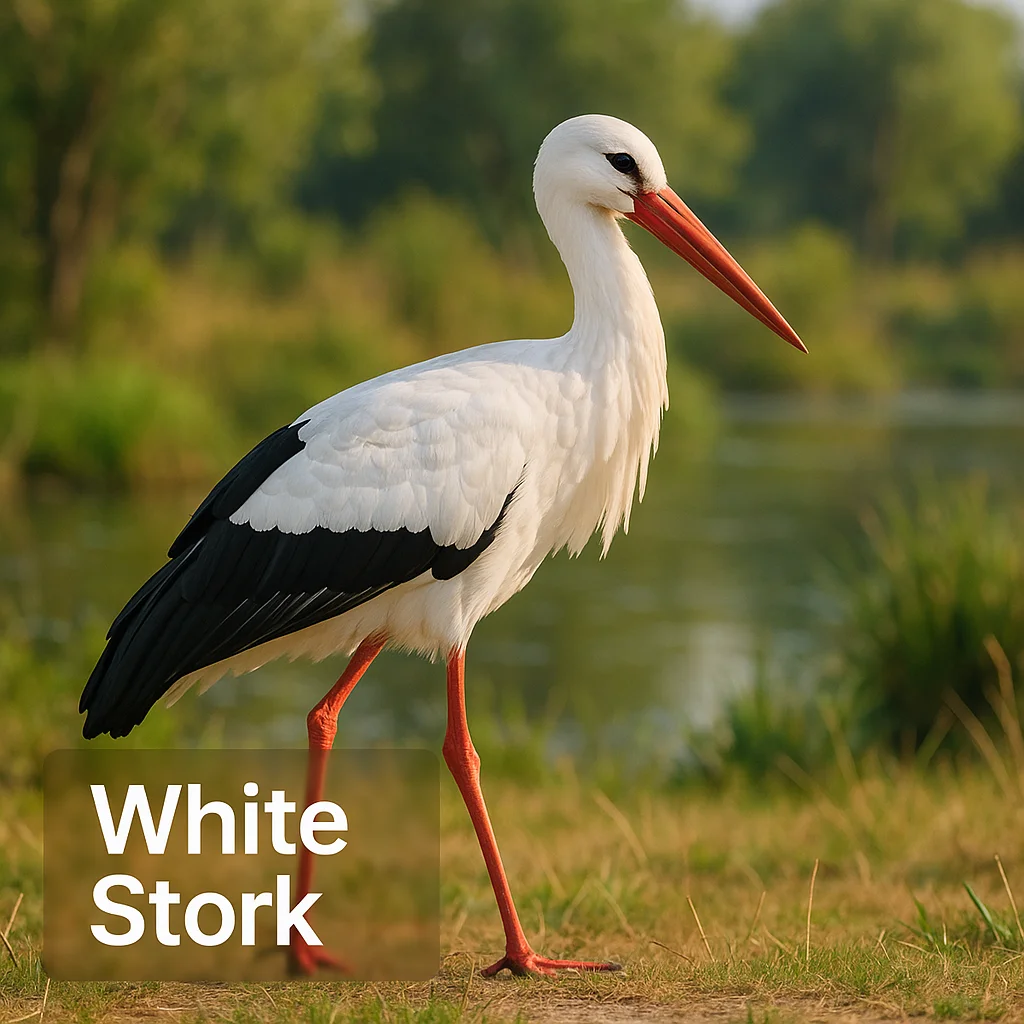
- Common name(s): White Stork
- Scientific name: Ciconia ciconia
- Animal type: Bird
- Typical adult size: Approximately 100–115 cm (40-45 inches) tall, with a wingspan of 195–215 cm (77-85 inches)
- Typical lifespan: 20–30 years in the wild
- Diet type: Carnivore; primarily feeds on insects, amphibians, small mammals, and occasionally birds and reptiles
- Activity pattern: Diurnal
- Social structure: Often found in pairs or small groups
- Speed / movement highlights: Strong fliers; migratory flights can span thousands of kilometers
- Intelligence/learning: Known for its navigational abilities and adaptability to diverse environments
- Primary habitats: Wetlands, marshes, fields, and meadows
- Geographic range: Europe, parts of Asia, and Africa
- Predators/threats: Eagles, foxes, and human-induced habitat destruction
- Conservation status: Least Concern, though local populations vary
🔍 Identification & Appearance
The White Stork is easily recognized by its striking black and white plumage, long red legs, and a distinctive long, pointed red beak. Adults are generally white with black flight feathers and tail feathers.
- Body shape and silhouette: Slim, elongated body with long neck and legs
- Key colors/patterns: Mostly white with prominent black on wings and tail
- Distinctive features: Red legs and beak stand out against its white plumage
- Tracks: Large, webbed footprints often found in wet ground
- Common look-alikes: Resembles the Black Stork but can be distinguished by its white body
- Top ID Tips
- Look for long red legs and red beak
- White body with black wing tips
- Slim and elongated silhouette
- Distinct, sharp bill for feeding
- Graceful flight with outstretched neck
- Sociable, often seen in small groups
🧱 Body Structure & Physical Adaptations
The White Stork is slender and built for long-distance flight and wading through water. It has a straight, sharp beak designed for capturing a wide variety of prey.
- Build and proportions: Slender body, long legs, and long neck optimize for wading and flight
- Beak adaptations: Long, pointed beak for spearing prey
- Wingspan: Large wings provide uplift for long migratory journeys
- Sensory strengths: Excellent vision for spotting prey; hearing is less developed
- Key Adaptations
- Long legs for wading in shallow waters
- Elongated beak to catch slippery prey
- Broad wings for soaring
- Sleek body reduces air resistance
- Strong navigational skills for migration
🌍 Range & Distribution
The White Stork primarily resides in Europe, with major migration routes extending to Africa and parts of Asia. They favor temperate and warm climates during breeding and wintering seasons.
- Europe, especially central and eastern regions
- Western and southern Asia
- Northern and southern Africa
- Migratory range includes Sahara desert crossings
- Prefers lowland, open spaces near water sources
🏞️ Habitat & Shelter
White Storks are generally found in open wetlands and agricultural fields where their prey is abundant. They prefer areas with shallow water for wading and large trees or buildings for nesting.
- Wetlands and marshes offer abundant feeding grounds
- Renowned for nesting on rooftops and tall structures
- Flexible in habitat selection; can adapt to human-altered landscapes
- Winter behavior varies with region and climate conditions
🧭 Behavior & Ecology
White Storks exhibit a range of fascinating behaviors, particularly their migration and nesting habits. They are generally social and communicate via bill clacking, which is loud and distinctive.
- Diurnal, with peaks of activity at dawn and dusk
- Construct large nests, often reused annually
- Complex migration often involves large flocks
- Play a significant role in controlling insect and rodent populations
- Behavior Highlights
- Elegant in flight with extended necks
- Social, often found in community roosts
- Migratory, favoring thermals for soaring
- Cooperative in nest building
👥 Social Life & Group Dynamics
White Storks are known for their strong pair bonds and often exhibit monogamous behavior. They may be seen in large groups during migration or in shared feeding or nesting sites.
- Monogamous pairs form strong, lasting bonds
- Colonial nesting sites are common, particularly in Europe
- Cooperative behavior observed during migration
- Communal roosting during the non-breeding season
- Social Structure Notes
- Pair bonds central to social life
- Nesting colonies can be extensive
- Flocks during migration
- Clear pecking order within groups
🍽️ Diet, Prey & Predators
As opportunistic feeders, White Storks have a varied diet that shifts seasonally. They are primarily carnivorous, consuming whatever practical prey is available.
- Prefers insects, frogs, fish, and small mammals
- Foraging mostly in shallow wetlands and open fields
- Main predators include birds of prey and terrestrial carnivores
- Defends nests vigorously against predators
- Feeding Notes
- Flexible diet supports ecological resilience
- Foraging often occurs in groups
- Scavenges when other food is scarce
🦌 Hunting, Foraging & Movement
White Storks are proficient foragers, using their sharp beak and keen eyesight to catch a variety of prey. They are also skilled migrators, leveraging air currents for efficient travel.
- Walks through fields and shallow waters stalking prey
- Utilizes thermals to save energy during migration
- Foraging activity peaks during daylight hours
- Roosts at night typically in safe, elevated sites
- Movement & Strategy
- Efficient migration as a hallmark behavior
- Still hunting accompanied by occasional short flights
- Keen eyesight aids in precise hunting
🧠 Intelligence & Senses
White Storks are observant and adaptable, demonstrating intelligence through their migration, hunting techniques, and nesting choices. They rely heavily on visual cues.
- Impressive navigational skills, particularly during migration
- Strong visual acuity for detecting movement
- Problem-solving abilities apparent in nest selection and construction
- Research on cognitive abilities remains limited
- Notable Abilities
- Spatial memory essential for migration
- Visual hunters with acute sight
- Adaptive to changes in environmental conditions
🪺 Reproduction, Pregnancy & Parenting
White Storks engage in elaborate courtship rituals and are largely monogamous. They are communal nesters, with both parents sharing duties of incubation and chick care.
- Monogamous pairs often last many seasons
- Nesting begins in spring with courtship displays
- Egg incubation lasts around 33–34 days
- Clutch size ranges from 3–5 eggs
- Both parents actively presented in feeding young
- Reproduction Snapshot
- Nurturing, cooperative parenting
- Shared incubation responsibilities
- Courtship includes dancing and bill clapping
- Nest sites are frequently reused
♀️♂️ Male vs Female Differences
In White Storks, sexual dimorphism is minimal, but subtle differences do exist primarily in size and behavior. Males typically engage in more dramatic display behaviors during courtship.
- Males are slightly larger than females
- Both sexes exhibit similar coloration and morphology
- Shared responsibilities in parental care
- Aggression in males observed during mating season
- Sex Differences at a Glance
- Slight size advantage in males
- Behavioral roles equal in parenting
- Display behaviors accentuated in males
🧬 Subspecies & Variation
The White Stork predominantly exists as a single species with minor regional color variations noted. Any subspecies typically remain poorly differentiated.
- Nominal subspecies have been proposed but remain debated
- Regional adaptations include migration timing and nest site preference
- Coloration generally consistent across ranges
- Variation Notes
- Limited known subspecies
- Local adaptations evidence ecological flexibility
⚠️ Threats, Conservation & Human Interaction
White Storks face several threats, primarily due to human activities such as habitat destruction and climate change. Conservation efforts have helped stabilize many populations.
- Urban expansion threatens nesting sites
- Pesticides and land use changes affect food availability
- Migration hazards include hunting in transit regions
- Conservation measures in Europe successful in population recovery
- Responsible Notes
- Provide artificial nesting platforms to aid breeding
- Preserve wetlands as key habitats
- Raise awareness on migration routes and protection
✨ Fun Facts & Unique Traits
- The White Stork is a symbol of good luck in many cultures.
- They are often depicted as delivering babies in folklore.
- The species undertakes impressive migrations, flying thousands of kilometers annually.
- White Storks prefer thermals to save energy during migration.
- They build large, durable nests often reused for years.
- Bill clacking is a common form of communication between mates.
📌 Summary
- Identification: Long-legged, red beak and legs, white plumage with black wings.
- Habitat: Wetlands, farmlands, open areas.
- Distribution: Europe, Africa, parts of Asia; migratory.
- Diet: Insects, amphibians, small mammals.
- Predators: Birds of prey, foxes.
- Social life: Monogamous, colonial nesting.
- Reproduction: Cooperative parenting, courtship displays.
- Key adaptations: Strong navigational skills, elongated beak and legs.
- Distinctive traits: Migration behavior, cultural symbolism.