🦁 Sacred Ibis
🧾 Quick Facts
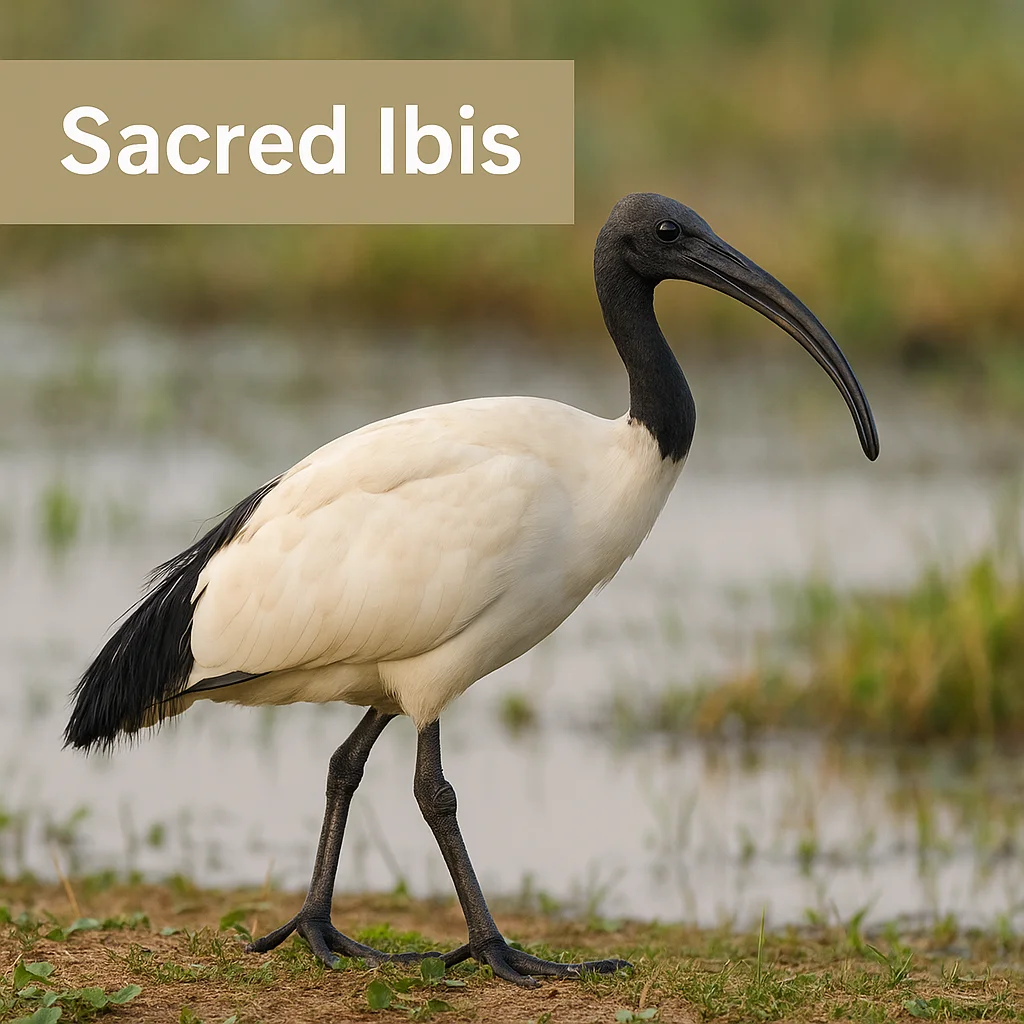
The Sacred Ibis, often celebrated in ancient cultures, is a wading bird most often associated with marshlands. These birds are easily recognizable by their distinct white and black plumage and are typically found in wetland areas across Africa and some parts of the Middle East.
- Common name(s): Sacred Ibis
- Scientific name: Threskiornis aethiopicus
- Animal type: Bird
- Typical adult size: 65–75 cm (25.6–29.5 in) in length, wingspan of 112–124 cm (44–49 in)
- Typical lifespan: 15–20 years in the wild
- Diet type: Omnivore; includes insects, small fish, amphibians, and carrion
- Activity pattern: Diurnal
- Social structure: Often found in groups or colonies
- Speed/movement highlights: Notably graceful fliers, use slow, powerful wing beats
- Intelligence/learning: Known for adaptive foraging strategies
- Primary habitats: Wetlands, marshes, lakeshores, and mudflats
- Geographic range: Sub-Saharan Africa, Madagascar, and occasional sightings in the Middle East
- Predators/threats: Large birds of prey, habitat destruction, occasional hunting
- Conservation status: Least Concern, but threats vary by region
🔍 Identification & Appearance
The Sacred Ibis has a distinctive, elegant appearance with a contrasting white body and black head and neck. The body's white plumage often has a glossy sheen, while its head and neck possess a leathery, featherless black skin. Its long, downward-curving beak is a significant feature, aiding in their foraging activities. Juvenile ibises may have greyer plumage which becomes more distinct as they mature.
- Smooth wading bird silhouette
- Contrasting white and glossy black plumage
- Long, curved beak
- Unfeathered, black head and neck
- Wing tips and tail are also black
- Juveniles have duller colors
- Often confused with Spoonbills, but the beak shape differs
- Distinctive extended flight profile
- Spotted in wetland environments
🧱 Body Structure & Physical Adaptations
The body of the Sacred Ibis is adapted to its wading lifestyle, featuring long legs and a balanced, slightly hunched structure that enables it to efficiently traverse muddy terrains. The long, decurved beak is superb for probing into the soft soil in search of food. Despite their size, they are adept flyers, using their large wings for effortless gliding. Their keen eyesight aids in detecting prey in shimmering waters, while their sense of touch in the beak is crucial for foraging.
- Slim, slightly rounded body
- Long legs suited for wading
- Curved beak perfect for probing
- Large wings for expansive gliding
- Sharp eyesight for spotting prey
- Sense of touch in beak for locating food
- Featherless head aids in cleanliness
- Adapted to live in varied water conditions
🌍 Range & Distribution
The Sacred Ibis is predominantly located across the wetlands and marshlands of sub-Saharan Africa, extending into parts of Madagascar and occasionally the Middle East. They are mostly residents of these regions, although some local movements occur based on water availability and food resources. The ibis is adaptable to various climates ranging from hot savannahs to temperate wetlands.
- Sub-Saharan Africa
- Madagascar
- Middle East occasional sightings
- Resides primarily in wetlands
- Occasional local movements based on food/water
- Adaptations to varied climates – hot to temperate
- Typically found in biodiversity-rich regions
- Colonial waterways and lakeshores
- Proximal to human settlements at times
🏞️ Habitat & Shelter
Sacred Ibises prefer habitats that include various wetland environments such as marshes, riversides, lakeshores, and mudflats. These areas are abundant with food resources and offer suitable conditions for nesting. During nesting, ibises will often choose secluded sites with protective vegetation. Seasonal changes affect their breeding behaviors and may cause temporary local migrations in search of optimal conditions.
- Wetlands and marshlands
- Rivers and lakesides
- Mudflats and floodplains
- Nests in trees or dense vegetation
- Sensitive to seasonal wet/dry changes
- Adjusts location based on weather
🧭 Behavior & Ecology
The Sacred Ibis displays a complex array of behaviors, largely correlated to its survival in wetland ecosystems. These birds form large colonies, particularly during the breeding season, which facilitates social interactions and learning. Communication is achieved through a variety of vocalizations and postures. In ecological terms, they serve significant roles in controlling insect and small fish populations and participate in seed dispersal through their movements.
- Forms large breeding colonies
- Communicates with various calls
- Social learning within groups
- Seed disperser via movement
- Predator of insects and small vertebrates
- Active during the day
- Participates in communal roosting
👥 Social Life & Group Dynamics
Sacred Ibises are social creatures that display a preference for living within colonies, especially during breeding periods. These colonies can range from a few dozen to several thousand individuals. The hierarchy within these groups is subtle, and cooperation during nesting and foraging is common, although individual conflicts can occur over resources. Their social structure relies on mutual benefits and shared responsibilities, particularly in defending nesting territories.
- Highly social, colony-forming
- Colony sizes can be vast
- Subtle hierarchies with minimal conflict
- Cooperation in foraging and nesting
- Shared defense of territories
- Fluid and dynamic group interactions
- Regular vocal communication within group
🍽️ Diet, Prey & Predators
The Sacred Ibis is an opportunistic omnivore. It thrives on a wide diet ranging from insects, fish, and small amphibians to carrion and organic refuse found in proximity to human habitations. This adaptability aids in their survival across variable environments. Their main natural predators include large birds of prey and carnivorous mammals that may attack nests. To defend against these, ibises exhibit collective roosting behaviors and may use their sharp beaks for deterrence.
- Diet includes insects and fish
- Also consumes carrion and refuse
- Predator of amphibians
- Vulnerable to birds of prey
- Employs nesting in dense groups for safety
🦌 Hunting, Foraging & Movement
The Sacred Ibis uses its adept foraging skills to navigate various wetland terrains. As a wader, its long legs allow it to cover large areas efficiently, and its beak is specialized for probing soft substrates to find hidden prey. Typically foraging during the day, ibises rely on both sight and touch for successful hunting. Movement between local habitats is common, dictated by resource availability, and although their flight is not speedy, they cover significant distances in search of new feeding grounds.
- Long-legged wader
- Dense group forager
- Probing foraging with beak
- Efficient in navigating wetlands
- Daytime foraging preference
- Flexibility in habitat movement
🧠 Intelligence & Senses
Sacred Ibises exhibit intelligence through adaptive foraging behaviors and problem-solving during food scarcity. While specific studies on cognitive abilities remain limited, observational evidence suggests a capacity for social learning and environmental adaptation. They possess keen eyesight critical for identifying prey in varied wetland conditions and use tactile feedback from their beak to locate food. The presence of complex vocalizations implies a structured communication method within colonies.
- Adaptable foraging strategies
- Keen eyesight for prey detection
- Social learning evident in foraging
- Beak sensitive to environmental stimuli
- Structured vocal communication
🪺 Reproduction, Pregnancy & Parenting
The breeding season of the Sacred Ibis is chiefly aligned with the rainy season, taking advantage of abundant resources. They generally exhibit monogamous pairing during this period. Nests are built cooperatively in colonies, composed of twigs and often nestled in trees or dense vegetation. The incubation period lasts approximately 21–29 days, with both parents participating in egg incubation and subsequent chick raising. The typical clutch size ranges from 2 to 4 eggs, with chicks being altricial, requiring parental care post-hatching.
- Breeds during rainy season
- Monogamous pairs
- Shared nest building
- 21–29 day incubation
- Clutch size of 2–4 eggs
- Altricial chicks need parental care
- Both parents involved in care
♀️♂️ Male vs Female Differences
In Sacred Ibises, sexual dimorphism is subtle but observable. Males are generally slightly larger and heavier than females, although this size difference is often only discernible when individuals are next to each other. Both sexes share similar coloration and plumage patterns, making visual differentiation challenging without direct comparisons. Their roles in parenting are largely shared, further reducing behavioral distinctions in gender roles.
- Minor size difference; males larger
- Similar coloration and plumage
- Behavioral roles are largely shared
- Co-parenting of young
- Subtle and variable dimorphism
🧬 Subspecies & Variation
While the notion of subspecies in Sacred Ibises is still debated among scientists, certain geographical variants have been noted to display differences in size and coloration. Variations are chiefly driven by local environmental conditions and may represent adaptations to specific ecosystems, such as those found on isolated islands or extreme climates.
- Discussion on subspecies ongoing
- Size differences seen in geographical variants
- Coloration variations in isolated populations
- Adaptations to distinct ecosystems
- Subtle genetic variation across range
⚠️ Threats, Conservation & Human Interaction
The Sacred Ibis faces numerous challenges from both natural factors and human interaction. Habitat destruction and alteration pose significant threats, while climate change leads to habitat unpredictability. Although classified as Least Concern globally, localized pressures such as urban expansion, pollution, and hunting may contribute to declining populations in certain areas. In some regions, their adaptability has led to coexistence in human-dominated landscapes, which can result in conflicts over resources.
- Subject to habitat destruction
- Threats of climate change
- Localized hunting pressures
- Coexistence leads to resource conflicts
- Occasionally scavenges in urban areas
- Conservation status varies by region
✨ Fun Facts & Unique Traits
- Once revered as sacred in Ancient Egypt
- Used in hieroglyphs symbolizing wisdom
- Adaptable diet aids survival across habitats
- Displayed problem-solving in historical captivity observations
- Sacred Ibises are excellent cleaners – have no feathers on head to avoid contaminants
- Can be mistaken for their relative, the Australian White Ibis
- Seen as indicators of wetland ecosystem health
- Part of ancient Egyptian art and scripture
📌 Summary
- Easily recognized by white and black coloration
- Inhabits wetlands and marshes in Africa
- Omnivorous diet covers a range of small animals
- Natural predators include birds of prey
- Forms colonies, particularly in the breeding season
- Engages in monogamous breeding pairs
- Adaptations include a long, curved beak for foraging
- Challenges include habitat destruction and climate change
- Adaptability aids survival in variable environments
- Culturally significant, particularly in ancient Egypt