🦁 Northern Gannet
🧾 Quick Facts
The Northern Gannet, known scientifically as Morus bassanus, is an impressive seabird known for its striking appearance and remarkable diving prowess. Commonly found in the North Atlantic, the Northern Gannet is an adept marine hunter and an intriguing subject of study for bird enthusiasts and researchers alike.
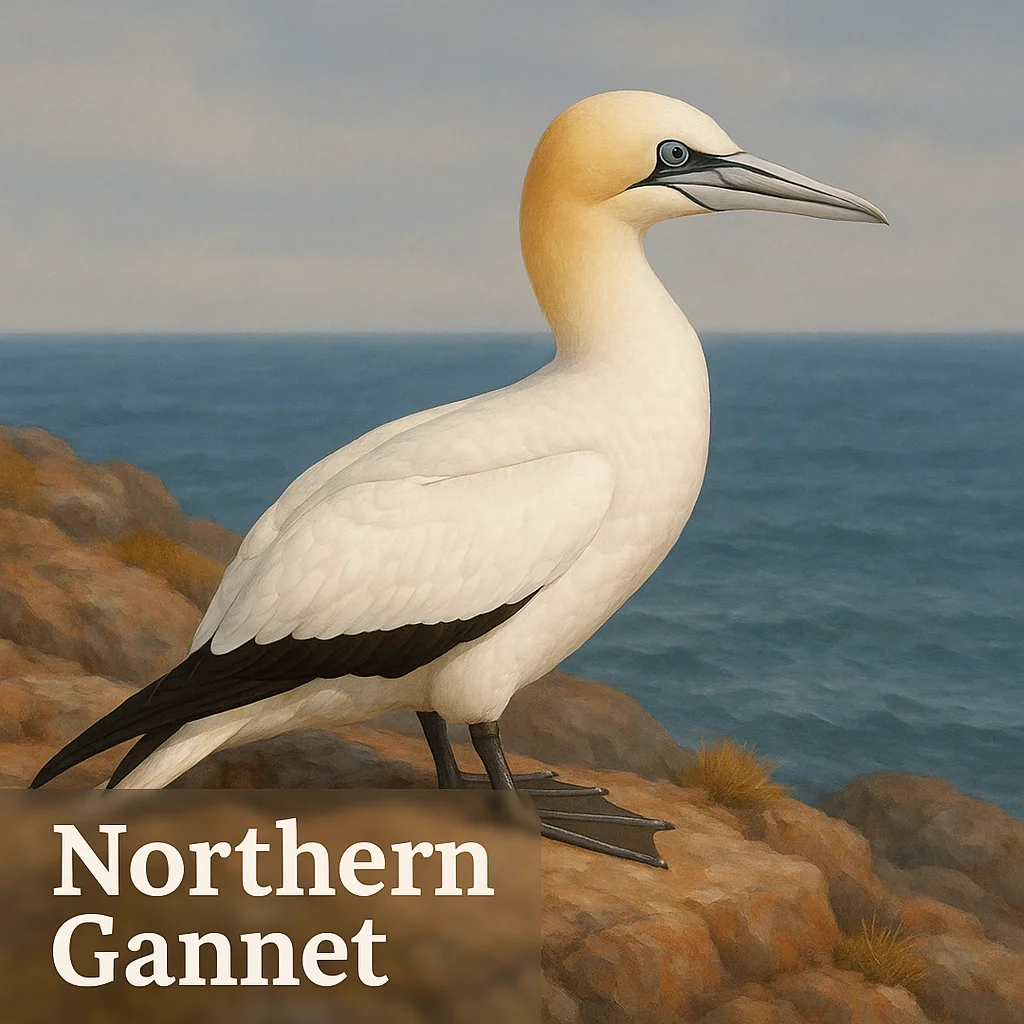
- Common name(s): Northern Gannet
- Scientific name: Morus bassanus
- Animal type: Bird
- Typical adult size: 87–100 cm in length; wingspan of 165–180 cm
- Typical lifespan: 15–20 years in the wild
- Diet type: Carnivore; primarily fish
- Activity pattern: Diurnal
- Social structure: Colonies
- Speed / movement highlights: Capable of diving at speeds up to 100 km/h
- Intelligence/learning: Highly skilled in hunting and navigation
- Primary habitats: Coastal cliffs and islands
- Geographic range: North Atlantic Ocean; coasts of Europe and North America
- Predators/threats: Large gulls, human activities
- Conservation status: Least Concern (varies by region)
🔍 Identification & Appearance
Recognizing the Northern Gannet is relatively straightforward due to its distinctive body shape and coloration. They exhibit a streamlined body with predominantly white plumage contrasted by black wingtips. During the breeding season, adults develop a striking yellow hue on their heads. Young gannets differ in appearance, being partially brown and gradually acquiring white plumage as they mature.
- Streamlined, elongated body
- Predominantly white plumage with black wingtips
- Breeding adults have a yellowish head
- Young birds are mottled brown
- Long, pointed wings suitable for soaring
- Distinctive blue-gray bill
- Webbed feet adapted for swimming
- Sharp dive seen when hunting
🧱 Body Structure & Physical Adaptations
The Northern Gannet exhibits several physical adaptations that facilitate its lifestyle as a skilled marine hunter. Its body is optimally streamlined, allowing efficient gliding and diving in search of prey. The beak is robust, designed for capturing and holding slippery fish. Additionally, gannets possess air sacs under their skin, cushioning the impact when hitting water at high speeds.
- Elongated body for streamlined movement
- Robust, pointed beak for catching fish
- Long, narrow wings adapted for soaring
- Webbed feet for powerful swimming
- Air sacs under skin cushion diving impacts
- Excellent vision for spotting fish from above
- Dense plumage for insulation and buoyancy
- Wings allow agile maneuvering in air
🌍 Range & Distribution
The Northern Gannet is primarily found in the North Atlantic, breeding in large colonies on rocky cliffs and islands. During the non-breeding season, these birds disperse across the ocean, ranging widely from the coasts of Europe to the eastern seaboard of North America.
- Found along the North Atlantic coasts
- Breeds in coastal regions of Europe and North America
- Winters across broader oceanic areas
- Common in countries like Norway, Iceland, and Canada
- Disperses widely outside breeding season
- Occasionally spotted further south beyond typical range
- Prefers temperate climates
🏞️ Habitat & Shelter
Northern Gannets are primarily associated with marine environments, favoring steep coastal cliffs and islands for breeding purposes. These habitats provide both the necessary vantage point for spotting prey and the space needed to accommodate large colonies. During the breeding season, their nesting sites can host thousands of individuals. Their oceanic habits require them to adapt to a range of conditions, including varying tides and weather patterns.
🧭 Behavior & Ecology
As a highly social species, Northern Gannets spend much of their life in large colonies, particularly during the breeding season. Their vocalizations are distinctive and play a fundamental role in communication within these groups. Gannets are also exceptional divers and feed predominantly on fish, often executing impressive plunges from great heights. They play a crucial role as predators within their marine ecosystem, helping to regulate fish populations.
- Daily colony gatherings during breeding
- Vocal communication to maintain social bonds
- Visual displays during mating rituals
- Expert divers, diving vertically to catch fish
- Important marine predators in their ecosystem
- Occasional kleptoparasitism, stealing food from others
- Seasonal migration patterns
- Cooperative presence in large colonies
👥 Social Life & Group Dynamics
Northern Gannets are highly social, forming substantial colonies during the breeding season. These colonies can range from a few individuals to tens of thousands, occupying densely packed nesting sites on cliffs and islands. Although primarily social birds, they can exhibit competitive behaviors during the breeding season, particularly concerning nesting sites and mates.
- Highly social, forming large colonies
- Colony sizes range from hundreds to thousands
- Monogamous pairs often nest close together
- Aggressive behaviors to defend nesting sites
- Vocalizations maintain cohesion within colonies
- Structured social interactions during breeding
- Seasonal solo dispersal during non-breeding months
- Colony life offers protection and enhances breeding
🍽️ Diet, Prey & Predators
Northern Gannets are carnivorous birds that predominantly feed on fish. Their diet includes species such as mackerel, herring, and other small fish. Gannets hunt by diving from considerable heights and capturing fish within their robust bills. Predators include large gulls and, on occasion, predatory mammals that may raid nesting sites. Human activities also pose threats to their food sources.
- Carnivorous diet centered on fish
- Prefers fish like mackerel and herring
- Excellent divers, catching fish with beaks
- Occasionally scavenge when opportunity arises
- Threatened by larger gull species
- Some vulnerability to human disturbances
- Young chicks potentially preyed upon by mammals
- Food competition in densely populated colonies
🦌 Hunting, Foraging & Movement
Known for their dramatic hunting technique, Northern Gannets exhibit a distinct diving strategy to catch prey. They dive from heights of up to 30 meters, entering the water at high speeds to pursue fish. This specialization requires both speed and precision, making them efficient marine hunters. Typically, they forage during daylight hours and return to their colonies in the evening.
- Remarkable divers with precision hunting
- Dive from heights to catch fish efficiently
- Foraging occurs mainly during daylight
- High-speed plunge-diving technique
- Coastal and pelagic foraging ranges
- Return to colonies for overnight rest
- Capable of long-distance travel when foraging
🧠 Intelligence & Senses
Northern Gannets are intelligent birds, relying on their keen senses for survival. Their vision is particularly well-developed, allowing them to spot fish from great heights above the ocean. While not much is known about their problem-solving abilities, their navigation skills and social interactions indicate advanced cognitive functions. Sensory adaptations support their impressive diving abilities and interactions within large colonies.
- Excellent vision for marine hunting
- Advanced navigation abilities for migration
- Strong olfactory senses assist in foraging
- Coordinated social behaviors suggest intelligence
- Adapted to detect prey underwater
- Limited research on cognitive problem-solving
🪺 Reproduction, Pregnancy & Parenting
Northern Gannets breed seasonally, forming monogamous pair bonds during this time. They engage in elaborate courtship displays, including mutual preening. The typical clutch size is one egg, with both parents involved in incubating and raising the chick. The incubation period lasts about 42 to 46 days. Chicks are initially altricial, requiring significant parental investment before fledging.
- Breeding occurs in large colonies
- Monogamous pairs exhibit strong bonds
- Typical clutch size: one egg
- Both parents incubate the egg
- Incubation period: 42–46 days
- Chicks are altricial, need parental care
- Chick fledging occurs after 84–97 days
- Courtship involves mutual preening and displays
♀️♂️ Male vs Female Differences
In terms of appearance, male and female Northern Gannets are similar, with little to no sexual dimorphism visible to casual observers. However, subtle differences do exist in behavior during the breeding season. Females are typically more involved in chick-rearing after hatching, while both sexes partake in nesting and incubation duties.
- Minimal size or coloration differences
- Both sexes share in incubation duties
- Females more involved post-hatching
- Behavioral differences subtle but present
- Similar appearance aids in colony cohesion
🧬 Subspecies & Variation
The Northern Gannet is considered monotypic, with no recognized subspecies. However, regional populations may exhibit some variations in size or coloration due to local environmental conditions. These variations do not warrant separate subspecies classifications, but they contribute to the species' overall adaptability across various habitats.
- No officially recognized subspecies
- Some regional size variation observed
- Coloration consistent across range
- Local conditions influence physical traits
- Species-wide adaptability noted
⚠️ Threats, Conservation & Human Interaction
Northern Gannets face several natural and human-induced threats. Natural predators, such as large gulls, pose risks mainly to eggs and chicks. Human activities, including fishing, can inadvertently affect gannet populations by reducing available food sources. Pollution and habitat disturbance are additional pressures. Conservation efforts focus on sustaining healthy colony sites and mitigating human impact.
- Exposed to marine pollution
- Competition with fisheries impacts food supply
- Habitat disturbance from coastal activities
- Conservation focuses on habitat protection
- Monitoring of population trends ongoing
- Human recreation near colonies is controlled
- Resilient to some climate variations
✨ Fun Facts & Unique Traits
- Northern Gannets can dive at high speeds, making them one of the fastest marine birds.
- They form life-long monogamous bonds, returning to the same nest site each year.
- Air sacs under their skin protect them when diving into water at high velocity.
- Their populations are a vital indicator of ocean health due to reliance on fish stocks.
- They're known for their long-distance migratory capabilities across the Atlantic.
- Chicks take months to develop full adult plumage, learning to fish on their own.
- Colony sizes can be massive, comprising thousands of breeding pairs.
- Gannets have a unique "gannetry" vocabulary for communication.
📌 Summary
- Identification: White plumage with black wingtips, streamlined body.
- Habitat: Coastal cliffs and islands in the North Atlantic.
- Distribution: Breeds in Europe and North America, migrates widely.
- Diet: Predominantly fish, adept diving hunters.
- Predators: Large gulls, human disturbances.
- Social Life: Highly social, forming large colonies during breeding.
- Reproduction: Monogamous pairs, single egg clutch.
- Key Adaptations: High-speed diving, robust beak, precise vision.
- Distinctive Traits: Large colony sizes, lifelong pair bonds.