🦁 Mute Swan
🧾 Quick Facts
The Mute Swan, known scientifically as Cygnus olor, is a captivating bird species known for its striking appearance and graceful swimming. Despite its name, the Mute Swan is not entirely silent but is less vocal compared to other swan species.
- Common name(s): Mute Swan
- Scientific name: Cygnus olor
- Animal type: Bird
- Typical adult size: 125–170 cm in length; 8–12 kg in weight
- Typical lifespan: 10–20 years in the wild; up to 30 years in captivity
- Diet type: Herbivore; mainly aquatic plants, algae, seeds
- Activity pattern: Diurnal
- Social structure: Often seen in pairs or small family groups
- Speed/movement highlights: Capable of flight speeds up to 80 km/h
- Intelligence/learning: Evidence of strong learning abilities, including social learning
- Primary habitats: Wetlands, lakes, rivers
- Geographic range: Europe, Asia, North America (introduced)
- Predators/threats: Foxes, raccoons; human interference and habitat loss
- Conservation status: Least Concern, but local populations vary
🔍 Identification & Appearance
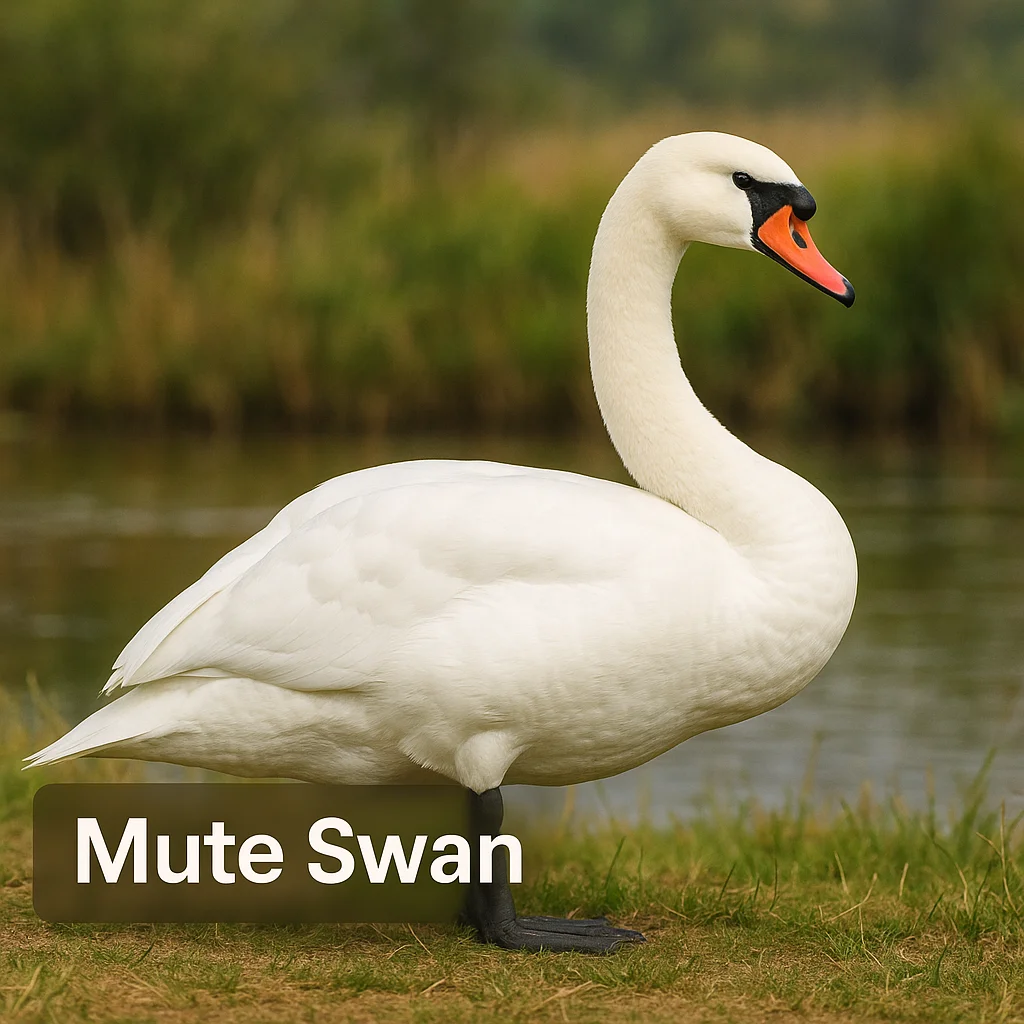
The Mute Swan is easily recognizable by its large size and elegant, curved neck. Its body is predominantly white, with a distinctive orange bill bordered by black at the base. The legs are dark, providing a stark contrast to its white plumage.
- Body shape and silhouette: Large, elongated body with a long, gracefully curved neck
- Key colors/patterns: White body, orange bill with black base
- Distinctive features: Black knob at the base of the bill, especially prominent in males
- Tracks, scat, or other field signs: Large webbed footprints near water bodies
- Common look-alikes and simple ways to tell them apart: Tundra Swan lacks the orange bill and knob
- Large, white plumage
- Long, curved neck
- Orange bill with a black base
- Black knob on the bill
- Dark legs and feet
- Graceful in water; stands upright on land
🧱 Body Structure & Physical Adaptations
The Mute Swan's physical structure is perfectly adapted for a life spent mostly in water. They have powerful wings and webbed feet, which make them excellent swimmers. Their long necks allow them to reach and feed on aquatic vegetation.
- Elegant, robust body with a long, flexible neck
- Rounded wings adapted for strong, sustained flight
- Webbed feet for efficient swimming
- Keen eyesight essential for navigation
- Moderate hearing; less reliance on sound
- Sleek, buoyant body for water navigation
- Webbed feet for propulsion and maneuvering
- Large, strong wings for migration
- Sharp visual acuity for spotting threats and food
- Long neck for reaching submerged plants
🌍 Range & Distribution
Mute Swans are native to Europe and Asia, but they have been introduced to North America, where they have established stable populations, particularly along the eastern seaboard. They are found year-round in temperate climates.
- Europe
- Asia
- North America (introduced species)
- Temperate and coastal regions
- Prefer lowland areas with abundant water
- Stationary in preferred habitats; limited migration
- Lakes and ponds in Europe and Asia
- Introduced in the U.S., especially around the Great Lakes
- Coastal regions with plentiful aquatic vegetation
- Non-migratory in most regions
- Absent from high mountains and dense forests
🏞️ Habitat & Shelter
Mute Swans are predominantly associated with freshwater bodies such as lakes, ponds, rivers, and marshes. They prefer habitats with abundant food resources and adequate nesting sites. During winter, they may shelter in more protected waters to avoid harsh weather conditions.
- Wetlands and marshes
- Slow-moving rivers
- Lakes, especially with extensive reeds
- Inland and coastal areas for shelter and resources
- Rests on land near water edges
🧭 Behavior & Ecology
Mute Swans are primarily diurnal and spend most of their time feeding, grooming, or resting. They are territorial birds that show aggression when defending their nests or territory. Communication is primarily visual, using body displays for interaction.
- Graceful swimming and foraging
- Vocal and body signals for communication
- Defense of territories and resources
- Role as grazers in their ecosystem
- Nesting and careful selection of breeding sites
- Daily feeding around aquatic areas
- Aggression displayed by wing and neck postures
- Mated pairs for life, rarely solitary
- Vital to maintaining aquatic vegetative balance
- Positions family units for protection and teaching
👥 Social Life & Group Dynamics
Mute Swans are mostly seen in pairs, and these pairs often mate for life. They have strong bonds and are dedicated parents. Although generally seen in pairs or family groups, swans may gather in larger groups outside of the breeding season.
- Social bonds in pair formation
- Pair or family group-centric behavior
- Territorial defense as a couple
- Occasional larger aggregations in non-breeding season
- Collaborative nest building
- Monogamous mating pairs
- Large family units when raising cygnets
- Strong cooperative nesting instincts
- Little tolerance for intruders in nesting territories
- Seasonal gathering in flocks
🍽️ Diet, Prey & Predators
Mute Swans are primarily herbivorous, feeding on a variety of aquatic vegetation. They dabble on the water's surface or tip their bodies to reach submerged plants. Swans face few natural predators due to their size, but eggs and cygnets may fall prey to a variety of animals.
- Feeds on aquatic plants and algae
- Dabbles in shallow waters
- Graze on land when plants are scarce
- Main natural predators: foxes, raccoons
- Defensive posturing deters threats
- Aquatic roots and tubers
- Surface-down behaviors for algae consumption
- Protector of young against raccoons and gulls
- Limited scavenging behavior
- Cattails and waterfowls included in diet
🦌 Hunting, Foraging & Movement
Mute Swans are adept swimmers and use their powerful webbed feet to propel themselves through the water. Their foraging involves dabbling and submerging their flexible necks to reach food. Swans exercise gentle movement on land but are capable of long-distance flights when needed.
- Graceful swimming using webbed feet
- Feed while swimming; extended neck reach
- Breeding season necessitates territorial patrol
- Seasonal movement to areas with rich resources
- Simple navigation around familiar territories
- Dabble method for gathering food resources
- Equipped for long migrational flights
- Non-aggressive foraging around lakes
- Direct terrestrial movement when foraging land-based plants
- Elevated nesting patrols during incubation
🧠 Intelligence & Senses
Mute Swans have keen visual acuity which aids in navigation and predator avoidance. Although less dependent on vocal communication, their intelligence lies in their social behaviors and territorial management. They exhibit problem-solving abilities, particularly in constructing nests and protecting their young.
- Visual sharpness crucial for territory monitoring
- Tactical use of visual cues for threats and mates
- Minimal reliance on vocal communication
- Awareness of landmarks for navigation
- Behavioral adaptation to environment changes
- High social awareness and adaptability
- Recognition of human habits and feeding patterns
- Visual-centric communication in mate acknowledgment
- Organized nesting in safe areas
- Strong protective instincts for family
🪺 Reproduction, Pregnancy & Parenting
Mute Swans are monogamous, with pairs often mating for life. The breeding season begins in spring, with elaborate courtship displays involving neck dips and synchronized swimming. Females lay four to eight eggs, with both parents involved in incubation and care of cygnets.
- Breeding begins in the spring
- Monogamous pairs with strong bonds
- Gestation lasts 36-40 days
- Typical clutch size: 4-8 eggs
- Both parents partake in feeding and protecting
- Pair remains for life, demonstrating strong fidelity
- Egg incubation under critical weather conditions
- Shared parenting ensures strong developmental caregiving
- Nest materials include reeds and plants
- Precocial young; adept swimmers quickly
♀️♂️ Male vs Female Differences
Male and female Mute Swans are similar in appearance, making it difficult to distinguish between the sexes at a glance. However, males (cobs) are generally larger and have a more pronounced black knob at the base of the bill compared to females (pens).
- Larger size in males compared to females
- Pronounced black knob on male's bill
- Similar plumage in both sexes
- Female participates actively in caregiving
- Males more involved in territorial defense
- Size: males typically bigger
- Knob prominence varies with gender
- No difference in plumage
- Shared incubation and chick-rearing duties
- Brotherus males for defense; females enhance care
🧬 Subspecies & Variation
The Mute Swan is not divided into formally recognized subspecies, but there are regional variations in size and physical characteristics based on habitats and climates. Variations include size and bill knob size, influenced by environmental factors.
- No recognized subspecies
- Regional size variation based on habitat
- Bill knob size differences as local adaptation
- Environmental influence on size and features
- Variation influenced by climate adaptability
- General uniformity across global locations
- No widely accepted subspecies differentiation
- Local adaptive traits observed
- Size varies slightly; environment linked
- Breeding season variations due to habitat
⚠️ Threats, Conservation & Human Interaction
Despite being listed as Least Concern, Mute Swans face several challenges including habitat destruction, pollution, and unintentional harm from fishing lines and boats. Protecting their habitats is crucial for their continued survival. In many areas, they are treated with both admiration and regarded as nuisances due to their territorial nature.
- Habitat loss is a significant risk
- Pollution affecting food sources
- Potential entanglement with fishing gear
- Protected species in many regions
- Coexistence strategies involve habitat conservation
- Maintain a balance between human recreational areas and swan populations
- Education to prevent harmful interactions
- Habitat preservation ensuring ecosystem balance
- Efforts to reduce pollution intact swan populations
- Responsible viewing guidelines promoted by conservationists
✨ Fun Facts & Unique Traits
- Mute Swans have necks that can be twice as long as their bodies.
- Despite their name, they produce hissing sounds as a warning signal.
- They are emblematic of love due to their pair fidelity.
- Males are called cobs, and females are called pens.
- The mutual head-dipping ritual is part of courtship.
- In flight, swans create a distinctive whooshing sound with their wings.
- Swans have been depicted in art and mythology for centuries.
- They help control the spread of aquatic plants in their habitats.
📌 Summary
- Large, white, and elegant waterfowl with an orange bill
- Inhabits wetlands and is a vital part of aquatic ecosystems
- Native to Europe and Asia; introduced to North America
- Primarily herbivorous, feeding on aquatic plants
- Fewer natural predators; mainly human-related threats
- Monogamous, forming lifelong pairs
- Integrated into ecosystems as grazers and as a tourist attraction
- Adaptive abilities include strong swimming and territorial behavior
- Distinctive due to their silent nature and graceful appearance
- Conservation awareness needed to maintain their populations