🦁 Magnificent Frigatebird
🧾 Quick Facts
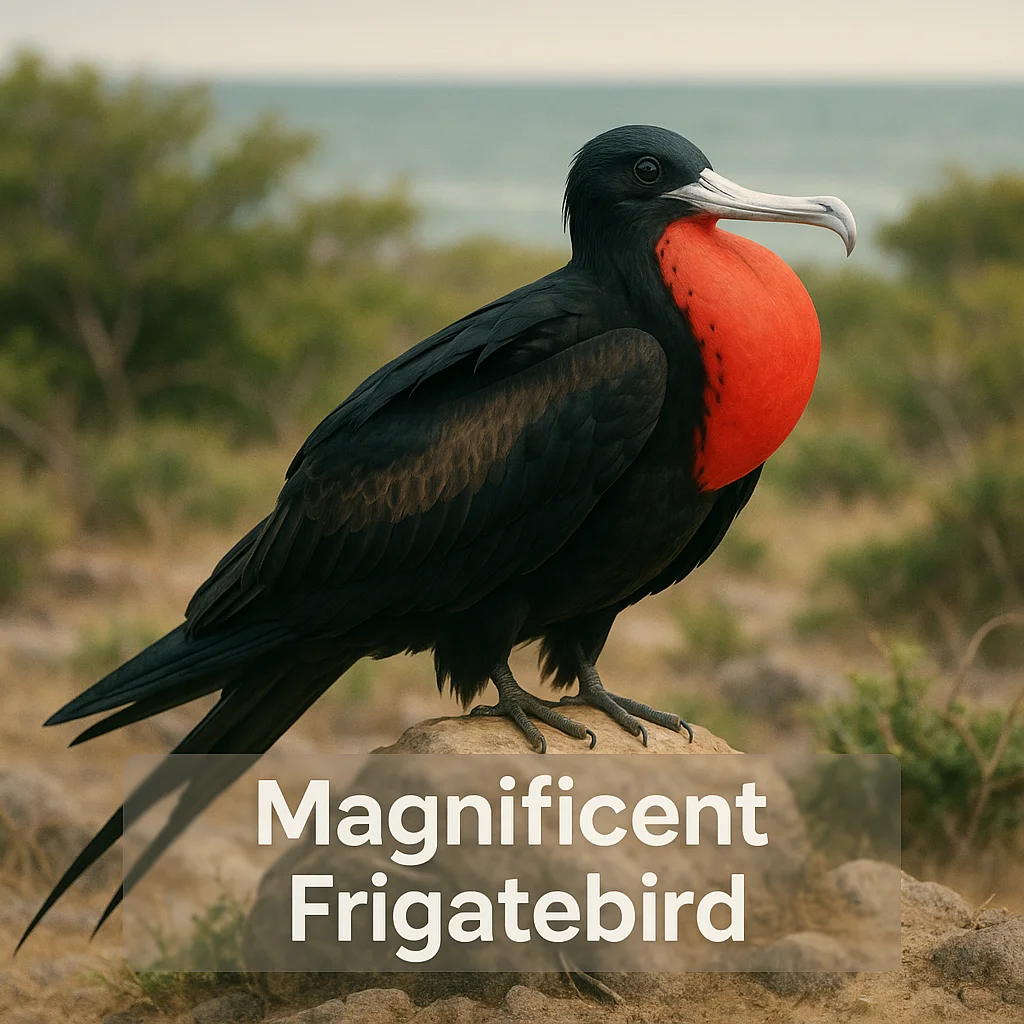
The Magnificent Frigatebird, scientifically known as Fregata magnificens, is a remarkable seabird renowned for its aerial acrobatics and unique breeding displays. Characterized by its distinctive silhouette and vibrant throat pouch during the breeding season, this bird captivates nature enthusiasts and ornithologists alike.
- Common name(s): Magnificent Frigatebird
- Scientific name: Fregata magnificens
- Animal type: Bird
- Typical adult size: Wingspan 2.1 to 2.3 meters; Weight 1.1 to 1.5 kg
- Typical lifespan: Up to 30 years in the wild
- Diet type: Carnivore; primarily fish and squid
- Activity pattern: Diurnal
- Social structure: Colonial, often seen in groups
- Speed / movement highlights: Agile and acrobatic flier
- Intelligence/learning: Skilled in learning and using wind currents for efficient soaring
- Primary habitats: Coastal regions, oceanic islands
- Geographic range: Tropical to subtropical waters of the Americas, including the Caribbean
- Predators/threats: Human-induced habitat loss and disturbance
- Conservation status: Least Concern, but varies by region
🔍 Identification & Appearance
Recognizing the Magnificent Frigatebird is relatively straightforward given its distinct features. It has long slender wings and a deeply forked tail that create an unmistakable silhouette in the sky. Males are predominantly black with a striking red throat pouch, while females have a white breast and a black face mask. Juveniles display light-colored heads and underbellies.
- Body shape: Long, angular wings; forked tail
- Colors/patterns: Black body with iridescence, red gular sac for males
- Distinctive features: Long wings and tail, sharp hooked beak
- Common look-alikes: Sometimes confused with other frigatebird species like the Great Frigatebird
- Flight pattern: Notably glides and soars, rarely flaps wings
- Long, forked tail visible in flight
- Males exhibit bright red throat pouch during breeding season
- Angular, elongated wings
- Light breast in females and juveniles distinguishes sex and age
- Rarely lands on water
- Uses thermal currents for efficient gliding
🧱 Body Structure & Physical Adaptations
The Magnificent Frigatebird boasts a lightweight skeletal structure allowing for impressive flight efficiency. Its hooked beak is perfect for snatching fish from the ocean surface. The bird's wings and tail are specifically adapted for aerial agility, enabling it to spend weeks in flight without touching land.
- Build: Slender with elongated wings and tail
- Beak: Long, sharp, and hooked for fishing
- Wings: Long and pointed for soaring
- Sensory strengths: Excellent vision for spotting prey
- Lightweight body aids in long-distance flight
- Efficient wing loading for maximizing lift
- Hooked beak aids in efficient feeding
- Gular sac can inflate for display and buoyancy
- Specialized air sacs in respiratory system for oxygen storage
🌍 Range & Distribution
The Magnificent Frigatebird can be found across a wide range of tropical and subtropical waters in the New World. Its distribution covers parts of the Atlantic and Pacific Oceans, extending through Central America and into the Caribbean Sea, with colonies on various isolated islands.
- Continents and countries: Americas; prevalent along North, Central, and South American coastlines
- Biomes: Oceanic islands, coastal marine environments
- Migration: Partial migrator; some populations travel long distances seasonally
- Caribbean islands
- Gulf of Mexico coastlines
- Pacific islands along the equator
- Colombia and Venezuela coastal areas
- Brazil's northeastern islands
- Occasional sightings in U.S. southern coasts
🏞️ Habitat & Shelter
These seabirds prefer nesting in colonies on remote islands devoid of terrestrial predators. Nesting sites are often in mangroves or on low-lying vegetation on coral atolls. Adapted to life at sea, they spend a significant portion of their time soaring over open waters, returning to land primarily for breeding purposes.
Changes in weather patterns, like storms, can drive these birds to alter their usual foraging paths and seek residential islets. Understanding their habitat is essential for conservation, as they are sensitive to disturbances in nesting colonies and feeding grounds.
🧭 Behavior & Ecology
The Magnificent Frigatebird is a master of the skies, often seen gliding expertly without flapping its wings. They are known for kleptoparasitism, where they harass other seabirds to release their catch. Their interactions with other marine life, including sharing feeding grounds with other predators, showcases their role as essential players in their ecosystem.
- Primarily aerial, only perching to rest or breed
- Male displays include inflating the red gular sac
- Interactions with other seabirds include competitive feeding
- Predatory role in marine ecosystems
- Displays include head bobbing and pouch inflation
- Feed opportunistically on surfacing schooling fish
- Spend the majority of time in flight
- Annual or bi-annual breeding, influenced by food availability
- Plays a role in controlling fish and squid populations
👥 Social Life & Group Dynamics
Magnificent Frigatebirds are social, particularly during breeding periods when they form large colonies. These colonies take advantage of communal nesting for predator awareness, though they maintain territorial spaces around individual nests. Males and females form pair bonds for a single breeding season, typically with one egg cared for by both parents.
- Form colonies for breeding
- Temporary pair bonds for mating
- Females predominantly select mates based on display performance
- Intricate aerial displays as part of courtship
- Colonial breeder
- Group size fluctuates with seasonality
- Territorial over nesting area but not foraging grounds
- Male displays are significant for mate selection
- Females lead in prey capture post-chick hatching
🍽️ Diet, Prey & Predators
Their diet mainly comprises flying fish and squid, which they catch mid-air or snatch from ocean surfaces. In addition to actively hunting prey, the Magnificent Frigatebird sometimes engages in kleptoparasitism, stealing food from other birds such as boobies and gulls. Predators such as large raptors and humans pose threats, especially to nesting chicks.
- Diet primarily consists of flying fish and squid
- Known for kleptoparasitic behavior
- Exploits updrafts for energy-efficient hunting
- Chicks vulnerable to predation by larger birds
- Feeds during daylight
- Prefers nutrient-rich zones
- Adapts feeding strategy according to prey availability
- Eyesight crucial for detecting surface prey
- Fluctuates feeding height based on prey type
🦌 Hunting, Foraging & Movement
The Magnificent Frigatebird is a consummate flier, often utilizing thermal updrafts and wind currents for sustained gliding. This ability enables it to travel vast distances over the open ocean in search of food. Their foraging strategy is opportunistic, adapting quickly to fluctuating prey availability near the ocean's surface.
- Uses soaring and seizing technique
- Masters of energy-efficient long-distance flight
- Extraordinary use of thermal and wind currents
- Foraging areas shift with ocean currents and prey migrations
- High endurance for long flights
- Relies on minimal energy expenditure for movement
- Frequently found in pursuit of other feeding seabirds
- Tactical in avoiding high-energy involvement with water
🧠 Intelligence & Senses
With acute eyesight and incredible spatial awareness, the Magnificent Frigatebird is adept at navigation and foraging at sea. Although not builders of complex structures or users of tools, their strategic and complex social displays demonstrate a keen learning adeptness and adaptability to environmental conditions.
- Excellent visual acuity
- Spatial memory aids navigation
- Social communication through visual and behavioral cues
- Limited research on cognitive functions outside foraging success
- High competition awareness
- Learning from human and tool avoidance
- Consistent communication despite minimal vocal interactions
- Reproductive success linked to display prowess
- Navigates vast distances with environmental cues
🪺 Reproduction, Pregnancy & Parenting
Breeding in the Magnificent Frigatebird follows a seasonal pattern. Courting involves elaborate aerial displays, with males showcasing their vibrant throat pouches to attract females. After copulation, females lay a single egg, which both parents incubate. Post-hatch, both engage in chick rearing, with extended parental care relative to many bird species.
- Breeds once per year
- Single-egg clutches
- Lengthy chick-rearing phase
- Male courtship through throat pouch inflation
- Bi-parental incubation
- Extended fledgling dependency on parents
- Variable timing based on regional environmental stability
- Males perform vivid courtship displays
- Colony breeding ensures protection through numbers
♀️♂️ Male vs Female Differences
Sexual dimorphism in the Magnificent Frigatebird is apparent during the breeding season when males display their bright red gular sacs, whereas females feature a white breast and a larger body size. Behaviors differ during breeding, with males investing more in attracting mates and females in nesting and chick rearing.
- Males possess vivid throat sacs for display
- Females larger and exhibit different plumage
- Behavioral roles vary in courtship and parental duties
- Mating displays performed solely by males
- Males smaller and more vibrantly colored
- Females exhibit white breast patch
- Juvniles resemble females until mature
- Mating season reveals differences in vocal communication
🧬 Subspecies & Variation
There is little subspecies variation recognized among Magnificent Frigatebirds, though geographic and environmental factors can influence minor individual differences. Habitat conditions lead to unique adaptations in feeding strategies and coloring, particularly where there is extensive human presence.
- Minor variation due to island habitat differences
- Some populations show size and coloration variance
- Adapts feeding style based on local prey
- Individual variance likely a result of isolated breeding colonies
- Geographic separation leads to observable minor differences
- Minimal recognized subspecies
- Feeding habits tuned to local aquatic conditions
- Birds along human-occupied islands adapt to anthropogenic changes
⚠️ Threats, Conservation & Human Interaction
While the Magnificent Frigatebird is listed as "Least Concern," human impacts such as coastal development and environmental pollution threaten certain populations. Coastal nesting sites are particularly vulnerable to habitat loss. Responsible observation and conservation efforts are key to safeguarding these spectacular seabirds.
- Exposed to risks from pollution in marine environments
- Disturbance from boat traffic near nesting sites
- Nesting habitat loss due to coastal development
- Vulnerable to entanglement in fishing gear
- Habitat conservation critical for colony success
- Awareness needed to reduce human disturbance
- Unintentional bycatch an ongoing issue
- Collaborative efforts critical for sustaining population
✨ Fun Facts & Unique Traits
- Frigatebirds can sleep while in flight, allowing them extended journeys without landing.
- The Magnificent Frigatebird's name comes from its freewheeling, pirate-like feeding style.
- Their large wingspans enable one of the largest wing area-to-weight ratios among birds.
- Unique among seabirds, they lack the waterproofing oil secretion for feathers.
- This species can stay in flight for up to two months continuously.
- The genotypic flight energy efficiency of frigatebirds is among the highest in avian species.
- Juvenile frigatebirds may take years to fully develop adult plumage.
- Thousands of frigatebirds can converge during large-scale feeding events.
📌 Summary
- Frigatebirds are large seabirds with long wings and forked tails, often spotted soaring above tropical and subtropical oceans.
- Identified by their red throat pouches (males) and black bodies, they are expert navigators and feed mainly on fish and squid.
- The species primarily nests on isolated islands and often engages in kleptoparasitism.
- Colonial breeders, they form impressive breeding colonies where males display vivid gular sacs to attract females.
- Primarily resident in the Americas, they can travel vast distances over the ocean.
- Existing threats include habitat disturbance from human development and environmental changes.
- Adaptively equipped for long-distance flight, they use minimal energy in air travel.
- Their large wingspan and lightweight structure contribute to their unique aerial lifestyle.
- Frigatebirds play a critical role in marine ecosystems by controlling fish populations and providing ecological balance.