🦩 Greater Flamingo
🧾 Quick Facts
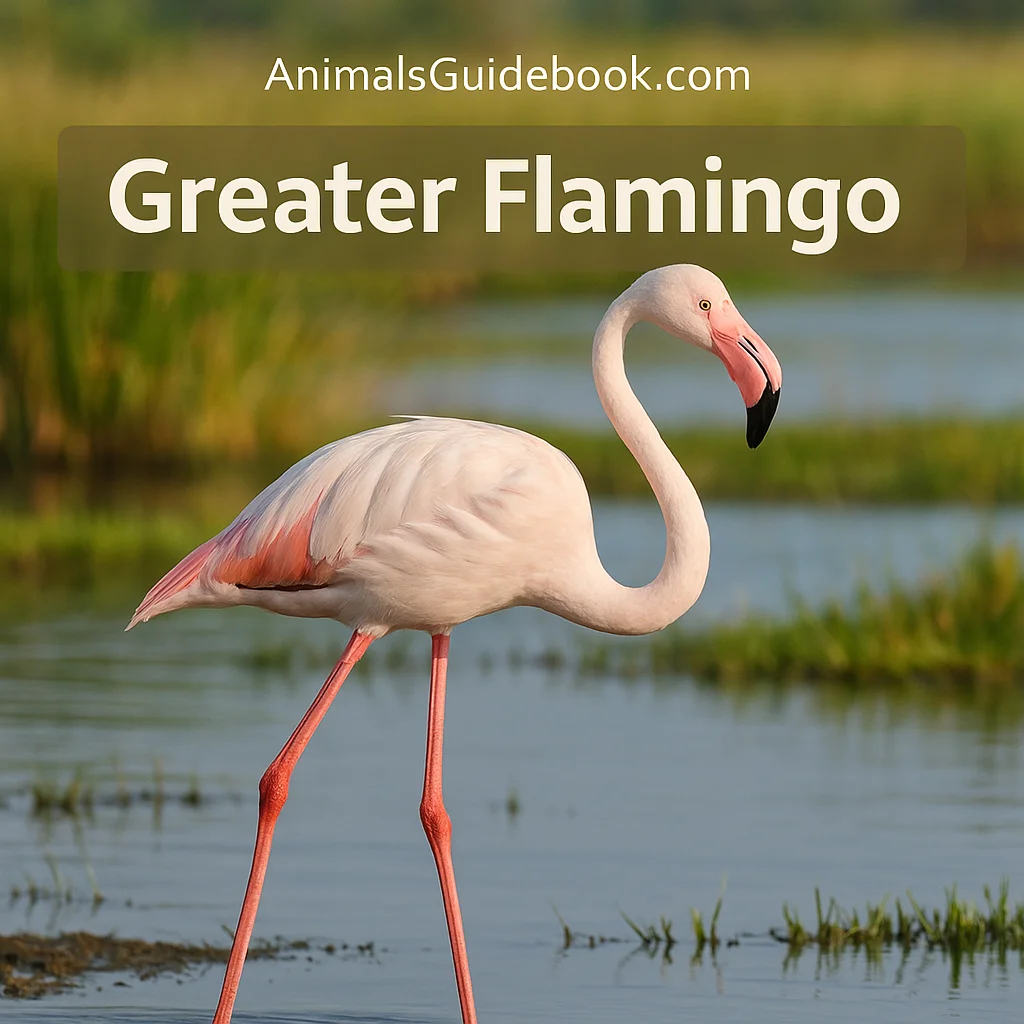
The Greater Flamingo is one of the most iconic and recognizable bird species known for its distinctive pink coloration and elegant posture. Found across various regions, this flamingo species is often observed wading through shallow waters using its specialized beak to feed.
- Common name: Greater Flamingo
- Scientific name: Phoenicopterus roseus
- Animal type: Bird
- Typical adult size: 110-150 cm (43-59 inches) in height
- Typical lifespan: 30-40 years in the wild
- Diet type: Omnivore; primarily feeds on algae, crustaceans, and small insects
- Activity pattern: Diurnal with peaks of activity during dawn and dusk
- Social structure: Highly social; forms large colonies
- Speed / movement highlights: Can fly at speeds of up to 60 km/h (37 mph)
- Intelligence/learning: Known for complex social behaviors and memory
- Primary habitats: Wetlands, including lagoons, salt pans, and mudflats
- Geographic range: Found in parts of Africa, Southern Europe, the Middle East, and South Asia
- Predators/threats: Predated upon by large birds of prey; habitat destruction and human activity pose threats
- Conservation status: Least Concern, but varies by region
🔍 Identification & Appearance
The Greater Flamingo is instantly recognizable by its tall, slender stance and vividly pink plumage, which derives from its diet. It has a long neck and legs, and a distinctive downward-curved beak designed for filter feeding. Juveniles start with gray plumage, gradually attaining the signature pink as they mature.
- Distinctive taller and larger build compared to lesser flamingos
- Paler pink to nearly white wings with a black edging
- Longer beak with a striking black tip
- Bright yellow eyes and muddy grey legs
- Top ID Tips
- Tall and elegant with long neck and legs
- Black-tipped, downward-curved beak
- Pink gradient on feathers, brightest on the wings
- Social species found in large groups, often near water bodies
- Younger birds have duller colors which brighten with age
- Usually silent, but can produce honking sounds when disturbed
🧱 Body Structure & Physical Adaptations
The Greater Flamingo's slender body is optimally designed for its aquatic lifestyle. The beak has a specialized structure with a filtering mechanism to separate food from water. Its lengthy legs enable wading in deeper waters compared to other birds.
- Slim and lightweight, designed for wading and flying efficiency
- Beak is adapted to filter-feeding, perfect for aquatic feeding
- Powerful wings for long migratory flights
- Keen vision for spotting potential predators and distant food sources
- Limited sense of smell, relies more on sight for survival
- Key Adaptations
- Lightweight skeleton for efficient flight
- Webbed feet for stability in wet environments
- Highly mobile neck allows for efficient foraging
- Coloration driven by diet (carotenoids)
- Long-legged structure aids in wading through water
🌍 Range & Distribution
The Greater Flamingo boasts a vast geographical range, inhabiting various wetlands across continents, from Africa to parts of Asia and Europe. These habitats are typically coastal or inland water bodies.
- Africa: Mediterranean coast, East and Southern Africa
- Southern Europe: Spain, Turkey, and Italy
- Middle East regions
- South Asia: Coastal India and Pakistan
- Adapted to both saline and brackish waters
- Where You Might Find It
- Shallow coastal lagoons
- Salt flats and marshes
- Wetlands near residential areas
- High-salinity lakes in arid zones
- Open mudflats for feeding
🏞️ Habitat & Shelter
Greater Flamingos prefer open, shallow water habitats where they can easily source their diet of small aquatic organisms. Their social nature means they often gather in large flocks, which can be seen as colorful spectacles in such environments. Seasonal changes influence their habitat choices, particularly water levels and food availability.
Understanding their habitat is crucial, as flamingos are highly adapted to specific environmental conditions, and any alteration in their habitat can significantly affect their survival and breeding success.
🧭 Behavior & Ecology
These birds are known for their sociability, gathering in large flocks which aid in protection and breeding success. They exhibit a variety of behaviors crucial for survival, such as filter-feeding and group-based vigilant behaviors. Greater Flamingos play a vital ecological role by controlling the populations of aquatic invertebrates and contributing to nutrient cycling in their habitats.
- Behavior Highlights
- Forms colonies from hundreds to thousands
- Distinct filter-feeding behavior
- Courtship involves synchronized dancing displays
- Communicate through vocalizations and displays
- Relies on group vigilance to detect predators
- Exhibits make-do nest building with mud stacking
👥 Social Life & Group Dynamics
The Greater Flamingo is inherently social, usually found in colonies that may range from a few dozen to tens of thousands. These colonies do not only enhance their survival odds but are essential for mating and raising young.
The creation of these large groups serves multi-functional purposes including predator protection, breeding, and increased feeding efficiency. Within these groups, complex social structures can be observed, involving various displays and communication forms during social interactions.
- Social Structure Notes
- Lives in highly synchronized, large flocks
- Dominance hierarchies observed within colonies
- Breeding is often communal in dense, protected areas
- Social interactions include vocalizations and posturing
- Adults are typically non-territorial unless nesting
- Group cohesiveness aids in successful fledging of chicks
🍽️ Diet, Prey & Predators
The diet of Greater Flamingos mainly consists of small aquatic organisms. Their unique filter-feeding strategy allows them to extract tiny animals and algae from the water. Predation is a risk, primarily from avian predators, but communal living deters most individual threats.
Their feeding patterns are heavily dependent on the water conditions, and as such, they may be seen moving to different water bodies as resources deplete or seasonal changes alter water levels.
- Feeding Notes
- Feeds by stirring up mud and scooping food
- Diet largely consists of brine shrimp and blue-green algae
- Avoids areas with heavy human disturbance during feeding
- Employs a side-sweep swimming motion to facilitate feeding process
- Natural predators include birds of prey and terrestrial carnivores
🦌 Hunting, Foraging & Movement
Greater Flamingos are known for their distinct feeding behavior. They use their beak and tongue in a specialized manner to filter small food particles from the water, a process which necessitates shallow wading habits. They rely on seasonal migrations to ensure access to optimal feeding ponds, which can be flown to at significant speed and height.
- Movement & Strategy
- Skilled waders due to long legs
- Migratory patterns influenced by food availability
- Flies in V-formation to reduce wind resistance
- Continuous foraging throughout daylight hours
- Navigates using celestial cues and landmarks
🧠 Intelligence & Senses
Greater Flamingos possess notable social intelligence, enabling complex interactions within their flocks. They exhibit problem-solving abilities, especially in building efficient nests or finding food. Their senses are finely tuned for their aquatic environment, with exceptional vision aiding both in detecting prey and avoiding predators.
- Notable Abilities
- Use spatial memory to navigate between known breeding and feeding sites
- Complex mating dances requiring timing and coordination
- Excellent long-distance visual detection
- Able to discern changes in water salinity affecting habitat choice
- Demonstrates memory retention related to social structure
🪺 Reproduction, Pregnancy & Parenting
The Greater Flamingo's breeding cycle is closely tied to rainfall and the presence of optimal nesting sites. These birds often form large nesting colonies where courtship rituals involving synchronized movements play a crucial role. They typically lay one egg, with both parents taking turns in incubation and chick-rearing duties.
- Reproduction Snapshot
- Breeding seasonality varies with water conditions
- Monogamous pairings common but not strictly so
- One egg per clutch; incubation lasts 27-31 days
- Chicks are altricial, needing extensive parental care
- Both sexes partake in chick rearing and feeding duties
♀️♂️ Male vs Female Differences
In Greater Flamingos, males tend to be slightly larger than females in terms of body size and bill length. However, these differences are not as pronounced as seen in many other bird species. Behaviorally, both sexes share roles in nurturing and feeding the young.
- Sex Differences at a Glance
- Males generally have a more robust build
- Females often have slightly shorter bills
- Both sexes exhibit similar plumage
- Shared incubation and parenting tasks
- Behavioral differences mostly negligible within the same colony
🧬 Subspecies & Variation
While the Greater Flamingo itself is known as a single species, slight variations occur based on geographical distribution. These primarily include differences in plumage saturation and body size as influenced by diet and environmental conditions. Genetic studies continue to assess the relationship between geographically distant populations, suggesting potential subspecies distinctions within the broader population.
- Variation Notes
- Plumage color intensity can vary by regional diet
- Body size slightly differs between African and Asian populations
- Adaptations allow for temperature tolerance in different habitats
- Regional behavioral adaptations observed
- Potential for more defined subspecies identification with ongoing research
⚠️ Threats, Conservation & Human Interaction
The primary threats to the Greater Flamingo stem from habitat degradation, pollution, and human disturbance. Despite being listed as Least Concern, regional threats must be monitored to ensure the species' overall health. Conservation efforts could include habitat protection and minimizing disturbances in key breeding sites.
- Responsible Notes
- Avoid disturbing nests during breeding season
- Support conservation programs focused on wetland preservation
- While captive breeding is possible, ethical considerations should guide such efforts
- Engaging in responsible tourism practices reduces human-wildlife conflict
- Efforts must be made to mitigate climate change impacts on habitats
✨ Fun Facts & Unique Traits
- Their pink color is due to carotenoid pigments obtained from their diet.
- Greater Flamingos are the largest species of flamingo.
- They have been documented to travel over 500 km in a single day.
- These birds are capable of living in both salt and freshwater conditions.
- The distinctive curved beak is specially evolved for filter-feeding.
- Flamingos produce a kind of ‘flamingo milk’ to feed their chicks.
- Large flamingo gatherings are called "flamboyances."
- Their knees are often mistaken for legs; these are actually an inverted ankle joint.
📌 Summary
- Greater Flamingos are notable for their tall, slender bodies and bright pink plumage.
- Predominantly inhabit wetlands, they are adept waders.
- Their distribution includes parts of Africa, Europe, South Asia, and the Middle East.
- Omnivorous, feeding primarily on crustaceans and algae via filter feeding.
- Threats include habitat destruction and human disturbances.
- Social life involves large flocks aiding in protection and breeding.
- Both males and females share responsibilities in chick-rearing.
- Adapted to migratory life, capable of long-distance flight.
- Key ecological role in maintaining the balance within their habitat.