🦁 Great Egret
🧾 Quick Facts
The Great Egret is a large, elegant bird known for its striking appearance and widespread distribution. It is often found in wetland areas and is easily recognized by its long legs and neck. Here are some quick facts about the Great Egret:
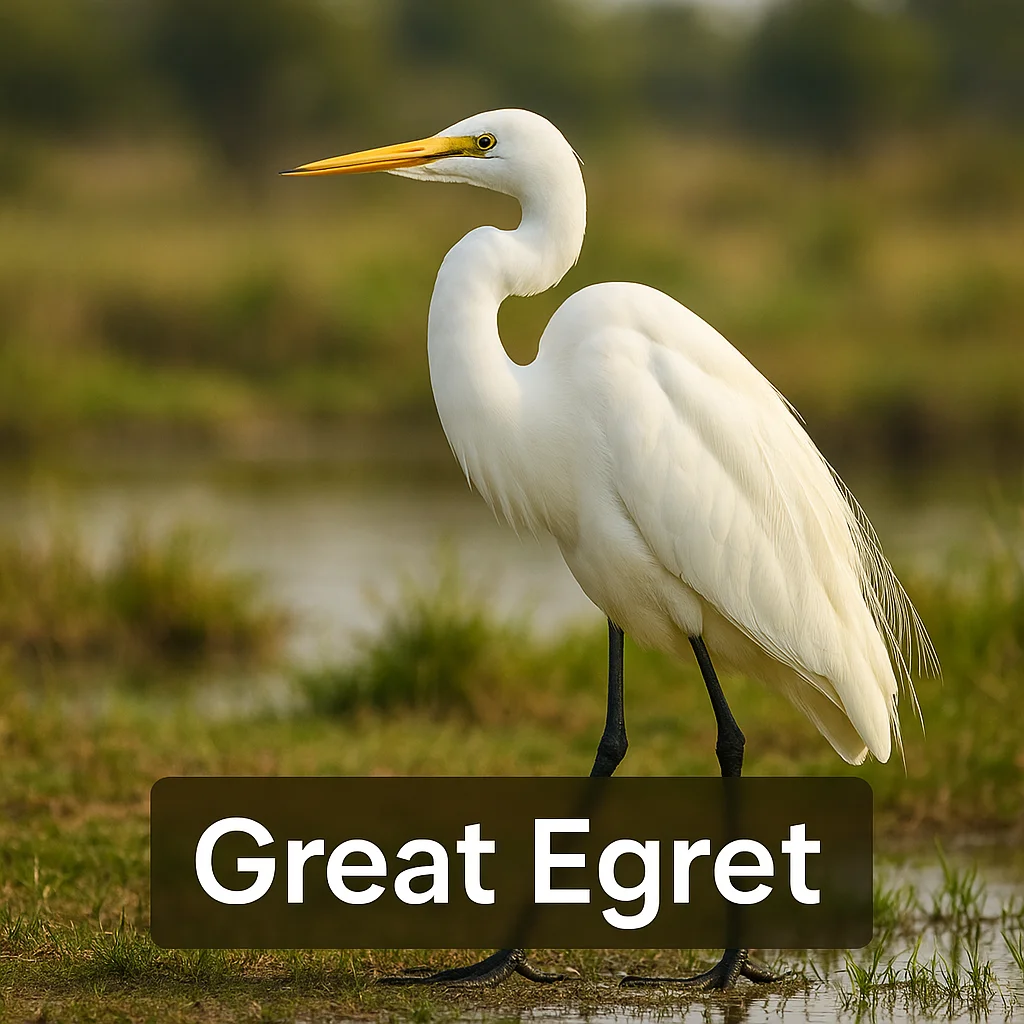
- Common name(s): Great Egret, Common Egret, Large Egret
- Scientific name: Ardea alba
- Animal type: Bird
- Typical adult size: 80-100 cm (31-39 inches) in length, wingspan up to 170 cm (67 inches)
- Typical lifespan: 15-20 years in the wild
- Diet type: Carnivore; primarily fish, amphibians, and small mammals
- Activity pattern: Diurnal
- Social structure: Generally solitary or in pairs; forms colonies during breeding season
- Speed / movement highlights: Flies with slow wing beats; adept at wading and standing still
- Primary habitats: Wetlands, marshes, lakes, rivers, coastal areas
- Geographic range: Worldwide, except for the polar regions and harsh deserts
- Predators/threats: Large birds of prey, snakes, and mammals; habitat loss and pollution
- Conservation status: Least Concern, but depends on regional habitat conditions
🔍 Identification & Appearance
The Great Egret is a tall, white bird with a distinctive S-shaped neck. Its body shape and striking white plumage make it relatively easy to identify, especially in wetland habitats.
- Body shape: Long neck and legs, slender body
- Color: Pure white plumage year-round
- Beak: Long, sharp, and yellow; becomes darker during the breeding season
- Feet: Black, aiding in stealth when stalking prey in water
- Tracks: Narrow, elongate tracks with webbed toes
- Common look-alikes: Snowy Egret, which is smaller and has yellow feet
- Look for the pure white plumage
- Observe the S-shaped neck and poised stance
- Notice the long, pointed yellow beak
- Observe the black legs and feet
- Check for large size compared to other egrets
- Look for slow, deliberate movement
- Watch the elegant, shallow wing beats in flight
🧱 Body Structure & Physical Adaptations
The Great Egret has a slender yet robust body that is perfectly adapted for its wetland lifestyle. Its physical build aids in both stealthy hunting and graceful flying.
- Build: Long neck and legs for wading; streamlined body for efficient flight
- Beak: Sharp and pointed for catching prey
- Wings: Broad and strong for sustained flight
- Sensory strengths: Excellent vision for spotting prey from a distance
- Long legs for wading in water
- Sharp beak for catching fish
- Broad wings for stability in the air
- Excellent eyesight for hunting
- Streamlined body for minimal air resistance
- S-shaped neck for quick striking action
🌍 Range & Distribution
The Great Egret is found on every continent except Antarctica. Its adaptability allows it to thrive in a variety of wetland environments, from coastal regions to inland freshwater bodies.
- Habitat: Wetlands, marshes, riversides, lakes
- Geographic distribution: Nearctic, Neotropical, Palearctic, Oriental, and Australian regions
- Migration: Some populations are migratory; others remain in temperate zones year-round
- North and South America
- Europe
- Africa
- Asia
- Australia
- Near shorelines and wetlands
- Temperate and tropical zones
🏞️ Habitat & Shelter
Great Egrets prefer habitats with abundant water and dense vegetation, which provide ample hunting opportunities and shelter from predators. Seasonal changes may affect their distribution as they seek food and nesting sites.
- Preferred habitats: Wetlands, estuaries, mangroves, and lagoons
- Shelter: Nesting occurs in tall trees or shrubs near water
- Weather impacts: During dry seasons, they may relocate to areas with available water sources
- Seek habitats with water and food
- Adapt to seasonal changes by moving to fertile wetlands
- Favor areas with protective cover
- Build nests in trees near water
- Relocate during dry spells
🧭 Behavior & Ecology
The Great Egret is a skilled hunter that uses stealth and patience to capture prey. Its behavior is centered around maximizing hunting success and minimizing energy expenditure. Communication and interaction with other species are also key parts of its ecological role.
- Tends to stand motionless to ambush prey
- Uses a rapid thrust to catch fish and other animals
- Vocalizations include croaks and squawks, especially during breeding
- Plays a crucial role as both predator and prey in wetland ecosystems
- Exhibits stealthy hunting techniques
- Shows territorial behavior during breeding season
- Communicates with vocalizations and displays
- Participates in nutrient cycling through predation
- Coexists with other wading birds for shared resources
👥 Social Life & Group Dynamics
Although typically solitary, the Great Egret forms colonies during the breeding season. These groups aid in protecting against predators and enhancing the chances of reproductive success. Social interactions are generally limited to the breeding season.
- Forms colonies during breeding season
- Solitary or in pairs when feeding
- Minimal to no hierarchy in colonies
- Engages in minimal social interactions outside breeding
- Breeds in colonies
- Often seen alone or in pairs
- Cooperative breeding for protection
- Minimal conflict within colonies
- Shares nesting areas with other bird species
🍽️ Diet, Prey & Predators
The Great Egret primarily feeds on aquatic organisms. Its diet includes fish, amphibians, crustaceans, and small mammals. Despite being a top predator in its habitat, it faces threats from larger animals and human activities.
- Fish, frogs, small reptiles, and insects
- Occasionally rodents and other small mammals
- Uses a sit-and-wait or slow stalk hunting technique
- Threatened by habitat destruction and pollutants
- Prefers aquatic prey
- Uses stealth to capture food
- Faces predation from birds of prey
- May scavenge on dead fish
- Caught prey swallowed whole
🦌 Hunting, Foraging & Movement
The Great Egret's hunting strategy typically involves standing still or slow wading to ambush prey. Its ability to move silently and strike rapidly is key to its success as a predator in aquatic environments.
- Uses methodical, slow wading to hunt
- Relies on excellent vision to spot prey underwater
- Moves silently to avoid alerting prey
- Has endurance for long flights during migration
- Stealthy ambush predator
- Flies with graceful, slow wing beats
- Forages during daylight
- Silent movement in water
- Efficient migrant
🧠 Intelligence & Senses
The Great Egret is equipped with keen sensory abilities, particularly in vision, which aids in detecting prey from afar. While not known for advanced problem-solving skills, it effectively uses its environment to its advantage.
- Excellent visual acuity for spotting prey
- Strong spatial understanding for navigation
- Adapts feeding strategies to different environments
- Limited tool use observed
- Sharp eyesight
- Spatial awareness
- Adapts hunting tactics
- Environmental awareness
- Communicative abilities
🪺 Reproduction, Pregnancy & Parenting
The Great Egret has a seasonal breeding cycle with courtship displays that include elaborate feather displays and vocalizations. Nest building is a shared task, with both parents involved in caring for the offspring.
- Breeding season varies by region
- Monogamous pairing during the breeding season
- Incubation period ranges from 23 to 26 days
- Clutch size ranges from 3 to 5 eggs
- Both parents feed and protect chicks
- Displays plumage during courtship
- Builds nests in colonies
- Shared parental care
- Eggs hatched in approximately a month
- Chicks are altricial, requiring care
♀️♂️ Male vs Female Differences
Visual differences between male and female Great Egrets are minimal, making it challenging to distinguish between the sexes without close observation during the breeding season, when subtle differences in behavior may appear.
- Similar size and color; males slightly larger
- Males may exhibit more pronounced breeding plumage
- Both sexes participate in nesting
- Differences in courtship displays
- Males larger but subtle
- Breeding plumage more visible on males
- Shared nesting duties
- Minimal size and color differences
🧬 Subspecies & Variation
The Great Egret is relatively uniform in appearance across its range, but regional variations exist due to environmental adaptations. Subspecies classification is sometimes debated among ornithologists.
- Subspecies classification can be inconsistent
- Little variation in plumage coloration
- Size may vary slightly by region
- Little plumage variation
- Minor regional size differences
- Habitat and climate influence behavior
⚠️ Threats, Conservation & Human Interaction
While currently not at immediate risk, the Great Egret faces threats from habitat destruction, pollution, and climate change. Conservation efforts focus on habitat preservation and education to minimize human impact.
- Threats include habitat destruction and pollution
- Climate change affects wetland habitats
- Responsible viewing involves keeping distance to avoid disturbance
- Conservation efforts aim at protecting wetland habitats
- Preserve wetlands
- Minimize pollution
- Promote habitat protection
- Engage in conservation awareness
✨ Fun Facts & Unique Traits
- Great Egrets were once extensively hunted for their feathers
- Their striking plumage inspired the formation of conservation organizations
- Aside from stunning looks, they play a significant role in aquatic ecosystems
- The occasional formation of breeding colonies aids their reproductive success
- Known for their graceful appearance and methodical hunting approach
- They can adapt to a wide range of wetland habitats
- From a distance, they may appear to be floating due to their posture
📌 Summary
- Large, white bird with a slender body and long legs
- Thrives in wetlands around the world
- Feeds mainly on fish, amphibians, and insects
- Predators include large birds of prey and mammals
- Social structure involves colonial breeding
- Reproduction involves shared parental duties
- Sensory and physical adaptations aid in hunting
- Faces threats from habitat degradation
- Conservation efforts focus on wetland protection
- Symbol of conservation success through history