🦁 Great Blue Heron
🧾 Quick Facts
The Great Blue Heron, a striking and majestic wader, is a common sight along North American waterways and wetlands. Known for its elegant poise and impressive wingspan, this bird is a familiar resident of both freshwater and saltwater marshes.
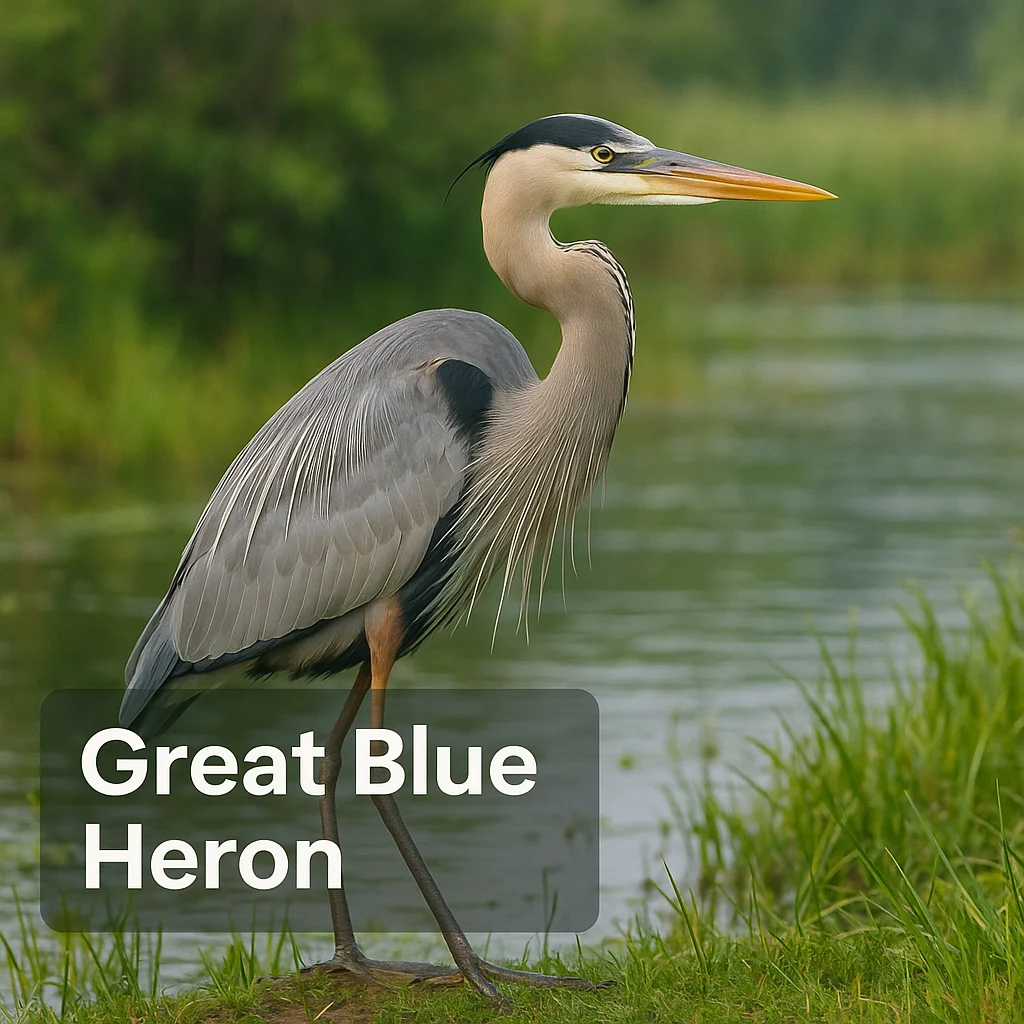
- Common names: Great Blue Heron
- Scientific name: Ardea herodias
- Animal type: Bird
- Typical adult size: 3.2–4.5 feet tall; wingspan of 5.5–6.6 feet
- Typical lifespan: 15–25 years in the wild
- Diet type: Carnivore; fish, amphibians, reptiles, small mammals
- Activity pattern: Diurnal
- Social structure: Solitary or small groups
- Speed/movement highlights: Flies up to 20-30 mph
- Intelligence/learning: Capable of learning feeding strategies
- Primary habitats: Wetlands, rivers, coastal marshes
- Geographic range: North America; occasional migratory presence in Central America and the Caribbean
- Predators/threats: Eagles, raccoons, human activity
- Conservation status: Least Concern
🔍 Identification & Appearance
The Great Blue Heron is easily recognized by its tall, slender stature and distinct blue-gray plumage. Its long neck and legs, combined with a sharp, pointed beak, make it an efficient hunter of aquatic prey.
- Body shape: tall and slender
- Color/pattern: blue-gray with white and black streaking on the head
- Distinctive features: long neck, dagger-like bill, elongated legs
- Field signs: Large, outstretched wings during flight
- Look for the S-shaped neck in flight
- Yellowish bill stands out against darker feathers
- Dark, sweeping plumes on the back of the head
- Mature individuals may show a slight reddish-brown cast
- Large, slow wingbeats when flying
- Feet trail straight behind when in flight
- Top ID Tips
🧱 Body Structure & Physical Adaptations
The Great Blue Heron is specially adapted for its aquatic lifestyle. It possesses a set of physical traits ideal for wading and spearing fish with precision.
- Build: slender and elongated; ideal for stalking prey
- Beak: long, pointed, effective for spearing fish
- Legs: long and sturdy for wading through water
- Wings: wide wingspan supports soaring flight
- Sensory strengths: excellent vision, moderate hearing capacity
- Elongated neck allows fast strikes at prey
- Sharp bill helps catch slippery fish
- Web-like feet for stability on muddy surfaces
- Feathers equipped for water resistance
- Ability to retract its neck during flight
- Acute vision for spotting prey from afar
- Key Adaptations
🌍 Range & Distribution
The Great Blue Heron is a common resident of many North American water bodies, readily identified across a host of marshy and aquatic locales.
- Preferred regions: throughout North America
- Habitat presence: found from Alaska to the southern United States
- Elevation range: from sea level to high-altitude wetlands
- Seasonal movements: migrates southward during colder months
- Coastal shorelines
- Inland lakes and reservoirs
- Grasslands adjacent to water
- Brackish and marine shorelines
- Urban waterways
- Wetland preserves and wildlife refuges
- Where You Might Find It
🏞️ Habitat & Shelter
The Great Blue Heron is exceptionally resourceful, adapting to diverse water habitats from shallow ponds to coastline bays. Habitat availability significantly affects foraging and breeding success.
- Preferred habitats: wetlands, river edges, lakesides, estuaries
- Shelter: typically roosts in trees near water
- Seasonal behavior: moves to warmer areas during winter
- Habitat importance: dense plant life provides cover and hunting grounds
🧭 Behavior & Ecology
One of the tranquil denizens of marshes, the Great Blue Heron strikes an intriguing balance between solitude and social interaction, crucial for its ecological niche.
- Daily routine: forages alone during the day
- Communication: guttural croaks and harsh, guttural squawks
- Interactions: competes for territory with other herons
- Ecosystem role: controls fish populations; indicator of environmental health
- Uses stealth in hunting
- Carefully chooses feeding sites
- Stands still or moves slowly to stalk prey
- Regulates body temperature by sunbathing
- Displays aggression with wings during fights
- Usually feeds alone, sometimes in groups in productive areas
- Behavior Highlights
👥 Social Life & Group Dynamics
While often seen alone, the Great Blue Heron forms temporary groups when roosting or breeding, displaying a complex social structure.
- Social tendencies: typically solitary but forms colonies during breeding season
- Group types: colonies range from small loose aggregations to large groups
- Cooperation: little direct cooperation outside of breeding
- Dominance: maintains territories with displays and postures
- Found alone outside of nesting season
- Colony nesting ensures better protection
- Minimal direct social interactions
- Defensive of feeding territories
- Fledglings show cooperative feeding in some cases
- Loose interactions with other waterbirds when feeding
- Social Structure Notes
🍽️ Diet, Prey & Predators
Standing as a master of patience and stealth, the Great Blue Heron is a skilled hunter of aquatic resources, with a varied diet that supports its thriving population.
- Diet: primarily fish; also consumes amphibians, insects, and small mammals
- Hunting strategy: patient stalking and quick strikes
- Predators: preyed upon by eagles, raccoons, and sometimes humans
- Prefers shallow waters for hunting
- Captures prey using sudden, striking motions
- Variety in diet helps adapt to changing ecosystems
- Uses shadows to help catch fish
- Occasionally scavenges when convenient
- Feeding Notes
🦌 Hunting, Foraging & Movement
The agility and precision of the Great Blue Heron in its daily movements reveal nature's design for balanced, efficient hunters.
- Locomotion style: slow walking through water; strong flying ability
- Speed: powerful, deliberate flier
- Hunting times: typically active during morning and late afternoon
- Navigation: returns to roost sites in the evening
- Wades through water stealthily
- Quiet and deliberate in approach
- Flies at a consistent speed over short distances
- Able to walk long distances while foraging
- Adapts flight height based on landscape
- Returns to familiar feeding spots
- Movement & Strategy
🧠 Intelligence & Senses
The Great Blue Heron exhibits notable problem-solving abilities and adaptable behavior, integral to its survival in diverse environments.
- Problem-solving: adjusts tactics based on prey behavior
- Memory: remembers productive feeding sites
- Senses: excellent eyesight for foraging; moderate auditory skills
- Utilizes shadow to assist in prey capture
- Adapts feeding strategies to prey availability
- Knows nesting sites year after year
- Exhibits caution in unfamiliar settings
- Visual acuity enhanced for spotting prey
- Notable Abilities
🪺 Reproduction, Pregnancy & Parenting
Great Blue Herons are seasonal breeders, displaying a complex courtship behavior that involves both vocal and visual signals to form pair bonds.
- Breeding season: generally in spring and early summer
- Mating system: generally monogamous
- Incubation period: 25–30 days
- Clutch size: 2–6 eggs, typically 3-4
- Parenting roles: both parents share incubation and feeding duties
- Elaborate courtship display involves stretching and snapping beaks
- Nests in colonies called heronries
- Chicks are altricial, requiring significant parental care
- Nest built from sticks and grass
- Parents regurgitate food for chicks
- Young fledge at 60 days
- Reproduction Snapshot
♀️♂️ Male vs Female Differences
In Great Blue Herons, males and females differ slightly in size and behavioral roles, with observable but subtle variations.
- Size: males slightly larger than females
- Coloration: generally similar between sexes
- Roles: males often participate more in nest building
- Males have longer plumes during breeding season
- Slight weight differences not easily observed
- Behavioral roles during courtship display differences
- Sexes similar in plumage patterning
- Equal division in chick rearing
- Punctuality in nest duties
- Sex Differences at a Glance
🧬 Subspecies & Variation
The Great Blue Heron, primarily considered a single species, can display regional variations attributable to environment and climate.
- Subspecies: minor recognized differences in North vs South American populations
- Local adaptation: Northern populations tend to be slightly larger
- Variation: subtle plumage differences based on regional diets
- Island populations may be smaller
- Color intensity may vary by locale
- Nest size and materials can differ
- Little genetic divergence across range
- Some populations remain resident, others migrate
- Variation Notes
⚠️ Threats, Conservation & Human Interaction
The Great Blue Heron faces a variety of natural threats ranging from predation to habitat loss, often exacerbated by human activity, yet it remains a resilient species.
- Threats: habitat destruction, pollution, climate change
- Conservation: protected by conservation laws in many areas
- Human Interaction: generally avoids populated areas, but adapts to urban waterbodies
- Avoid disturbing nesting sites
- Continuous monitoring necessary in urban settings
- Important to maintain clean and preserved wetlands
- Reduce pollution to support healthy fish stocks
- Observing quietly limits their stress levels
- Responsible Notes
✨ Fun Facts & Unique Traits
- Known for their dramatic "s" shaped neck in flight.
- Has a specialized tongue adapted to capture slippery fish.
- The largest heron in North America, known for its imposing presence.
- Exhibits sunbathing behavior to sanitize after feeding.
- In flight, the heron tucks its long neck back into an "s" shape.
- Can stand still in water for long periods, often mistaken for statues.
- Chicks initially display noisy begging calls.
- Has been known to travel up to 20 miles from the nesting site to find food.
📌 Summary
- Distinctive blue-gray plumage
- Common in North American wetlands
- Favors fish-rich habitats
- Solitary yet colonies form during breeding
- Exhibits patient and skillful foraging strategies
- Adaptable to various wetland environments
- Coexists with many aquatic species
- Subject to threats from habitat loss and pollution
- Significant ecological role as a top wader
- Relied upon as a biodiversity indicator