🦁 Emperor Penguin
🧾 Quick Facts
The Emperor Penguin, known for its remarkable resilience and adaptability, thrives in one of the harshest environments on Earth. These iconic birds are the largest of the penguin family, and they play an essential role in the Antarctic ecosystem.
- Common name: Emperor Penguin
- Scientific name: Aptenodytes forsteri
- Animal type: Bird
- Typical adult size: 100–120 cm in height, 22–40 kg in weight
- Typical lifespan: 15–20 years in the wild
- Diet type: Carnivore; primarily fish, squid, and crustaceans
- Activity pattern: Primarily diurnal
- Social structure: Colony, often comprising thousands of individuals
- Speed / movement highlights: Capable of swimming up to 15 km/h
- Intelligence/learning: Known for social learning and cooperative behavior
- Primary habitats: Sea ice and surrounding Antarctic waters
- Geographic range: Endemic to Antarctica
- Predators/threats: Leopard seals, killer whales, human-induced climate changes
- Conservation status: Near threatened
🔍 Identification & Appearance
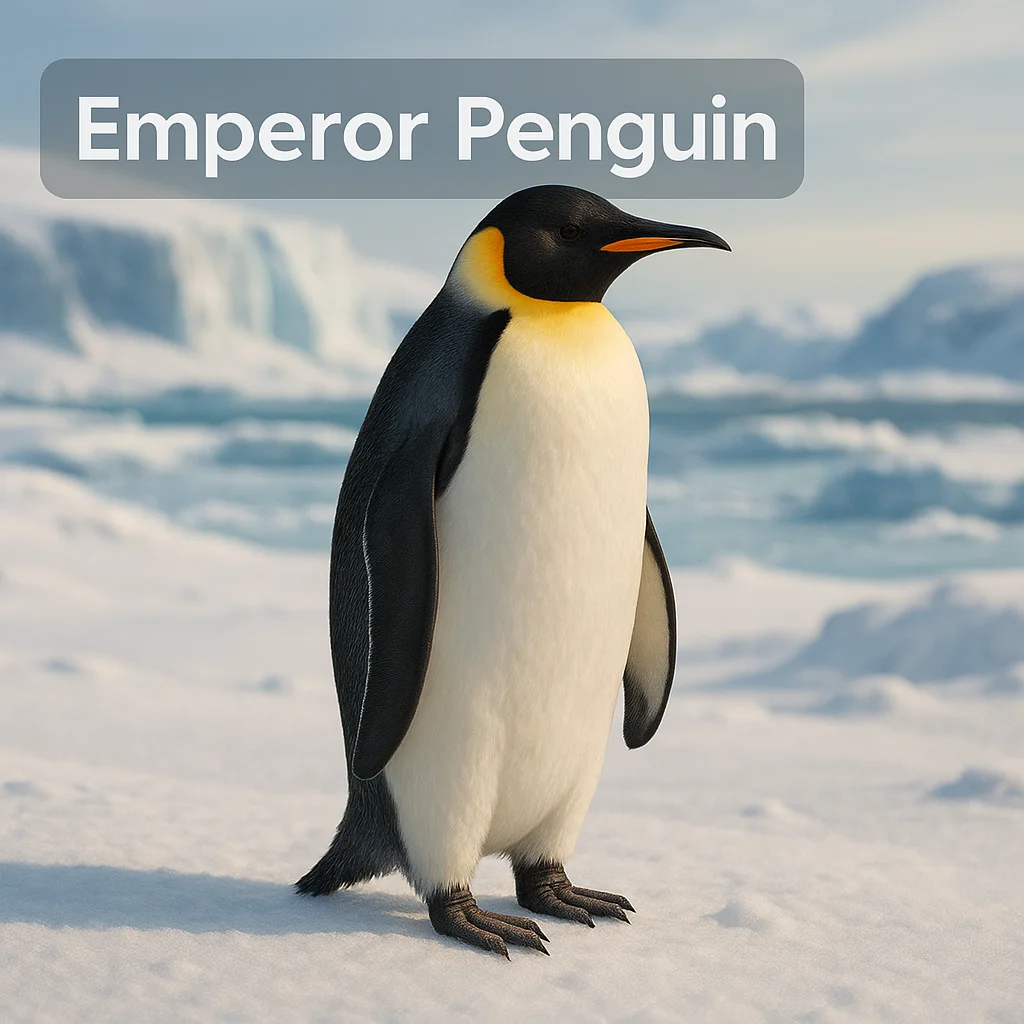
The Emperor Penguin is easily recognizable by its impressive stature and distinct coloration. Adults have a black cap, blue-grey neck, and orange spot on the ear. Their flippers are black on the upper surface and white underneath. Their upright posture, substantial body mass, and striking color contrast make them unmistakable within their icy domain.
- Large, upright bird with a streamlined body
- Sleek feathers providing insulation against cold
- Black back and head, with white belly and light grey throat
- Bright orange patches near each ear
- Juveniles have white down feathers
- Distinctive waddling gait on land
- Powerful, paddle-like flippers for swimming
- Short tail and black feet
🧱 Body Structure & Physical Adaptations
The Emperor Penguin's robust build and adaptations allow it to survive and thrive in icy conditions. They possess a thick layer of fat beneath their skin, providing crucial insulation. Their beaks are short and robust, optimized for capturing slippery prey. Notably, their wings have evolved into flippers that afford excellent swimming agility.
- Streamlined body for efficient diving
- Short, conical beak for grasping prey
- Strong flippers for propulsion underwater
- Dense, waterproof plumage trapping air for insulation
- Excellent low-light vision for hunting beneath ice
- Thick fat layer for warmth
- Reduced extremities to minimize heat loss
🌍 Range & Distribution
Emperor Penguins are endemic to Antarctica and are primarily found around the coastlines of the continent's vast ice sheets and pack ice. While most are permanent residents of this frigid environment, some seasonal migrations occur in response to shifts in sea ice availability.
- Resides exclusively in Antarctica
- Found along coastal ice shelves and sea ice
- Inhabits areas with sufficient ice floes for breeding
- Concentrated around Ross Sea, Weddell Sea, and other coastal regions
- Breeding colonies often located on stable sea ice
🏞️ Habitat & Shelter
The Emperor Penguin's habitat is characterized by icy landscapes and frigid waters. Their breeding colonies are typically situated on stable sea ice, which provides safety from predators and proximity to feeding grounds. Adaptations to the extreme cold are evident in all aspects of their behavior, from huddling for warmth to participating in long foraging trips beneath the ice.
🧭 Behavior & Ecology
Emperor Penguins are social birds, relying on collective strategies to endure severe Antarctic winters. They employ huddling tactics to conserve heat and often communicate through vocal and visual displays. Their role as both predator and prey establishes them as integral members of the Antarctic food web.
- Behavior Highlights:
- Huddling behavior for warmth conservation
- Vocal chatter facilitates communication
- Cooperative raising of young in colonies
- Effectively adapted to long-distance swimming
- Opportunistic feeders on fish and crustaceans
- Vital prey for apex predators like leopard seals
👥 Social Life & Group Dynamics
Emperor Penguins exhibit highly social behavior, forming large colonies during breeding seasons that can number in the thousands. These colonies enable them to share warmth and enhance survival odds during extreme conditions. Within the colony, they display coordinated child-rearing and a marked capacity for individual recognition through vocal cues.
- Form colonies for breeding and sheltering
- Colony sizes range from 500 to several thousand individuals
- Pair bonds often last for a season
- Cooperative care in chick rearing observed
- Group interactions dominated by vocal communication
- Minimal intra-colony competition observed
🍽️ Diet, Prey & Predators
As carnivorous birds, Emperor Penguins primarily rely on a diet of fish, krill, and squid, leveraging their adept swimming skills to capture prey. They face natural predation from leopard seals and killer whales. To protect themselves, penguins often swim in coordinated groups and rely on their physical speed and agility.
- Feast mainly on Antarctic silverfish and lanternfish
- Krill form a secondary dietary component
- Employ agile swimming for catching fast-moving prey
- Monitored predation threats from leopard seals
- Predator evasion includes group swimming strategies
🦌 Hunting, Foraging & Movement
Emperor Penguins are exceptional swimmers, adapted to diving deep and long to catch prey under the ice. They are capable of reaching depths of over 500 meters and can hold their breath for around 20 minutes. Typically, they forage within 100 km of their breeding sites.
- Rely on agile swimming to pursue prey
- Remarkable diving capabilities for hunting
- Forage mainly beneath ice during daylight
- Extended swimming ranges during seasonal migrations
- Optimal use of landscape features for navigation
🧠 Intelligence & Senses
Emperor Penguins exhibit intelligence through adaptive behaviors, social coordination, and problem-solving abilities. Their robust sense of vision, especially in low-light conditions typical of underwater environments, assists significantly in foraging. Vocalization and personal recognition play key roles in maintaining social bonds within large colonies.
- Social learning evident in chick rearing
- Low-light eyesight aids underwater hunting
- Memory and recognition through individual vocalizations
- Limited tool use despite environmental challenges
- Unable to detect distant threats by scent
🪺 Reproduction, Pregnancy & Parenting
Reproductive behavior in Emperor Penguins is marked by a unique breeding cycle where they endure the harsh Antarctic winter. Monogamous pair bonds are formed annually during courtship displays, with each breeding pair producing a single egg. Shared parenting roles are observed, with males incubating eggs and females foraging for sustenance.
- Breeding season spans from May to June
- Mating system involves seasonal monogamy
- Egg incubation period lasts around 64 days
- Single egg per breeding cycle
- Chicks are semi-precocial, born with protective down
- Male penguins incubate eggs during the harsh winter
♀️♂️ Male vs Female Differences
Male and female Emperor Penguins are nearly identical in appearance, with subtle differences that may not be easily noticeable. While males are not visibly distinguished from females, their roles during breeding cycles create functional variations that are critical for species survival.
- Similar size and weight, with slight male predominance
- Both exhibit comparable plumage coloration
- Diet and foraging behaviors are uniform
- Seasonal role differences observed in breeding
- Distinctive nurturing behavior seen in males
🧬 Subspecies & Variation
No recognized subspecies of the Emperor Penguin exist, with the species appearing relatively uniform across their range. Despite limited genetic divergence, some variation in size and breeding colonies has been noted based on environmental challenges and resource availability.
- No officially recognized subspecies
- Standard size and coloration range across populations
- Minor local adaptations to severe climatic shifts
- Uniform breeding habits across all colonies
- Population size fluctuations due to regional conditions
⚠️ Threats, Conservation & Human Interaction
Emperor Penguins are near threatened, primarily due to climate change impacting their icy habitats. Human activities such as overfishing and pollution also pose indirect threats. Conservation efforts focus on preserving ice habitats and monitoring environmental changes. Ethical zoos play a role in conservation awareness without disrupting natural behaviors.
- Climate change impacts sea ice availability
- Vulnerable to food supply disruptions from overfishing
- Limited human interaction due to remote habitat
- Awareness initiatives in zoos foster public conservation
- Global efforts to mitigate climate-related threats rising
✨ Fun Facts & Unique Traits
- Emperor Penguins can dive over 500 meters deep, the deepest recorded of any bird.
- They endure wind chills as cold as -60°C, thanks to their dense feathers and thick fat layers.
- Their flute-like calls can penetrate the dense Antarctic winds.
- Chick huddling significantly reduces individual heat loss, demonstrating sophisticated group survival tactics.
- Emperor Penguins are the only penguin species that breed during the Antarctic winter.
- Capable of fasting for up to 90 days during the breeding season.
- Known to traverse up to 200 km across ice for food with unparalleled navigation skills.
- Capable of remaining submerged for more than 20 minutes when necessary.
- They spend approximately 80% of their life at sea, demonstrating extreme aquatic adeptness.
📌 Summary
- Identification: Largest penguin species, distinctive white belly and orange ear spots
- Habitat: Endemic to Antarctic ice shelves and sea ice
- Distribution: Exclusive to the southernmost continent of Antarctica
- Diet: Diet consists of fish, krill, and squid, captured through underwater foraging
- Predators: Natural predators include leopard seals and killer whales
- Social life: Highly social, forming large colonies for breeding and warmth sharing
- Reproduction: Single chick per pair, with shared parental duties, including males incubating eggs
- Adaptations: Razors-sharp flippers for efficient swimming and deep diving capabilities
- Distinctive: Unique breeding cycle during Antarctic winter with exceptional cold resistance