🦁 Common Loon
🧾 Quick Facts
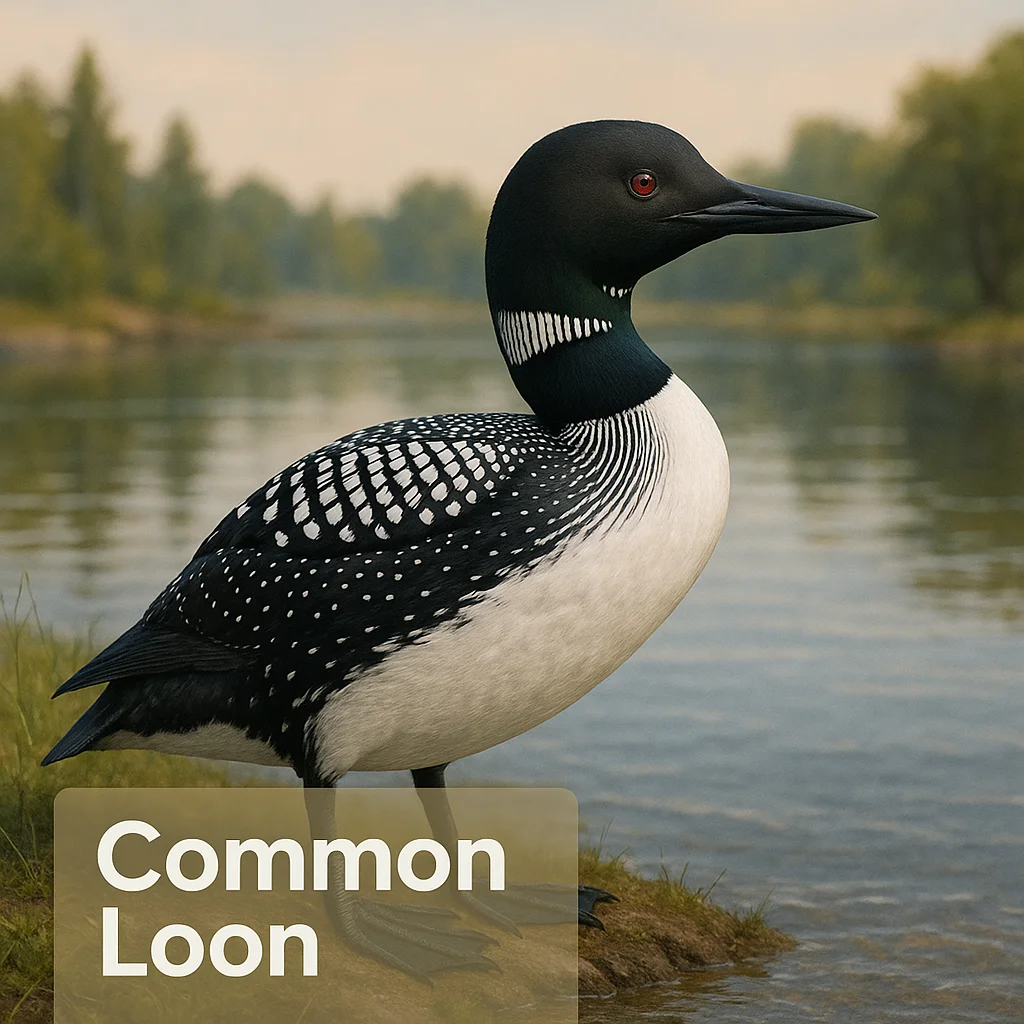
The Common Loon, also known as the Great Northern Diver, is a striking aquatic bird famous for its eerie calls and excellent diving capabilities. Found primarily in North America, this bird is known for its distinctive black and white plumage and ability to thrive in both freshwater and saltwater environments.
- Common name(s): Common Loon, Great Northern Diver
- Scientific name: Gavia immer
- Animal type: Bird
- Typical adult size: 70-90 cm (27-35 inches) in length, 2.7-6.3 kg (6-14 pounds)
- Typical lifespan: 20-30 years in the wild
- Diet type: Carnivore; primarily fish, but also some crustaceans and aquatic insects
- Activity pattern: Diurnal, but often more active at dawn and dusk
- Social structure: Mainly solitary or in pairs, though occasionally seen in small groups
- Speed / movement highlights: Fast swimmer and strong flier; dives underwater for food
- Intelligence/learning: Known for learning feeding techniques and adapting to environments
- Primary habitats: Lakes, reservoirs, large ponds, coastal bays
- Geographic range: North America; migrates to coastal areas during winter
- Predators/threats: Eagles, large fish, human-related pressures
- Conservation status: Least Concern, but populations vary by region
🔍 Identification & Appearance
The Common Loon features a distinctive black and white checkered back, a stark black head and neck, and red eyes. During the breeding season, they exhibit a black throat band bordered by white stripes. In non-breeding seasons, their plumage becomes more muted gray, but their sharp, dagger-like bill remains a key identifier.
- Recognizable silhouette with a sleek body and pointed bill
- Bright red eyes standout, especially in breeding season
- Checkered back pattern is unique among birds
- Thick neck with a white stripe in adults during breeding
- Webbed feet not visible when swimming
- Common look-alikes: Able to be distinguished from ducks by neck thickness and bill shape
- Winter plumage more subdued; still identifiable by size and shape
- Bill often appears held level with the water
- Field marks differ from cormorants in neck and bill characteristics
🧱 Body Structure & Physical Adaptations
The Common Loon's body is built for diving and swimming. A streamlined body and powerful legs allow it to be an efficient underwater predator. The legs, positioned far back on the body, aid in propulsion underwater, though they make walking awkward.
- Sleek, hydrodynamic body for underwater movement
- Legs are placed well back on the body, optimizing swimming
- Strong, pointed bill for catching fish
- Monocular vision adapted for seeing underwater
- Webbed feet providing excellent propulsion
- Limited walking ability due to rear-leg position
- Dense bones help in diving and staying submerged
- Feathers provide insulation and waterproofing
- Specialized vision adapting to light levels above and below water
🌍 Range & Distribution
The Common Loon breeds primarily in freshwater lakes and large ponds across Canada and the northern United States. During winter, they migrate to coastal marine environments along the Atlantic and Pacific Oceans, as well as the Gulf of Mexico.
- Breeding range includes northern U.S. states and much of Canada
- Migratory species wintering along coastal North America
- Can be found in freshwater and marine environments
- Prefers large, clean, fish-filled lakes for breeding
- Winter locations typically include shallow coastal bays
- Elevation range from sea level to boreal forest lakes
- Finds habitat across a variety of latitudinal ranges
- Mostly migratory, but some populations are resident
🏞️ Habitat & Shelter
The Common Loon favors lakes and large water bodies with clear waters which support abundant fish populations. In winter, they adapt to coastal waters where they continue their aquatic lifestyle. Seasonal changes impact their habitat notably when it comes to breeding and migration behavior.
Understanding their habitat preferences aids in conservation efforts and our understanding of their ecological needs.
🧭 Behavior & Ecology
The Common Loon is primarily a solitary bird or found in pairs, but during migration, small groups can be observed. Their haunting calls are a remarkable aspect of their behavior, serving as communication tools for territory and pair bonding. As predators, they play a crucial role in regulating fish populations within their ecosystems.
- Known for eerie and haunting calls
- Mainly solitary or in pairs; congregates in groups during migration
- Defends territory with vocalizations and displays
- Plays a critical role as a predator in aquatic ecosystems
- Uses extensive dives to catch prey
- Rests on water or near shores
- Engages in mutual preening behaviors during mating
- Adapts diet based on available fish stocks
- Utilizes specialized calls for communication
👥 Social Life & Group Dynamics
During the breeding season, Common Loons are highly territorial and will defend their nesting area aggressively. While generally seen alone or in pairs, some degree of social interaction occurs during migration, where they can be observed forming small, loose flocks.
- Territorial over breeding lakes
- Strong pair bonds; often monogamous
- Occasional social gatherings during non-breeding seasons
- Communication pivotal in maintaining pair bond
- Primarily solitary but may join small groups when not nesting
- Adults show cooperation in parenting
- Interactions involve displays of vocal and physical presence
🍽️ Diet, Prey & Predators
The Common Loon primarily feeds on fish, which it catches by diving adeptly underwater. This diet may be supplemented with aquatic insects and crustaceans during certain seasons. Their main predators include large birds of prey like eagles, and they face threats from human activities such as pollution.
- Feeds mainly on fish; diets vary seasonally with availability
- Supplements diet with crustaceans and aquatic insects
- Remarkable diving hunting strategy
- Main predators include bald eagles and large predators
- Anti-predator strategies include diving and vocal alarms
- Vigilance around nesting sites helps deter predators
🦌 Hunting, Foraging & Movement
As a strong swimmer, the Common Loon primarily forages by diving beneath the surface, using its powerful legs for propulsion. Known for its speed and agility in water, loons can reach depths exceeding 60 meters (200 feet). They typically hunt alone, skilled at both sighting and catching prey.
- Primarily a deep diver foraging underwater
- Capable of considerable speed underwater
- Strong flier, often seen traveling long distances during migration
- Utilizes sight to locate and catch prey
- Song and calls are integral during navigation
- Environmental cues used for migration navigation
- Adjusts movement patterns seasonally
🧠 Intelligence & Senses
The Common Loon has developed advanced senses suited to its aquatic lifestyle. It utilizes its keen eyesight to catch elusive prey underwater and has been noted for its ability to learn new feeding techniques to adapt to various environments. Their intelligence is evident in how they utilize complex calls for communication and navigation.
- Strong eyesight both above and underwater
- Able to learn and adapt feeding techniques
- Advanced communication through vocalizations
- Remarkable memory for navigation and territory maps
- Sensitive to environmental changes
- Ability to problem-solve, particularly in foraging
🪺 Reproduction, Pregnancy & Parenting
Common Loons engage in monogamous pair bonds, often returning to the same mate for several years. Their breeding season occurs in spring and early summer, with nests typically constructed near water bodies on secluded islands or shoreline. Both parents share responsibilities in incubating eggs and caring for the precocial young.
- Monogamous pair bonds, often lasting multiple seasons
- Breeding season across late spring to early summer
- Clutch size: 1 to 3 eggs, typically 2
- Both parents responsible for incubation and care
- Nests built near water with some cover
- Chicks are precocial, able to swim shortly after hatching
- Parental protection crucial for chick survival
- Incubation typically lasts around 28-30 days
♀️♂️ Male vs Female Differences
Male and female Common Loons are similar in appearance, making gender identification difficult solely by observation. However, males typically exhibit slightly larger body sizes. There are subtle differences in vocalizations, which are vital during mating and territory defense.
- Males usually larger than females
- Both sexes similar in plumage
- Vocal variations used for mate communication
- Feathers and coloration nearly identical
- Differences in size more apparent during breeding displays
🧬 Subspecies & Variation
The Common Loon is generally recognized as a single species without subspecies, though variations in size and plumage intensity are noted across different geographic regions. Potential adaptations may occur in response to local environmental conditions.
- No widely recognized subspecies
- Regional variations in size and plumage noted
- Potential adaptability to environmental changes
- Consistency in key identifying features
- Some debate in classification based on slight variations
⚠️ Threats, Conservation & Human Interaction
While presently classified as Least Concern, the Common Loon faces significant threats from habitat loss, environmental pollution, and human disturbances. Conservation efforts focus on protecting water quality and habitats critical for breeding. Responsible human interaction emphasizes the need to respect their space, particularly during breeding seasons.
- Threats include habitat destruction and pollution
- Human recreation activities can disturb habitats
- Conservation focuses on habitat maintenance
- Efforts to reduce pollution positively impact loon populations
- Encouraged to respect nesting territories
- Vital role in ecosystems as fish population controllers
✨ Fun Facts & Unique Traits
- Common Loons have a distinct wailing call, often described as eerie
- They are powerful divers, able to reach significant depths
- Able to remain underwater up to a minute during hunting
- Have specialized vision for sight both in air and water
- Known for their iconic, haunting presence in northern lakes
- Loons can fly at speeds of up to 120kph (75mph) during migration
- Form long-term pair bonds with elaborate mating displays
- The scientific name "Gavia immer" signifies their ancient lineage
- Unlike many birds, loons develop solid bones to dive efficiently
📌 Summary
- The Common Loon can be identified by its distinctive black and white coloring and red eyes
- Habitat preferences include clear, fish-rich waters
- Distributed across North America, with seasonal migrations
- Diet centered on fish, supplemented by invertebrates
- Predators include eagles and environmental threats stem from humans
- Primarily solitary, forming bonds only in breeding pairs
- Engages in unique long-term pair bonding during reproduction
- Powerful swimmer and flier owing to physical adaptations
- Fascinating with its unique calls and ecological importance