🦁 Shrew
🧾 Quick Facts
The shrew is a fascinating and diverse group of small mammals found across a wide range of habitats globally. Known for their tiny size and high metabolism, shrews play vital roles in their ecosystems, particularly as insect predators.
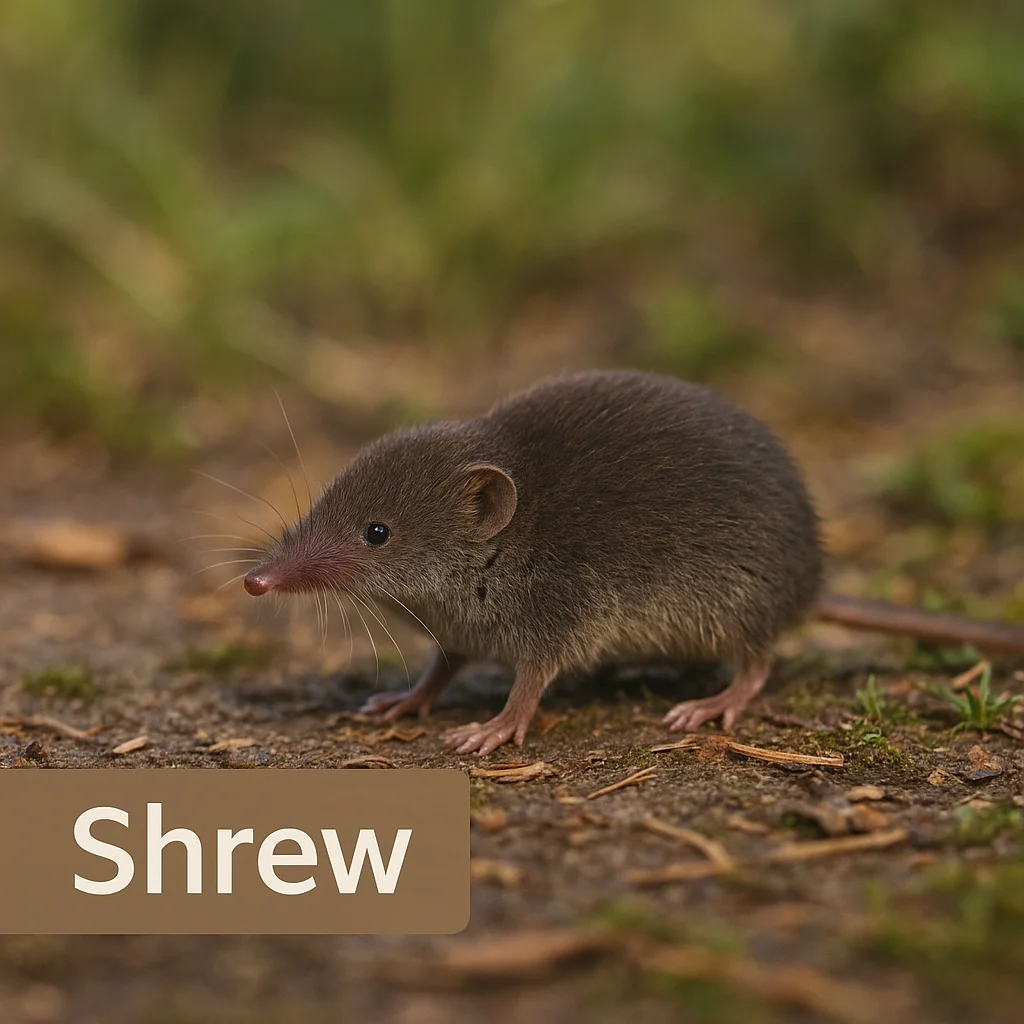
- Common name(s): Shrew
- Scientific name: Varies by species; includes families Soricidae and Talpidae
- Animal type: Mammal
- Typical adult size: 5–15 cm in length, 2–50 grams in weight
- Typical lifespan: 1–2 years in the wild
- Diet type: Carnivore; primarily insects and other invertebrates
- Activity pattern: Nocturnal or crepuscular
- Social structure: Generally solitary
- Speed / movement highlights: Quick and agile; capable of rapid bursts of speed
- Intelligence/learning: Known for their acute senses rather than complex learning
- Primary habitats: Forests, grasslands, wetlands
- Geographic range: Found on most continents except Antarctica
- Predators/threats: Birds of prey, snakes, cats, habitat loss
- Conservation status: Varies by species; generally not endangered
🔍 Identification & Appearance
Shrews are often mistaken for mice due to their small size, but they are characterized by their elongated snouts, tiny eyes, and short limbs. Most shrews have velvety fur that is usually brown or gray, though coloration can vary. Their sharp teeth, which are essential for an insectivorous diet, are another distinguishing feature.
- Small, mouse-like body with an elongated snout
- Tiny, beady eyes almost covered by fur
- Velvety fur typically in brown or gray shades
- Slightly hairy tail usually shorter than body
- Sharp, pointed teeth well-suited for eating insects
- Active, skittish movement behavior
- High-pitched ultrasonic sounds used for echolocation in some species
- Scat is tiny, pellet-like, often found near feeding areas
- Tend to leave small, quick-moving tracks without a visible tail mark
🧱 Body Structure & Physical Adaptations
The shrew's small, slender build allows it to navigate through dense vegetation and burrows with ease. Adaptations include sharp incisors for slicing through exoskeletons of insects, and some possess venomous saliva to subdue prey. Shrews also have exceptional hearing and smell, which helps compensate for their limited vision.
- Slender body adapted for quick, agile movement
- Sharp, pointed incisors for insect predation
- Some species have venomous saliva
- Excellent sense of smell for locating food
- Acute hearing aids in navigation and prey detection
- Permanent, continuously growing teeth suited for constant gnawing
- Short limbs facilitate rapid underground movement
- Dense fur provides insulation against cold environments
🌍 Range & Distribution
Shrews are widely distributed and can be found in many climates and regions worldwide, including North America, Europe, Asia, and Africa. They inhabit areas from sea level up to alpine habitats and are most abundant in temperate and boreal zones.
- Widely found in North and South America, Europe, Asia
- Absent in Australia and polar regions
- Reside in environments from tropical rainforests to tundra
- Often occupy diverse biomes like forests, grasslands, wetlands
- Prefer lowlands and hills but some species adapt to higher altitudes
- Generally non-migratory, with home ranges correlated with food availability
🏞️ Habitat & Shelter
Shrews are versatile in their habitat preferences, often found in moist environments that support abundant invertebrate life. They typically seek out shelters such as leaf litter, underground burrows, and dense vegetation to avoid predators and harsh weather conditions.
- Thrives in forests, grasslands, and wetlands
- Prefer areas with rich leaf litter and dense ground cover
- Create burrows for shelter and breeding
- Adapt to seasonal changes with varying activity levels
- Habitat choice directly influences diet and reproductive success
🧭 Behavior & Ecology
Shrews exhibit frantic, high-energy behavior due to their rapid metabolism. They are primarily solitary, using high-pitched sounds to communicate. Shrews may compete with rodents for food but serve as crucial predators of insects, playing a significant ecological role.
- Constantly foraging due to high metabolic rate
- Emit ultrasonic calls for echolocation
- Solitary nature with limited territorial interactions
- Compete with mice and voles for resources
- Insect control; crucial to limiting pest populations
- Active year-round, less visible in winter due to hibernation
- Display stress-related behavior when threatened
👥 Social Life & Group Dynamics
Despite their solitary lifestyle, shrews exhibit some social interactions, especially during the breeding season. Social hierarchies are generally absent due to their isolationist tendencies, and they seldom form groups except temporarily for mating purposes.
- Mostly solitary, territorial individuals
- Vocalizations used to mark territory briefly
- Occasional pairing during the breeding season
- Lack of cooperative behavior in hunting or childcare
- No structured hierarchy due to mostly solitary existence
- Display territorial aggression if territories are encroached
🍽️ Diet, Prey & Predators
Shrews consume a varied diet of worms, insects, slugs, and small vertebrates. They employ acute senses to detect prey. Predators include birds of prey, snakes, and small mammals, which shrews evade through agility and hiding in dense foliage.
- Feeds on insects, worms, slugs, and small vertebrates
- Flexible diet adapts to seasonal availability of prey
- Uses venomous bite to immobilize prey
- Avoids predation through quick reflexes and burrow use
- Utilizes acute senses of smell and hearing for hunting
- Scavenging behavior uncommon
- Primarily a predator of pests and beneficial insects alike
🦌 Hunting, Foraging & Movement
Shrews are energetic foragers, actively moving about in search of food due to their high metabolic demands. They employ ambush and pursuit strategies and navigate with finely tuned senses of smell and hearing to maintain effective hunting routines.
- Agile forager with quick movement
- Primarily nocturnal or crepuscular hunting activity
- Relies on smell and sound for prey detection
- Uses rapid tunneling and above-ground shadowing to forage
- Able to cover considerable ground searching for food
- Resilient navigational skills even without site fidelity
- Displays surprising bursts of speed relative to size
🧠 Intelligence & Senses
Shrews rely on their sharp senses rather than cognitive complexity. They have developed highly sensitive hearing and proficient olfactory abilities to detect prey and avoid predators, making them adept navigators of their environments despite limited learning abilities.
- Relies on acute sense of smell for environmental navigation
- Highly developed hearing aids in echolocation and communication
- Limited visual acuity; mostly depend on other senses
- Displays basic problem-solving and spatial memory
- Adapts behaviors for survival in varied environments
- Data on shrew learning and intelligence is limited
🪺 Reproduction, Pregnancy & Parenting
Shrews typically breed during warmer months, often resulting in several litters per year. Mating systems vary between species, with females usually responsible for nesting and rearing the young. The gestation period is short, leading to rapid offspring development.
- Breed primarily in spring and summer
- Mating systems can vary; often polygynous
- Gestation typically around 20–30 days
- Litters average 4–8 young, born altricial
- Females provide sole parental care, with no male involvement
- Young develop quickly, weaned in a few weeks
- Nesting occurs in burrows or similar sheltered spaces
♀️♂️ Male vs Female Differences
Sexual dimorphism in shrews is subtle, with males sometimes slightly larger than females, but differences in behavior, appearance, or roles are not overtly pronounced. Breeding-related behaviors can vary between genders.
- Males can be slightly larger and heavier
- Females exhibit nesting and caregiving behaviors
- Mating roles can exhibit differences, males often more mobile
- Overall, minimal sexual dimorphism in physical traits
- Some morphological size variations may exist between different regions or species
🧬 Subspecies & Variation
Diverse, with many species exhibiting variations in size, color, and ecological adaptations across regions. Variations such as smaller size in island or colder climates are observed. However, taxonomic classification is complicated and debated.
- Extensive variation in size and color across species
- Island dwarfism observed in some isolated populations
- Differences in fur density and thickness align with climate adaptation
- Ongoing debate on species and subspecies classification
- Local adaptations significant to mobility and foraging behavior
- Complex taxonomy reflects evolutionary divergence
⚠️ Threats, Conservation & Human Interaction
Shrews face threats from habitat destruction and pollution, as well as natural predation. They are relatively resilient given their broad range but require intact ecosystems to thrive. Conservation efforts should focus on habitat preservation and pollution mitigation.
- Primary threat from habitat degradation and fragmentation
- Column prey for domestic cats, birds of prey, and snakes
- Pollution impacts waterways, directly affecting habitats
- Resilience seen in broad, adaptable distributions
- Conservation actions focus on preserving natural habitats
- Coexistence strategies include mitigating pollution and habitat protection
✨ Fun Facts & Unique Traits
- Some shrew species are among the smallest mammals on earth
- Shrews must eat constantly due to their rapid metabolism
- Known for venomous saliva in some species, rare for mammals
- Often consume 1-2 times their body weight daily
- Some species have toxic enough saliva to kill small rodents
- Shrews can starve if deprived of food for just a few hours
- Exceptional echolocation skills despite their size
- Ability to dig extensive burrow systems adds to their survival
📌 Summary
- Shrews are small, mammal insectivores with an expansive global presence.
- Identification can be tricky due to similarities with small rodents, but features like elongated snouts and velvety fur distinguish them.
- Adaptable to habitats from forests to grasslands, leveraging acute senses to thrive.
- Solitary, relying on impressive hunting prowess and metabolic demands to shape their daily activities.
- They play a critical role as predator within their ecosystems.
- Reproduction involves high birth rates to offset their short lifespans and harsh predation pressures.
- Limited sexual dimorphism, mostly evident in size differences.
- Diversity across species is marked by ecological and physical adaptation according to environmental pressures.