🦁 Prairie Dog
🧾 Quick Facts
Prairie dogs are small, burrowing rodents native to North America's grasslands. They are known for their complex social structures and vocal communication.
- Common name(s): Prairie Dog
- Scientific name: Cynomys (varies by specific species)
- Animal type: Mammal
- Typical adult size: 12-16 inches in length, including tail; weight ranges from 1-3 pounds
- Typical lifespan: 3-5 years in the wild; longer in captivity
- Diet type: Herbivore; grasses, roots, seeds, and occasionally insects
- Activity pattern: Diurnal
- Social structure: Highly social, living in colonies known as towns
- Speed / movement highlights: Capable of short sprinting bursts; mostly seen bounding and scampering
- Intelligence/learning: Known for complex vocalizations and social interactions
- Primary habitats: Grasslands and open prairies
- Geographic range: Central North America
- Predators/threats: Hawks, coyotes, badgers; human-induced threats include habitat destruction
- Conservation status: Varies by region; some species are of conservation concern
🔍 Identification & Appearance
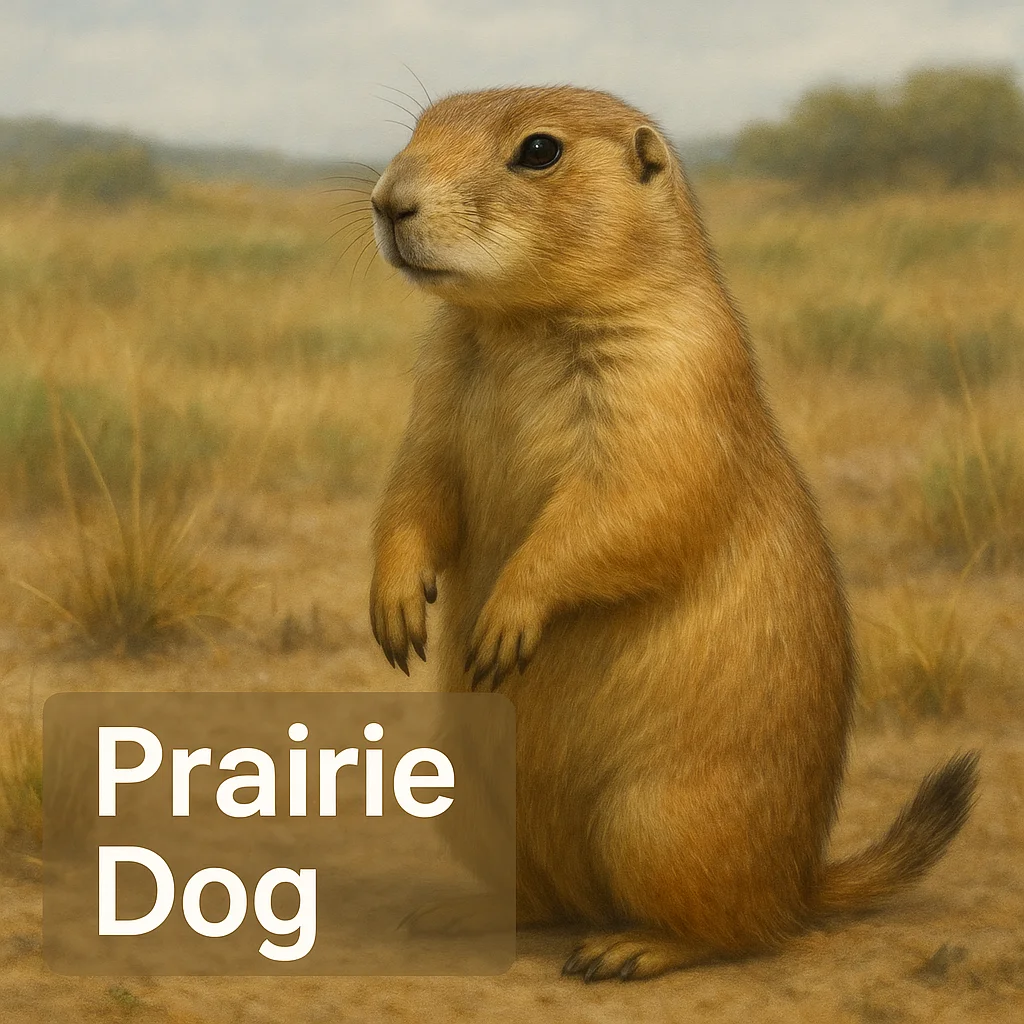
Prairie dogs have a distinctive short, stocky build with brown or tan fur that helps them blend into their grassland environments. They have small, rounded ears and short limbs adapted for digging. Their eyes are set high on their heads, offering a wide field of view to spot predators.
- Body shape: Short and stocky
- Fur color: Generally brown/tan with lighter underbellies
- Distinctive features: Short, bushy tail; long claws for digging
- Tracks: Small, with prominent claw marks
- Common look-alikes: Ground squirrels; differentiated by tail position and movement patterns
- Top ID Tips
- Look for colonies known as "towns" with visible burrow entrances
- Observe short, stocky bodies and short tails
- Identify by distinctive warning calls
- Note large, prominent eyes for spotting predators
- Look for dirt mounds around burrow entrances
- Understand the difference between prairie dogs and similar rodents like ground squirrels
🧱 Body Structure & Physical Adaptations
Prairie dogs exhibit robust physical adaptations that support their burrowing lifestyle. Their strong hind limbs enable rapid movement across open terrain, while their forelimbs are equipped with long, sharp claws for digging. Their dental structure is optimized for a herbivorous diet, with sharply edged incisors for slicing through tough grasses.
- Key Adaptations
- Sharp claws for efficient digging
- Strong hind limbs for quick movement
- Large incisors for cutting vegetation
- High-set eyes for spotting predators at a distance
- Flat molars for grinding plant material
- Compact bodies suited for subterranean environments
- Sturdy neck and shoulder muscles for burrow maintenance
🌍 Range & Distribution
Prairie dogs primarily inhabit the central plains of North America. Their range extends across expansive grassland regions from southern Canada down through the central United States and into northern Mexico. They prefer relatively flat terrain where they can dig extensive burrow systems.
- Where You Might Find It
- Great Plains of North America
- Grasslands from Canada to Mexico
- Flat, open fields and prairies
- Regions with sparse vegetation and loose soil
- Conservation reserves and protected sites
🏞️ Habitat & Shelter
Prairie dogs are predominantly found in grassland ecosystems where they construct elaborate burrow systems. These burrows provide shelter from predators and extreme weather, while also functioning as nursery sites for young. The structure and location of their burrows play a crucial role in their survival as they offer protection and house the social units within a colony.
🧭 Behavior & Ecology
Prairie dogs display a range of fascinating behaviors that emphasize their social nature. They are active mainly during the day when they engage in foraging and social interactions. Communication is key in their societies, with a series of vocalizations used to warn others of approaching danger. Prairie dogs play an important ecological role as ecosystem engineers. Their burrowing activities can modify landscape features, which influences the local biodiversity.
- Behavior Highlights
- Daytime activity with peak foraging in early morning and late afternoon
- Complex warning calls and vocalizations
- Co-habitation with other burrowing species
- Altruistic behavior, with individuals raising alarm to protect colony
- Territoriality established through scent marking and vocal threats
👥 Social Life & Group Dynamics
Prairie dogs are highly social animals that live in large colonies, also known as towns. These colonies are structured into family groups called coteries, which include one or two males, several females, and their offspring. Cooperation is essential for various tasks, such as sentry duty and raising young. Within colonies, prairie dogs display intricate social interactions and maintain complex social hierarchies.
- Social Structure Notes
- Colonies can consist of hundreds of individuals
- Family units are called coteries
- Sentry duty is shared among members for predator detection
- Greeting behavior includes "kissing" to confirm identity
- Displays a hierarchal structure within communities
🍽️ Diet, Prey & Predators
Prairie dogs are primarily herbivorous, feeding on a variety of grasses, roots, and seeds. Their diet changes with the seasons as different plants become available. Despite being herbivores, prairie dogs face numerous natural predators, including birds of prey, coyotes, and badgers. They depend on their burrows and vigilant sentries to avoid predation.
- Feeding Notes
- Mostly feed on grasses and small plants
- Occasionally consume insects
- Adapt feeding habits with seasonal plant availability
- Storing food is uncommon, largely consuming fresh forage
- Engage in extensive foraging trips during the day
🦌 Hunting, Foraging & Movement
Prairie dogs are not hunters but skilled foragers. They spend much of their day searching for food in the grasslands. They communicate and coordinate activities such as lookout duties to protect one another from predators, allowing them to forage more effectively. Their movement is mainly quadrupedal, moving rapidly in short bursts to escape threats.
- Movement & Strategy
- Move in short bursts when escaping predators
- Travel across open grasslands to forage
- Reliance on cooperative vigilance for safety during foraging
- Avoid long-distance travel; stay close to burrows
- Navigate via scent trails and visual landmarks
🧠 Intelligence & Senses
Prairie dogs are intelligent animals, reflected in their complex communications and social organizations within colonies. Their senses are acute, particularly their vision which is adapted to detect predators at great distances. They communicate using a sophisticated system of vocalizations that can convey detailed information about dangers encountered.
- Notable Abilities
- Complex alarm call systems to indicate different predators
- Able to remember specific locations and paths within large colonies
- Possess acute vision optimized for detecting threats
- Use of body postures to communicate mood and intentions
- Research suggests the presence of a rudimentary syntax in their calls
🪺 Reproduction, Pregnancy & Parenting
Breeding in prairie dogs typically occurs once a year, with mating systems varying slightly among species. After a gestation period of approximately 30-35 days, females give birth to a litter of three to eight young. Newborns are altricial and require significant parental care, primarily provided by the mother, though communal rearing among close females is not uncommon.
- Reproduction Snapshot
- Breeding season in late winter to early spring
- Mating systems largely polygynous
- Gestation lasts about 30-35 days
- Litter size ranges from 3 to 8 pups
- Young emerge from burrows after approximately 6 weeks
- Mother responsible for primary care and feeding
♀️♂️ Male vs Female Differences
While male and female prairie dogs appear similar, males are generally larger with slightly more robust builds. Behavioral differences exist, especially in terms of territorial defense; males are more active in maintaining and defending territories. Female prairie dogs primarily focus on rearing young and managing social bonds within coteries.
- Sex Differences at a Glance
- Males typically larger than females
- Males play a larger role in territorial defense
- Females central to social dynamics of coteries
- Seasonal weight fluctuation more pronounced in males
🧬 Subspecies & Variation
Prairie dogs are divided into five species: black-tailed, white-tailed, Gunnison's, Utah, and Mexican prairie dogs. Each species exhibits variation in physical characteristics, such as tail color, and is adapted to slightly different habitats. The classification of these subspecies is crucial for conservation planning, as some are more threatened than others.
- Variation Notes
- Black-tailed prairie dogs are the most widespread
- Gunnison's prairie dogs often found at higher elevations
- White-tailed and Utah prairie dogs are more localized
- Subspecies exhibit differences in habitat preferences
- Physical distinctions include variations in tail and fur coloration
⚠️ Threats, Conservation & Human Interaction
Prairie dogs face various threats, such as habitat destruction due to agriculture and urban development. They are sometimes considered pests, which can lead to extermination efforts. Conservation measures focus on habitat preservation and management. Prairie dogs are crucial to their ecosystems, and their protection can support biodiversity conservation efforts.
- Responsible Notes
- Habitat destruction poses a major threat
- Subject to pest control measures in some regions
- Protected areas are crucial for their conservation
- Serve as a keystone species, impact on local biodiversity
- Encouraged coexistence through understanding ecological role
✨ Fun Facts & Unique Traits
- Prairie dogs are named for their warning calls, which sound similar to a dog's bark.
- They can communicate detailed information about specific predators through their calls.
- Burrow systems can be extensive, with multiple entrances and chambers.
- Their digging activities can increase local plant diversity by aerating the soil.
- They help support other species, providing burrows for animals like owls and snakes.
- Prairie dogs were once so numerous that early settlers described vast "dog towns" visible for miles.
- They can often be seen performing a "jump-yip" together, a behavior often involving many members of a colony.
📌 Summary
- Recognized for short, stocky build with brown/tan fur.
- Inhabit grasslands and construct complex burrow systems.
- Wide range across Central North America in open prairies.
- Primarily herbivorous, foraging during the day.
- Face predation from hawks, coyotes, and other carnivores.
- Live in large colonies with complex social interactions.
- Breeding occurs once yearly, with litters averaging 3-8 young.
- Key adaptations include burrowing efficiency and complex communication.
- Vital role as ecosystem engineers; impact extends beyond their presence.