🦁 Nine-banded Armadillo
🧾 Quick Facts
The Nine-banded Armadillo, recognized by its distinctive shell and digging habits, is an intriguing mammal found across the Americas. These unique creatures are known for their armor-like bony plates and their ability to dig with remarkable speed.
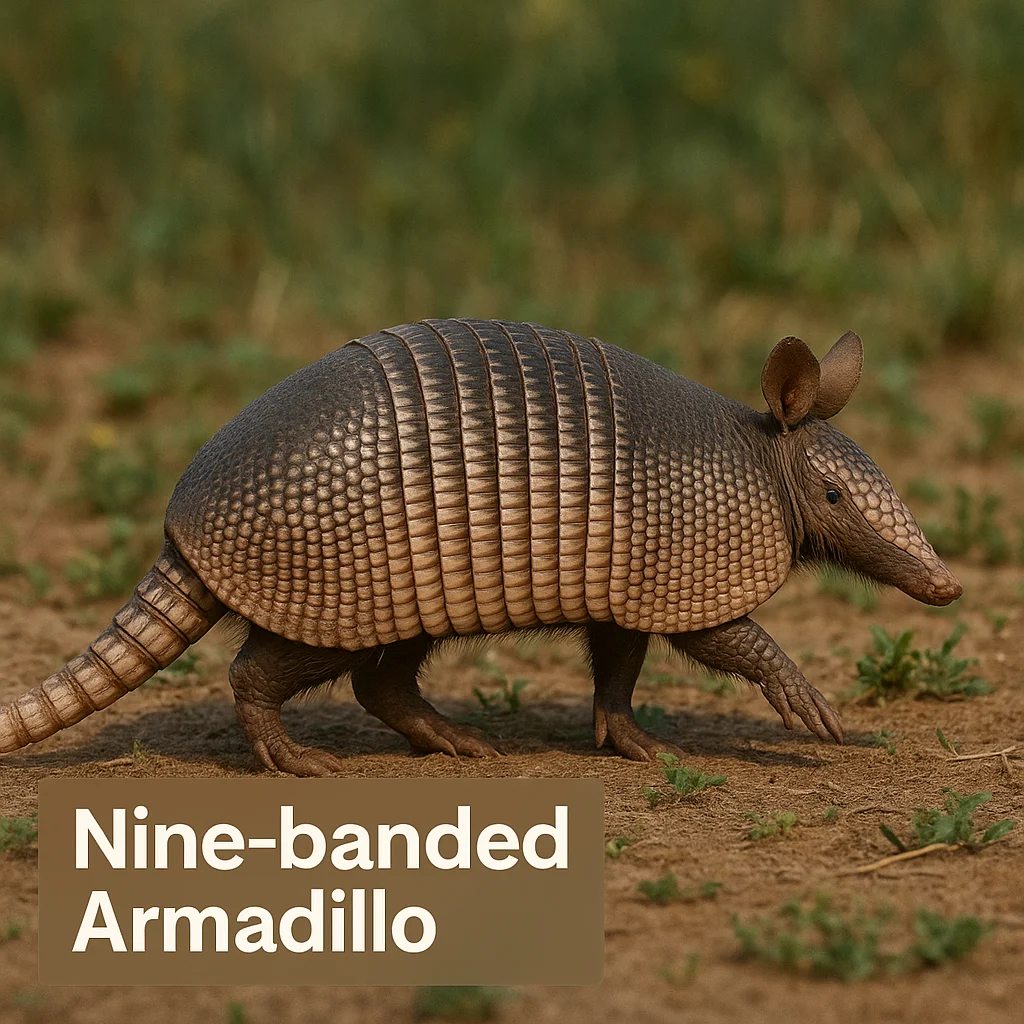
- Common Name(s): Nine-banded Armadillo
- Scientific Name: Dasypus novemcinctus
- Animal Type: Mammal
- Typical Adult Size: 15 to 23 inches (38 to 58 cm) in length, 9 to 13 pounds (4 to 6 kg) in weight
- Typical Lifespan: 7 to 20 years in the wild, up to 23 years in captivity
- Diet Type: Omnivore; feeds on insects, grubs, small vertebrates, and plants
- Activity Pattern: Nocturnal
- Social Structure: Solitary
- Speed / Movement Highlights: Effective digger and can run at speeds of up to 30 miles per hour (48 km/h)
- Intelligence/Learning: Capable of simple problem-solving; relies heavily on memory for navigation
- Primary Habitats: Grasslands, forests, semi-deserts
- Geographic Range: Central and South America, especially in the United States as far north as Nebraska
- Predators/Threats: Coyotes, bears, bobcats, and domestic dogs; habitat loss and vehicle collisions
- Conservation Status: Least Concern, but varies by region
🔍 Identification & Appearance
The Nine-banded Armadillo is immediately recognizable due to its plate-like armor and long snout. The body shape is elongated with a low stance, and its armor consists of 9 flexible bands. The upper body is covered in a dark brown, leathery shell with pale yellowish bands. They have short, strong legs equipped with claws optimized for digging.
- Head-to-tail view shows distinct armored bands
- Rough, bony shell with a leathery texture
- Pointed snout and relatively large ears for detecting predators
- Four toes on the front feet, five on the back with prominent claws
- Greyish-brown coloration, lighter underparts
- The underside lacks bony protection
- Tracks show toe and claw marks; scat is cylindrical
🧱 Body Structure & Physical Adaptations
The Nine-banded Armadillo has a unique body structure that allows it to adapt to various environmental challenges. Its strong, stocky build and muscular limbs make it an excellent digger, capable of burrowing quickly into the ground.
- Compact build with robust muscle structure
- Jaws contain peg-like teeth for crushing insects
- Large claws are well-adapted for digging and tearing open ant hills
- Sharp sense of smell helps in finding food and navigating in the dark
- Poor eyesight, relies on olfactory and auditory cues
- Bony shell acts as a defense against predators
🌍 Range & Distribution
The Nine-banded Armadillo is found in a wide range of environments across the Americas, from Argentina to the southern United States. It prefers regions that offer both protective cover and abundant food supply.
- North and Central America, from the United States to Argentina
- Thrives in tropical and subtropical regions
- Common in temperate and semi-arid climates
- Found at elevations from sea level to 1000 meters
- Largely non-migratory, but expanding northward
🏞️ Habitat & Shelter
The Nine-banded Armadillo favors areas with soft, moist soil that is easy to dig, such as forests, shrublands, and grasslands. Burrowing is a key survival strategy, providing shelter and protection from predators and extreme weather.
In regions with distinct wet and dry seasons, armadillos may dig deeper burrows to maintain moisture and temperature levels.
🧭 Behavior & Ecology
The Nine-banded Armadillo is primarily active at night, when it forages for food. Its foraging behavior involves a lot of digging to unearth insects and small prey. During the day, they rest in burrows dug into the soil.
Communication is largely silent, relying on scent markings and the occasional grunt or squeak. They have a solitary nature, but during the breeding season, males may be seen together with females briefly.
- Primarily nocturnal, foraging at night
- Resting and sheltering in burrows during the day
- Occasionally vocal, with simple sounds
- Plays a role in ecosystem as insectivore and seed disperser
👥 Social Life & Group Dynamics
The Nine-banded Armadillo is mostly solitary outside of the breeding season. These animals are territorial and maintain individual burrows. They do not form groups, but females raise young alone, demonstrating limited social interaction.
- Solitary except during mating
- Females rear offspring independently
- Non-social; lack of cooperative behavior
- Defend territory primarily through avoidance
🍽️ Diet, Prey & Predators
As omnivores, Nine-banded Armadillos enjoy a varied diet. They primarily consume insects, larvae, and earthworms, but also eat fruits, plants, and small vertebrates. Natural predators include large carnivores such as coyotes and bobcats.
- Feeds mostly on invertebrates and small vertebrates
- Includes plants and fruit in their diet
- Uses claws to excavate food from the ground
- Natural camouflage and burrowing serve as defenses
🦌 Hunting, Foraging & Movement
The Nine-banded Armadillo is an adept forager, using its acute sense of smell to locate food. It moves at a moderate trot when foraging but can run quickly to evade predators. Burrowing is both for finding food and creating shelter.
Navigation within their home range is an important aspect of their movement, primarily relying on olfactory landmarks to guide them.
- Forages by sniffing out prey, digging extensively
- Capable of ~30 mph speed in short bursts
- Utilizes keen olfactory sense for navigation
- Primarily stays within established home ranges
🧠 Intelligence & Senses
Armadillos, including the Nine-banded variety, possess a moderate level of intelligence, adept primarily in tasks requiring memory and navigation. Their best-developed sense is smell, which aids them in both locating food and navigating their environment.
- Strong memory, aiding in territory navigation
- Developed olfactory sense crucial for locating prey
- Vision is relatively weak
- Rudimentary problem-solving skills observed
🪺 Reproduction, Pregnancy & Parenting
The Nine-banded Armadillo practices a unique reproductive strategy called "delayed implantation," ensuring the birth of offspring during favorable environmental conditions. Breeding occurs once annually, with females giving birth to quadruplets—four genetically identical young—after a gestation period of approximately four months.
- Breeding season varies by region
- Typically monogamous during breeding period
- Produces litters of four identical young
- Females solely responsible for rearing
♀️♂️ Male vs Female Differences
In Nine-banded Armadillos, sexual dimorphism is subtle. Males and females generally appear similar in size and coloration. However, minor differences in behavior can be noted, particularly during the breeding season.
- Males slightly larger on average
- Behavioral differences mostly during mating
- Both sexes have similar coloration and armor
🧬 Subspecies & Variation
While subspecies classification in Nine-banded Armadillos is not widely debated, some regional variations exist in size and coloration, influenced by environmental factors such as habitat and temperature.
- Generally consistent features across regions
- Some variability in size, dependent on geography
⚠️ Threats, Conservation & Human Interaction
The major threats to Nine-banded Armadillos are human-related, including habitat destruction, vehicular accidents, and hunting. Fortunately, their population is stable, and they are classified as Least Concern by conservation bodies. Responsible human-armadillo interaction involves respecting their natural habitats and not encouraging domestication.
- Subject to habitat destruction due to agriculture
- Common roadkill victim
- Hunted for their meat in some regions
- Important to ensure conservation efforts are habitat-focused
✨ Fun Facts & Unique Traits
- Nine-banded Armadillos can hold their breath for up to six minutes while submerged
- Known to jump vertically when startled
- They can swim by inflating their intestines for buoyancy
- Armadillos are the only mammals that give birth to identical quadruplets, a unique reproductive trait
- Their bony plates are covered by a layer of tough skin
📌 Summary
- Recognizable by its unique armored shell with 9 bands
- Found throughout the Americas, favoring warm climates
- Largely nocturnal and solitary by nature
- Omnivorous diet predominantly consists of insects
- Faces threats from predation and human activity
- Reproduction involves unique delayed implantation
- Adapts to a range of environments with proficient digging skills
- Stable population, classified as Least Concern