🦁 Muskrat
🧾 Quick Facts
The muskrat is a semi-aquatic rodent known for its adaptability and resilience in wetland habitats. They are commonly mistaken for other aquatic mammals but hold their unique niche in the ecosystem.
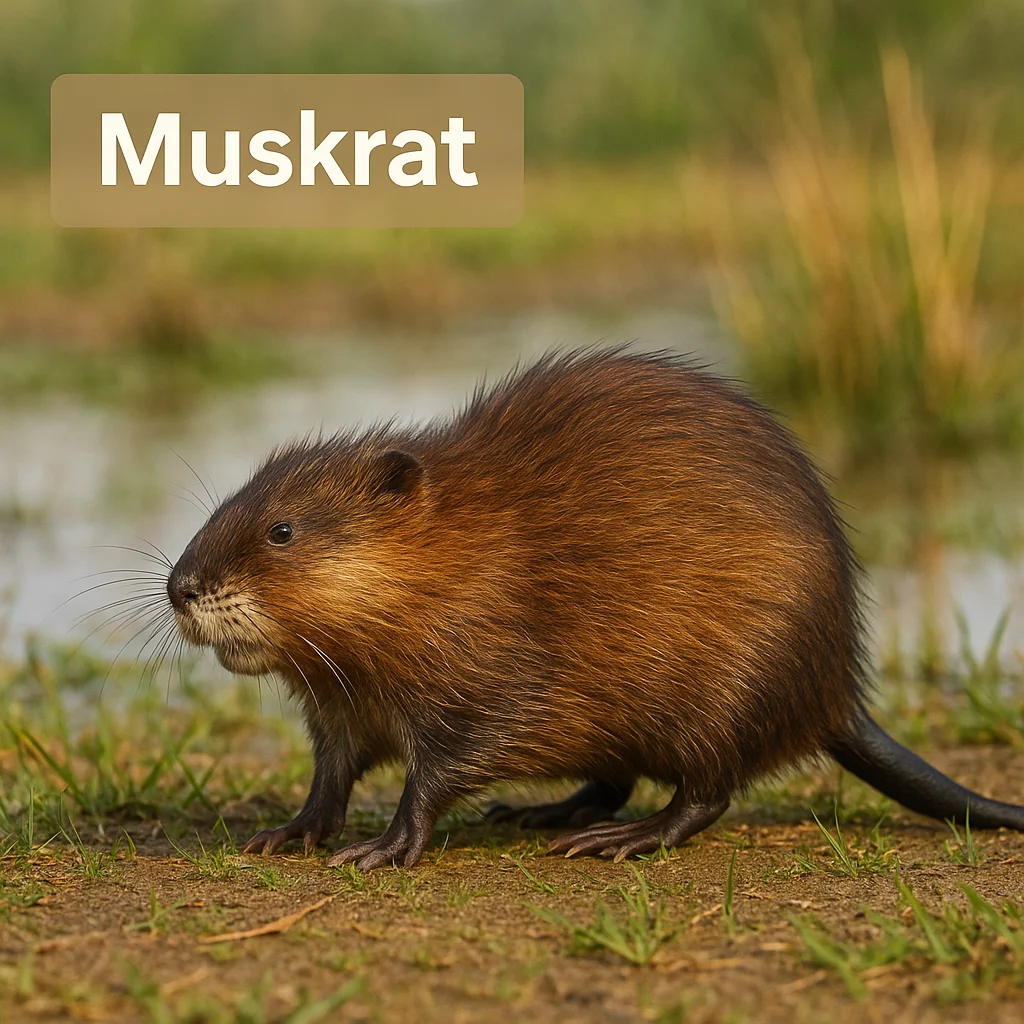
- Common name(s): Muskrat
- Scientific name: Ondatra zibethicus
- Animal type: Mammal
- Typical adult size: 40–60 cm in length, including the tail; weight 0.7–1.8 kg
- Typical lifespan: 3–4 years in the wild
- Diet type: Primarily herbivorous, occasionally omnivorous; consumes aquatic plants, roots, and small animals
- Activity pattern: Crepuscular and nocturnal
- Social structure: Generally solitary, except during the breeding season
- Speed / movement highlights: Effective swimmer, can remain submerged up to 15 minutes
- Intelligence/learning: Adapts to environment changes through learned behaviors
- Primary habitats: Wetlands, lakes, and riverbanks
- Geographic range: Widely distributed in North America, introduced to parts of Europe and Asia
- Predators/threats: Birds of prey, larger mammals, water pollution, and habitat destruction
- Conservation status: Least Concern, though varies by region
🔍 Identification & Appearance
Muskrats have a compact, robust body appearance with a noticeable long, laterally compressed tail that aids in swimming. Their dense fur is usually brown in color with a lighter underbelly, serving as good camouflage in water-based environments.
Muskrats have small, rounded ears and a blunt snout, distinguishing them from other semi-aquatic mammals like the beaver, which is generally larger and has a more flattened tail.
- Robust, compact body shape
- Brown fur with a light underbelly
- Lateral flat tail (not rounded like a beaver's)
- Small, rounded ears
- Blunt snout distinct from a rat
- Webbed hind feet for swimming
- May emit a musky odor
- Tracks show webbed feet with visible claws
🧱 Body Structure & Physical Adaptations
The muskrat's body is built for an aquatic lifestyle. It has webbed hind feet that help propel it through water, and a dense fur coat that provides insulation while submerged. Its front feet are adapted to manipulating food and building burrows.
Muskrats have a specialized jaw structure with ever-growing incisors suited for gnawing on hard plant material. Their eyes, ears, and nostrils are adapted for wet environments, allowing them to close while underwater.
- Stocky build with webbed hind feet
- Dense fur for insulation
- Long, laterally flattened tail for stability in water
- Strong incisors for gnawing
- Adapted vision and breathing for underwater activity
- Sensitive whiskers for detecting food
- Musky gland secretions for marking territory
- Flexible spine aids in maneuverability
🌍 Range & Distribution
Muskrats are native to North America, ranging from northern Canada to the southern United States. Due to introductions, they are also now found in parts of Europe and Asia. They inhabit freshwater wetlands and are extremely adaptable to different environments.
- Common in North America
- Introduced in northern Europe
- Found in Asian wetlands also
- Primarily in freshwater environments
- Adapt to mangroves and marshy areas
- Lowland habitats preferred
- Does not migrate seasonally
🏞️ Habitat & Shelter
Muskrats prefer wetlands such as marshes, lakes, and slow-moving streams. They typically build lodges out of vegetation and mud on the water, providing protection from predators and weather extremes. These structures also serve as breeding and feeding places.
Seasonal changes influence the muskrat's activity; during colder months, they tend to remain more secluded within their lodges.
🧭 Behavior & Ecology
Muskrats are known for their resourcefulness. They are primarily active during twilight hours and at night, engaging in grooming and feeding activities. Their communication involves vocalizations like squeaks and squeals, as well as movements and musky scent markings.
Muskrats play a significant ecological role by influencing aquatic plant dynamics and providing food for predators. They are also known to create channels that facilitate water movement in marshy areas.
- Active at dusk and night
- Construct burrows and lodges
- Groom regularly to maintain fur
- Use squeals and scent for communication
- Important prey for many predators
- Facilitate plant growth in wetlands
- Capable of altering aquatic ecosystems
- Protect against aquatic predators using underwater entrances
👥 Social Life & Group Dynamics
While generally solitary, muskrats come together during the breeding season. They establish territories which they vigorously defend from intruders. Communication between muskrats is essential for maintaining these territories and involves vocalizations, scent markings, and physical displays.
There are no significant cooperative behaviors outside of the necessary pair bonding for rearing young.
- Mainly solitary outside breeding
- Territorial with clear boundaries
- Display hierarchical dominance in territories
- Limited social interactions
- Pairs form only for reproduction
- Young disperse after weaning
🍽️ Diet, Prey & Predators
Muskrats primarily feed on aquatic vegetation such as cattails, water lilies, and sedges. In scarce times, they will include small aquatic animals like insects or mussels in their diet. Muskrats face predation from larger aquatic mammals, raptors, and even humans.
- Prey on aquatic plants
- Seasonal diet variation
- Consume small animals occasionally
- Utilize night feeding to avoid predators
- Store food in caches for winter
- Raptors and larger animals are main predators
- Use water as escape route
- Camouflage aids in predator avoidance
🦌 Hunting, Foraging & Movement
As proficient swimmers, muskrats forage for food primarily in aquatic environments. They build strategic paths or tunnels in wetlands to access food sources such as aquatic plants efficiently.
Muskrats are not known for speed on land but utilize their exceptional swimming abilities to escape threats and navigate their water-based habitats.
- Water-based foragers
- Construct tunnels for easy movement
- Predominantly nighttime foragers
- Efficient swimmers
- Remain submerged to avoid predators
- Adapt movement patterns to season
- Create clear paths in dense vegetation
🧠 Intelligence & Senses
Although not particularly known for problem-solving skills, muskrats display intelligent behaviors in resource finding and adaptation to environmental changes. Their senses, particularly touch and hearing, are highly developed, preparing them for nocturnal and semi-aquatic life.
- Adept at nest-building
- Sensitivity to environmental changes
- Strong sense of smell and hearing
- Use whiskers to detect objects
- Limited visual acuity
- Quick learners in familiar environments
- Observation-based environmental responses
🪺 Reproduction, Pregnancy & Parenting
Muskrats typically breed in late spring into summer, with a polygamous mating system. Females can have 2–3 litters per season, with gestation lasting about 28–30 days. Litters include 4–8 kits, which are born blind and helpless.
Parental care is significant in early life stages, with females being primary caregivers. Young muskrats are weaned after about a month and become independent soon after.
- Breeds in spring/summer
- Multiple litters per season
- Gestation: 28–30 days
- Litters of 4–8 kits
- Female-dominant caregiving
- Kits born altricial
- Weaned at 30 days
- Independent post-weaning
♀️♂️ Male vs Female Differences
Muskrats show slight sexual dimorphism, with males generally being slightly larger. Behavioral differences manifest during the breeding season when males can display more territorial aggression.
- Males slightly larger than females
- Males may be more territorial
- Both sexes participate in territory establishment
- Females lead in nesting
- Males do not contribute to parental care
🧬 Subspecies & Variation
There are several subspecies of muskrats, generally varying by region and habitat. Physical differences are primarily in fur color and size. However, significant genetic research is limited, and some classifications are debated.
- Regional subspecies vary by size
- Fur color varies with habitat
- Climate adaptations observed
- Little genetic data available
- Subspecies classification debated
- Northern populations are slightly larger
⚠️ Threats, Conservation & Human Interaction
Muskrats face threats primarily from habitat destruction and water pollution. They are sometimes trapped for fur in certain areas, posing additional risks. Conservation statuses may differ regionally, leaning towards management in naturally-occupied lands.
Human interaction is limited, but promoting healthy wetland ecosystems supports muskrat populations and biodiversity broadly.
- Habitat loss, especially wetland drainage
- Policed for water quality maintenance
- Occasional trapping for fur
- Efforts to preserve wetland habitats
- Introduction to new regions can cause ecological balance issues
- Enhancing local wetland protections beneficial
✨ Fun Facts & Unique Traits
- Muskrats can close their ears to keep water out
- Muskrat cabins can be larger than those of some beavers
- The muskrat is a symbol in Native American mythology
- Muskrats communicate with each other using over a dozen vocal sounds
- They can remain underwater for longer periods compared to most other rodents
- The term "muskrat" comes from their musky scent and rat-like appearance
- In cold regions, they build shelters that trap heat to survive harsh winters
- They have a unique way of gnawing above water, unlike some other aquatic mammals
📌 Summary
- Muskrats are medium-sized, aquatic rodents known for their adaptability.
- Commonly found in North American wetlands, they play a key ecological role.
- They are herbivorous, with a diet centered around aquatic plants.
- Common predators include large birds of prey and certain mammals.
- Muskrats exhibit minimal social interactions outside of the mating season.
- Females are primarily responsible for the care of young muskrats.
- Known for their remarkable swimming abilities and unique lodge-building skills.
- Conservation varies by region, with habitat preservation being crucial for their survival.