🦁 Little Brown Bat
🧾 Quick Facts
The Little Brown Bat, often listed under the scientific name Myotis lucifugus, is a small yet widespread species of bat found in various regions across North America. Known for their agile flying capabilities and nocturnal feeding patterns, these bats play a vital role in controlling insect populations.
- Common name(s): Little Brown Bat, Little Brown Myotis
- Scientific name: Myotis lucifugus
- Animal type: Mammal
- Typical adult size: 3-4 inches in length, weighing approximately 0.2-0.5 ounces
- Typical lifespan: 6-10 years in the wild; up to 20 years in captivity
- Diet type: Insectivore; feeds primarily on flying insects
- Activity pattern: Nocturnal
- Social structure: May be solitary but often roosts in colonies
- Speed / movement highlights: Efficient flyers; capable of rapid, agile maneuvers
- Intelligence/learning: Known for excellent echolocation and spatial memory
- Primary habitats: Forests, wetlands, and urban areas
- Geographic range: North America, primarily in temperate regions
- Predators/threats: Birds of prey, snakes, cats, habitat disturbance
- Conservation status: Varies by region; some populations face threats from white-nose syndrome
🔍 Identification & Appearance
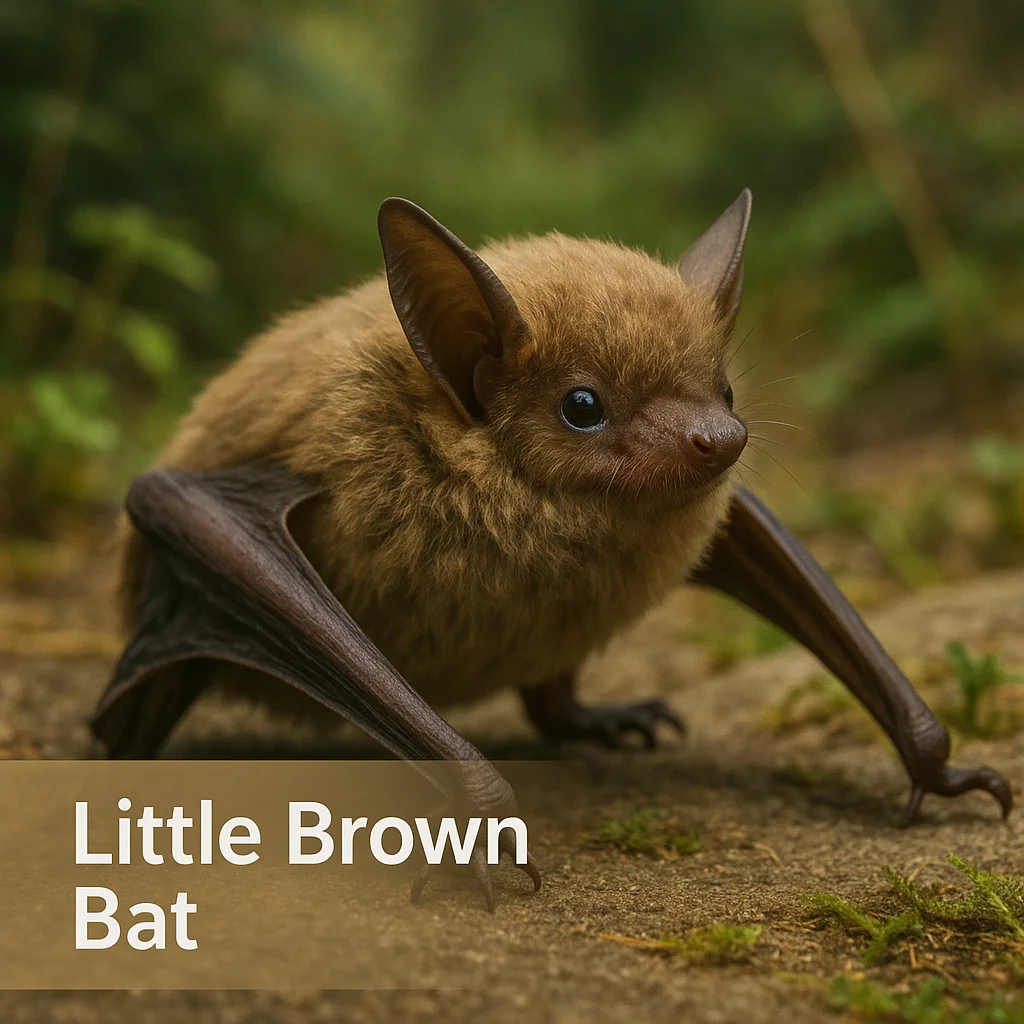
The Little Brown Bat is easily recognized by its small, stocky body and broad wings. Their fur is typically glossy and varies from light brown to nearly black. They have a pointed snout and large, rounded ears that aid in their echolocation.
- Top ID Tips:
- Small, compact body shape
- Brown to dark glossy fur
- Broad, well-developed wings
- Large, rounded ears with tragus
- Pointed snout
- Common roosting in colonies
🧱 Body Structure & Physical Adaptations
The Little Brown Bat is adapted for flight with elongated fingers and a membrane called the patagium stretching between them. Their small teeth are specialized for catching and consuming insects. The keen sense of hearing aids in echolocation for navigation and hunting.
- Key Adaptations:
- Elongated fingers for wing support
- Membrane (patagium) for agile flight
- Sharp, tiny teeth for insect consumption
- Large ears for enhanced echolocation
- Keen spatial awareness
🌍 Range & Distribution
Little Brown Bats are widely distributed across North America, from the northern United States to parts of Canada. They can be found from sea level to higher altitudes, typically in temperate climates.
- Where You Might Find It:
- Deciduous and coniferous forests
- Near bodies of water
- Urban and suburban areas
- Throughout the United States
- Across southern Canada
🏞️ Habitat & Shelter
The Little Brown Bat favors forested areas, especially near water sources, due to their feeding habits. They often seek shelter in tree hollows, buildings, caves, and even attics. Seasonal changes may influence their roosting locations, with hibernation occurring in protected caves and mines during winter.
🧭 Behavior & Ecology
These bats are known for their nocturnal lifestyle, emerging at dusk to hunt. They utilize echolocation to navigate and find prey. Little Brown Bats play a crucial ecological role by consuming large amounts of insects, thus aiding in pest control.
- Behavior Highlights:
- Nocturnal hunting patterns
- Echolocation used for navigation
- Forming roosting colonies
- Insect regulation in ecosystems
- Seasonal hibernation
👥 Social Life & Group Dynamics
While many Little Brown Bats are solitary, they frequently gather in colonies for roosting, particularly during breeding and hibernation seasons. These colonies can number from a few dozen to several thousand individuals.
- Social Structure Notes:
- Forms roosting colonies
- Colony sizes vary significantly
- Some solitary tendencies
- Cooperation in thermoregulation
🍽️ Diet, Prey & Predators
Strictly insectivorous, Little Brown Bats primarily feed on aquatic insects such as flies and moths. They hunt by catching these insects mid-flight using their quick, agile maneuvers. Predation pressures include certain birds, snakes, and terrestrial animals when roosting.
- Feeding Notes:
- Diverse insect diet
- Expert aerial hunters
- Eat significant insect biomass nightly
- Sensitive to prey availability
🦌 Hunting, Foraging & Movement
Renowned for their flight capabilities, Little Brown Bats rely on agility and speed to capture prey. They usually hunt at night when insects are active. Their flight is characterized by swift, acrobatic movements, and they can cover considerable distances in search of food.
- Movement & Strategy:
- Fast, agile flyers
- Nocturnal foraging
- Primarily aerial hunting
- Utilize echolocation for navigation
🧠 Intelligence & Senses
Little Brown Bats possess a highly refined sense of hearing, used in echolocation to navigate and hunt in complete darkness. They demonstrate spatial memory and learning abilities but do not use tools or displays complex social behavior as seen in larger mammals.
- Notable Abilities:
- Exceptional echolocation
- Spatial awareness
- Strong memory for roosting sites
- Adaptable hunting strategies
🪺 Reproduction, Pregnancy & Parenting
The breeding season for Little Brown Bats typically occurs in late summer and early autumn, with females initiating hibernation while pregnant. Gestation lasts about 50-60 days, and females usually give birth to one pup per year. Mothers are solely responsible for feeding and caring for the young, often congregating in maternity colonies.
- Reproduction Snapshot:
- Seasonal breeders
- Females hibernate while pregnant
- One pup per year
- Maternity colonies for nursing
♀️♂️ Male vs Female Differences
There is little sexual dimorphism in Little Brown Bats, meaning males and females appear similar in size and coloration. Behavioral roles may differ slightly, with females forming maternity colonies during the birthing season, while males do not participate in caregiving.
- Sex Differences at a Glance:
- Similar size and appearance
- Maternity colony formation by females
- Independence of males in summer
🧬 Subspecies & Variation
There are several recognized subspecies of the Little Brown Bat, each displaying slight variations in size and coloration. These variations are generally adapted to their specific regional climates and habitats.
- Variation Notes:
- Slight size variations
- Coloration adapted to habitat
- Local climate adaptations
⚠️ Threats, Conservation & Human Interaction
Little Brown Bats face significant threats from human activities, including habitat loss and disturbance, as well as disease, particularly white-nose syndrome. Conservation efforts focus on habitat preservation and studying disease impacts. Coexistence can be encouraged by protecting natural roosting sites and reducing disturbances.
- Responsible Notes:
- Impacted by white-nose syndrome
- Habitat disturbance threats
- Key role in insect control
- Encourage roost protection
✨ Fun Facts & Unique Traits
- One of the most widespread bat species in North America.
- Can consume half their body weight in insects each night.
- Known for entering torpid states to conserve energy.
- Utilize communal roosts for warmth conservation.
- Have been clocked flying at speeds up to 22 mph.
📌 Summary
- Identified by small size, brown fur, and broad wings.
- Found throughout North America, often near water.
- Variety of habitats including forests and urban areas.
- Diet primarily consists of insects captured mid-flight.
- Natural predators include birds of prey and snakes.
- Forms colonies for roosting, especially during maternity season.
- Unique echolocation abilities for navigation and hunting.
- Faces conservation challenges from disease and habitat loss.