🦁 Hedgehog
🧾 Quick Facts
Hedgehogs are small, spiny mammals found in various parts of the world. Known for their distinctive appearance and charming nature, they draw interest from both wildlife enthusiasts and pet owners. However, it's essential to understand their natural history to appreciate these creatures fully.
- Common name(s): Hedgehog
- Scientific name: Varies; commonly includes Erinaceus europaeus and Atelerix algirus
- Animal type: Mammal
- Typical adult size: 5 to 12 inches in length; 0.5 to 2 pounds in weight
- Typical lifespan: 3 to 7 years in the wild; 5 to 10 years in captivity
- Diet type: Insectivore; primarily feeds on insects, worms, and small invertebrates
- Activity pattern: Nocturnal
- Social structure: Solitary, except during breeding
- Speed / movement highlights: Slow walkers, but capable of quick bursts
- Intelligence/learning: Basic problem-solving and memory
- Primary habitats: Woodlands, meadows, and grasslands
- Geographic range: Europe, Africa, Asia, and introduced in New Zealand
- Predators/threats: Birds of prey, foxes, habitat loss, road traffic
- Conservation status: Varies by region; some species are declining
🔍 Identification & Appearance
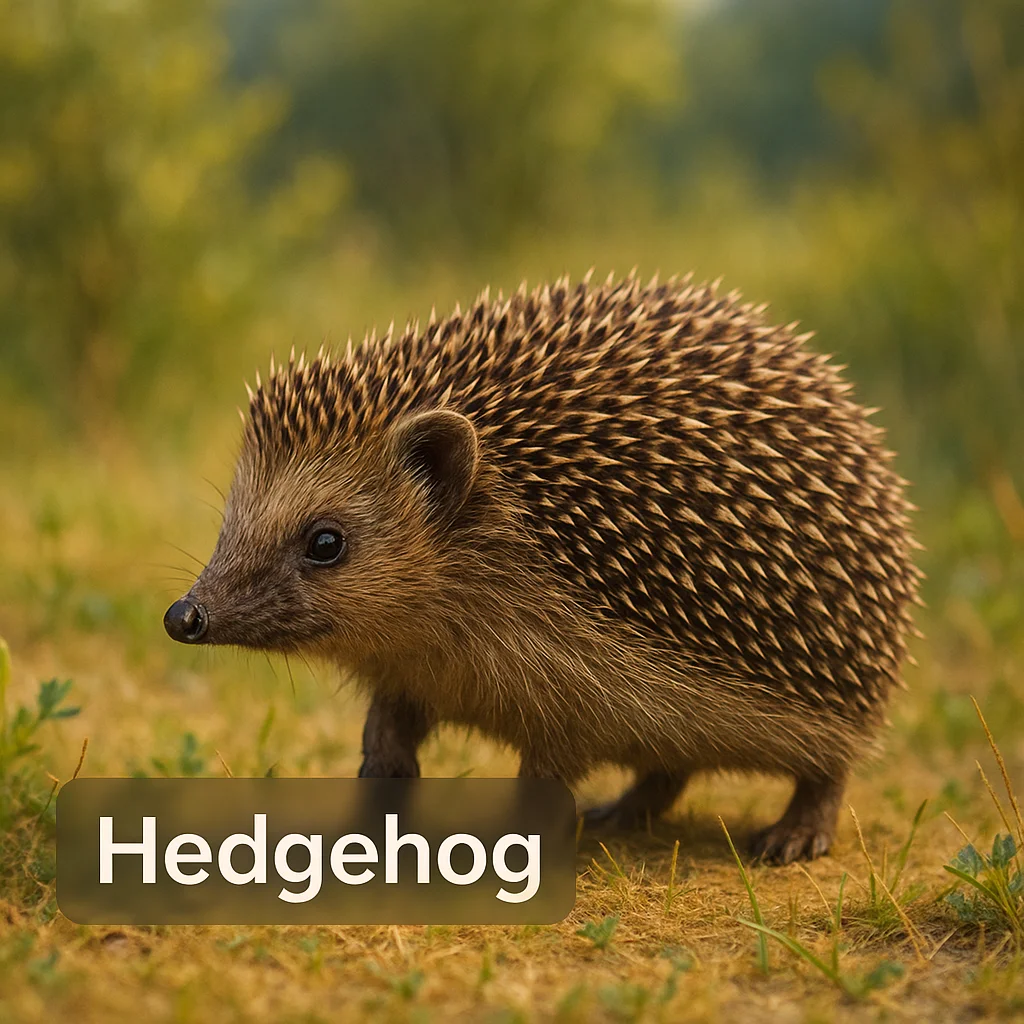
Hedgehogs are easily recognizable by their unique body shape and spiny coat. Their bodies are short and rounded, characterized by dense spines covering their back, which are used as a defensive mechanism. The belly and face are not spined but covered with soft, brown fur. Their snouts are pointed, aiding them in foraging for food.
- Body shape and silhouette: Rounded, compact body with a characteristic spiny back
- Key colors/patterns: Coat can be brown, grey, or white-tipped with spines
- Distinctive features: Spined back, small eyes, and elongated snout
- Tracks/scat: Small footprints with visible claw marks; scat is cylindrical and often dark
- Common look-alikes: Tenrecs; can be distinguished by the lack of spines on look-alikes
- Top ID Tips:
- Rounded body with spines on the back
- Small, black eyes and elongated snout
- Soft fur on the belly
- Nocturnal behavior
- Usually seen alone
🧱 Body Structure & Physical Adaptations
Hedgehogs are built for mobility and defense. Their stocky build and sturdy limbs allow them to navigate a variety of terrains. The teeth are sharp, enabling them to catch and eat a variety of invertebrates. Their claws are adapted for digging, useful in foraging and creating shelter. Hedgehogs have excellent hearing, which aids them in predator detection, but their eyesight is less acute, especially in daylight.
- Build and proportions: Compact and stocky, with short limbs
- Teeth/jaw adaptations: Sharp teeth suitable for insectivorous diet
- Claws: Well-suited for digging and foraging
- Sensory strengths: Acute sense of hearing, moderate sense of smell, limited vision
- Key Adaptations:
- Spines for protection
- Acute hearing
- Effective foragers with sharp claws
- Compact body for defensive ball formation
- Ability to hibernate in colder climates
🌍 Range & Distribution
Hedgehogs are found in a diverse range of environments from Europe, Asia, and Africa, with species adapted to regions with varied climates. They do not migrate but may alter activity with seasonal changes.
- Continents: Europe, Africa, Asia
- Typical countries/biomes: Mediterranean regions, deciduous forests, temperate zones
- Elevation range: Sea level to montane regions
- Seasonal movements: Primarily residents with some hibernating in winter
- Where You Might Find It:
- Forest edges
- Grasslands
- Urban gardens and parks
- Open meadows
- Hedgerows
🏞️ Habitat & Shelter
Hedgehogs prefer environments with ample cover such as forests, grasslands, and even urban parks and gardens. They make nests in logs, under leaves, or burrow into the ground to seek shelter. Weather influences their activity, with colder climates prompting hibernation.
Understanding their habitat needs is crucial for conservation efforts, as habitat loss is a significant threat.
🧭 Behavior & Ecology
Hedgehogs are nocturnal creatures, engaging in foraging and other activities during the night. They communicate through grunts and snuffles, primarily using scent marking for territories. Hedgehogs play an essential role in ecosystems by managing insect populations.
- Daily routine: Nocturnal, spends days resting
- Communication: Vocalizations and scent marking are prominent
- Interactions: Territorial, with limited interactions outside of breeding
- Role in ecosystem: Helps control insect populations
- Behavior Highlights:
- Nocturnal activity
- Defensive ball formation
- Solitary wandering
- Ecosystem insect controllers
- Seasonal hibernation
👥 Social Life & Group Dynamics
Hedgehogs are inherently solitary, coming together only for mating purposes. There is minimal parental care, with females responsible for nursing and weaning young. Typically, they do not form groups and are often seen alone.
- Solitary tendencies: Predominantly solitary; only pairs up for breeding
- Group types: No established groups; solitary individuals
- Cooperation: Limited to parent-offspring interactions
- Social Structure Notes:
- Primarily solitary
- Breeds in pairs
- Limited social interactions
- Individual territories
- Minimal offspring care
🍽️ Diet, Prey & Predators
Hedgehogs are primarily insectivores, consuming a diet rich in beetles, worms, and other small invertebrates. Besides insects, they sometimes eat fruits and vegetables. Natural predators include birds of prey and foxes, but their spines provide an effective defense mechanism. Hedgehogs roll into a ball when threatened to protect their vulnerable parts.
- Main diet: Insects, worms, and other small invertebrates
- Occasional foods: Fruits and vegetables
- Natural predators: Birds of prey, badgers, foxes
- Anti-predator strategies: Ball-rolling and spine defense
- Feeding Notes:
- Insect-heavy diet
- Opportunistic foragers
- Occasional plant material
- Protective spine ball formation
- Visual and acoustic foraging aids
🦌 Hunting, Foraging & Movement
Hedgehogs are foragers, known for searching for food along the ground at night. They rely on their keen sense of smell and hearing to locate food. Although generally slow-moving, hedgehogs are capable of quick movements, particularly when threatened. They primarily roam designated territories rather than migrate.
- Locomotion style: Slow, deliberate walking with sudden quick bursts
- Foraging times: Primarily nocturnal
- Navigation abilities: Possess a well-mapped home range
- Movement & Strategy:
- Slow, cautious movement
- Finely tuned foraging senses
- Hearing-driven tracking
- Limited territorial roaming
- Night-based activity
🧠 Intelligence & Senses
Hedgehogs exhibit basic problem-solving skills and are capable of learning through memory-based experiences. They excel in olfactory and auditory senses, the two primary methods for exploring and understanding their surroundings. Their eyesight, however, is less developed, impacting navigation during daylight.
- Problem-solving: Basic, task-oriented learning
- Sensory use: Excellent hearing and smell
- Notable Abilities:
- Vibrant memory for routes
- Effective at obstacle navigation
- Keen olfactory senses
- Strong auditory capabilities
- Limited but purposeful problem solving
🪺 Reproduction, Pregnancy & Parenting
Breeding season varies by region but generally occurs in warmer months. Hedgehogs exhibit promiscuous mating behavior, with limited male participation post-mating. Females undergo a gestation period of around 30 to 45 days, birthing 2 to 6 young. Offspring are altricial, requiring maternal care initially.
- Breeding season: Spring to early summer
- Mating system: Promiscuous, no long-term pair bonds
- Gestation period: 30 to 45 days
- Litter size: 2 to 6 young
- Reproduction Snapshot:
- Seasonal breeding
- Females leading offspring care
- 2 to 6 young per litter
- Promiscuous mating behaviors
- 30 to 45-day gestation
♀️♂️ Male vs Female Differences
Male and female hedgehogs have subtle differences, particularly in size and behavior during breeding. Males may be slightly larger and more active during mating seasons, exhibiting increased aggression in pursuit of mates.
- Physical differences: Males slightly larger
- Behavioral roles: Males are primarily involved in mating pursuits
- Subtle appearances: Difficult to distinguish without close examination
- Sex Differences at a Glance:
- Males larger, generally
- Slight behavioral variation during mating
- Mating-focused male activity
- Subtle physical differences
- Highly individualistic behavior
🧬 Subspecies & Variation
Several hedgehog species exhibit variations across their range, often related to local environments. Notably, the European Hedgehog and African Pygmy Hedgehog differ in size and behavior. Some subspecies classifications remain debated among researchers, reflecting ongoing scientific discourse in hedgehog taxonomy.
- Known subspecies: Numerous, including European and African hedgehogs
- Adaptations: Size and dietary variation among regions
- Variation Notes:
- Regional size differences
- Dietary flexibility
- European and African hedgehog distinctions
- Ongoing taxonomic debates
- Temperature-driven adaptations
⚠️ Threats, Conservation & Human Interaction
Hedgehogs face several natural and human-induced threats, including habitat loss, road traffic, and predation. It is crucial to monitor habitats and minimize human-related risks to ensure their conservation. If kept as pets, it is essential to respect the natural behaviors and characteristics of hedgehogs.
- Natural challenges: Predation, environmental changes
- Human pressures: Traffic, habitat encroachment
- Coexistence tips: Create safe gardens with hedgehog homes
- Responsible Notes:
- Monitor garden habitats
- Create hedgehog-friendly spaces
- Avoid domesticating wild individuals
- Ensure naturalistic pet environments
- Observe environmental adaptations
✨ Fun Facts & Unique Traits
- Hedgehogs are ancient creatures, existing for millions of years.
- They are immune to some snake venoms, thanks to a substance in their genetic makeup.
- Hedgehogs can fit into remarkably small spaces due to their flexible spines.
- When threatened, they roll into a tight ball with spines protruding outward.
- Hedgehogs are excellent swimmers, able to cross streams as needed.
- In some cultures, they are symbols of good fortune.
- They emit a range of sounds, from grunts to squeals, to communicate with one another.
- They possess a unique self-anointing behavior, often licking new objects and producing foamy saliva.
📌 Summary
- Distinctive spiny mammals known for defensive ball formation.
- Found in diverse habitats across Europe, Asia, and Africa.
- Primarily insectivorous, aiding in pest control.
- Face threats from predators and habitat loss.
- Generally solitary, interacting primarily during mating season.
- Females manage post-birth care of litters.
- Exhibit minor size and behavior differences between sexes.
- Diverse subspecies and local adaptations contribute to varied appearances.
- Efforts needed to mitigate human-induced threats for conservation.
- Known for unique features, including self-anointing and swimming capabilities.