🦁 Flying Squirrel
🧾 Quick Facts
Flying squirrels are fascinating creatures known for their unique ability to glide through the air. Despite their name, they cannot fly like birds or bats but use a special membrane to soar from tree to tree. Found across various regions of the world, these nocturnal mammals captivate both researchers and wildlife enthusiasts with their aerodynamic movements and adaptive capabilities.
- Common name(s): Flying squirrel
- Scientific name: Pteromyini (tribe, varies by species)
- Animal type: Mammal
- Typical adult size: Length 20-37 cm (including tail), Weight 100-150 g
- Typical lifespan: 4-6 years in the wild
- Diet type: Omnivore; consumes nuts, fruits, insects, seeds
- Activity pattern: Nocturnal
- Social structure: Generally social; can be found in groups
- Speed / movement highlights: Glides up to 90 meters; exceptional maneuverability
- Intelligence/learning: Capable of navigating complex environments
- Primary habitats: Forested areas, including temperate and tropical forests
- Geographic range: North America, Europe, Asia, parts of Africa
- Predators/threats: Owls, snakes, domestic cats, habitat destruction
- Conservation status: Varies by region; some species are threatened
🔍 Identification & Appearance
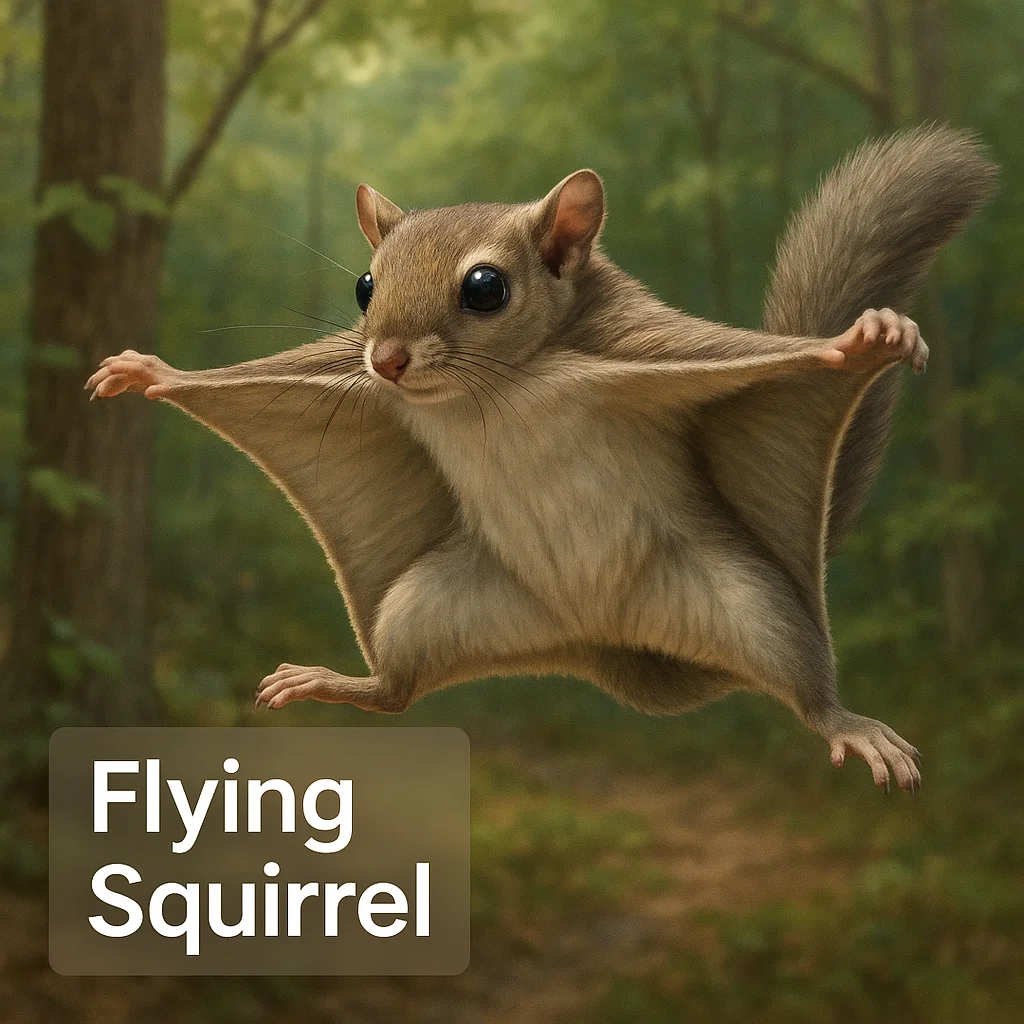
Flying squirrels have a distinctive appearance that facilitates their unique mode of locomotion. Their bodies are adapted to gliding, with a flattened tail and a membrane called the patagium extending between the wrists and ankles. This gliding membrane is key to their silhouette as they soar through the air. Their fur is soft and dense, usually a blend of brown or gray on the back with a lighter underside. Large, dark eyes provide enhanced night vision.
In identifying flying squirrels, one might confuse them with regular tree squirrels. However, the presence of the gliding membrane and their nocturnal activity patterns are clear distinguishing factors.
- Slender body with a distinct gliding membrane
- Soft fur, typically brown or gray
- Large eyes suited for night vision
- Flattened tail aiding in aerial maneuverability
- Light-colored underbelly
- Patagium visible when outstretched
- Small rounded ears
- Often seen gliding between trees at night
- Scat often circular and found at the base of trees
🧱 Body Structure & Physical Adaptations
The physical structure of flying squirrels is perfectly adapted for gliding. Their slender bodies house elongated limbs that support the patagium, enabling them to catch air and glide effectively. The flattened tail acts as a stabilizer, helping steer during flight. Flying squirrels have sharp claws suited for climbing and gripping tree bark. Their eyes are adapted for low-light conditions, making them highly effective nocturnal creatures.
- Elongated limbs connected by a gliding membrane
- Flattened tail for aerial maneuverability
- Sharp claws for gripping and climbing
- Large eyes adapted for improved night vision
- Dense fur for insulation in cold environments
- Flexible wrists and ankles for tight turns mid-air
- Sensitive hearing detecting potential predators
🌍 Range & Distribution
Flying squirrels are broadly distributed across various continents. They are primarily found in forested regions, ranging from North America to parts of Asia and Africa. Their presence is often noted in temperate and tropical forests, where they have access to tall trees necessary for gliding. While some species exhibit residency largely through stable environments, others may move slightly in search of food and optimal conditions.
- North America: Eastern and Northern regions
- Europe: Limited presence in forests
- Asia: Abundant, particularly in dense forests of India and China
- Africa: Niche populations in specific regions
- Prefers forested biomes with tall trees
- Mostly non-migratory, but may expand range searching for food
- Occasional elevation changes due to seasonal resource availability
- Primarily temperate and tropical climates
🏞️ Habitat & Shelter
Flying squirrels thrive in forest habitats where tall trees provide the necessary platforms for their gliding activities. Microhabitats include tree hollows or abandoned nests where they seek shelter and raise young. In cold or wet conditions, they tend to become less active, often seeking shelter within dense canopies. An understanding of their habitat is crucial to studying their behavior, as their entire lifestyle revolves around having adequate foliage coverage and a suitable nesting environment.
🧭 Behavior & Ecology
With nocturnal habits, flying squirrels are most active at night when they forage for food and socialize. Despite their quiet nature, communication occurs through ultrasonic calls imperceptible to humans. They often display territorial behaviors and may use scent marking. Role-wise, they contribute significantly to their ecosystems as seed dispersers, facilitating forest regeneration. Inter-species interactions include competition and occasional predator-prey dynamics.
- Nocturnal foragers
- Ultrasonic communication
- Essential seed dispersers
- Display territoriality through scent marking
- Often share space with other arboreal species
- Rest in tree hollows during the day
- Might use body language for in-group communication
- Environmentally sensitive, responding to changes in temperature and light
👥 Social Life & Group Dynamics
Flying squirrels exhibit social behavior more than many other squirrels. They may live independently or in small groups, particularly during colder months when communal nesting provides warmth. Group size fluctuates, but typically ranges from a few individuals to larger communal nests. Some species show strong familial bonds, demonstrating cooperative behaviors such as shared childcare and joint foraging.
- Mix of solitary and social living
- Group sizes vary by resource availability
- Communal nesting common in winter
- Strong familial bonds within groups
- Cooperative care of young
- Occasional territorial clashes resolved with displays rather than physical contact
- Barriers, like dense canopy coverage, used as territory indicators
🍽️ Diet, Prey & Predators
Your typical flying squirrel consumes a varied diet comprised of nuts, seeds, fruits, and occasional insects. They forage primarily at night, utilizing their keen sense of smell to locate food. Natural predators include owls and snakes. To counter predation, they rely on their exceptional gliding ability to swiftly escape threats. They also exhibit scampering behaviors when on the ground to avoid detection.
- Omnivorous diet: nuts, fruits, seeds
- Occasionally consumes insects
- Forages under cover of night
- Uses scent to detect and locate food
- Natural predators: owls, snakes, cats
- Relies on camouflage and speed to avoid predators
- Scampering motion when on ground
- Occasional scavenging of fallen nuts or fruits
🦌 Hunting, Foraging & Movement
Flying squirrels exhibit remarkable gliding abilities, often performing acrobatic maneuvers in mid-air. Their locomotion style involves launching from one tree and using the patagium to glide to another, covering distances up to 90 meters. Evening and night are their primary activity periods, employing strategies that include silent gliding and quick bursts to capture food or escape predators. Their home ranges are not strictly defined, fluctuating with food availability and season.
- Exceptional gliders: can cover long distances rapidly
- Evening foragers, reducing predation risk
- Flexible navigation through dense canopy
- Depend on visual landmarks for orientation
- Adapt to varied forest terrains with agile movements
- Temporary migration related to food scarcity
- Integrate memory to revisit feeding hotspots
🧠 Intelligence & Senses
Flying squirrels display high adaptability to their environment, showcasing evidence of learning and memory. While specific tool use has not been formally documented, they exhibit behaviors reflecting spatial awareness and problem-solving skills. Their acute senses of sight and hearing allow them to detect nocturnal predators and forage effectively. Research on their cognitive abilities is promising, revealing a complex understanding of their lush forest habitats.
- Advanced problem-solving abilities
- Spatial awareness aids navigation
- Strong night vision due to large eyes
- Excellent auditory perception for predator detection
- Limited research on social intelligence
- Memory used to track food sources
- Varied responses to changing environmental stimuli
🪺 Reproduction, Pregnancy & Parenting
Breeding mainly occurs in the spring and summer, though exact timing varies. Flying squirrels are usually promiscuous, and after mating, females assume most parenting responsibilities. The gestation period lasts around 40 days, and litters typically consist of 2-4 young. Newborns are altricial, requiring maternal care within nests. In some species, males provide protection during early stages.
- Breeding seasons: spring and summer
- Generally promiscuous mating system
- Gestation period approximately 40 days
- Litter size: 2-4 young per birth
- Newborns are initially altricial
- Maternal nest care essential for development
- Males may sometimes protect mother and young
- Independence reached after a few months
♀️♂️ Male vs Female Differences
In flying squirrels, sexual dimorphism is minimal, with males and females appearing similarly in size and coloration. Behavioral roles slightly diverge during breeding seasons with females taking on nurturing duties while males size up potential threats to their offspring. Despite similarities, small differences in aggression and territorial displays may exist, especially within overlapping home ranges.
- Minimal size difference between sexes
- Coloration largely identical for both
- Females: primary caregivers of young
- Males: protect offspring during early stages
- Equal dispersal of traits across populations
- Minor behavioral differences during mating season
🧬 Subspecies & Variation
The flying squirrel family includes numerous species across the globe, each showcasing unique traits adapted to their specific environments. Subspecies classification often highlights slight size, coloration, or geographical preference differences. In some cases, classification is subject to debate among scientists, with studies ongoing to better understand these varied lines of descent and adaptation.
- Species include Northern and Southern flying squirrels
- Variations in fur thickness related to climate
- Different gliding ranges influenced by habitat structure
- Slight size adjustments among island vs mainland populations
- Coloration diversity due to environmental demands
- Classification often under review with new findings
⚠️ Threats, Conservation & Human Interaction
Flying squirrels face threats from habitat destruction, climate change impacts, and some local hunting. Habitat conservation is crucial to their persistence, as deforestation removes vital nesting and feeding sites. In urban areas, flying squirrels intrigue many; however, it's important to respect their wild nature and avoid domestic capture. In conservation regions, efforts include habitat preservation and legal protection against hunting.
- Threats: habitat loss, climate change
- Preservation of nesting sites key for survival
- Occasional illegal trapping in some regions
- Human-wildlife coexistence strategies needed
- Conservation status varies by species
- Public education vital for species protection
- Mismatched assumptions as pets highlight ethical concerns
✨ Fun Facts & Unique Traits
- Flying squirrels are part of the tribe Pteromyini, encompassing over 50 species.
- They have been recorded gliding distances of up to 90 meters in a single leap.
- Flying squirrels' patagium is a membrane similar to that of flying fish and gliding marsupials.
- The Siberian flying squirrel is famous in some cultures as a symbol of good luck.
- These squirrels have been known to use vocalizations inaudible to humans to communicate.
- Japanese flying squirrels are known for their captivating, anime-like appearance.
- In the ecosystem, their key role involves dispersing nuts and seeds crucial for plant proliferation.
- Despite their status as non-volant mammals, they inspire aerodynamics research in engineering.
📌 Summary
- Identified by their gliding patagium and nocturnal behaviors
- Found in temperate and tropical forests worldwide
- Diet includes nuts, seeds, and occasional insects
- Predators include owls and snakes
- Social animals often gathering in small groups
- Breeding predominantly in spring and summer
- Adaptations like nocturnal vision and aerodynamic body structure
- Distinctive for their ability to glide impressive distances