🦁 European Mole
🧾 Quick Facts
The European Mole, a fascinating creature often spotted across much of Europe, is known for its unique underground lifestyle. Despite being commonly found, it remains a subject of curiosity due to its secretive, subterranean habits.
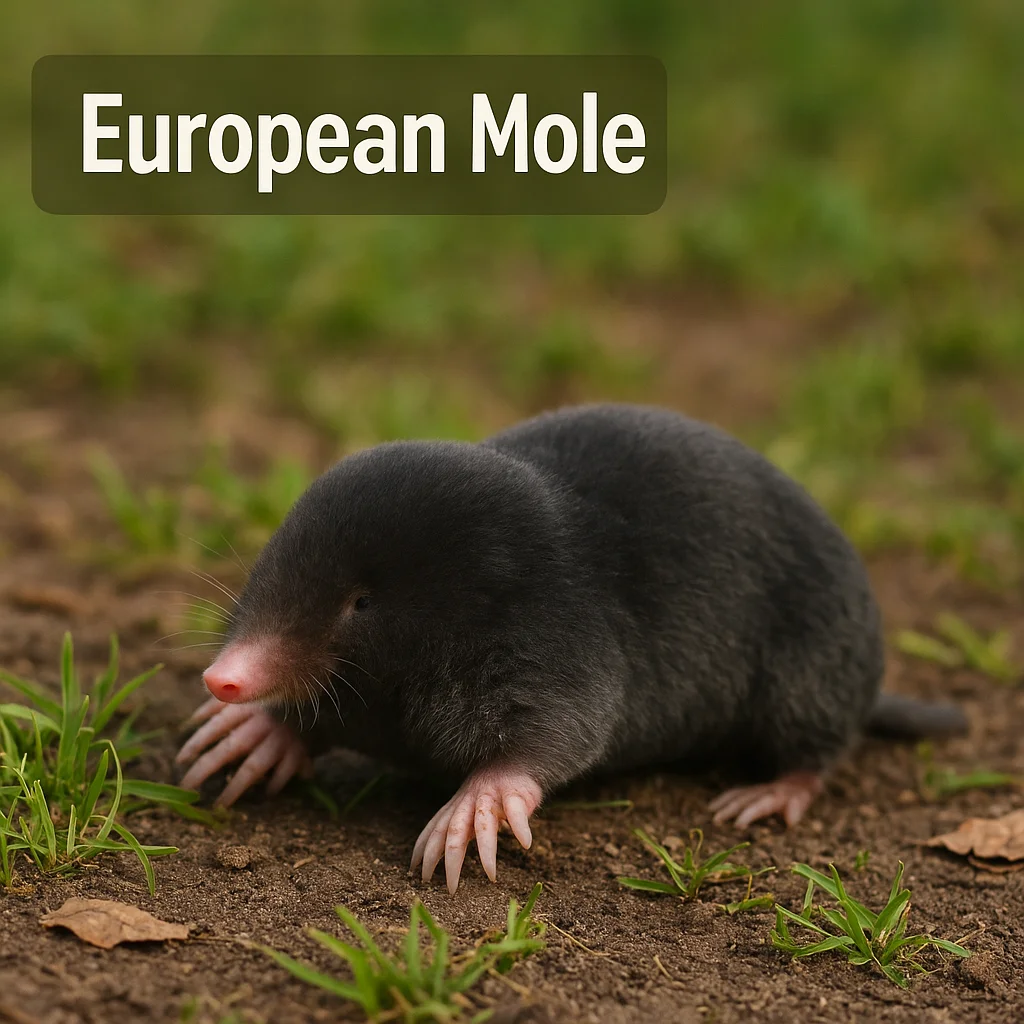
- Common Name: European Mole
- Scientific Name: Talpa europaea
- Animal Type: Mammal
- Typical Adult Size: 11.5-16 cm (length), 60-130 grams (weight)
- Typical Lifespan: 3-6 years in the wild
- Diet Type: Carnivore; eats insects, earthworms, and other small invertebrates
- Activity Pattern: Primarily nocturnal
- Social Structure: Solitary
- Speed / Movement Highlights: Adapted for digging; rapid tunnel building
- Intelligence/Learning: Known for effective problem-solving in seeking food
- Primary Habitats: Grasslands, woodlands, and gardens
- Geographic Range: Europe, widespread but absent in Ireland
- Predators/Threats: Birds of prey, snakes, and domestic cats
- Conservation Status: Least Concern
🔍 Identification & Appearance
European Moles are easily recognized by their distinctive physical features suited for a life underground. Their continuous digging leads to the characteristic molehills dotting landscapes.
- Compact, cylindrical body designed for burrowing
- Velvety fur, usually black in color, providing easy movement through soil
- Large, spade-like forelimbs with strong claws for digging
- Small, functional eyes and concealed ears to prevent soil intrusion
- Distinctive pointed snout used for probing soil
- Molehills are a classic sign of their presence
- Can be confused with the Common Shrew but distinguishable by size and behavior
- Tracks are rare as they rarely move above ground
- Distinguishable from voles by the lack of visible ears
- Occasional silvery sheen in their fur can help in identification
🧱 Body Structure & Physical Adaptations
The European Mole has evolved a robust body structure and a range of physical adaptations that enable it to live efficiently underground.
- Stocky, cylindrical build for streamlined movement in tunnels
- Larger forelimbs compared to hind limbs for powerful digging
- Sharp, strong claws designed for shifting soil
- Reduced eyesight but acute sense of touch and smell
- Dense, soft fur aligned to minimize friction
- No apparent tail, minimizing obstruction while moving underground
- Highly developed olfactory senses to detect prey
- Teeth arranged for gripping slippery prey such as earthworms
- Key Adaptations: Optimized for underground life, adaptable to various soil types
🌍 Range & Distribution
The European Mole is widely distributed across Europe, adapting to different environments but preferring specific conditions that support its lifestyle.
- Common in many European countries, absent in Ireland
- Prefers temperate climates with moist, fertile soils
- Found up to 1,000 meters in elevation
- Non-migratory, primarily resident to their local sites
- Thrives in areas with a rich supply of earthworms and insects
- Occasionally found in gardens and agricultural fields
- Higher densities in regions with fewer predators and stable climates
- Adaptive to a wide range of elevations
- Where You Might Find It: Woodlands, grasslands, gardens, and meadows
🏞️ Habitat & Shelter
The European Mole prefers environments where soil is easy to dig and supports the insects and invertebrates it feeds on.
- Common in deciduous woodland regions with plenty of leaf litter
- Often inhabits grassy fields, meadows, and lawns
- Builds complex tunnel systems for shelter and hunting
- Active year-round, modifying behavior with temperature fluctuations
- Disliked by gardeners due to molehills damaging lawns and crops
- Creates elaborate networks of exploratory and permanent tunnels
- Habitats offer insight into its role as an ecosystem engineer, aerating soil and mixing nutrients
🧭 Behavior & Ecology
The behavior of the European Mole is closely tied to its subterranean lifestyle, with a significant impact on the ecosystems it inhabits.
- Spends most of the time underground; rarely ventures to the surface
- Creates molehills by pushing excavated soil to the surface
- Primarily solitary except during breeding season
- Communicates primarily through pheromones due to dark habitats
- Plays a role in soil health by aerating the ground
- Competitor for invertebrate prey with other small mammals
- Mole tunnels can serve as highways for other small animals
- Agile in burrowing, which makes observing its daily routine challenging
- Behavior Highlights: Skilled digger, solitary nature, influential in soil ecosystem dynamics
👥 Social Life & Group Dynamics
Primarily solitary, the European Mole comes together only during specific periods, reflecting its preference for a solitary existence.
- Solitary and territorial, defending tunnel systems from others
- Engages with conspecifics only during the breeding season
- While underground conflicts can occur, they are largely anecdotal
- Minimal cooperation beyond mating; no known group hierarchies
- Each mole maintains its own tunnel network
- Communication primarily through scent markings
- Longevity supported by reducing interspecific conflict
- Structure simplicity highlights independence and territory fidelity
- Social Structure Notes: Solitary, territorial, seasonal social bonds
🍽️ Diet, Prey & Predators
The European Mole is a skilled hunter of invertebrates, fulfilling its nutritional requirements through its intricate tunnel systems.
- Diet predominantly consists of earthworms, grubs, and insects
- Occasionally consumes small vertebrates underground
- Relies on highly sensitive snout to locate prey
- Keenly adapted for subterranean hunting and prey capture
- Main predators include avian species like owls and mammals like stoats
- Primary defense against predation is remaining underground
- Rarely forages on the surface; exposed moles are at risk of predation
- Feeding Notes: Worm-catcher extraordinaire, adapted digestive processes for invertebrates
🦌 Hunting, Foraging & Movement
With unique adaptations for an underground lifestyle, the European Mole showcases particular methods for foraging and movement.
- Masters of a burrower lifestyle; relentless diggers building complex tunnels
- Efficient digger, can create extensive tunnel systems relatively quickly
- Employs a tactile-based foraging strategy within burrows
- Energy expenditure balanced via calculated, energy-efficient movement
- Exploratory tunnels increase forage efficiency, forming trap-like networks
- Little visible surface movement; stealth an advantage against being prey
- Maintains a defined home range marked by tunnel systems
- Movement & Strategy: Powerful forelimbs for digging, sensitive snout for prey detection, isolated locomotion
🧠 Intelligence & Senses
Though the European Mole's lifestyle may seem simple, it demonstrates notable adaptations in intelligence and senses that enhance survival.
- Demonstrates problem-solving capabilities when trapped or blocked
- Highly developed tactile system overcomes limited vision
- Sensitive ears, though not visible, support above-ground awareness
- Relies heavily on sense of smell in foraging and navigation underground
- Cognitive abilities tailored to maximising underground efficiency
- Limited studies on learning, likely due to secretive lifestyle
- Capable of precision in tunnel construction and burrow complexity
- Notable Abilities: Proficient tunnel navigators, adept problem solvers in confined spaces
🪺 Reproduction, Pregnancy & Parenting
Reproductive strategies in the European Mole reflect its solitary nature, adapting to ensure offspring survival in subterranean environments.
- Breeding occurs in the spring
- Typically promiscuous, though specifics can vary by location
- Gestation lasts approximately 4 months
- Litters generally consist of 2-7 young
- Young are altricial, requiring significant parental care initially
- At birth, moles are blind and furless
- Paternal care is rare; females provide the majority of parenting
- Young moles mature quickly, becoming independent within months
- Reproduction Snapshot: Seasonal breeders, relatively high reproductive output, maternal devotion
♀️♂️ Male vs Female Differences
European Moles present minimal sexual dimorphism, but there are subtle distinctions between the sexes.
- Females are slightly smaller than males
- Behavioral variations are limited outside breeding times
- No significant color differences between sexes
- Size difference aids males in establishing territories
- Physiological adaptations more pronounced during gestation
- Despite size, males do not dominate females; both maintain territories
- Observation of differences aided by breeding season behaviors
- Sex Differences at a Glance: Subtle size variations, minimal behavioral differences outside reproduction
🧬 Subspecies & Variation
The European Mole is relatively uniform across its range, though geographic variations may occur.
- Subspecies classification sparingly debated among scientists
- Localized adaptations noted, but morphological differences minor
- Soil type influences physical variation in burrowing proficiency
- Adaptation to different climates affects reproductive timing
- Variation Notes: Minimal subspecies differentiation, possible soil-driven adaption, widespread uniformity
⚠️ Threats, Conservation & Human Interaction
Despite being considered a species of least concern, the European Mole faces various pressures from its environment and human activities.
- Threats include habitat destruction and intensive agriculture
- Climate change affects food availability and habitat integrity
- Accidental deaths from mechanical digging devices
- Often perceived as pests by gardeners due to lawn damage
- Important to maintain natural habitats for broader ecological health
- Non-invasive coexistence promoted by preserving diverse ecosystems
- Reports of moles in captivity highlight the need for ethical considerations
- Responsible Notes: Emphasize ecological balance, caution against unnecessary pests control measures
✨ Fun Facts & Unique Traits
- Despite poor vision, moles have highly sensitive snouts and whiskers
- Molehills aid aeration of soil, contributing to better root growth for plants
- Newborn moles, though helpless at first, quickly become proficient diggers
- Each mole's fur is soft, aiding ease of movement regardless of direction
- They can build tunnels at remarkably rapid speeds
- An adult mole can construct several meters of tunnels in a single night
- European Moles contribute to controlling insect populations
- They are less affected by pesticides compared to other small mammals
- Though not seen often, their existence is indicated by molehills
- Moles maintain metabolism optimized for low-oxygen environments
📌 Summary
- European Mole, Talpa europaea, is a small, burrowing mammal.
- It is found extensively across Europe, barring Ireland.
- Prefers moist, fertile soils to support its insectivorous diet.
- Recognizable by its cylindrical body, velvety black fur, and powerful claws.
- Though largely solitary, it interacts with others during the breeding season.
- Plays a crucial role in soil aeration and ecosystem health.
- Has few natural threats but faces human-related pressures such as habitat loss.
- Moles show specialized adaptations for underground life, including tactile senses.
- Reproductive strategies include spring breeding and maternal care.
- Molehills are signature signs of its presence, though difficult to observe directly.
- Subtle sexual dimorphism mainly revolves around size.
- Conservation and human coexistence depend on balanced ecosystem approaches.