🦁 Eastern Gray Squirrel
🧾 Quick Facts
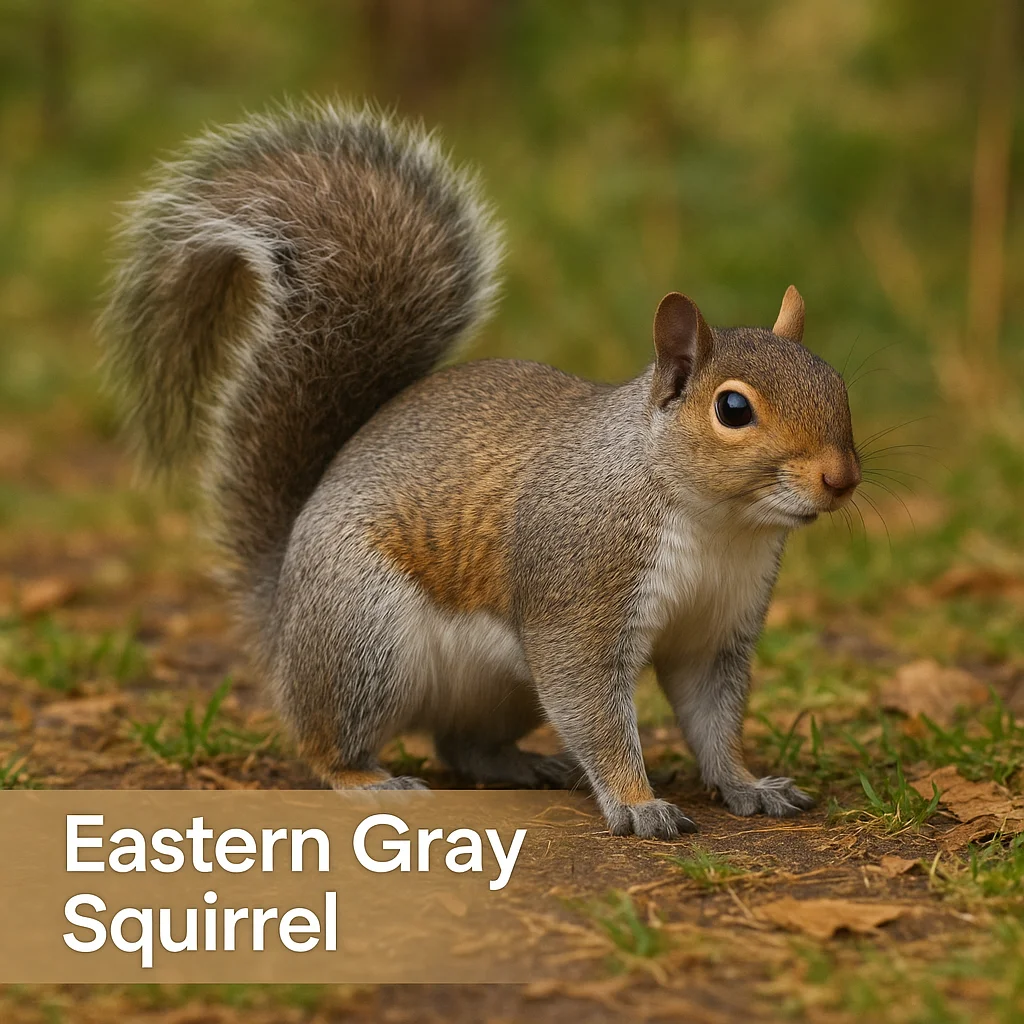
The Eastern Gray Squirrel (Sciurus carolinensis) is a common and adaptable rodent known for its agility and acrobatics in the treetops of North America's forests and urban areas.
- Common name(s): Eastern Gray Squirrel, Grey Squirrel
- Scientific name: Sciurus carolinensis
- Animal type: Mammal
- Typical adult size: 9–12 inches (body), 8–10 inches (tail); 14–21 ounces (weight)
- Typical lifespan: 6–12 years in the wild
- Diet type: Omnivore; mainly nuts, seeds, fruits, and occasionally insects
- Activity pattern: Diurnal
- Social structure: Solitary or in small family groups
- Speed / movement highlights: Agile climbers and jumpers
- Intelligence/learning: Capable of problem-solving and cache retrieval
- Primary habitats: Deciduous and mixed forests, urban areas
- Geographic range: Eastern United States, parts of Canada
- Predators/threats: Birds of prey, snakes, domestic cats, habitat loss
- Conservation status: Least Concern
🔍 Identification & Appearance
The Eastern Gray Squirrel is easily identified by its predominantly gray fur, bushy tail, and large, expressive eyes. Its underbelly is white or light gray, and it has rounded ears without tufts. During the winter, their coat may appear thicker and more silvery.
- Medium-sized rodent with a slender body and long, bushy tail
- Gray fur with some individuals showing brownish tones
- White or light gray underside
- Large eyes with a slightly pointed nose
- Tracks show four-toed front feet and five-toed hind feet
- Possible confusion with the similar-looking Western Gray Squirrel
- Eastern Grays are generally smaller than Fox Squirrels
- Distinctive bushy tail aids in balance and communication
- Footprints often found near nut caches and feeding sites
🧱 Body Structure & Physical Adaptations
The Eastern Gray Squirrel is built for agility, with strong hind legs for jumping and climbing. Its sharp claws help it grip surfaces, and its tail offers balance and warmth. Teeth are adapted for gnawing hard nuts.
- Slender build with long limbs
- Powerful hind legs for leaping
- Sharp incisors that grow continuously
- Claws designed for climbing trees
- Highly flexible tail, useful for balance and thermal regulation
- Keen sense of smell and hearing
- Excellent vision, particularly in low light
🌍 Range & Distribution
Eastern Gray Squirrels are predominantly found in the eastern United States and southeastern Canada. They thrive in forests and urban parks, adapting well to different environments.
- Native to eastern North America
- Found in deciduous and mixed forests
- Commonly spotted in city parks and suburbs
- Introduced populations in parts of western North America and Great Britain
- Adaptable to a variety of climates
- Resident species with no significant migration patterns
- Occupy altitudes from sea level to upland regions
- Common in areas with abundant food sources
- Range can vary slightly due to food availability and predation pressures
🏞️ Habitat & Shelter
Eastern Gray Squirrels prefer areas with abundant trees for both food and shelter. They use tree cavities and build leaf nests, or dreys, to stay safe from predators and harsh weather.
- Deciduous and mixed woodlands
- Urban and suburban areas with tree cover
- Homemade nests (dreys) in trees
- Tree cavities often used for winter shelter
- Active during the day and seek shelter at night
- Increased activity during autumn to build food caches
- Adapted to various climates by stocking food for winter
🧭 Behavior & Ecology
Known for their active lifestyles, Eastern Gray Squirrels spend much of their time foraging, grooming, and interacting through vocalizations and visual signals. They are vital seeds dispersers, helping forests to regenerate.
- Mostly solitary but become social in winter
- Vocalizes through chattering and tail flicks
- Distributed seeds aid forest growth
- Build food caches to retrieve later
- Territorial over cache sites, but not strictly over other resources
- Commonly seen grooming vigorously
- Active mainly during the daytime, especially early morning and late afternoon
- Strong climbers, often seen scampering up trees or along branches
👥 Social Life & Group Dynamics
Eastern Gray Squirrels are primarily solitary, but they engage in social interactions during mating season and harsh winter months. They generally form loose colonies around abundant food sources.
- Primarily solitary creatures
- Form small family groups in winter
- Communicate through vocalizations and tail signals
- Male squirrels show hierarchy when competing for mates
- Lactating females may exhibit more territorial behavior
- Limited cooperative behavior between loose colonies
- Occasionally seen sharing feeding grounds
🍽️ Diet, Prey & Predators
The diet of Eastern Gray Squirrels varies with the seasons, focusing on available plant material. While herbivorous, they occasionally consume insects, especially when other food is scarce.
- Primarily feeds on nuts, seeds, berries, and tree bark
- Occasional insect consumption during summer
- Stored food in caches for winter use
- Natural predators include hawks, owls, and snakes
- Rely on quick reflexes and agility to avoid danger
- Use alarm calls to warn nearby squirrels of predators
- Urban living increases exposure to domestic pets
🦌 Hunting, Foraging & Movement
Eastern Gray Squirrels are agile climbers, using trees to move around and forage for food. Their foraging behavior is characterized by storing and later retrieving food caches.
- Excellent climbers and jumpers
- Build food caches, remembered with spatial memory
- Active foragers, especially busy during fall
- Agile movement allows quick retreat from threats
- Vigorous movements to deter predators
- Back-and-forth movements between ground and trees
- Tendency to explore new environments for food
🧠 Intelligence & Senses
Eastern Gray Squirrels possess a keen intelligence demonstrated by their memory and problem-solving capabilities, particularly in recalling the locations of their food caches.
- Strong spatial memory aids in cache retrieval
- Exhibit complex problem-solving skills
- Excellent vision for detecting motion
- Keen sense of smell for locating food
- Possess acute hearing, avoiding stealthy predators
- Senses provide early signals of danger or opportunity
- Learning from experience significantly enhances survival
🪺 Reproduction, Pregnancy & Parenting
Eastern Gray Squirrels mate twice a year. After mating, females care for the young in nests, with no involvement from males. The young are born blind and helpless, developing independence over several weeks.
- Mating seasons: late winter and mid-summer
- Polygynous mating systems are common
- Gestation period is approximately 44 days
- 2–8 young per litter, typically 2–4
- Born altricial, requiring maternal care
- Weaned and independent by 10 weeks old
- Females solely responsible for nurturing young
♀️♂️ Male vs Female Differences
Eastern Gray Squirrels display subtle sexual dimorphism, primarily in reproductive roles and sometimes in size. Males compete for access to females during mating seasons.
- Slightly larger males in some populations
- No distinct color variations between sexes
- Males actively seek mates, especially during estrous
- Females exhibit territoriality when with young
- Minimal horn or crest differences, unlike some mammals
- Females focus on nesting and young care after mating
🧬 Subspecies & Variation
While the Eastern Gray Squirrel lacks formal subspecies, there is noticeable color variation across its range, with some populations showing more brown or melanin-rich individuals.
- Coat color varies from gray to brown
- Albino individuals are rare but occasionally seen
- No widely recognized subspecies
- Adaptations allow survival in urban environments
- Coloration reflects regional climates and habitats
⚠️ Threats, Conservation & Human Interaction
Though the Eastern Gray Squirrel is adaptable, urbanization and habitat destruction pose significant risks. They are often seen as pests in urban settings, leading to conflicts with humans.
- Adapts well to urban environments
- Loss of forested areas reduces available habitat
- Occasional hostility due to agricultural and urban presence
- Subject to road traffic hazards
- Conservation status: Least Concern, but variable locally
- Depredation by domestic animals in residential settings
- Public education can foster peaceful coexistence
✨ Fun Facts & Unique Traits
- Eastern Gray Squirrels can bury thousands of nuts each season.
- They can jump as high as 8 feet when startled.
- Squirrels excel at 'caching', a complex behavior of food storage.
- They are one of the few mammals that can descend a tree head-first.
- Highly adaptable to urban settings, often seen in city parks.
- Eastern Grays communicate through a variety of calls and tail signals.
- They are excellent swimmers and can cross bodies of water when necessary.
📌 Summary
- Easily recognized by gray fur and distinctive bushy tail.
- Thrives in both forest and urban settings across eastern North America.
- Omnivorous diet with a focus on nuts, seeds, and fruits.
- Predators include birds of prey, snakes, and domestic animals.
- Solitary or small family groups, with a rich communication system.
- Breeds twice a year, with females providing all parental care.
- Agile climbers and intelligent foragers known for caching behavior.
- Conservation status varies, generally least concern but sensitive to habitat loss.