🦁 Capybara
🧾 Quick Facts
The capybara, the world's largest rodent, is a remarkable and unique species found primarily in South America. Known for its social nature and semi-aquatic lifestyle, the capybara is a fascinating subject for both wildlife enthusiasts and researchers alike.
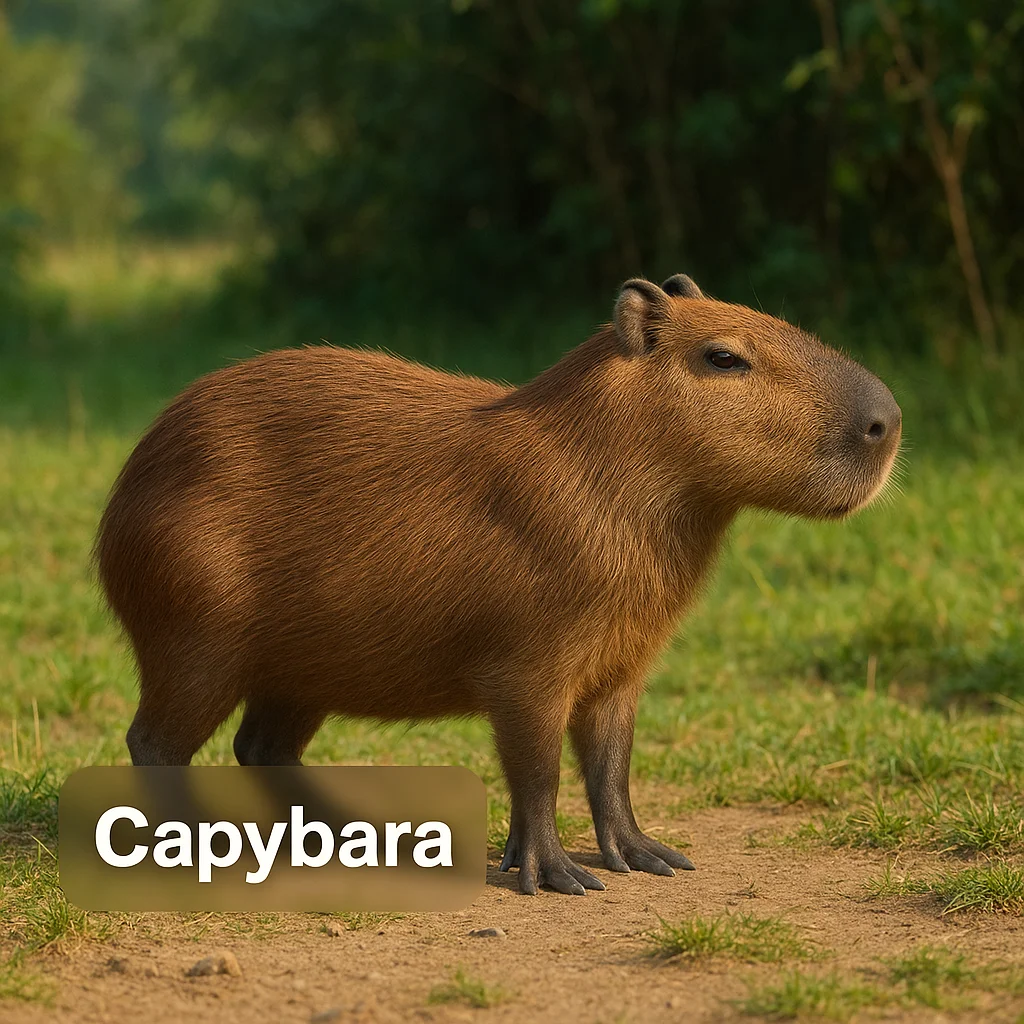
- Common name(s): Capybara
- Scientific name: Hydrochoerus hydrochaeris
- Animal type: Mammal
- Typical adult size: 1.0 to 1.35 meters long and 35 to 65 kg in weight
- Typical lifespan: 8 to 10 years in the wild; up to 12 years in captivity
- Diet type: Herbivore; primarily grasses, aquatic plants, fruits, and tree bark
- Activity pattern: Crepuscular, with peaks of activity around dawn and dusk
- Social structure: Group living; typically in family groups or larger aggregations
- Speed / movement highlights: Capable swimmer, using webbed feet for propulsion
- Intelligence/learning: Displays social learning and adaptable behavior
- Primary habitats: Wetlands, river banks, and marshy areas
- Geographic range: South America, primarily in countries like Brazil, Venezuela, Colombia, and Argentina
- Predators/threats: Jaguars, pumas, caimans, and human activities
- Conservation status: Least Concern, but varies by region due to habitat loss and hunting
🔍 Identification & Appearance
Capybaras have a distinctive body shape and appearance that makes them easily identifiable. Their robust and barrel-shaped body is supported by short legs, and they have a relatively small head with a blunt snout. Their fur is coarse and varies from yellowish-brown to grayish-brown, providing camouflage in their natural surroundings.
- Body shape and silhouette: Large, cylindrical, and sturdy
- Key colors/patterns: Yellowish-brown to grayish-brown, no significant seasonal changes
- Distinctive features: Webbed feet, small ears, and prominent front teeth
- Tracking signs: Tracks show webbed feet with four toes on the front and three on the back
- Common look-alikes: Often confused with other rodents, but size and aquatic nature are distinctive
- Top ID Tips
- Look for a large, heavy-bodied rodent with short limbs
- Check for a blunt snout and small, rounded ears
- Notice the coarse, light brown fur
- Observe behavior near water bodies
- Listen for distinctive vocalizations in social groups
- Check for webbed toes in tracks around wet areas
🧱 Body Structure & Physical Adaptations
The capybara's physical adaptations make it well-suited for a life both on land and in water. Its body is stocky and heavy, which aids in buoyancy, while its webbed feet provide effective propulsion in aquatic environments. They have large incisors that continually grow, perfectly adapted for grazing on tough vegetation.
- Key Adaptations
- Webbed feet facilitate efficient swimming
- Constantly growing incisors for feeding on grasses
- Excellent swimmers with eyes and nostrils positioned high on the head
- Dense fur helps repel water
- Good vision and hearing aid in predator detection
- Nasal flaps and ears close when submerged
🌍 Range & Distribution
Capybaras are primarily distributed across South America, occupying regions in the northern and central parts of the continent. They are commonly found in countries like Brazil, Venezuela, Colombia, and Argentina, thriving in tropical and subtropical environments. While mostly resident, their movements are closely linked to water availability, particularly during dry seasons.
- Where You Might Find It
- Tropical rainforests in Brazil
- Savannas and wetlands in Venezuela and Colombia
- Seasonally flooded grasslands in the Pantanal
- In and around marshes and swamps
- Near slow-moving rivers and lakes
🏞️ Habitat & Shelter
Capybaras prefer habitats associated with water, such as riverbanks, marshes, and wetlands. They require access to water to maintain their skin condition and for safety from predators. During the wet season, they may spread out into flooded areas, while in the dry season, they concentrate near permanent water bodies. Understanding their habitat is crucial for conservation efforts, as wetland drainage and deforestation pose significant threats.
🧭 Behavior & Ecology
Capybaras exhibit a complex social structure and behavior. They are crepuscular, being most active at dawn and dusk, and spend much of their time foraging near water. They use a range of vocalizations to communicate within their groups and are known for their grooming and social interactions. As primary consumers, capybaras play a vital role in their ecosystems by controlling vegetation growth and serving as a food source for larger predators.
- Behavior Highlights
- Live in groups that provide social structure and protection
- Vocalize to communicate with group members
- Engage in mutual grooming as a social activity
- Spend large portions of the day resting near water
- Graze extensively on grasses and aquatic plants
- Maintain territories mainly during the breeding season
👥 Social Life & Group Dynamics
Capybaras are highly social animals, typically forming groups of 10 to 30 individuals, which can grow even larger during the dry season when resources become limited. These groups are known as herds and are composed of a dominant male, several females, subordinate males, and young. The dominant male plays a crucial role in maintaining group cohesion and access to resources.
- Social Structure Notes
- Dominant males lead and protect the herd
- Group sizes can vary from 10 to 100 individuals
- Communication helps coordinate activities
- Subordinate males may help in defense
- Females often cooperate in caring for young
🍽️ Diet, Prey & Predators
As herbivores, capybaras primarily feed on grasses and aquatic plants, but they may also consume fruits and tree bark when available. Their diet can vary seasonally based on plant availability. Predation by large carnivores like jaguars, pumas, and caimans is a natural threat, as well as hunting by humans in some areas. Capybaras use their excellent swimming abilities as an escape tactic from predators.
- Feeding Notes
- Primarily consume a variety of grasses
- Supplement diet with aquatic plants and fruits
- Browse on shrubs and tree bark when grass is scarce
- Seek aquatic vegetation for moisture and nutrients
- Gather food at dawn and dusk for safety
🦌 Hunting, Foraging & Movement
Capybaras are adept at foraging on both land and water. They are crepuscular foragers, taking advantage of cooler temperatures and lower predation risk. They graze in groups, providing safety in numbers while foraging. Their strong swimming skills enable them to access submerged vegetation and escape predators swiftly. Despite their bulk, capybaras can run quickly for short distances if needed.
- Movement & Strategy
- Excellent swimmers, can evade predators in water
- Forage primarily in early morning and late afternoon
- Move efficiently in large groups for safety
- Run fast for short distances on land
- Follow distinct trails to water sources
🧠 Intelligence & Senses
Capybaras are considered intelligent animals, showing problem-solving abilities and learning from social interactions. Their social structure enhances their ability to learn from others. They have acute senses of sight and hearing, aiding in early predator detection. Although research on capybara cognition is limited, their behavior indicates a level of social intelligence important for group living.
- Notable Abilities
- Use vocalizations to communicate complex messages
- Learn from and mimic the behavior of others
- Maintain vigilance for predators with sharp senses
- Quickly learn new routes to water and food
- Develop social bonds through grooming and play
🪺 Reproduction, Pregnancy & Parenting
Capybaras breed throughout the year, with most births occurring during rainy seasons when food is abundant. They are polygynous, with dominant males mating with multiple females. The gestation period lasts about 150 days, leading to the birth of relatively precocial young. Capybaras typically give birth to 4 to 5 young, which are well-developed and capable of grazing within a week. Both parents and sometimes other group members contribute to the care of the young.
- Reproduction Snapshot
- Breeding occurs year-round, peaking in the wet season
- Polygynous mating system
- Gestation lasts around 150 days
- Litter size generally ranges from 2 to 8 pups
- Young are highly developed at birth, joining the group quickly
♀️♂️ Male vs Female Differences
In capybaras, sexual dimorphism is relatively subtle. Males are generally larger than females, although this size difference can be variable. Dominant males develop distinctive scent glands on their noses, used for marking territory and attracting mates. Both sexes participate in group activities, though males may engage more in territorial disputes and protection duties.
- Sex Differences at a Glance
- Males are typically larger than females
- Dominant males have a noticeable scent gland
- Males often responsible for territorial defense
- Females participate extensively in child-rearing
- Size difference is more prominent in dominant individuals
🧬 Subspecies & Variation
While specific subspecies of capybaras are not widely recognized, local populations may exhibit variations in size, behavior, and adaptation to different environments. These variations are generally linked to the availability of resources and local environmental conditions. Current research may clarify subspecies distinctions in the future, but for now, the capybara is treated mostly as a single species.
- Variation Notes
- Possible size variations linked to local environmental conditions
- Adaptations to available resources influence behavior
- Skin and fur color can vary slightly by region
- Research on subspecies is ongoing
⚠️ Threats, Conservation & Human Interaction
While capybaras are listed as Least Concern, they face various human-related threats, including habitat destruction, hunting for meat and skin, and conflicts with agricultural practices. Conservation measures focus on protecting wetland habitats and ensuring sustainable hunting practices. As they are sometimes kept in zoos or as pets, it's important for caretakers to provide them with appropriate environments and respect their natural behaviors.
- Responsible Notes
- Conservation efforts target habitat protection
- Sustainable hunting practices are crucial for population stability
- Provide natural-like settings in captivity to promote health
- Avoid illegal pet trade and respect conservation laws
✨ Fun Facts & Unique Traits
- Capybaras are often seen with birds perched on their backs, a mutual relationship where birds pick off parasites.
- They have a social nature, regularly engaging in communal activities like wallowing in mud for cooling and grooming each other.
- In the wild, capybaras communicate with a range of sounds, including purrs, barking, whistles, and grunts.
- They can remain submerged underwater for up to 5 minutes to avoid predators.
- Capybaras mark their territories using scent glands, particularly by dominant males.
- These rodents can sleep in the water, with only their noses above the surface.
📌 Summary
- Capybaras are the largest rodents, known for their social and aquatic lifestyles.
- They are found in South American wetlands and are skilled swimmers.
- Their diet is herbivorous, primarily consisting of grasses and aquatic plants.
- Natural predators include jaguars, pumas, and caimans.
- Capybaras form social groups with a structured hierarchy.
- Breeding can occur year-round, with more births during rainy seasons.
- Adaptations such as webbed feet make them efficient swimmers.
- Conservation efforts are important due to habitat threats.