🦁 Arctic Hare
🧾 Quick Facts
The Arctic Hare is a remarkable animal known for its ability to survive in the harsh climates of the Arctic Circle. This resilient species has adapted to some of the most extreme cold environments on Earth.
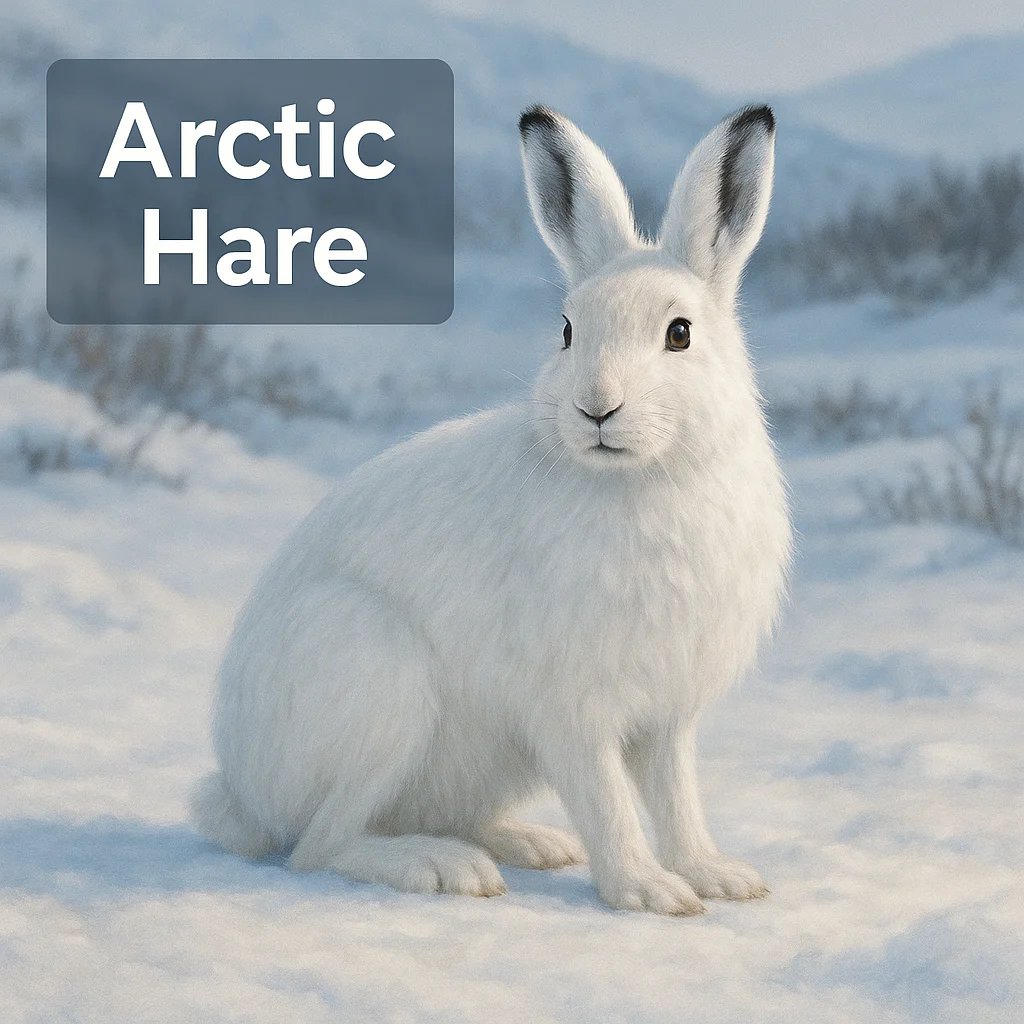
- Common name(s): Arctic Hare
- Scientific name: Lepus arcticus
- Animal type: Mammal
- Typical adult size: 43 to 70 cm in length; weight ranges from 3 to 7 kg
- Typical lifespan: 3 to 5 years in the wild
- Diet type: Herbivore; feeds on woody plants, mosses, and lichens
- Activity pattern: Primarily crepuscular, active during dawn and dusk
- Social structure: Solitary or small groups in winter for warmth
- Speed / movement highlights: Capable of running at speeds up to 60 km/h
- Intelligence/learning: Adapted to find food and shelter in extreme conditions
- Primary habitats: Arctic tundra
- Geographic range: Northern Canada, Greenland, and the Arctic Archipelago
- Predators/threats: Predators include Arctic foxes, wolves, and birds of prey
- Conservation status: Least Concern, but varies by region
🔍 Identification & Appearance
The Arctic Hare is easily recognized by its thick, white winter coat, which provides excellent camouflage against the snowy backdrop of its habitat. Its body shape is stocky yet elongated, with powerful hind legs built for fast movement across snow and ice. In summer, its fur changes to a blue-gray or brown to blend in with the rocky, snowless tundra.
- Body shape: Stocky with elongated body
- Color: White in winter, blue-gray or brown in summer
- Distinctive features: Long ears and powerful hind legs
- Tracks: Large, round tracks with visible toe prints
- Look-alikes: Snowshoe Hare; Arctic Hare is larger and has longer ears
- Tail: Short and usually matches body fur color
- Head: Rounded with a blunt snout
- Seasonal changes: Coat color changes with seasons
- Juvenile vs adult: Juveniles are smaller but similar in appearance
🧱 Body Structure & Physical Adaptations
Arctic Hares are built to endure the severe Arctic climate. They have compact bodies to reduce exposure to cold, and their fur is one of the densest among hares, providing excellent insulation. Their strong, muscular hind legs allow them to leap long distances, while their sharp claws help them dig through snow to access food.
- Compact, stocky build for minimizing heat loss
- Dense fur for insulation against cold and wind
- Sharp incisors for eating woody plants
- Powerful hind legs for fast running and high jumping
- Large feet act as snowshoes, preventing sinking into snow
- Long ears aid in heat dissipation during warmer months
- Sharp claws for digging and foraging for food
- Excellent vision, especially in low light conditions
- Varied fur length provides seasonal adaptation
🌍 Range & Distribution
The Arctic Hare inhabits the northernmost regions of North America, including parts of Canada and Greenland. They are also found across various Arctic islands. These hares are highly adaptable, residing in lowland tundra as well as areas with rocky outcrops.
- Northern Canada and Greenland
- Found throughout the Arctic Archipelago
- Prefers tundra regions
- Resides in areas with significant snowfall
- Found from low sea level to high plateaus
- Stays mostly in open, treeless regions
- Some populations are resident year-round
- Occasionally found in coastal areas
🏞️ Habitat & Shelter
Arctic Hares prefer the open expanses of the Arctic tundra where they can easily see predators. They create forms, shallow depressions in the ground or snow, to shield themselves from the wind. During winter, they might group together to conserve heat.
- Open tundra with sparse vegetation
- Utilizes natural shelters provided by rocky outcrops
- Forms shallow depressions in the ground for resting
- Adapted to less robust plant life of the Arctic
- In some regions, builds burrows for shelter
- Habitat knowledge crucial for understanding survival strategies
🧭 Behavior & Ecology
Arctic Hares are primarily solitary, but they exhibit social behavior in winter when conditions necessitate. They are highly adapted for survival in their environment, using cryptic coloration and speed to evade predators. Their feeding habits play a vital role in shaping the plant community of the tundra.
- Cleverly utilize camouflage for avoiding predators
- Form groups in winter for warmth and predator detection
- Effective at exploiting limited vegetation resources
- Crucial food source for many Arctic predators
- Active at dawn and dusk, minimizing daylight exposure
- Communication through visual signals and posture
- Practices resting in forms to minimize environmental exposure
- Relies on keen senses to detect threats
👥 Social Life & Group Dynamics
Arctic Hares are mostly solitary, but during the harsh Arctic winters, they may form small groups to help keep warm and increase predator vigilance. However, they do not form lasting social bonds and will separate as soon as conditions allow.
- Primarily solitary outside of winter
- Forms temporary groups in extreme cold
- No complex hierarchies or lasting bonds
- Split from group as soon as conditions improve
- Low reliance on social cooperation
- Brief encounters at feeding sites
- No cooperative hunting or rearing of young
🍽️ Diet, Prey & Predators
The Arctic Hare is a herbivore, primarily consuming woody plants, mosses, and lichens that are prevalent in its Arctic habitat. Its diet shifts slightly depending on seasonal availability of food sources. These hares are preyed upon by various Arctic predators.
- Herbivorous diet, relies on plants and lichens
- Feeding behavior changes with seasons
- Primary food sources include willow and saxifrage
- Targeted by Arctic foxes, wolves, and raptors
- Use speed and camouflage as main anti-predator strategies
- Constant foraging during winter months over large areas
- No evidence of storing food for winter
🦌 Hunting, Foraging & Movement
As agile foragers, Arctic Hares cover large distances to locate food, employing their exceptional speed and endurance. They primarily forage at dusk and dawn. Their large feet prevent them from sinking into snow, which aids in their movement across the winter landscape.
- Exceptional runners, achieving speeds of 60 km/h
- Predominantly dusk and dawn foragers
- Agile leapers and capable of maneuvering over snow
- Utilize a wide search area for their food
- Navigation relies on memory of local terrain
- Pattern of short bursts and pauses when moving
🧠 Intelligence & Senses
The Arctic Hare's intelligence is displayed in its ability to navigate and adapt to the harsh Arctic environment. Its strong senses, particularly sight and hearing, are crucial for detecting predators. While research on cognitive abilities is limited, their ecological adaptations suggest a keen ability to survive.
- Excellent vision for spotting predators in the snow
- Relies on memory to navigate familiar territories
- Adapted to detect low-frequency sound vibrations
- Quick adaptive responses to environmental challenges
- Limited research on problem-solving abilities
- No recorded instances of tool use
🪺 Reproduction, Pregnancy & Parenting
Arctic Hares breed in spring, and after a gestation period of approximately 50 days, the female gives birth to a litter of leverets. The young are precocial, born fully furred and open-eyed, allowing them to be relatively independent shortly after birth.
- Breeding occurs as snow begins to melt
- Typically, one breeding season per year
- Gestation period ranges from 45 to 55 days
- Litter size ranges from 1 to 8, generally around 3
- Female exclusively tends to the young
- Young are weaned at approximately 2 to 3 weeks
- No long-term parental care after weaning
- Reproductive success tied to environmental conditions
♀️♂️ Male vs Female Differences
Sexual dimorphism in Arctic Hares is subtle. Males and females are similar in appearance with no noticeable difference in size or coloration. Behavioral roles during reproduction and parenting are also not significantly different, with the female responsible for nurturing the young.
- No prominent size difference between males and females
- Similar coloration across sexes and age groups
- Both sexes exhibit similar agility and speed
- Females exclusively responsible for nurturing leverets
- Lack of distinct sexual display behaviors
- Subtle hormonal differences during breeding season
🧬 Subspecies & Variation
The Arctic Hare is primarily categorized as a single species, Lepus arcticus, with little recognized subspecies variation. However, there is variation in color and size due to local environmental adaptations. Current classifications of any subspecies remain debated among scientists.
- Mainly uniform across its range
- Coloration varies with geographical location
- Slight size variation across different regions
- Adaptation to specific local climates
- Unclear classification of potential subspecies
⚠️ Threats, Conservation & Human Interaction
The Arctic Hare faces threats from natural predators and climate change, which impacts their habitat. Despite being classified as Least Concern, their populations may fluctuate based on environmental changes. Human activities such as habitat disturbance pose secondary challenges.
- Primary threat: Predation by natural Arctic carnivores
- Climate change alters their cold habitat
- Loss of suitable breeding grounds due to warming
- Human-induced habitat disturbance poses a threat
- Populations resilient but potentially fluctuating
- Uncommon in captivity, limited conservation need
- Increased awareness beneficial for habitat preservation
✨ Fun Facts & Unique Traits
- Arctic Hares are one of the only hare species to change coat color seasonally.
- They can survive temperatures as low as -60 degrees Celsius.
- Despite their size, Arctic Hares can jump distances of up to 2 meters.
- Their large feet are uniquely adapted to act like snowshoes.
- Often found sitting motionless for prolonged periods to avoid detection.
- Capable of running faster than a tennis ball serve (approaching 60 km/h).
- Resilient against frigid winds due to their dense fur.
- Their winter pelage provides crucial camouflage in snowy landscapes.
📌 Summary
- An easily recognizable resident of the Arctic tundra.
- Well adapted to one of the harshest environments on Earth.
- Changes coat color with the season for camouflage.
- Feeds on available vegetation such as lichens and mosses.
- Acts as key prey species for several Arctic predators.
- Solitary lifestyle with winter grouping behavior.
- Reproduction is seasonally dependent, with early independence for young.
- No notable sexual dimorphism, with standard roles during breeding.
- Color and size variation aid in localized survival.
- While classified as Least Concern, climate impact needs monitoring.