🦁 Ocean Sunfish
🧾 Quick Facts
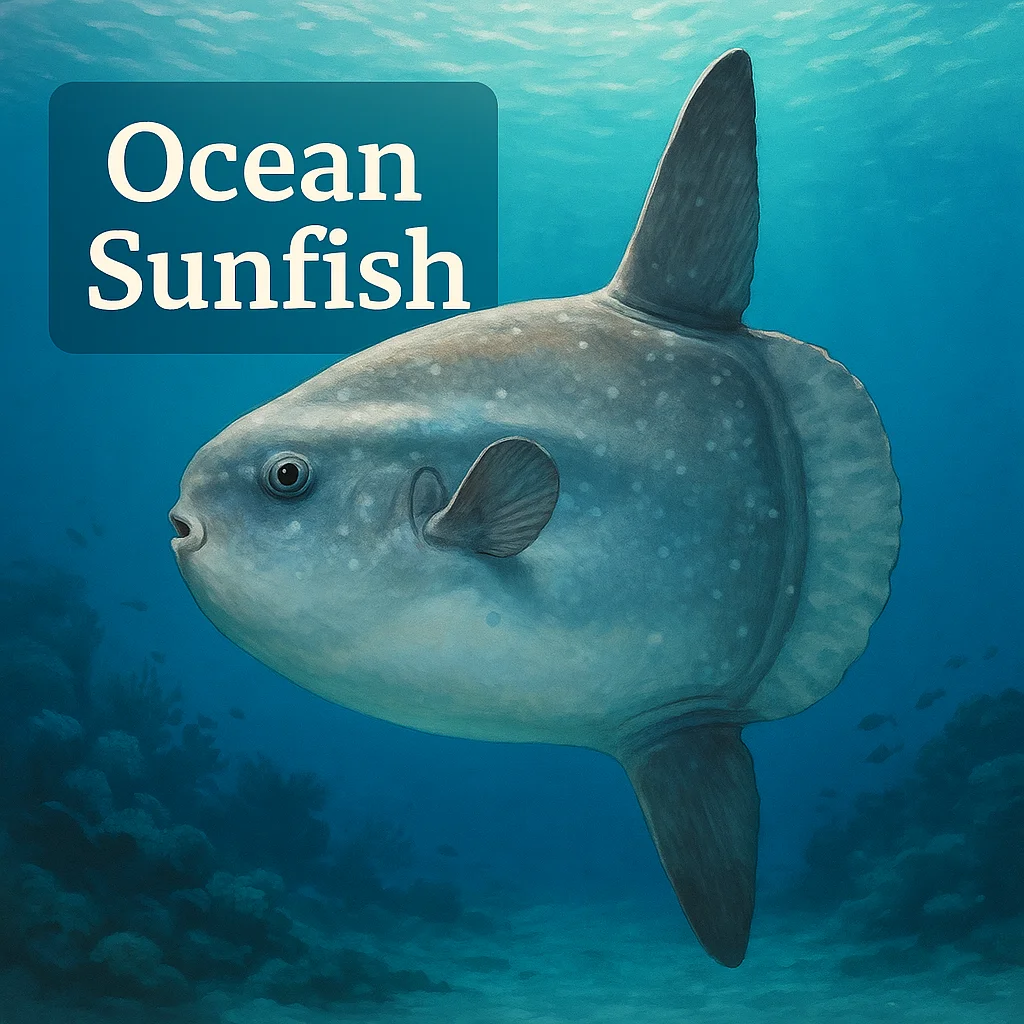
The Ocean Sunfish, also known as the Mola mola, is a distinct marine creature often noted for its unusual shape and massive size. These fascinating fish inhabit the world's oceans and are known for their gentle nature despite their formidable appearance.
- Common Name(s): Ocean Sunfish, Common Mola
- Scientific Name: Mola mola
- Animal Type: Fish
- Typical Adult Size: 1.8–3.3 meters in length; weight up to 2,300 kg
- Typical Lifespan: 10–20 years in the wild
- Diet Type: Carnivore; primarily feeds on jellyfish and small fish
- Activity Pattern: Diurnal
- Social Structure: Generally solitary
- Speed / Movement Highlights: Slow swimmer
- Intelligence/Learning: Basic learning behaviors observed
- Primary Habitats: Temperate and tropical oceans
- Geographic Range: Worldwide distribution
- Predators/Threats: Sharks, orcas, sea lions; human impacts include fishing nets
- Conservation Status: Varies by region; generally considered vulnerable
🔍 Identification & Appearance
The Ocean Sunfish is renowned for its peculiar appearance. Its body is laterally compressed, giving it a flattened, disc-like shape with a high dorsal fin and an elongated anal fin. This unusual shape is accented by their large rounded heads and a tail-like structure called a clavus.
- Body : Flattened sideways with a tall dorsal and elongated anal fin
- Color: Generally a silvery-gray, sometimes brownish
- Distinctive Features: Clavus instead of a true tail fin
- Changes: Little variation across seasons but juveniles more rounded
- Common Look-Alikes: None; unique silhouette
- Top ID Tips:
- High dorsal and extended anal fins
- Silvery-gray or brownish color
- Rounded body without true tail fin
- Largest of bony fishes
- No scales, but rough-textured skin
- Juveniles are a smaller, more rounded version of adults
🧱 Body Structure & Physical Adaptations
The Ocean Sunfish's body is adapted for its lifestyle in the open ocean. Its reduced tail fin, the clavus, results in an inefficient swimmer. Yet, it can maneuver effectively as it leverages its large dorsal and anal fins for movement. Despite these physical constraints, they can dive to depths exceeding 600 meters to feed.
- Build: Stocky and disc-shaped
- Jaw Adaptations: Fused teeth forming a parrot-like beak
- Fins: Large dorsal and anal fins provide propulsion; no true tail
- Sensory Strengths: Good vision but limited olfactory senses
- Key Adaptations:
- Flattened body for vertical swimming
- Bony plates instead of scales for extra protection
- Buoyancy adapted to frequent deep dives
- Capable of basking on sea surface
- Resistant skin against jellyfish stings
🌍 Range & Distribution
The Ocean Sunfish is found in temperate and tropical ocean waters globally. They are resident mostly in open oceans and are rarely seen near the coastlines unless following cooler currents or prey.
- Continents: Oceans around North and South America, Africa, Europe, Asia, and Australia
- Elevation Range: Sea level to open ocean depths
- Migratory Behavior: Limited; generally follows food sources and currents
- Where You Might Find It:
- Global oceanic waters
- Near the surface basking in sunlight
- Sometimes found washed up on beaches
- Open sea coasts with plenty of jellyfish
- Warm tropical regions
🏞️ Habitat & Shelter
Though Ocean Sunfish are primarily open-ocean dwellers, they may venture into coastal areas. They do not use shelters like caves or reefs but rely on the open water for space and sunlight for thermoregulation.
- Preferred Habitats: Mostly open ocean
- Shelter and Microhabitats: None; utilize open waters
- Behavioral Changes with Season: Moving closer to surface in warmer waters
- Importance of Habitat Knowledge: Understanding their preference for open, sunlit waters helps in studying their thermoregulation and basking behavior
🧭 Behavior & Ecology
Ocean Sunfish are diurnal creatures that exhibit a unique thermoregulation behavior by basking in the sun to warm up after deep dives. They are non-territorial and mostly solitary. They play an ecological role in controlling jellyfish populations.
- Daily Routine: Alternating between deep diving and surface basking
- Communication: Limited direct communication with conspecifics
- Interactions with Other Species: Limited; prey for larger marine predators
- Ecological Role: Control jellyfish populations
- Behavior Highlights:
- Surface basking for warming after deep dives
- Generally solitary but occasionally form groups during feeding
- Non-aggressive and avoid confrontations
- Vulnerable to fishing nets
- No specific defense mechanisms against predators
👥 Social Life & Group Dynamics
Ocean Sunfish are largely solitary creatures, coming together occasionally in small groups when feeding. They do not form structured social groups or maintain territories.
- Tendencies: Predominantly solitary
- Group Types: Temporary aggregations when feeding
- Cooperation: None observed
- Dominance Hierarchies: Not applicable
- Social Structure Notes:
- Mostly solitary existence
- Occasional group feeding
- No hierarchy formation
- Limited interaction with other marine species
🍽️ Diet, Prey & Predators
Ocean Sunfish have a diet predominantly composed of jellyfish, although they also consume small fish, zooplankton, and algae. Predators include marine animals like sharks, orcas, and sea lions. Their main anti-predator defense is their large size, though it offers limited protection against modern fishing practices.
- Diet Composition: Mainly jellyfish; also small fish and zooplankton
- Feeding Strategy: Opportunistic carnivore
- Main Natural Predators: Sharks, orcas, sea lions
- Anti-Predator Defenses: Large size to deter smaller predators
- Feeding Notes:
- Feeds frequently on jellyfish
- Opportunistically consumes small fish
- Nocturnal feeding observed in certain areas
- Large, slow swimmer makes escape difficult
🦌 Hunting, Foraging & Movement
Ocean Sunfish are generally slow swimmers that move primarily using their dorsal and anal fins, giving a distinct, casual flap like motion. Despite their bulk, they can dive deeply, allowing them access to a variety of prey. They tend not to migrate long distances but will follow warm ocean currents.
- Locomotion Style: Slow-moving, flapping their dorsal and anal fins
- Diving Capability: Known to dive over 600 meters when foraging
- Movement Strategy: Follows ocean currents
- Movement & Strategy:
- Flaps large dorsal and anal fins for movement
- Dives deeply to access jellyfish populations
- Not strong migrators
- Spends considerable time basking at the surface
🧠 Intelligence & Senses
Ocean Sunfish display basic learning abilities, possessing moderate intelligence relative to their simple lifestyles. They rely on their vision more heavily than on olfactory senses due to the nature of their prey.
- Learning: Basic capabilities, little need for complex problem-solving
- Sensory Use: Reliance on vision rather than smell
- Intellectual Highlights:
- Capable of learning simple tasks
- Primarily uses vision for navigation and hunting
- Research on cognition is limited
🪺 Reproduction, Pregnancy & Parenting
The Ocean Sunfish spawns in aggregations, releasing massive amounts of eggs and sperm into the water column. Fertilization is external. After a brief embryonic stage, the sunfish larvae grow rapidly, undergoing an extensive metamorphosis before becoming adults. Parental care is non-existent.
- Breeding Seasonality: Not well defined; occurs in warm waters
- Mating System: Promiscuous spawning aggregations
- Reproduction Strategy: High number of offspring to offset predation
- Reproduction Snapshot:
- Females produce millions of eggs
- External fertilization in open water
- Larvae undergo significant transformation
♀️♂️ Male vs Female Differences
Male and female Ocean Sunfish are generally similar in appearance, yet studies suggest females might be larger; however, observable differences are subtle and often vary among populations, complicated by their unique life in the vast ocean.
- Size Differences: Females are often larger
- Behavioral Role: Comparable roles due to shared environment
- External Morphology: Overall similar vision
- Sex Differences at a Glance:
- Females may be larger
- Subtle differences generally
🧬 Subspecies & Variation
There are no officially recognized subspecies of the Ocean Sunfish; instead, their population varies subtly across different oceans due to environmental factors. Their morphological consistency makes them distinguishable by their structural uniqueness.
- Variation Notes:
- No distinct subspecies identified
- Size and color can vary with environment
⚠️ Threats, Conservation & Human Interaction
Ocean Sunfish face threats from human activities, including bycatch in fisheries, pollution, and habitat degradation. Conservation efforts include reducing bycatch through modified net designs.
- Responsible Notes:
- Efforts to reduce bycatch through awareness and fishing practices
- Minimizing ocean pollution can significantly enhance their survival
✨ Fun Facts & Unique Traits
- Ocean Sunfish are the heaviest known bony fish in the world.
- A single female can produce up to 300 million eggs at one time, more than any other vertebrate.
- They are known to occasionally leap from the water to remove parasites.
- Despite their large size, they tend to have a placid nature.
- Sunfish suffer from a high number of parasites; they often seek cleaner fish to remove them.
- Their unusual shape and size make them a popular subject of interest for marine enthusiasts.
📌 Summary
- The Ocean Sunfish is uniquely disc-shaped and the largest of the bony fish.
- Found in temperate and tropical oceans worldwide, they bask in sunlit waters.
- Diet consists mainly of jellyfish and other small marine creatures.
- They face natural threats from sharks and human impacts from fisheries.
- Predominantly solitary, they may congregate during feeding on jellyfish blooms.
- Females produce millions of eggs, with little to no parental care involved.
- Faster than it appears, the Sunfish relies on its dorsal and anal fins for effective propulsion.
- The fish exhibits basic intelligence with heavy reliance on visual cues.
- They’re vulnerable with increased threats from human fishing techniques and pollution.
- Their unique morphology and serene behavior make them a captivating species.