🦁 Oarfish
🧾 Quick Facts
The oarfish is a fascinating and mysterious deep-sea creature renowned for its extraordinary length and enigmatic behaviors. Often mistaken for a sea serpent in folklore, it is a striking and elusive species found in the world's oceans.
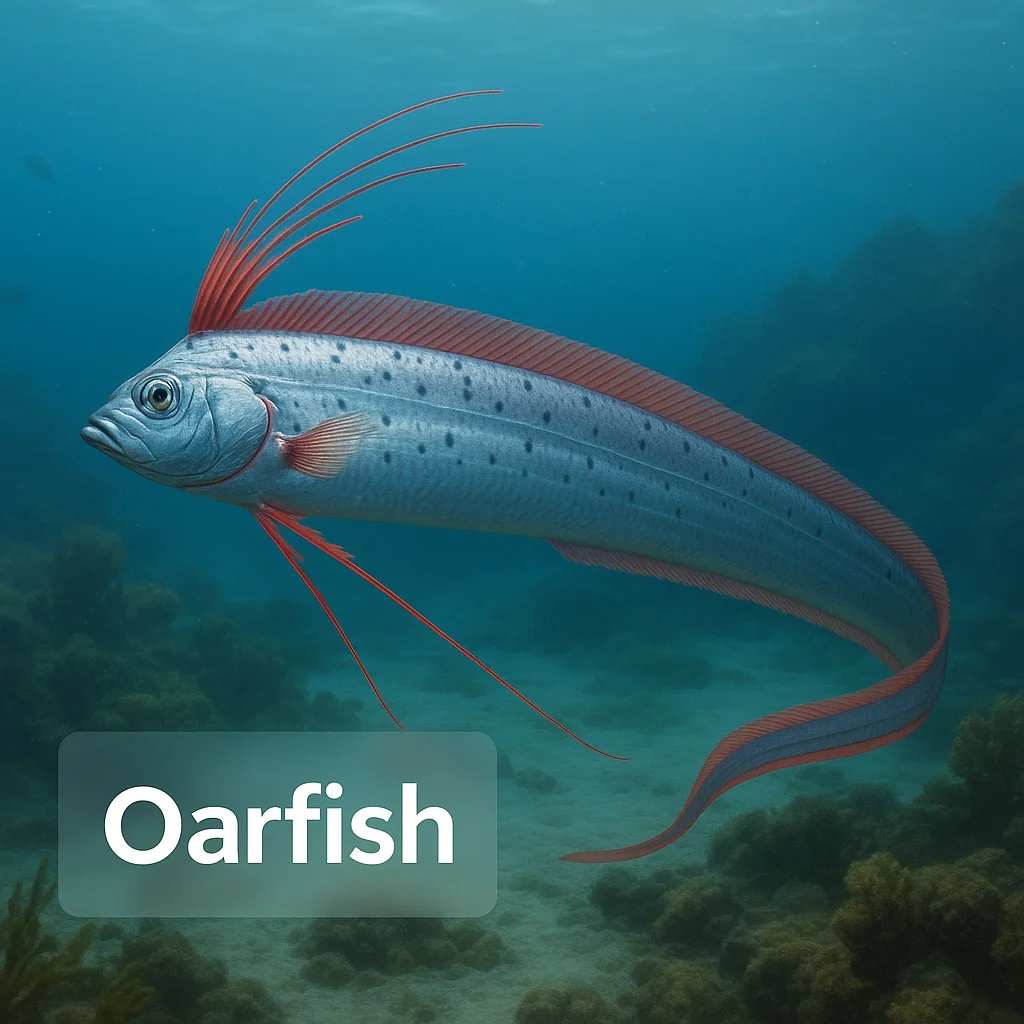
- Common name(s): Oarfish, Ribbon Fish
- Scientific name: Regalecus glesne (Giant Oarfish)
- Animal type: Fish
- Typical adult size: 20 to 30 feet (6 to 9 meters) in length
- Typical lifespan: Unknown; estimates suggest 10 to 20 years
- Diet type: Carnivore; primarily plankton, small fish, and squid
- Activity pattern: Mostly nocturnal, though poorly studied
- Social structure: Solitary
- Speed / movement highlights: Slow swimming, often vertically oriented
- Intelligence/learning: Limited understanding due to deep-sea habitat
- Primary habitats: Deep ocean waters
- Geographic range: Worldwide in temperate and tropical oceans
- Predators/threats: Sharks, large predatory fish; human curiosity impacts
- Conservation status: Data deficient; varies by region
🔍 Identification & Appearance
The oarfish is easily identified by its elongated, ribbon-like body and distinctive dorsal fin running the length of its body. Its silvery skin and bright red orifice on its dorsal fin make it stand out in the sea.
- Body shape is long and serpentine
- Silvery body with a vibrant red dorsal fin
- Fins create a fringe-like appearance
- Lack of scales, smooth skin
- Slight undulations to move through the water
- No swim bladder, aiding in deeper dives
- Rarely seen by humans; often found washed ashore
- Distinguishable from eels by dorsal fin features
- No significant age-related color changes
- No distinctive tracks or field signs due to oceanic nature
🧱 Body Structure & Physical Adaptations
Oarfish have a unique physical structure that allows them to thrive in the deep ocean. Their bodies are adapted for slow, stealthy swimming, with specialized fins and sensory adaptations.
- Very slender and elongated build
- Bristle-like teeth suited for grasping small prey
- Elegant dorsal fin provides propulsion and stabilization
- Fins optimized for vertical orientation
- Limited vision; relies on vibration detection
- Flexible body allows for maneuverability in dense waters
- No visible pectoral fins
- Sensitive to changes in water pressure
- Possesses bioluminescent capabilities
- Thin, translucent skin conserves energy
🌍 Range & Distribution
Oarfish are distributed across the world's oceans, favoring temperate and tropical waters. They are mostly found at significant depths but occasionally venture closer to the surface.
- Present in every ocean except the polar regions
- Commonly found at depths of 200 to 1,000 meters
- Favor warmer, tropical waters
- Rarely seen in shallow waters, often after storms
- Previously thought to be only in the Atlantic; now known globally
- Detection primarily by deep-sea cameras or wash-ups
- Commonly caught in fishing nets as bycatch
- No known migratory patterns
- Typically resident at oceanic depths
🏞️ Habitat & Shelter
The elusive oarfish prefers the deep pelagic zones of the ocean. Its habitat is characterized by sparse light and high-pressure environments that challenge many other marine life forms. Knowledge of this habitat is crucial to understanding its reclusive nature and feeding strategies.
- Inhabits the mesopelagic to bathypelagic zones
- Occasionally seen in shallower waters, usually by accident
- Lives in waters as deep as 200 to 1,000 meters
- Rare sightings often coincide with storms or disturbances
- No known nesting or burrowing behavior
- Prefers open ocean environments over coastal areas
- Seldom seen by divers due to depth preference
🧭 Behavior & Ecology
Much about the oarfish's behavior remains a mystery due to its deep-sea habitat. What is known suggests a solitary life with unique adaptations for survival in extreme environments.
- Primarily solitary and elusive
- Vertical swimmer; uses undulating motions
- Feeds near the surface at night, descends by daylight
- Not known to form schools or groups
- No documented vocalizations or communications
- Likely a slow, opportunistic feeder
- Vital part of the deep-sea food chain
- Evidence of mutualistic relationships with other marine life
- Role as prey for larger marine predators
- Presence indicates healthy oceanic ecosystems
👥 Social Life & Group Dynamics
Oarfish are solitary animals, known for living most of their life alone. Their interactions with others of their species or any other marine creatures are rarely observed, making their social life largely unknown.
- Exclusively solitary
- No known group structures or bonds
- Absent any known cooperative behavior
- No dominance hierarchies recorded
- Lacks territorial behavior
- Necessarily independent due to deep-sea environments
- Rare encounters outside of spawning events
- Loners throughout most life stages
🍽️ Diet, Prey & Predators
Oarfish primarily feed on plankton and small marine organisms, often ingesting what they encounter as they swim. Their diet reflects the abundance of small prey in their deep-sea habitat. While they have few predators, they risk impact from human activity.
- Feeds mainly on plankton and small invertebrates
- Consumes smaller fish and squid occasionally
- Swallows prey whole due to body shape and teeth arrangement
- Poor hunting skills supplemented by opportunistic feeding
- Natural predation by larger fish and sharks
- Rarely scavenges due to depth constraints
- Exposure to human threats such as fishing nets
🦌 Hunting, Foraging & Movement
Oarfish move with a mesmerizing wave-like motion, allowing them to navigate deep-sea pressures gracefully. Their hunting strategy is less about active pursuit and more opportunistic, capitalizing on available food sources.
- Adopts a graceful, wave-like swimming motion
- Slow swimmer, helps conserve energy
- Movement adapted to significant depth pressures
- Occasional visits to shallows, likely related to foraging
- Nocturnal feeding coincides with vertical migration of prey
- Glides more than propells itself actively
- No evidence of territory or home range behavior
- Likely to follow nutrient-rich currents
- Rarely seen breaching near surface
🧠 Intelligence & Senses
The oarfish's intelligence is difficult to quantify due to its inaccessible lifestyle; however, its sensory adaptations are suited for a deep-sea environment, where light is minimal, and pressure is high.
- Limited data on problem-solving abilities
- Senses adapted for low light and high pressure
- Utilizes lateral lines to detect water movements
- Evidence of bioluminescence as a communication method
- No known tool use or sophisticated learning behavior
- Highly specialized vision for deep-ocean conditions
- Unlikely to demonstrate memory retention
- Research on its intelligence is minimal
🪺 Reproduction, Pregnancy & Parenting
Oarfish reproduction remains enigmatic, but it is understood that they likely spawn near the surface. The specifics of their courtship, gestation, and parental roles continue to intrigue marine biologists.
- Spawning likely occurs at the ocean's surface
- Eggs are buoyant, floating until hatching
- Details on mating systems are unknown, varies likely
- Juveniles rapidly develop distinctive elongated bodies
- No parental care; offspring are independent from hatching
- Reproductive seasonality remains largely speculative
- Egg size and color not well documented
- Alloparenting not typically observed
♀️♂️ Male vs Female Differences
Sexual dimorphism in oarfish is presumed minimal if present. The lack of distinct differences between males and females suggests a limited role for competition or mate selection based on physical traits.
- Minimal observable external differences
- No significant size variation noted between sexes
- Unknown mating displays or differences during courtship
- Variance in reproductive roles not well-documented
- Environmental factors may obscure subtle differences
- Both sexes possess similar dorsal fin adaptations
🧬 Subspecies & Variation
Currently, only the giant oarfish is widely recognized, but regional variation may exist. As deep-sea creatures, their classification is subject to ongoing study, requiring more specimens for comprehensive understanding.
- Giant Oarfish is the most studied variety
- Potential variations not extensively documented
- Saltwater ecosystems contribute to regional adaptations
- Differences largely anecdotal, requiring scientific validation
- Minimal genetic diversity suggested due to ocean-wide distribution
⚠️ Threats, Conservation & Human Interaction
The oarfish faces threats from human activities, primarily through accidental capture and environmental disturbances. Conservation efforts are hindered by its elusive nature and deep-sea habitat.
- Bycatch in commercial fishing nets
- Climate change impacts on oceanic temperature and currents
- Pollution leading to habitat degradation
- Ocean acidification threatening deep-sea biodiversity
- Lack of comprehensive data on population numbers
- Encourage mindfulness near marine habitats
- Sightings contribute to awareness and data gathering
✨ Fun Facts & Unique Traits
- The oarfish is the longest bony fish in the world.
- Historically mistaken for sea serpents in sailors' tales.
- They can shed their tails when threatened.
- Unlike many fish, they lack typical swim bladders.
- They are rarely seen alive due to deep-sea preference.
- Oarfish have been featured in many cultural myths and folklore.
- Their body movements are a study of physics in motion.
- They are often washed ashore during strong storms.
- In Japan, they are considered harbingers of earthquakes.
- Despite their fearsome legend, they are harmless to humans.
📌 Summary
- Oarfish are identifiable by their elongated, serpentine body.
- They reside in deep ocean habitats worldwide, favoring warmer waters.
- Their diet consists of plankton and small marine organisms.
- Natural predators include sharks and large predatory fish.
- Primarily solitary with no known complex social structures.
- Reproduction involves surface spawning with buoyant eggs.
- Key adaptations include a specialized dorsal fin for stabilization.
- Known for mysterious appearances on shores and in folklore.
- Subject to threats from fishing practices and environmental change.
- Their presence aids in indicating oceanic health.