🦁 Manta Ray
🧾 Quick Facts
Manta rays are among the most majestic and recognizable marine creatures in the ocean. These gentle giants glide through open waters and are well-known for their impressive size, large wingspans, and unique feeding behavior.
- Common name(s): Manta Ray
- Scientific name: Manta birostris, Manta alfredi
- Animal type: Fish
- Typical adult size: 5.5 to 7 meters (18 to 23 feet) across
- Typical lifespan: 20 to 50 years
- Diet type: Planktivore; feeds on plankton, small fish
- Activity pattern: Diurnal; active during daylight
- Social structure: Generally solitary but can be found in groups during feeding or breeding
- Speed / movement highlights: Glides gracefully, can reach speeds up to 24 km/h (15 mph)
- Intelligence/learning: Known for curiosity and problem-solving skills
- Primary habitats: Open ocean, coral reefs
- Geographic range: Tropical and subtropical oceans worldwide
- Predators/threats: Sharks, orcas; human activities like fishing and habitat loss
- Conservation status: Varies by region; generally threatened
🔍 Identification & Appearance
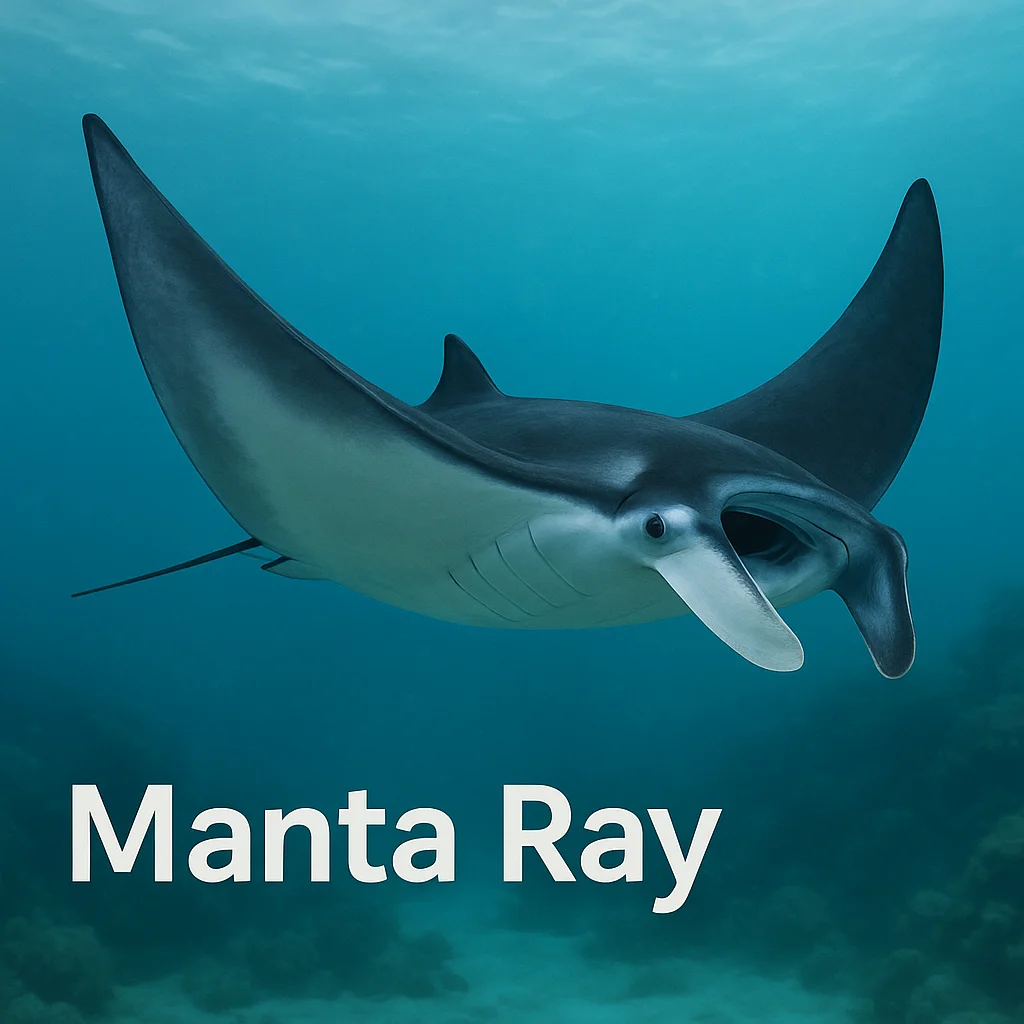
Manta rays are unmistakable with their huge, wing-like pectoral fins and flat, diamond-shaped bodies. These rays are typically dark on top, with varying shades of black, grey, or blue, and white underneath. Distinctive cephalic fins extend forward, resembling horns, which they use to direct plankton into their mouths. Manta rays are often confused with smaller stingrays, but the lack of a venomous tail is a key distinction.
- Body shape: Diamond-shaped body with large pectoral fins
- Distinctive colors: Dark dorsal side, white ventral side
- Cephalic fins: Horn-like structures on head
- Tail: Short and whip-like; lacks venomous barb
- Ventral pattern: Unique to each individual, useful for identification
- Common look-alikes: Stingrays (smaller, have a venomous tail)
- Top ID Tips:
- Look for large, triangular pectoral fins
- Notice the horn-shaped cephalic fins
- Identify tail without a sting
- Check for unique belly patterns
- Consider size, significantly larger than most rays
- Focus on graceful swimming style
🧱 Body Structure & Physical Adaptations
Manta rays have highly specialized adaptations that allow them to thrive in their environments. Their wide, flat bodies are perfectly designed for efficient swimming across vast ocean distances. Mantas possess a unique feature called a spiracle behind each eye, which aids in breathing while they rest. Their large mouths enable effective filter feeding, and the cephalic fins help guide food into their mouths. Furthermore, the manta's sense of vision is highly developed, helping them navigate the vast oceans.
- Build: Flat, diamond-shaped bodies with wide "wingspan"
- Jaws: Adapted for filter feeding, wide mouth
- Fins: Large pectoral fins for gliding
- Sensory strengths: Excellent vision, possibly UV vision
- Cephalic fins: Help funnel plankton into mouth
- Key Adaptations:
- Efficient filter feeding system
- Highly maneuverable body for escaping predators
- Large wingspan for long-distance swimming
- Advanced vision for detecting prey and predators
- Cephalic fins for effective food ingestion
- Spiracles aiding in respiration during rest
🌍 Range & Distribution
Manta rays inhabit the warm-water regions of the planet, frequenting tropical and subtropical waters. They're found in both coastal areas and the open ocean, and while they generally prefer shallow waters for feeding, they are capable of diving to great depths. Manta migration patterns are determined by the availability of plankton, their primary food source, and they may travel long distances to locate these feeding grounds. Despite being pelagic creatures, manta rays are commonly found near productive coastal waters.
- Indian Ocean: Tropical regions around India, Sri Lanka
- Pacific Ocean: Coastal areas near Indonesia, Thailand
- Atlantic Ocean: Gulf of Mexico, Caribbean Sea
- Red Sea: Coral-rich areas
- South America: Coastlines of Brazil
- Where You Might Find It:
- Warm, tropical waters
- Near coral reefs
- Along productive coastal zones
- Open ocean regions
- Regions with high plankton density
🏞️ Habitat & Shelter
Manta rays are predominantly found in warm, tropical, and subtropical waters where coral reefs and nutrient-rich waters are abundant. These organisms thrive in environments with high plankton availability, which is essential for their filter-feeding diet. Although manta rays generally prefer to stay near the surface, they can dive to considerable depths, often near reef cleaning stations where they engage in symbiotic relationships with cleaner fish. Understanding their habitat preferences can provide insight into their migratory patterns, feeding behaviors, and vulnerability to environmental changes.
- Preferred habitats: Coastal regions, coral reefs, open ocean
- Microhabitats: Cleaning stations in reefs
- Weather influence: Movements can vary with plankton blooms
- Importance of habitat: Critical for feeding and cleaning behaviors
🧭 Behavior & Ecology
Manta rays are notable for their distinctive feeding techniques and symbiotic relationships. They often perform acrobatic leaps from the water surface, thought to aid in plankton intake and parasite removal. Mantas use a graceful swimming style, aided by their large fins, to glide gracefully through the water. They communicate through body movements and may engage in social behaviors around feeding zones or during breeding seasons. As large filter feeders, they play a crucial role in maintaining the health and dynamics of marine ecosystems.
- Daily routine: Includes filter feeding and visiting cleaning stations
- Communication: Uses body language
- Inter-species relationships: Often interact with cleaner fish
- Role in ecosystem: Filter feeders that maintain marine health
- Behavior Highlights:
- Acrobatic behavior
- Social feeding in groups
- Resting in shallow cleaning stations
- Seasonal migrations for feeding
- Non-aggressive, curious nature
👥 Social Life & Group Dynamics
Manta rays exhibit a fascinating mix of solitary and social behaviors. While they are predominantly solitary creatures, they can be seen congregating in groups during feeding frenzies or at mating aggregate sites. These gatherings are not composed of permanent groups but are more opportunistic based on environmental conditions. Mantas lack significant social hierarchies and generally form non-structured group interactions. Cooperation is mostly seen during hunting and in their interaction with cleaner fish.
- Tendency: Mostly solitary, occasional group gatherings
- Group types: Temporary aggregations during feeding
- Cooperation: Mostly for feeding and breeding
- Social Structure Notes:
- No permanent social group structures
- Gather in groups when feeding is optimal
- Role in cleaning stations
- No clear dominance hierarchies
- Fraudulent cleaning behavior seen occasionally
🍽️ Diet, Prey & Predators
Manta rays are filter feeders that sustain themselves mainly by consuming plankton, although they may also consume small fish when available. They employ a feeding strategy known as unfurling their cephalic fins to guide plankton-filled water into their large mouths. Natural predators include large sharks and orcas. Manta rays rely on their exceptional swimming abilities and awareness to avoid predators, rather than engaging in direct confrontations.
- Diet: Plankton, small fish
- Feeding method: Filter feeding using cephalic fins
- Main predators: Large sharks, orcas
- Feeding Notes:
- Highly specialized filter feeders
- Consumes vast quantities to sustain energy
- Plankton ingestion dictates movement
- Avoids conflict, uses agility against predators
- Analogous to baleen whales' feeding technique
🦌 Hunting, Foraging & Movement
Manta rays are primarily swimmers, using their large pectoral fins to navigate and maneuver expertly in water. They rely on continuous swimming both for feeding and respiration, as water flow across gills is imperative. While not particularly fast, they are capable of graceful acrobatics including forward flips and leaps above the water's surface. Their movements are largely influenced by feeding requirements, leading them to migrate long distances based on plankton availability.
- Locomotion style: Efficient swimmers
- Speed and endurance: Prefers steady, agile movements over speed
- Navigation: Follows plankton blooms, guided by senses
- Movement & Strategy:
- Long-distance migrations following currents
- Uses grace, not speed, for predator avoidance
- Engages in social swimming when feeding
- Highly adaptable to dynamic water conditions
- Relies on sensory navigation along routes
🧠 Intelligence & Senses
Research into manta ray intelligence suggests they possess high levels of cognitive function, often demonstrated by their curiosity towards divers and novel objects. Their advanced forms of communication and behavior also relate to their significant brain size, amongst the largest of all fish. Mantas rely heavily on sight, possibly augmented by UV vision, to discern potential food sources and avoid predators. However, much about their precise cognitive abilities remains a topic of ongoing study and exploration.
- Problem-solving ability: Shows curiosity
- Senses: Acute vision possibly including UV perception
- Notable Abilities:
- Recognizes individual belly patterns
- Curiosity towards humans and objects
- Memory for feeding grounds
- Sophisticated maneuverability in water
- Potential use of UV light for navigation
🪺 Reproduction, Pregnancy & Parenting
Manta rays follow a typically slow and cautious reproductive strategy. Mating often involves elaborate displays and courtship "trains" where males follow a female in a line. Mantas are thought to be ovoviviparous, with embryos developing inside the mother before being born as live young. Upon birth, the pup, resembling a miniature adult, is generally left to fend for itself, as parental care is minimal to nonexistent.
- Breeding seasonality: Varies with region, often triggered by food availability
- Mating system: Promiscuous
- Gestation period: Typically around 12 months
- Reproduction Snapshot:
- Breeds every 2-3 years due to long gestation
- Usually one offspring per birth, rarely twins
- Pups are born fully formed
- No parental care post-birth
- Reproduction influenced by environmental conditions
♀️♂️ Male vs Female Differences
Manta rays exhibit sexual dimorphism to a limited degree, primarily seen in size and reproductive organs. Females are often larger than males, providing some advantage in mating and food storage capabilities. Males are distinguished by the presence of claspers, specialized appendages used in reproduction. Behaviorally, females are typically the initiators in mating rituals and pursue selective mating strategies, emphasizing the role size plays in sexual selection.
- Size: Females larger than males
- Reproductive organ difference: Males have claspers
- Behavioral roles: Females lead mating; selective
- Sex Differences at a Glance:
- Females generally larger
- Males possess claspers
- Females may engage in longer migrations
- Different roles during mating behaviors
- Females carry and give birth to live young
🧬 Subspecies & Variation
Two primary species of manta rays are widely recognized: the reef manta ray (Manta alfredi) and the giant oceanic manta ray (Manta birostris). The former tends to be smaller and inhabits coral reefs, while the latter is the largest ray species and roams the open oceans. Both show some local adaptations to environmental conditions, though extensive migration prevents pronounced geographic subspeciation.
- Reef vs Oceanic: Manta alfredi (reef), Manta birostris (oceanic)
- Size: Manta birostris generally larger
- Range: Local adaptations but minimal speciation
- Variation Notes:
- Reef manta more localized
- Oceanic manta highly migratory
- Similar feeding strategies despite habitat
- Limited physical differences aside from size
- Some local behavioral adaptations noticed
⚠️ Threats, Conservation & Human Interaction
Manta rays face several threats both from natural predators and human-induced challenges. Habitat degradation, bycatch in commercial fisheries, and target hunting for gill plates pose significant threats to their populations. Despite being tourist attractions in some regions, human interactions can sometimes stress these animals. Conservation efforts focus on habitat preservation, reducing bycatch, and raising awareness through marine protection acts. Interaction with humans should be respectful and considerate, ensuring minimal disturbance to their natural behaviors.
- Natural challenges: Predation by sharks, orcas
- Human-related pressures: Fishing bycatch, habitat loss
- Coexistence tips: Enjoy responsibly, adhere to wildlife guidelines
- Responsible Notes:
- Avoid disrupting feeding or mating behaviors
- Support marine protected areas
- Promote sustainable fishing practices
- Participate in conservation efforts
- Raise awareness through education
✨ Fun Facts & Unique Traits
- Mantas can leap impressively out of water, a behavior known as breaching.
- Their wingspan can reach over 23 feet, making them the largest of the rays.
- Individual manta rays can be identified by their unique binary patterns on their bellies.
- Mantas perform intricate "dances" during courtship, involving rolling and looping.
- Despite their size, they are considered gentle giants with a calm demeanor.
- These rays are known for their intelligence within the fish class.
- Manta rays are continually swimming as they need constant water flow over their gills.
- They can form social feeding groups when food aggregations are found.
- Some mantas exhibit a peculiar "fraudulent cleaning behavior" where they act as if to be cleaner fish.
📌 Summary
- Identify by large, wing-like pectoral fins and a unique body shape.
- Inhabit warm coastal and open ocean waters worldwide.
- Primarily consume plankton through filter feeding adaptations.
- Natural predators include large sharks and orcas.
- Social behavior is opportunistic, usually solitary or in feeding groups.
- Mating involves elaborate courtship; long gestation with minimal parenting.
- Key adaptations include maneuverable pectoral fins and effective sensory organs.
- Conservation efforts focus on habitat protection and mitigation of fishing threats.
- Unique traits include breaching behaviors and intricate social “dances.”