🦁 Eagle Ray
🧾 Quick Facts
Eagle Rays are a fascinating group within the family Myliobatidae, known for their graceful swimming and unique adaptations. These marine creatures are often spotted gliding gracefully through ocean waters worldwide.
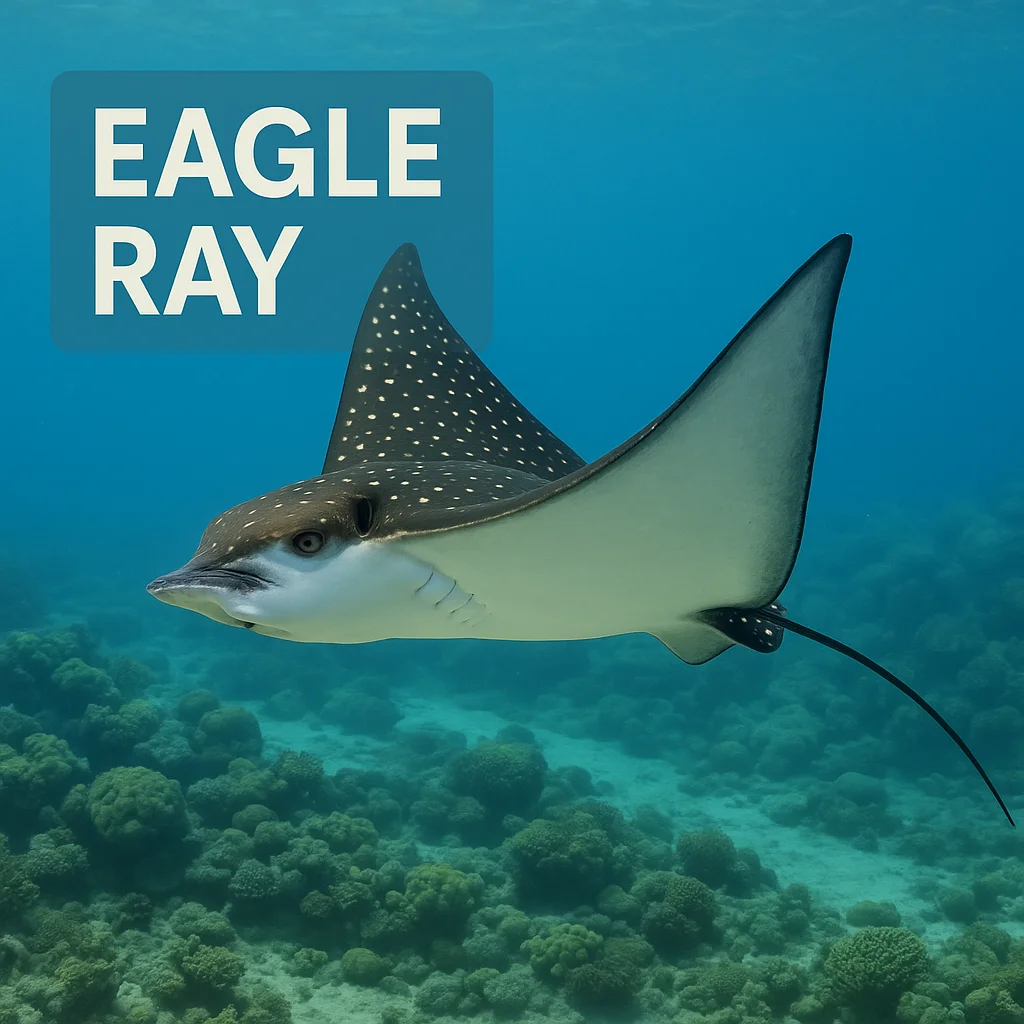
- Common name(s): Eagle Ray
- Scientific name: Myliobatidae (varies by species)
- Animal type: Fish
- Typical adult size: 6–12 feet wingspan; up to 20 feet in some species
- Typical lifespan: 15–25 years in the wild
- Diet type: Carnivore; feeds on mollusks, crustaceans, and small fish
- Activity pattern: Diurnal, mostly active during the day
- Social structure: Generally solitary but occasionally seen in groups
- Speed / movement highlights: Excels at fast swimming with quick bursts of speed
- Intelligence/learning: Sharp learning abilities, especially in foraging strategies
- Primary habitats: Coastal waters, coral reefs, and open ocean
- Geographic range: Tropical and temperate oceans worldwide
- Predators/threats: Sharks, large fish; human pressures include fishing and habitat degradation
- Conservation status: Varies by species; some are threatened
🔍 Identification & Appearance
Eagle Rays are easily recognized by their distinctive body shape and movement. They have broad, flat bodies with wing-like pectoral fins extending outward. The coloration typically includes patterns of dark spots or blotches on a lighter background, which can vary depending on the species and individual age.
- Top ID Tips:
- Broad, flat body with wing-like pectoral fins
- Typically spotted or blotched patterns
- Long, whip-like tail
- Pointed snout in most species
- Distinct disc shape differing from similar ray species
- Moves by flapping pectoral fins like wings
- Contrast with mantas by smaller size and more elongated snouts
- Visible spiracles behind the eyes
- Unlike stingrays, tail is not used for stinging
🧱 Body Structure & Physical Adaptations
The Eagle Ray's body structure is designed for agility and speed in the water. Their pectoral fins are large and wing-like, allowing them to glide gracefully and perform agile maneuvers. The tail is long and whip-like, primarily used for balance and steering rather than defense.
- Key Adaptations:
- Wing-like pectoral fins for efficient swimming
- Streamlined body for reduced water resistance
- Robust jaws and teeth adapted to crush shellfish
- Good eyesight for locating prey
- Sensitive lateral line system for detecting movements in water
- Spiracles for breathing while resting on the seafloor
- Tail used for maneuverability, not for defense
- Strong, flattened teeth ideal for grinding
- Deceptively powerful bursts of speed for escaping threats
🌍 Range & Distribution
Eagle Rays are found in warm and temperate coastal waters worldwide. They inhabit various marine environments from shallow waters to the open ocean. Their distribution is extensive across tropical and subtropical seas, illustrating their adaptability to different marine habitats.
- Where You Might Find It:
- Shallow coastal waters
- Coral reefs
- Tropical and subtropical oceans
- Seagrass beds
- Estuaries
- Open ocean from surface to deeper waters
- Northern and southern hemispheres
- Predominantly in warmer seas
- Frequently seen near islands
🏞️ Habitat & Shelter
Eagle Rays prefer warm coastal waters and can often be found in coral reefs, where they can easily find food. Their shelter needs are minimal due to their mobile nature, but they do appreciate areas with abundant food supply and adequate hiding spots to avoid predators.
Habitat knowledge is vital to understand Eagle Ray behavior and survival. Changes in habitat availability due to human impact can greatly affect their populations.
🧭 Behavior & Ecology
Eagle Rays are mostly solitary but are known to form small groups during mating or when feeding. They exhibit intricate behaviors, including synchronized swimming when in groups. Their ecological role is significant as they control the population of mollusks, and their feeding activities help in the energy cycling of marine ecosystems.
- Behavior Highlights:
- Gentle swimmers, using large wings for propulsion
- Feed mainly during daylight hours
- Occasionally leap out of the water
- Solitary but may group when food is abundant
- Role as a predator helps control prey species
- Feeds on benthic invertebrates, affecting substrate ecology
- Uses senses to locate prey hidden under sand
- Displays play behaviors, suggesting enjoyment of swimming
- Part of a complex food web, both predator and prey
👥 Social Life & Group Dynamics
Eagle Rays are predominantly solitary animals. However, some species display social tendencies, especially during feeding and mating seasons. There is no extensive hierarchy, but certain dominance behaviors may be observed within their groups.
- Social Structure Notes:
- Mostly solitary
- Loose groups during feeding events
- Occasional pair bonds observed during mating season
- No strict dominance hierarchies
- Varies by species and environmental pressures
- Seasonally social during breeding times
- Can demonstrate temporary coordinated hunting
- Interactions mostly harmonious
- Primarily independent creatures
🍽️ Diet, Prey & Predators
Eagle Rays primarily feed on benthic invertebrates such as mollusks and crustaceans. They use their strong jaws to crush the shells of their prey. They may also consume small fish as part of their diet. Natural predators include larger fish and sharks, but human activities pose significant threats.
- Feeding Notes:
- Utilizes strong jaw muscles to crush prey
- Primarily feeds on shellfish and crustaceans
- Diet may include small fish
- Displays foraging behaviors to uncover buried prey
- Uses keen sense of smell to detect prey
- Important ecological role as a predator of hard-shelled prey
- Rely on visual cues and water movements
- Has adaptations to feed on hard-to-reach invertebrates
- May scavenge occasionally but not typical behavior
🦌 Hunting, Foraging & Movement
Eagle Rays are adept swimmers, using their large pectoral fins to "fly" through the water. They are capable of fast, agile movements and can leap from the water's surface when startled. Their foraging strategy includes digging through sand with their snouts to find hidden prey.
- Movement & Strategy:
- Skilled swimmers using wing-like fins
- Can achieve short bursts of high speed
- Known to leap clear of the water
- Forages on ocean floor using snout
- Primarily uses eyesight and lateral line to detect prey
- Tendency to migrate following water temperature changes
- Relies on strong swimming to cover large areas
- Mostly non-migratory but exhibits local movements
- Versatile feeding methods for diverse environments
🧠 Intelligence & Senses
Eagle Rays exhibit considerable intelligence, especially in their foraging techniques. They have evolved a combination of senses to locate prey, including keen eyesight and a well-developed lateral line system to detect vibrations. Despite their apparent intelligence, much about their cognitive abilities remains to be studied.
- Notable Abilities:
- Sharp eyesight for spotting prey and predators
- Impactful use of lateral line system
- Quick learning evident in adapting foraging strategies
- Displays complex behaviors when in social scenarios
- Keen sense of smell enhances hunting success
- Memory plays a role in navigating complex habitats
- Spatiotemporal awareness of tidal changes
- Coordinated swimming suggests some social intelligence
- Research into full extent of cognitive ability is limited
🪺 Reproduction, Pregnancy & Parenting
Breeding in Eagle Rays involves seasonal migrations to specific sites. Their mating system is generally promiscuous. After internal fertilization, females give live birth to a few extremely well-developed young. Parental care post-birth is absent, as young are capable of independence shortly after birth.
- Reproduction Snapshot:
- Mating often occurs in warmer seasons
- Generally promiscuous mating system
- Internal fertilization; males use claspers
- Gestation period varies by species
- Live birth of typically 4–6 pups
- Young born well-developed (precocial)
- Immediate independence post-birth
- No parental care or investment after birth
- Breeding sites dictate annual migrations
♀️♂️ Male vs Female Differences
Eagle Rays exhibit some sexual dimorphism, although differences are subtle. Males possess claspers, which are modified pelvic fins used for mating. Additionally, females tend to be slightly larger in size, which is common among ray species.
- Sex Differences at a Glance:
- Males have claspers for mating
- Females often larger than males
- Behavioral differences mainly during mating
- Males actively seek out females in mating season
- Females migrate to specific birthing areas
- Differences not always observable in the field
- Subtle coloration differences occasionally noted
- Pelvic fin anatomy distinct between sexes
- Size difference assists in buoyancy and energy efficiency for females
🧬 Subspecies & Variation
The Eagle Ray family encompasses several species, each adapted to local environments. Variations can occur in size, pattern, and habitat preference. These differences illustrate their adaptability and evolutionary success in diverse marine conditions.
- Variation Notes:
- Several species within the Myliobatidae family
- Size and coloration varies by species
- Local adaptations include temperature tolerance
- Some species more coastal, others roam open water
- Patterns range from distinct spots to uniform colors
- Subspecies classifications sometimes debated
- Adapted to specific salinity levels in different regions
- Some prefer coral reefs, others in sandy bottoms
- Morphological differences aid in species identification
⚠️ Threats, Conservation & Human Interaction
Eagle Rays face multiple challenges, both natural and anthropogenic. While they are preyed upon by larger marine predators, human activities like fishing, habitat degradation, and pollution constitute significant threats. Conservation efforts focus on habitat protection and monitoring fishing practices to ensure sustainable populations.
- Responsible Notes:
- Threats include overfishing and bycatch
- Habitat destruction affects breeding sites
- Pollution impacts health and population levels
- Protection policies vary regionally; some lack enforcement
- Education on sustainable fishing impacts conservation
- Encounters in ecotourism provide economic incentives for protection
- Preservation efforts focus on marine protected areas
- Understanding ecological role crucial for effective conservation
- Responsible human interaction can support population stability
✨ Fun Facts & Unique Traits
- Eagle Rays can leap several feet out of the water!
- One of the few ray groups exhibiting social behaviors
- Patterned backs help with camouflage on the ocean floor
- Eagle Rays have electroreceptive capabilities for detecting prey
- They can travel long distances across open ocean
- Occasionally seen following tide lines to find food
- Despite graceful movements, they can change direction swiftly
- They are often featured in marine-themed folklore
- Long-lived, with the potential for extended generational influence
📌 Summary
- Eagle Rays are characterized by their broad, flat bodies and distinctive "wings."
- Inhabit warm coastal waters and reefs, displaying adaptability across various environments.
- Distributed widely in tropical and temperate oceans.
- Carnivorous diet mainly consists of benthic invertebrates.
- Face threats from natural predators and increasing human activities.
- Exhibit solitary behaviors but occasionally form groups.
- Live birth with young capable of immediate postnatal independence.
- Adaptations include a specialized jaw for crushing shells and a lateral line system for detecting prey.
- Notable ability for high-speed swimming and occasional leaping behavior.