🦈 Bull Shark
🧾 Quick Facts
The Bull Shark is a powerful fish known for its adaptability and ability to thrive in various aquatic environments. Here are some quick facts about this fascinating species:
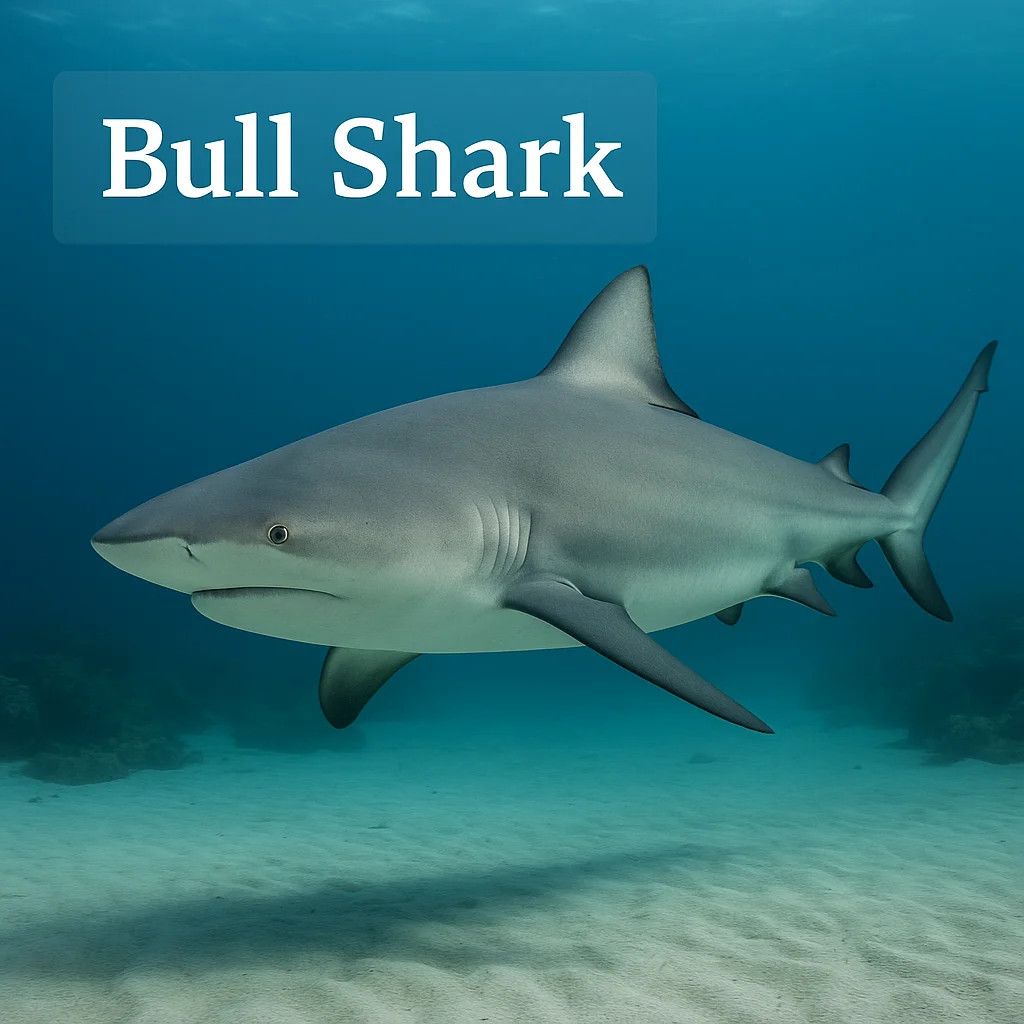
- Common name(s): Bull Shark
- Scientific name: Carcharhinus leucas
- Animal type: Fish
- Typical adult size: 7-11.5 feet in length
- Typical lifespan: Approximately 12-16 years in the wild
- Diet type: Carnivore; commonly feeds on fish, dolphins, and turtles
- Activity pattern: Mostly diurnal with some nocturnal tendencies
- Social structure: Usually solitary but can be seen in small groups
- Speed / movement highlights: Swims up to 25 mph in short bursts
- Intelligence/learning: Known for its curiosity and adaptability to new environments
- Primary habitats: Coastal waters, rivers, and lakes
- Geographic range: Warm, shallow waters of oceans and rivers worldwide
- Predators/threats: Larger sharks, humans (via fishing and habitat destruction)
- Conservation status: Near Threatened
🔍 Identification & Appearance
The Bull Shark is recognized by its robust and stout body. It has a wide snout and a relatively small dorsal fin compared to other shark species. Its skin is grey on top and white underneath, aiding in camouflage from both prey and predators.
-
Top ID Tips
- Stocky body with a broad and flat snout
- Two dorsal fins, the second smaller than the first
- Non-distinctive coloration with potential for slight yellow tinge in juveniles
- Upper teeth are triangular and less serrated
- Tail fin has a larger upper lobe than lower lobe
- Distinguishable by its aggressiveness
- Prefers murky water where prey is abundant
🧱 Body Structure & Physical Adaptations
The Bull Shark is built for power and tenacity, with several adaptations that support its role as an apex predator. It features a muscular body and powerful jaw equipped with sharp teeth for gripping and tearing prey. The shark's fins facilitate maneuverability in diverse environments including coastal and freshwater settings.
-
Key Adaptations
- Muscular and robust build for powerful swimming
- Prefers shallow, murky waters aiding in hunting stealth
- Ability to osmoregulate, allowing for survival in both salt and freshwater
- Powerful jaw with hundreds of sharp teeth
- Acute sense of smell to detect prey from far distances
- Good vision in low-light conditions
- Exceptional burst speed for capturing fast prey
🌍 Range & Distribution
The Bull Shark is highly adaptable, found in a variety of aquatic habitats across the world. It primarily inhabits warm waters but is also unique for its ability to travel far upstream in rivers, making its way into freshwater lakes.
-
Where You Might Find It
- Coastal regions of the Atlantic and Pacific Oceans
- Rivers like the Mississippi and Amazon
- Gulf of Mexico
- Indian Ocean coastal regions
- Freshwater lakes such as Lake Nicaragua
- Tropical and subtropical seas
- Estuaries and bay areas
🏞️ Habitat & Shelter
The Bull Shark exhibits remarkable ecological versatility, inhabiting warm, shallow waters close to the shorelines, estuaries, and even freshwater systems. This makes its encounters with humans more frequent compared to other shark species. Seasonal movements are commonly dictated by the availability of prey and temperature preferences.
🧭 Behavior & Ecology
Bull Sharks are opportunistic hunters, actively using their superb senses to stalk and ambush a wide variety of prey. Eternal wanderers, they exhibit nomadic characteristics, rarely claiming a specific territory but rather following food sources. They also play a crucial role in maintaining the balance of marine ecosystems as apex predators.
-
Behavior Highlights
- Aggregates near abundant prey
- Known to investigate new environments curiously
- Ambushes prey using sudden bursts of speed
- Basic communication through body language
- Occasionally displays mutualistic interactions with pilot fish
👥 Social Life & Group Dynamics
Often solitary creatures, Bull Sharks sometimes gather in small groups, especially young individuals. However, meaningful social interactions are rare and typically revolve around feeding opportunities. Unlike many species, Bull Sharks do not form stable group hierarchies but can display aggressive dominance when competing for food.
-
Social Structure Notes
- Generally solitary, temporary groups often form
- Occasional cooperative hunting observed
- Displays of dominance during feeding
- Younger sharks more commonly seen together
🍽️ Diet, Prey & Predators
Bull Sharks are carnivorous generalists, preying on fish, other sharks, seabirds, and marine mammals. Their willingness to explore both coastal and riverine systems broadens the scope of their diet drastically. Although not frequently preyed upon, juvenile Bull Sharks may fall victim to larger predators, including other sharks.
-
Feeding Notes
- Opportunistic and varied diet
- Consumes small fish to large marine mammals
- Adapts diet based on prey availability
- Food preferences can vary by region
- Exhibits scavenging behavior in some cases
🦌 Hunting, Foraging & Movement
Bull Sharks are expert swimmers, combining stealth, speed, and aggression with keenly developed senses to hunt successfully. They exploit shallow, murky waters to obscure their approach to prey and have the capability to travel far inland via rivers, showcasing extreme ecological flexibility.
-
Movement & Strategy
- Prefers ambush tactics within murky waters
- Capable of rapid movement for short chases
- No fixed territory; roams based on prey locations
- Estuarine and riverine navigation
- High stamina for extended exploratory journeys
🧠 Intelligence & Senses
The Bull Shark exhibits a balance of intelligence and instinct, relying heavily on keen senses developed for its aquatic lifestyle. Its ability to learn and adapt to new conditions is well-documented, contributing to its fearsome reputation and survival proficiency.
-
Notable Abilities
- Acute sense of smell and hearing
- Adaptability to both salt and freshwater environments
- Capable of problem-solving
- Use of electroreception to detect prey
🪺 Reproduction, Pregnancy & Parenting
Bull Sharks have a viviparous mode of reproduction, with the mother providing nourishment to the developing embryos in her womb. Mate selection and courtship periods typically occur during warmer months in specific regions.
-
Reproduction Snapshot
- Viviparous with breeding season in summer
- Gestation lasts about 10-11 months
- Litters average 1-13 pups
- Young are independent upon birth
- No parental care post-birth
♀️♂️ Male vs Female Differences
Differences between male and female Bull Sharks can be subtle and primarily involve size variances. Females are typically larger, a characteristic common in many shark species. There are no significant sexual dimorphisms in coloration or secondary characteristics.
-
Sex Differences at a Glance
- Females generally larger than males
- Similar coloration and physical structures
- Sex differentiation primarily internal
🧬 Subspecies & Variation
While there are no officially recognized subspecies of Bull Sharks, regional adaptations do occur. These adaptations include behavioral and dietary changes dependent on environmental conditions and available prey.
-
Variation Notes
- Behavioral adaptations by habitat
- Possible dietary differences regionally
- Flexibility in salinity tolerance enhances distribution
⚠️ Threats, Conservation & Human Interaction
Bull Sharks face numerous threats from human activities including fishing, pollution, and habitat degradation. While they are categorized as Near Threatened, localized conservation efforts aim to protect critical populations. The species' presence near human-inhabited waters calls for coexistence strategies.
-
Responsible Notes
- Mitigate overfishing in coastal regions
- Maintain healthy marine and river ecosystems
- Avoid pollution and habitat destruction
- Awareness-raising on shark behavior
✨ Fun Facts & Unique Traits
- One of few shark species capable of living in freshwater
- Known to travel up several rivers, including the Mississippi
- Characterized by a powerful 'bite-and-shake' feeding strategy
- Young Bull Sharks often form small groups, unlike adults
- Exhibit seasonal migration patterns for breeding
📌 Summary
- Robust and adaptable apex predator
- Thrives in both saltwater and freshwater environments
- Found primarily in tropical and subtropical regions
- Carnivorous diet varies by habitat and availability
- Larger females compared to males
- Seasonally reproduces with minimal parental care
- Faces conservation challenges due to habitat loss