🦁 Blue Marlin
🧾 Quick Facts
The Blue Marlin, a majestic inhabitant of the ocean's depths, is admired for its vibrant appearance and impressive size. Often seen in tropical and subtropical waters, this large fish is sought after both for sport and study. Below is a quick overview of this fascinating species.
- Common name(s): Blue Marlin
- Scientific name: Makaira nigricans (often listed as)
- Animal type: Fish
- Typical adult size: 11-14 feet in length; up to 1,800 pounds
- Typical lifespan: 20-30 years (varies wild vs. captive)
- Diet type: Carnivore; feeds on smaller fish, squid
- Activity pattern: Diurnal
- Social structure: Mostly solitary
- Speed / movement highlights: Known to reach speeds of up to 50 mph
- Intelligence/learning: Capable of problem-solving; limited study on learning capacities
- Primary habitats: Open ocean, near-surface waters
- Geographic range: Tropical and subtropical oceans worldwide
- Predators/threats: Sharks, human fishing
- Conservation status: Varies by region; generally near-threatened due to overfishing
🔍 Identification & Appearance
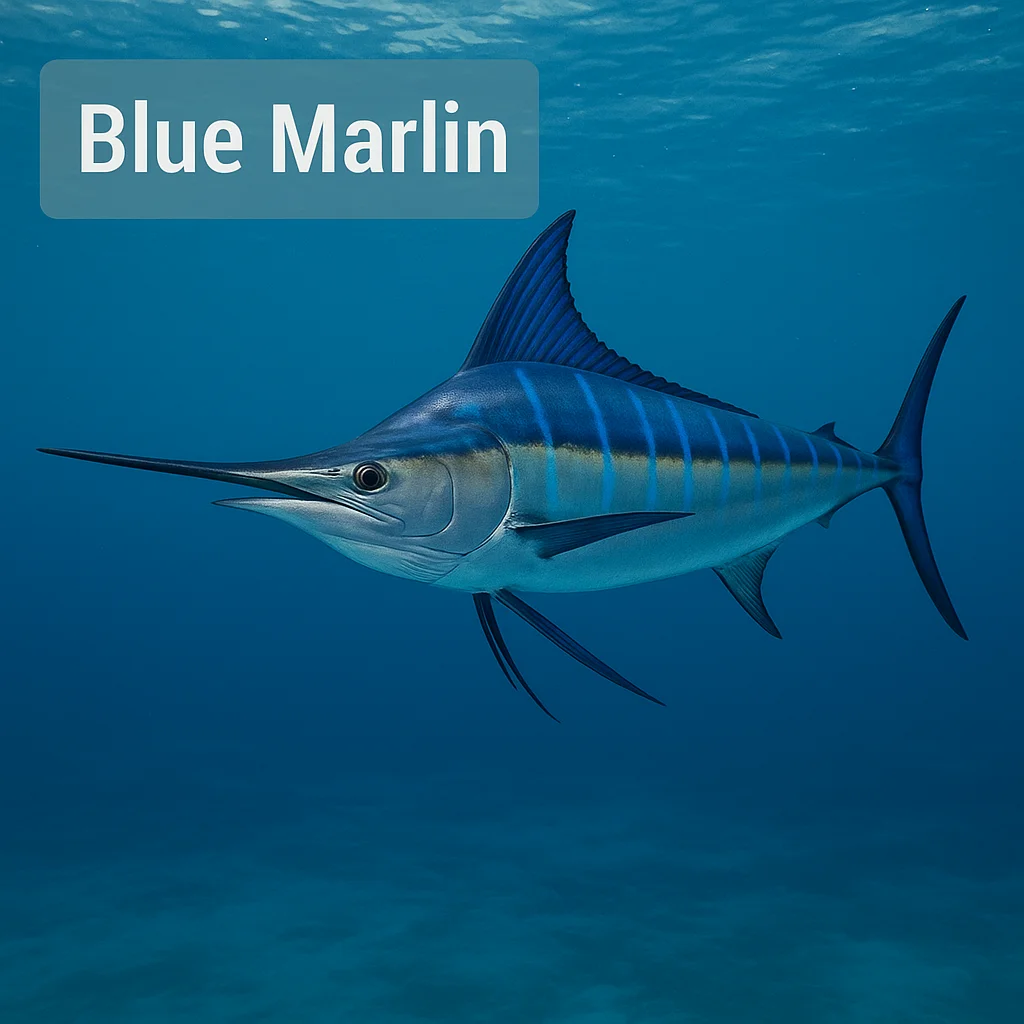
The Blue Marlin is an unmistakable fish with a body adapted for life in the open ocean. It boasts a streamlined, torpedo-like shape that reduces water resistance as it glides through the sea. Its deep blue coloring and large size make the Blue Marlin a picturesque sight.
- Body shape and silhouette: Streamlined, long with a pointed bill
- Key colors/patterns: Cobalt blue dorsally, silvery-white ventrally
- Distinctive features: Long, sharp, spear-like upper jaw called a "bill"
- Tracks, scat, or other field signs: N/A for marine species
- Common look-alikes: White Marlin, Black Marlin; differs by size, coloration
- Top ID Tips
- Look for the elongated, piercing bill.
- Note the deep cobalt blue color on the dorsal side.
- Examine the large, recognizable dorsal fin.
- Check the length; often 11-14 feet for adults.
- Observe the streamlined body shape that's built for speed.
- See silvery-white underbelly contrasting with the blue above.
- Notice pointed pectoral fins that don't fold against the body.
- Spot the forked tail typical of pelagic fish.
🧱 Body Structure & Physical Adaptations
The Blue Marlin's body is an epitome of aquatic elegance and efficiency. Its adaptations are mainly geared toward enhancing speed, strength, and effective prey capture in the vast oceans.
- Build and proportions: Slender, muscular with a streamlined shape
- Teeth/beak/jaw adaptations: Long, spear-like bill used to stun prey
- Claws/hooves/wings/fins: Powerful dorsal and pectoral fins for balance and speed
- Sensory strengths: Excellent vision; some studies suggest sensitivity to electric fields
- Key Adaptations
- Streamlined body for fast, efficient swimming.
- Highly muscular tail for bursts of speed.
- Bill used for slashing and stunning prey.
- Large eyes for sharp vision underwater.
- Pectoral fins facilitate quick turns.
- Forked tail laser-optimized for swift, powerful propulsion.
- Counter-shading for camouflage from above and below.
🌍 Range & Distribution
Blue Marlins are globe-trotters of the sea, inhabiting tropical and subtropical waters across the globe. Their distribution is influenced by water temperature and prey availability.
- Where You Might Find It
- Tropical Atlantic Ocean
- Tropical Pacific Ocean
- Indian Ocean
- Caribbean Sea
- Gulf of Mexico
- Northern Australia coastal waters
- Sometimes in temperate waters seasonally
🏞️ Habitat & Shelter
Primarily found in the open ocean, Blue Marlins thrive in warm waters. They occupy different ocean layers, from near-surface waters to depths in pursuit of prey. Though not reliant on specific structures for shelter like reefs or submerged features, their habitat preferences are crucial for their feeding and breeding behaviors.
🧭 Behavior & Ecology
The Blue Marlin is a solitary creature, excelling in hunting with impressive agility. Its presence in the ocean ecosystem plays a significant trophic role, often linked to the availability of smaller fish and squid.
- Behavior Highlights
- Primarily solitary, except during spawning periods.
- Daytime feeders, mostly hunting during daylight hours.
- Employs bill for hunting, stunning prey by spearing.
- Critical apex predator maintaining prey populations.
- Migratory patterns tied to water temperature and prey.
👥 Social Life & Group Dynamics
While Blue Marlins are mostly solitary, they sometimes form loose, temporary groups known as 'schools' during the spawning season. These interactions are mainly driven by breeding rather than cohesive social structures.
- Social Structure Notes
- Solitary by nature.
- Temporal groups during the breeding season.
- No permanent group hierarchies.
- No significant cooperative hunting.
- Occasional encounters with other big game fish.
🍽️ Diet, Prey & Predators
As carnivorous hunters, Blue Marlins feed on a diet consisting mainly of smaller fish and squids. They hunt by utilizing their speed and agility, occasionally using their bills to stun or injure their prey. Predators primarily include large sharks, while humans pose significant threats due to fishing activities.
- Feeding Notes
- Diet primarily consists of mackerel and tuna.
- Squid forms a part of their staple food.
- Known to eat cephalopods.
- Hunting involves slashing prey with their bill.
- Powerful swipes with the bill to stun prey.
🦌 Hunting, Foraging & Movement
Blue Marlins are agile swimmers, utilizing their streamlined bodies and powerful tails for rapid movement. They are adept hunters, employing strategies that involve quick chases and skilled maneuvers. Occasionally, they are seen partaking in feeding on bait balls formed by other predatory activities.
- Movement & Strategy
- Diesel-powered by sleek forms for fast swimming.
- Ability to burst at speeds, attacking quickly.
- Diverse hunting tactics; from patience to pursuit.
- Migratory paths adapted to ocean temperature.
🧠 Intelligence & Senses
Blue Marlins exhibit discerning hunting strategies, though studies on their intelligence are limited. Their vision is particularly fine-tuned for underwater, facilitating efficient prey location. Other senses are less documented, but they likely possess acute subsurface navigation capabilities.
- Notable Abilities
- Exceptional vision for locating prey.
- Swift adaptability to change in ocean current.
- Acquaintance with thermal fronts that guide migration.
- Strategic use of speed in predatory pursuits.
🪺 Reproduction, Pregnancy & Parenting
Reproductive strategies of Blue Marlins are believed to align with their solitary habits, characterized by open-ocean, external spawning. Mating does not result in parental investment post-spawning, with larvae highly independent soon after hatching.
- Reproduction Snapshot
- Spawn primarily in warmer months.
- Females capable of releasing up to several million eggs.
- Broadcast spawners, fertilizing eggs externally.
- No parental care post-fertilization.
♀️♂️ Male vs Female Differences
Generally, female Blue Marlins grow significantly larger than their male counterparts. These size differences are especially evident because larger females can produce more offspring, buffering against natural variations in survival rates.
- Sex Differences at a Glance
- Females typically larger in size.
- No significant coloration difference between sexes.
- Mating roles quite similar, participation in spasmodic spawning.
🧬 Subspecies & Variation
There is some genetic variation among Blue Marlin populations that align with the different ocean basins they inhabit. No distinct subspecies are currently formally recognized, but variations in size and colorations are noted regionally.
- Variation Notes
- Variations largely influenced by oceanic regions.
- Subtropical populations may display size differences.
- Coloration intensity can vary by water temperature.
⚠️ Threats, Conservation & Human Interaction
Threats to Blue Marlins include both direct human action (overfishing, bycatch) and indirect impacts (habitat degradation, climate change). Conservation efforts focus on sustainable fishing practices. Those interested in interacting with these fish should do so responsibly, ensuring practices that safeguard future populations.
- Responsible Notes
- Observe fishing regulations to prevent overfishing.
- Support policies advocating for bycatch reduction.
✨ Fun Facts & Unique Traits
- Blue Marlins are known for incredible leaping abilities.
- They feature prominently in big game fishing circles.
- Iconic in Hemingway's "The Old Man and the Sea".
- Highly regarded in sport fishing; known for strength.
📌 Summary
- A distinctive marine predator with a streamlined physique and notable speed, the Blue Marlin is an iconic species in global oceans.
- The cobalt blue coloring and powerful build are complemented by an elongated bill used in hunting.
- Primarily occupying tropical and subtropical waters, they have a significant role in oceanic ecosystems.
- While sporting solitary behaviors, limited social congregation occurs during spawning.
- The blue marlin is both a predator to smaller fish and prey to larger oceanic predators.
- Conservation efforts must address overfishing and bycatch, recognizing the species' ecological and recreational importance.