🦁 Amberjack
🧾 Quick Facts
Amberjacks are a group of strong, fast-swimming fish known for their importance both commercially and recreationally. These fish are widespread in the world's oceans, primarily in warm and tropical waters. Rightly admired for their robust body and fighting spirit, amberjacks attract anglers seeking a challenge.
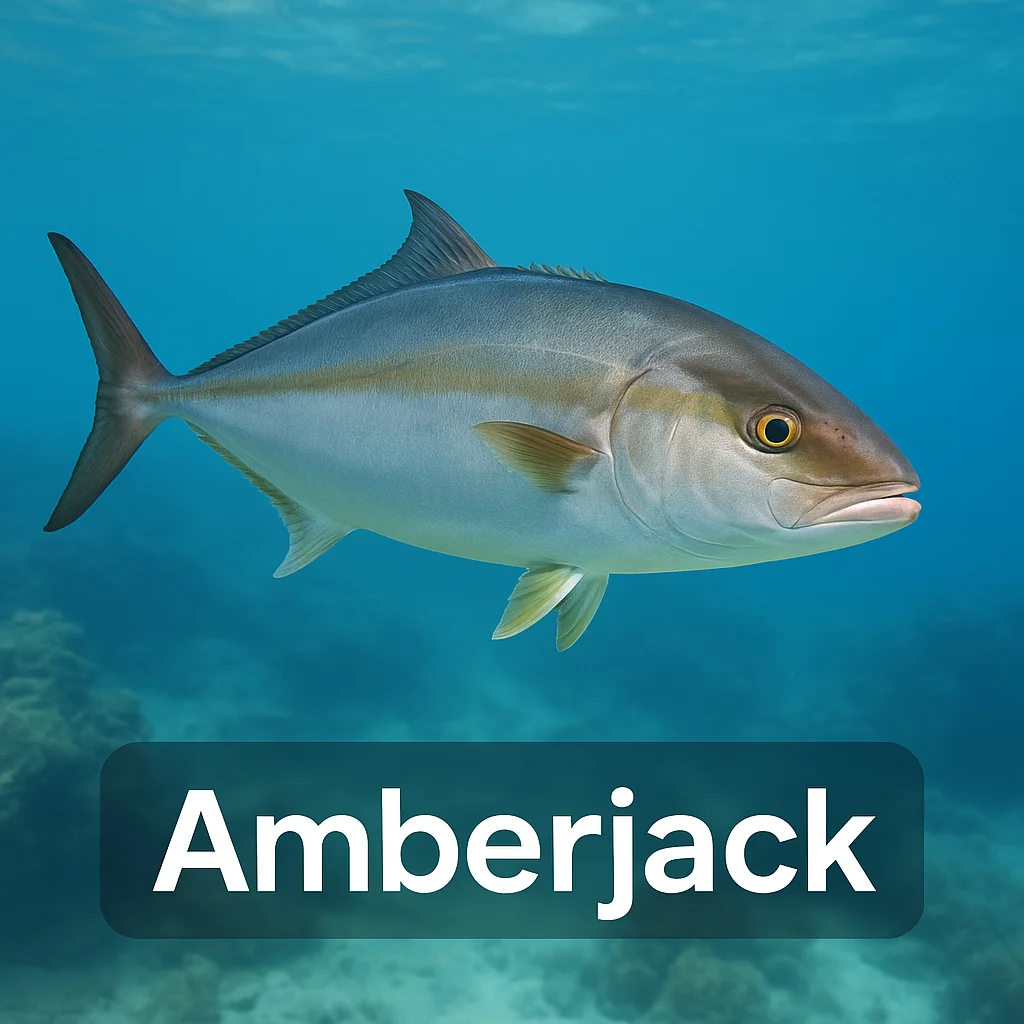
- Common name(s): Amberjack
- Scientific name: Seriola spp. (varies by species)
- Animal type: Fish
- Typical adult size: 23–59 inches (60–150 cm) in length; up to 150 pounds (68 kg)
- Typical lifespan: 10–17 years in the wild
- Diet type: Carnivore, mainly fish and invertebrates
- Activity pattern: Diurnal
- Social structure: Often solitary or in small groups
- Speed / movement highlights: Agile swimmer; known for quick bursts
- Intelligence/learning: Highly adapted to hunting, with effective learning of prey patterns
- Primary habitats: Coastal and offshore waters
- Geographic range: Atlantic and Pacific Oceans, notably found near North and South America, Europe, and Asia
- Predators/threats: Larger predatory fish and sharks; human fishing pressures
- Conservation status: Varies by region
🔍 Identification & Appearance
Amberjacks are recognizable for their sleek, elongated bodies and powerful build. They feature a distinctive golden or brownish stripe running from their nose to the back of their dorsal fins. The coloration can vary based on age, size, and environment, generally ranging from bluish-green to silvery on their sides, with a white belly.
The body shape and pattern of the amberjack allow it to blend into open ocean habitats and ambush prey efficiently. While they have similar patterns to other fish, their distinguished stripe and size make them easier to identify for those familiar with the species.
- Top ID Tips
- Larger size compared to many similar fishes
- Golden or brownish stripe along the body
- Sleek, elongated shape typical of fast swimmers
- Silvery color with a darker dorsal area
- Strong, forked tail for powerful movements
- Deep, laterally compressed body
- Longer dorsal fin compared to many other fish
- Large, outgoing nature when hooked by fishing enthusiasts
🧱 Body Structure & Physical Adaptations
The body of the amberjack is built for speed and maneuverability, with streamlined contours that allow it to swim rapidly through open water. Its jaw is designed for capturing and consuming prey efficiently, featuring sharp teeth for gripping fish and invertebrates.
The fins of amberjacks, especially the caudal (tail) fin, provide exceptional propulsion, while its large pectoral fins enhance turning and stabilizing abilities. Additionally, they possess a remarkable sensory system, notably their lateral line, which detects vibrations and water movements for precise hunting.
- Key Adaptations
- Streamlined body for rapid movement
- Strong caudal fin delivering powerful swimming strokes
- Adapted jaw and teeth for efficient prey capture
- Highly developed vision for spotting prey
- Acute sense of lateral line for detecting ocean currents
- Pectoral fins for stability and quick turning
- Red muscle fibers for endurance swimming
- Symmetrical body shape aiding in streamlined motion
🌍 Range & Distribution
Amberjacks are widely distributed across tropical and subtropical regions. They commonly inhabit the Atlantic and Pacific Oceans, stretching along the coasts of North and South America, Europe, and Asia.
These fish prefer coastal and offshore environments, often found around reefs, wrecks, and drop-offs where prey is plentiful. While they can make short migratory movements, primarily in search of food or breeding grounds, amberjacks are generally residential within their chosen territorial waters.
- Where You Might Find It
- Atlantic Ocean, from coastal USA to Brazil
- Pacific regions near Japan, Australia, and the Philippines
- Common around coral reefs and underwater structures
- Frequently off the Gulf of Mexico and Mediterranean Sea
- Atlantic coastlines of Europe
- Warmer oceanic zones
- Near underwater drop-offs
- Habitats with ample fish prey and invertebrates
🏞️ Habitat & Shelter
Amberjacks thrive in marine environments, opting for coastal areas that include coral and rocky reefs, underwater wrecks, and ledges. These habitats provide abundant shelter and breeding sites. The fish tend to dwell at varying depths from 65 to 240 feet, though they prefer areas with easy access to open, deeper waters.
Their choice of habitat is deeply linked to their predator and prey activities, frequently shifting location depending on seasonal food supply and breeding necessities. Understanding these habitat preferences is essential for recognizing their behaviors, especially for fishing activities and conservation efforts.
🧭 Behavior & Ecology
Amberjacks exhibit a pattern of diurnal activity, often foraging during daylight hours. They are known for their agile swimming and quick hunting abilities. The fish tend to associate with various marine structures where prey is abundant, using these surroundings to ambush smaller fish and invertebrates.
Communication among amberjacks may occur through subtle body movements and the use of their lateral line system, which reads environmental changes for survival tactics. As a predatory species, they play a vital ecological role in controlling small fish populations, ensuring a balanced marine ecosystem.
- Behavior Highlights
- Diurnal foraging patterns
- Ambush predator; uses habitats for camouflage
- Quick, agile swimmer
- Feeds primarily in reef areas
- Utilizes lateral line for environmental sensing
- Regulates smaller fish populations as a predator
- Occasional territorial behavior around feeding grounds
- Responsive to seasonal prey movements
👥 Social Life & Group Dynamics
Amberjacks are predominantly solitary creatures but can be found in small groups or schools, particularly during breeding periods or when hunting larger schools of prey. Social structures like dominance hierarchies are not well-documented but primarily vary with environmental conditions.
Occasional cooperative hunting behaviors are observed, where individual fish align their attacks to disorient prey groups, maximizing their hunting efficiency. This behavior underscores a basic level of social interaction, enhancing their collective survival strategies.
- Social Structure Notes
- Primarily solitary, with occasional small groups
- Group formations during breeding or hunting
- Limited known social hierarchy
- Possible cooperative hunting strategies
- Interactions primarily influenced by environmental changes
- Adaptive social behavior based on survival needs
- Behavioral plasticity in search of food resources
🍽️ Diet, Prey & Predators
Amberjacks mainly consume smaller fish, such as sardines and mackerel, along with a variety of invertebrates like crustaceans. In varied habitats, their diet adapts to the available prey, highlighting their role as adaptive predators within diverse marine ecosystems.
Despite being predators, amberjacks face threats from larger predatory fishes, including sharks, and human activities such as overfishing and habitat disruption. Their feeding strategies are opportunistic, often taking advantage of the scattering prey found around reefs and wrecks.
- Feeding Notes
- Opportunistic carnivorous diet
- Diet includes fish like sardines and mackerel
- Feeds on crustaceans and other invertebrates
- Known to hunt in coastal regions
- Large fish and sharks are main predators
- Strong reliance on near-shore shelf habitats for food
- Adapts diet based on regional prey availability
🦌 Hunting, Foraging & Movement
Amberjacks are powerful swimmers due to their streamlined bodies and muscular build, making them adept hunters in the open ocean. They employ a nearly relentless pursuit style when chasing down prey, especially around reef environments where ambush tactics can be employed effectively.
These fish can adjust their swimming and hunting approaches based on the presence and types of available prey, showcasing a strategic blend of speed and agility. While they generally do not migrate large distances, amberjacks are known to travel between feeding and spawning grounds to optimize resource use.
- Movement & Strategy
- Strong swimmer with high endurance
- Utilizes ambush and pursuit tactics
- Reef and offshore environment exploitation
- Strategic movement between feeding regions
- Fine-tuned agility for chasing fish
- Robust body shape for sustained swimming
- Responsive to shifts in prey density
- Energetic movements attracting anglers
🧠 Intelligence & Senses
Amberjacks possess a highly developed sensory system critical for survival in the varied environments they inhabit. Their vision is well-adapted to detect prey and avoid predators, while the lateral line system helps sense water disturbances.
Though largely instinctual, their hunting and foraging strategies suggest a level of problem-solving ability. The fish can notably leverage environmental cues to exploit feeding opportunities, demonstrating an instinctual adaptability to different marine conditions.
- Notable Abilities
- Strong vision critical for hunting
- Lateral line enhances environmental sensing
- Instinctual adaptability to shifting prey sites
- Effective use of environmental cues
- Pursuit of elusive, fast-moving prey species
- Quick responsiveness to predator presence
- Moderate ability for strategic hunting
🪺 Reproduction, Pregnancy & Parenting
Amberjacks typically breed in the warmer months, with variations depending on geographical location. They possess a polygamous breeding system, where multiple males often fertilize the eggs laid by a single female.
The incubation period for the eggs varies, but once hatched, larvae are typically planktonic before settling into their juvenile habitats. There is minimal parental involvement post-spawning, as young amberjacks learn to forage and fend for themselves in the safety of coastal waters.
- Reproduction Snapshot
- Breeding mostly in warmer months
- Polygamous mating system
- Eggs hatch into planktonic larvae
- Minimal direct parental care
- Larvae settle into shallow coastal areas
- Egg incubation period varies
- Juveniles adapt quickly to independence
♀️♂️ Male vs Female Differences
Physically, males and females of the amberjack species show similar appearances with subtle differences mainly observable through closer scientific examination and research. Size can sometimes differ slightly, with males typically showing greater body size within some populations.
Behaviorally, both sexes participate in feeding and territorial activities, but detailed distinctions in roles regarding spawning and post-spawn dispersal are less pronounced in this species due to their external fertilization methods.
- Sex Differences at a Glance
- Minor size differences
- Similar coloration patterns for both sexes
- Shared feeding and roaming habits
- Limited behavioral role distinctions
- External fertilization processes
- Broad overlap in habitat use
🧬 Subspecies & Variation
The amberjack group consists of various species, such as the greater amberjack, lesser amberjack, and Almaco jack, each differentiated by subtle variations in size, coloration, and regional distribution. These variations largely align with adaptation to specific ecological niches and geographic regions.
While subspecies classification can sometimes be debated, they exhibit diversity in habitat preference and morphological adaptations to take advantage of local resources, showcasing a high degree of environmental plasticity.
- Variation Notes
- Greater vs. lesser amberjack size differences
- Almaco jack is another known variant
- Regional adaptation to warm and temperate waters
- Subtle coloration variations based on environment
- High degree of ecological adaptability
- Occasional classification debates among scientists
⚠️ Threats, Conservation & Human Interaction
Amberjacks face numerous pressures from human activities, including overfishing, habitat degradation, and bycatch during commercial fishing operations. Additionally, climate change and water pollution pose significant threats, impacting their survival and distribution globally.
Ensuring sustainable fishing practices can mitigate some of these impacts, as these fish species are crucial both environmentally and economically. Anglers are advised to practice catch-and-release methods to conserve populations, keeping ethical considerations in mind.
- Responsible Notes
- Impact from commercial and recreational fishing
- Vulnerable to overfishing pressures
- Threatened by habitat degradation
- Influence of climate shifts on habitats
- Importance of sustainable fishing practices
- Guidance for catch-and-release methods
- Role in marine ecosystems requires protection
✨ Fun Facts & Unique Traits
- Amberjacks are popular among sport fishing enthusiasts due to their fighting capability.
- Their name originates from the amber stripe visible along their body.
- Amberjacks play a critical role in controlling small fish populations.
- They are known to inhabit waters as deep as 300 feet.
- Greater amberjacks are among the largest jack species.
- Their robust body allows for high-speed pursuits underwater.
- They are sometimes mistaken for bluefin trevally due to similar coloration.
📌 Summary
- Recognizable by their sleek body and amber stripe.
- Found in coastal regions and open oceans globally.
- Carnivorous diet includes smaller fish and invertebrates.
- Speedy swimmer and effective predator.
- Favors habitats like reefs and wrecks for hunting.
- Minimal sexual dimorphism; similar male and female roles.
- Reproduce by external fertilization in warmer months.
- Facing pressures from fishing and habitat changes.