🦁 Tuatara
🧾 Quick Facts
The tuatara is a unique reptile found in New Zealand, often mistaken for a lizard but actually part of an ancient group of reptiles that thrived alongside dinosaurs. Understanding the tuatara can give insights into the resilience and adaptation of species over millions of years.
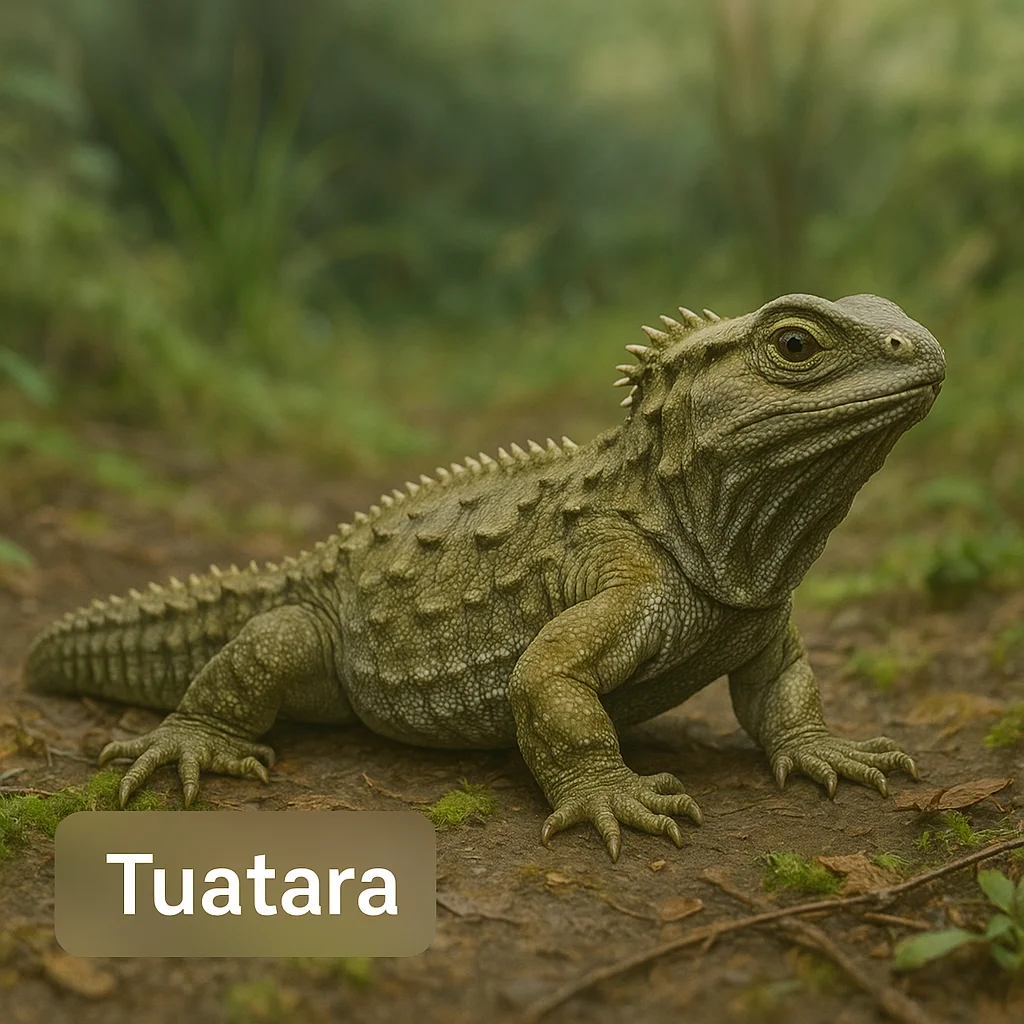
- Common name: Tuatara
- Scientific name: Sphenodon punctatus
- Animal type: Reptile
- Typical adult size: Approximately 50–80 cm in length
- Typical lifespan: Up to 60–100 years in the wild
- Diet type: Carnivore; primarily insects, small reptiles, and birds
- Activity pattern: Nocturnal
- Social structure: Solitary
- Speed/movement highlights: Slow mover with a deliberate gait
- Intelligence/learning: Displays basic problem-solving skills
- Primary habitats: Forests and grasslands
- Geographic range: Limited to New Zealand
- Predators/threats: Introduced species like rats and stoats; habitat destruction
- Conservation status: Vulnerable
🔍 Identification & Appearance
The tuatara is easily identified by its robust, lizard-like body, though it is not a true lizard. Its color can range from brown to greenish-gray, with males generally having spikier crests along their back. They have a distinctive spiny crest along their back, which is more pronounced in males compared to females. The tuatara's eyes are a striking feature, capable of moving independently.
- Stout, lizard-like body
- Greenish-gray to brown coloration
- Spiky crest along the back
- Movable eyes
- Interval of growth during juvenile stages
- Broad, flat head with powerful jaws
- Presence of a third "parietal" eye
- Solid, squarish body silhouette
- Distinctive tracks showing clawed toes
🧱 Body Structure & Physical Adaptations
The tuatara is adapted to a cool, temperate environment. It has a stocky build with strong limbs. Its teeth are fused to its jawbone, unlike other reptiles, allowing them to chop insects and small vertebrates effectively. Although slow-moving, they are strategically ambush predators. The tuatara is also equipped with a unique parietal eye on the top of its head, which becomes less visible with age but aids in regulating circadian rhythms and detecting light changes.
- Stocky and robust physique
- Fused, serrated teeth directly attached to the jaw
- Strong claws for digging and gripping
- Sharp sense of smell
- Parietal eye for light detection
- Excellent night vision
- Efficient at thermoregulation
- Slow metabolism suited to cooler climates
🌍 Range & Distribution
The tuatara is endemic to New Zealand, predominantly residing on offshore islands where conservation efforts have been made to ensure their survival. They thrive in cooler climates typical of these islands, largely free from the threats posed by introduced predators found on the mainland.
- Endemic to New Zealand
- Primarily found on offshore islands
- Restricted to cooler, temperate zones
- Populations maintained on predator-free islands
- Not known to migrate or exhibit long-range movements
🏞️ Habitat & Shelter
Tuatara prefer dense forests and grasslands, often choosing burrows for shelter. These burrows, sometimes shared with petrels, provide a safe retreat from the sun and protection from predators. The tuatara's activity is influenced by the season, with warmer months promoting increased activity. The knowledge of their habitat preferences is crucial in conservation planning to maintain the delicate balance necessary for their survival.
🧭 Behavior & Ecology
Primarily nocturnal, tuataras emerge at night to feed, avoiding the more extreme temperatures of the day. They are territorial and will defend their home range against others of the same species. Tuataras do not vocalize much but may communicate through body language and scent marking. Their interactions with other species are limited, though they have a symbiotic relationship with certain seabirds that share their burrows, benefiting from the presence of one another.
- Nocturnal activities dominate their routine
- Use of physical displays for territory defense
- Symbiotic relationship with seabirds
- Follows specific routines related to thermoregulation
- Feeding mostly consists of insects and small animals
- Simple social signaling through movements
- Play a role as a predator in their ecosystem
👥 Social Life & Group Dynamics
Tuatara are largely solitary creatures, with interaction among individuals primarily occurring during the breeding season. They defend their territory vigorously. There is no organized group living, and cooperation among individuals is rare outside of mating contexts. However, males do sometimes establish dominance hierarchies, which can influence mating opportunities.
- Predominantly solitary animals
- Engagement in territorial displays
- Occasional dominance interactions among males
- Mating as the primary social interaction
- Limited cooperative behavior
- No stable groups; individuals keep separate territories
🍽️ Diet, Prey & Predators
The tuatara is an opportunistic carnivore, feeding on insects, spiders, small reptiles, and even birds or eggs when available. Hunting is generally conducted during the night, utilizing their keen sense of smell and night vision. Their main predators are introduced species like rats and stoats, which have significantly impacted their population. Tuatara rely on their cryptic coloration and strong jaws as their primary defenses.
- Carnivorous diet focusing on insects and small animals
- Occasional consumption of eggs or small birds
- Night-time hunting with stealth tactics
- Main predators include invasive mammal species
- Good camouflage helps avoid detection
- Employ sharp jaws for capturing and eating prey
🦌 Hunting, Foraging & Movement
Tuatara are deliberate movers and utilize a sit-and-wait strategy when hunting. They ambush prey rather than chase it down. Their movement is slow but purposeful, primarily relying on the element of surprise. They do not migrate, typically staying within their established territory, using excellent memory to recall favorable hunting grounds.
- Ambush predator utilizing stealth
- Slow, deliberate movement style
- Long-term residence in established home ranges
- Memory aids in effective hunting
- No migratory behavior observed
🧠 Intelligence & Senses
Tuatara demonstrate basic problem-solving skills, particularly in finding food and optimal shelter. They lack the advanced social intelligence of more gregarious species but show competence in solitary survival strategies. Their sensory abilities are well-honed; vision is particularly acute at night, and their sense of smell guides feeding behavior.
- Keen night vision
- Reliable sense of smell
- Ability to learn from routine
- Not known for complex social intelligence
- Functional problem-solving for basic survival tasks
🪺 Reproduction, Pregnancy & Parenting
Tuatara have a slow reproductive process, with females breeding once every four years or so. Mating occurs during the warmer months, a time when males engage in displays to attract females. The incubation period for tuatara eggs can range from 12 to 15 months, one of the longest among reptiles. Mothers do not care for the young; the hatchlings are precocial and must fend for themselves from the start.
- Breeding occurs every few years under ideal conditions
- Males court females with physical displays
- One of the longest incubation periods among reptiles
- Clutch size can vary between 6 to 10 eggs
- Hatchlings are independent and fend for themselves
♀️♂️ Male vs Female Differences
There are notable sexual dimorphisms in tuatara, with males typically being larger and sporting heavier spiny crests. In behavior, males display more active territorial and mating displays compared to females. Despite these differences, both sexes show similar coloring and general morphology.
- Males are larger with more pronounced crests
- Males display territorial and mating behaviors
- Females are slightly smaller and less ornate
- Overall similar coloration between genders
- Both sexes have similar survival strategies
🧬 Subspecies & Variation
There are two recognized species of tuatara: Sphenodon punctatus and Sphenodon guntheri. The former is more widespread, while the latter, found only on North Brother Island, tends to be greener and smaller. These variations are mainly dictated by geographic isolation and specific environmental conditions of their respective habitats.
- Sphenodon punctatus: Widespread species
- Sphenodon guntheri: North Brother Island; smaller and greener
- Adaptations linked to island living
- Physical differences mainly in size and color
- Variation accentuated by isolated populations
⚠️ Threats, Conservation & Human Interaction
The primary threat to the tuatara comes from introduced predators like rats and stoats, as well as habitat destruction and climate change, which affect nesting habitats. Conservation efforts focus on habitat protection and predator eradication from their environments. Tuataras are often seen as living relics, and educating the public about their importance aids conservation efforts. In captivity, they are used for research, breeding programs, and public education.
- Threatened by invasive predators
- Fragmented habitats due to human activity
- Climate change impacts nesting success
- Conservation through sanctuary establishment
- Managed care in captivity helps bolster numbers
- Public education is key to their conservation
- Ethical care guidelines in place for captivity
✨ Fun Facts & Unique Traits
- Tuatara show the longest documented incubation period among reptiles.
- The parietal eye is a unique feature among reptiles today.
- Tuatara have ancient lineage links to the dinosaur era.
- Their ability to slow down metabolism helps survive cold months.
- Tuatara are often referred to as "living fossils".
- Despite their lizard-like appearance, they belong to their own order: Rhynchocephalia.
- The name "tuatara" is Maori for "peaks on the back".
- Tuatara can remain active in cooler temperatures that would immobilize other reptiles.
- They are capable of regenerating lost tails.
📌 Summary
- Identified by robust body and spiny crest.
- Inhabits New Zealand's cooler offshore islands.
- Feeds on insects and small reptiles.
- Main threats: invasive species and habitat loss.
- Solitary with slow reproductive cycles.
- Exhibits unique adaptations like parietal eye.
- Vulnerable species with dedicated conservation efforts.
- Living relic with ties to ancient reptiles.
- Supports a role as predator in its ecosystem.
- Unique among reptiles for slow metabolism and cool-temperature activity.