🦁 Sea Snake
🧾 Quick Facts
Sea snakes are a fascinating group of aquatic reptiles that are highly adapted to life in the marine environment. With numerous species, they vary widely in appearance and behavior but share common features distinguishing them from their terrestrial relatives.
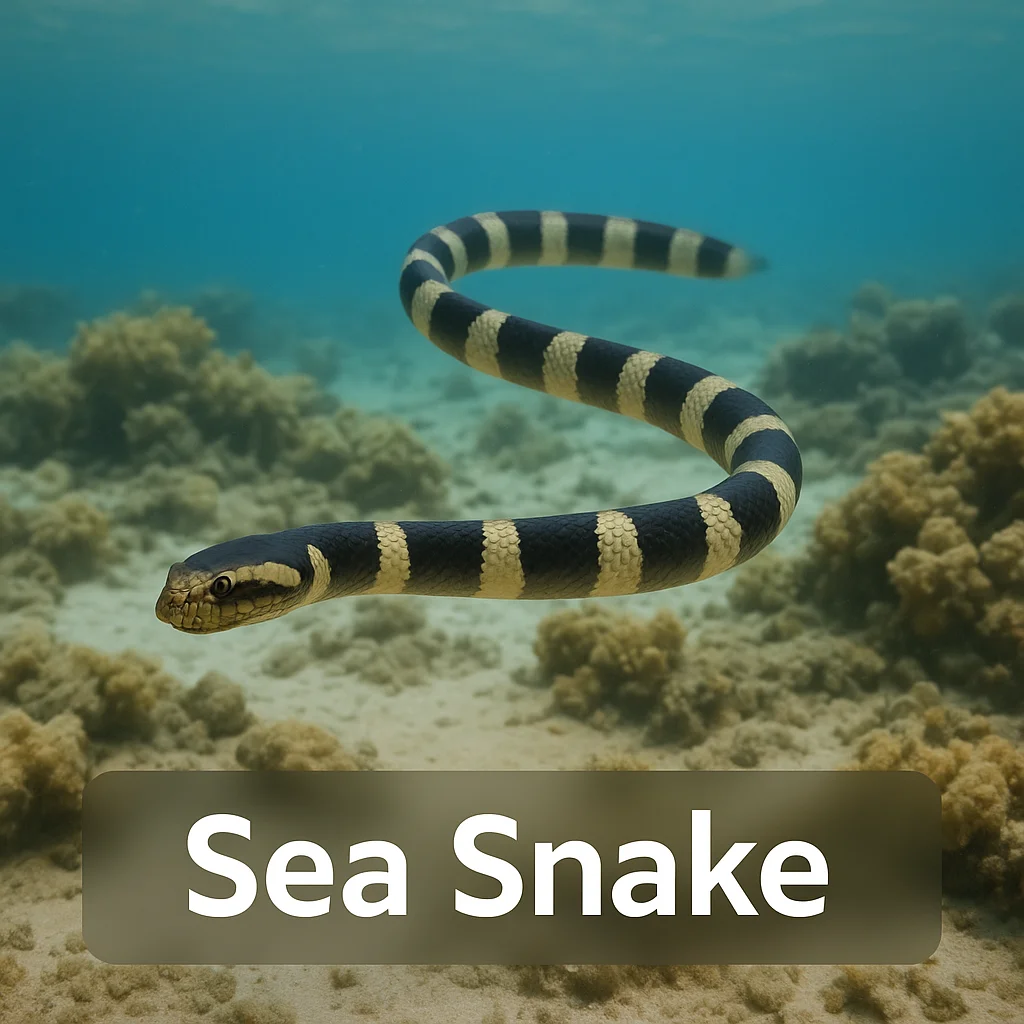
- Common name(s): Sea snake, Marine snake
- Scientific name: Hydrophiinae (subfamily)
- Animal type: Reptile
- Typical adult size: 0.5 to 3 meters (length)
- Typical lifespan: 5 to 10 years (in the wild)
- Diet type: Carnivore; feeds on fish and sometimes eels
- Activity pattern: Diurnal (mostly active during the day)
- Social structure: Solitary
- Movement highlights: Excellent swimmers, adapted for life underwater
- Intelligence/learning: Capable of complex hunting tactics
- Primary habitats: Coastal waters, coral reefs, estuaries
- Geographic range: Indo-Pacific, Australia, parts of the Indian Ocean
- Predators/threats: Sharks, large fish, birds; human pressures such as bycatch
- Conservation status: Varies by region and species
🔍 Identification & Appearance
Sea snakes are recognizable by their elongated, slender bodies and the absence of limbs. They have paddle-shaped tails for swimming and vary in color from black and white banded to vivid blues and greens.
- Long, cylindrical body adapted for swimming
- Distinctive flat, paddle-like tail
- Color patterns range from bands to solid colorful hues
- Smooth scales and lack of ventral scales typical in terrestrial snakes
- Small head relative to body size
- May resemble eels but have distinct body and tail structure
- Some species have nostrils located on top of the snout for breathing at the surface
- Varied by species, with some having more prominent patterning
🧱 Body Structure & Physical Adaptations
Sea snakes have unique physical adaptations that allow them to thrive in marine environments. Their bodies are streamlined for efficient swimming, and they have special physiological features to manage their aquatic lifestyle.
- Hydrodynamic body for swift swimming
- Flattened tail acts as a paddle for propulsion
- Lack of large ventral scales facilitates movement in water
- Enlarged lungs for extended diving duration
- Skin can absorb oxygen, aiding in long dives
- Salt glands to excrete excess salt from drinking seawater
- Ability to reduce metabolic rate during dives to conserve oxygen
- Nostrils with valves to prevent water entry
- Modified jaws to grip slippery prey
- Acute vision adapted for underwater hunting
🌍 Range & Distribution
Sea snakes inhabit warm coastal waters and are primarily found in the Indo-Pacific region. They are commonly seen near coral reefs and mangroves, areas that provide abundant prey and shelter.
- Found throughout the Indo-Pacific region
- Present along the coastlines of India, Southeast Asia, Northern Australia
- Frequent among coral reefs, estuaries, and lagoons
- Within the tropical and subtropical latitudes
- Mostly resident but may show seasonal shifts within coastal waters
- Occur at various depths, from shallow coastal areas to deeper waters
🏞️ Habitat & Shelter
Sea snakes are adapted to a life in the water and typically inhabit coral reefs, rocky shores, and estuaries. These environments offer plenty of food sources and hiding spots for both predators and prey.
- Coral reefs: abundant food and shelter
- Mangroves and estuaries: good hiding spots from predators
- Rocky shores: basking and resting areas
- Open water: for traveling between habitats
- Adapt behavior to tides and seasons for hunting and mating
- Knowledge of habitat critical for conservation efforts
🧭 Behavior & Ecology
Sea snakes are mostly solitary and spend much of their time swimming and hunting for food. They play a significant ecological role in marine ecosystems as both predator and prey.
- Solitary hunters, actively search for prey during daylight
- Utilize venom to subdue fish and eels
- Rely on vision and olfaction to locate prey
- Natural cleaners of coral reefs by controlling fish populations
- Use body language for intraspecific interactions
- May interact with other marine species via mutualism or competition
- Important prey item for larger marine predators
- Contribute to nutrient cycling in reef ecosystems
👥 Social Life & Group Dynamics
Sea snakes are largely solitary creatures, though they may aggregate in certain areas during specific times, such as mating season. Most interactions are limited to courtship and mating.
- Primarily solitary; not typically found in groups
- Males may gather where females are concentrated to mate
- No cooperative hunting behavior observed
- Limited aggression; conflict usually resolved without severe injury
- Lack of structured hierarchy compared to social mammals
- Occasional encounter with conspecifics, mainly for reproduction
- Opportunistic mating encounters; not long-term pair bonds
- Seasonal interactions during breeding periods
🍽️ Diet, Prey & Predators
Sea snakes are carnivorous, feeding primarily on fish and eels. They possess venom to incapacitate their prey quickly. Sea snakes also have a few natural predators that prey on them.
- Diet consists mostly of fish and eels
- Employ venom to subdue prey with minimal struggle
- Utilize ambush tactics or active pursuit depending on species and environment
- Predators include sharks, large fish, and marine birds
- Employ camouflage and flight as defenses against predators
- Humans pose threats via bycatch and habitat destruction
- Key predators in marine food webs, controlling fish populations
- No significant scavenging behavior observed
🦌 Hunting, Foraging & Movement
Sea snakes use both ambush and pursuit techniques when hunting, relying on their excellent swimming abilities. They are generally active hunters, using vision to locate prey against the backdrop of coral and rock.
- Swimmers with remarkable agility in the water
- Venomous bite to efficiently subdue slippery prey
- Active hunters who pursue prey, especially during daylight
- Undulating body movements enhance swimming speed and maneuverability
- Navigate based on marine landscapes and currents
- May have a home range but are not strongly territorial
- Capable of impressive endurance while searching for food
- Utilize visual and olfactory cues for prey detection
🧠 Intelligence & Senses
Sea snakes are equipped with heightened senses that facilitate their aquatic lifestyle. While not known for exceptional intelligence, they demonstrate keen hunting strategies and adaptability to prey conditions.
- Excellent vision adapted for detecting motion and shapes underwater
- Adequate olfactory abilities for detecting chemical cues in water
- Problem-solving mainly revolves around hunting and escaping predators
- Good adaptability to different prey types in marine environments
- Social intelligence is limited due to generally solitary behavior
- Uncertain about specific tool use or complex social learning
- Spatial memory aids in navigation and locating habitual hunting grounds
- Research on cognitive capabilities varies by species
🪺 Reproduction, Pregnancy & Parenting
Reproductive strategies of sea snakes can vary. Many are ovoviviparous, essentially giving birth to live young. Courtship behaviors involve chemical cues and sometimes physical displays.
- Breeding season varies with environmental conditions
- Most species believed to be ovoviviparous; some lay eggs
- Mating systems generally promiscuous
- Varied gestation periods; often several months long
- Clutch size varies from a few to over a dozen young
- Young are typically precocial and independent shortly after birth
- Parental care is minimal or absent
- Reproduction rates and success can be affected by environmental factors
♀️♂️ Male vs Female Differences
Male and female sea snakes may exhibit subtle differences in size and behavior. While both sexes appear similar, males are often slightly smaller and engage more actively in searching for mates.
- Males are usually smaller and more slender
- Female sea snakes may have larger body size to accommodate more offspring
- Males may exhibit more active search behaviors during mating season
- No significant color difference between sexes for most species
- Female reproductive cycles impact movement and behavior
- Displays and interactions are more common among males seeking mates
- Sexual dimorphism is subtle and varies with species
- Behavioral roles predominantly focused on reproduction rather than other social functions
🧬 Subspecies & Variation
With over 60 species, sea snakes exhibit considerable diversity in size, coloration, and habitat preference. Some species have adapted to local conditions, leading to physical and behavioral variations.
- Over 60 recognized species found in different marine biomes
- Diversification led by geographical isolation and environmental factors
- Variations in size and coloration driven by habitat type
- Some species are adapted to coral reefs, while others prefer open waters
- Debate over classification remains for certain groups
- Local adaptations may include tolerance to varying salinities and temperatures
- Some species have specialized diets or unique behaviors
- Variation ensures ecological resilience across different environments
⚠️ Threats, Conservation & Human Interaction
Sea snakes face threats from habitat degradation, bycatch in commercial fishing, and pollution. Conservation efforts focus on protecting marine environments and reducing accidental captures.
- Bycatch in fisheries is a significant threat
- Habitat loss due to human activity impacts populations
- Pollution affects coastal habitats crucial for sea snakes
- Climate change may alter marine environments, impacting sea snake habitats
- Conservation efforts benefit from habitat protection and sustainable fishing practices
- Legal protections vary by region and species
- Responsible ecotourism can aid in awareness and preservation
- Handling sea snakes is discouraged for amateur enthusiasts
✨ Fun Facts & Unique Traits
- Sea snakes can hold their breath for several hours when diving
- They have evolved specialized fangs for efficient venom delivery
- Some species can absorb moisture through their skin, reducing freshwater needs
- Their venom is among the most potent of all snakes, used for quick prey capture
- Not all sea snakes require land; some live entirely afloat in oceans
- They play a vital role in controlling fish population dynamics
- Have been known to exhibit curiosity towards divers and boats
- Believed to have evolved from terrestrial ancestors that colonized the sea
📌 Summary
- Sea snakes are a diverse group with over 60 species
- Primarily found in the Indo-Pacific region in coastal waters
- Carnivorous, feeding mainly on fish and eels
- Predators include sharks and birds, with human activities posing threats
- Solitary with limited social interaction outside of breeding
- Most species are ovoviviparous, giving live birth in water
- Adaptations include paddle-like tails and venomous fangs
- Significant for marine ecosystems for controlling prey populations
- Diverse in appearance; some species have vivid coloration
- Conservation dependent on marine habitat protection efforts