🦁 Rattlesnake
🧾 Quick Facts
Rattlesnakes are a group of venomous snakes known for the distinctive rattle at the end of their tails. They belong to the genera Crotalus and Sistrurus, which are part of the Viperidae family. These snakes are primarily found in the Americas and are notable for their distinctive appearance and warning mechanism.
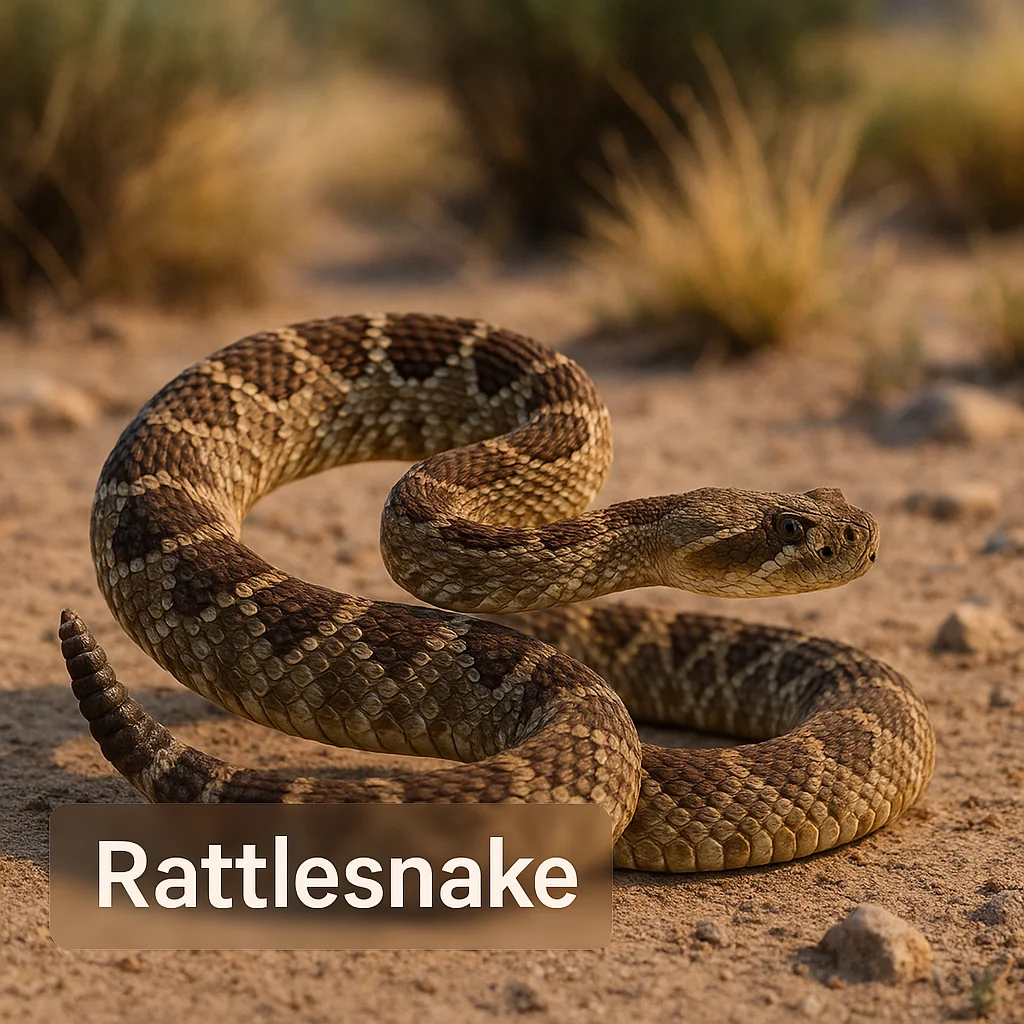
- Common name(s): Rattlesnake
- Scientific name: Genera Crotalus and Sistrurus
- Animal type: Reptile
- Typical adult size: 2 to 8 feet in length
- Typical lifespan: 10 to 20 years
- Diet type: Carnivore, feeds on small mammals, birds, and amphibians
- Activity pattern: Primarily nocturnal
- Social structure: Solitary
- Speed / movement highlights: Typically slow-moving; capable of quick strikes
- Intelligence/learning: Known for advanced hunting strategies
- Primary habitats: Deserts, grasslands, forests, and scrublands
- Geographic range: North and South America
- Predators/threats: Birds of prey, larger mammals, human threats
- Conservation status: Varies by region, some species are threatened
🔍 Identification & Appearance
Rattlesnakes can be identified by their heavy, stocky bodies and distinctive rattles on their tails, which they use as a warning signal. Most species have a characteristic pattern of dark diamonds or patches on lighter brown or grey skin. Juveniles and adults may differ slightly in pattern brightness, but all ages possess venomous fangs used for capturing and disabling prey. The head is typically triangular, and their eyes have vertical pupils.
- Stocky body with triangular head
- Dark diamond or blotched pattern on skin
- Tail ends in a rattle, used for warning
- Vertical, slit-shaped pupils
- Venomous fangs for subduing prey
- Varies in color, from pale grey to dark brown
🧱 Body Structure & Physical Adaptations
The rattlesnake's robust body allows it to store energy, necessary for its ambush hunting strategy. Its fangs are retractable and hinged, allowing deep bites that deliver venom efficiently. Their tail ends with a rattle, which is made of interlocking segments of keratin that make a loud noise when vibrated as a warning. Though their vision is not exceptional, rattlesnakes have specialized pit organs that detect heat from potential prey or threats.
- Robust body shape for efficient energy storage
- Retractable fangs that inject venom
- Heat-sensing pits for detecting warm-blooded prey
- Rattle on tail for auditory warning signals
- Limited vision but compensate with sensory adaptations
🌍 Range & Distribution
Rattlesnakes are found throughout the Americas, from the southern tip of Canada down to Argentina. They inhabit a range of environments, including deserts, forests, and grasslands, indicating their adaptability to various landscapes. While some species may adopt specific seasonal behaviors, such as hibernation in colder regions, most rattlesnakes do not migrate significantly.
- Found in North, Central, and South America
- Present in countries such as the USA, Mexico, and Argentina
- Commonly inhabit desert and scrubland regions
- Can be found in both high and low elevation areas
- Typically a resident species with some seasonal activity changes
🏞️ Habitat & Shelter
Rattlesnakes prefer habitats that provide ample cover and a suitable climate for thermoregulation, such as deserts, grasslands, and rocky hillsides. Their shelters often include rock crevices, animal burrows, or fallen logs that protect them from predators and extreme weather. Rattlesnakes are ectothermic and thus rely heavily on environmental temperature for activity regulation.
🧭 Behavior & Ecology
Rattlesnakes are primarily known for their ambush hunting tactics. They remain concealed and wait for prey to venture close before striking with their venomous bite. Their daily routine includes alternating between basking to regulate body temperature and hiding within their shelters. Although they are solitary, rattlesnakes briefly associate during mating season. They play a critical role as both predator and prey within their ecosystems.
- Solitary hunters, except during the breeding season
- Use camouflage and stillness to ambush prey
- Regulate body temperature by basking in the sun
- Consume rodents, thus controlling their populations
- Provide food for larger predators, like hawks and eagles
👥 Social Life & Group Dynamics
Rattlesnakes are typically solitary animals, interacting with each other mainly during the mating season or when congregating at dens in colder climates for hibernation. They do not form stable social groups or hierarchies. Breeding aggregations can occur, but individual interactions are still minimal.
- Primarily solitary outside the breeding season
- No permanent groups; occasional aggregations in denning
- Minimal social structure, no dominance hierarchies
- Some cooperation during communal hibernation
- Females do not maintain long-term bonds with offspring
🍽️ Diet, Prey & Predators
Rattlesnakes are carnivorous, with diets consisting primarily of small mammals like rodents and birds. They hunt using a sit-and-wait strategy, relying on their heat-sensitive pits to detect prey. Natural predators of rattlesnakes include birds of prey, such as hawks and owls, as well as larger mammals. Rattlesnakes use their venom as a primary defense mechanism against predators.
- Feast on small mammals and occasional birds
- Ambush predators using heat detection
- Main predators include hawks, owls, and larger mammals
- Venom deters many potential threats
- Scavenging behavior is rare but can occur
🦌 Hunting, Foraging & Movement
As ambush predators, rattlesnakes rely heavily on patience and stealth. They typically strike quickly at prey with their venomous fangs, injecting toxins that immobilize. Rattlesnakes are not fast-moving but are adept at short bursts of speed when necessary. Their movement is usually limited to searching for a suitable position from which to wait for prey.
- Use a sit-and-wait strategy for ambushing prey
- Capable of rapid strikes with high precision
- Favors ground movement over climbing or swimming
- Adapts to environmental changes by relocating when necessary
- Relies on chemical trails and heat sensing for navigation
🧠 Intelligence & Senses
Rattlesnakes possess a sophisticated suite of sensory adaptations that aid in their survival. Their heat-sensing pits allow them to detect and effectively hunt endothermic prey. While their cognitive abilities do not match those of mammals, rattlesnakes demonstrate complex behavior patterns suited to their lifestyle. Studies suggest they might be capable of rudimentary problem-solving tasks.
- Possess heat-sensing pit organs for detecting prey
- Limited vision but excellent olfaction and tactile senses
- Exhibit learned behaviors and strategic hunting
- Simple problem-solving abilities observed in studies
- Utilizes chemosensory cues for tracking
🪺 Reproduction, Pregnancy & Parenting
Rattlesnakes typically breed in the spring, with courtship consisting of a form of "combat dance" where males vie for the attention of females. They practice a polygynous mating system. Following fertilization, females give birth to live young, with litter sizes varying depending on species and environmental conditions. Offspring receive no parental care after birth and are independent from a young age.
- Breeding occurs mostly in spring
- Polygynous mating system observed
- Gestation lasts several months, depending on climate
- Offspring are live-born and independent shortly after birth
- Litter sizes range based on species and habitat conditions
♀️♂️ Male vs Female Differences
Males tend to be slightly larger than females, which can be attributed to their competitive behaviors during the breeding season. While size differences are the most apparent, there are no notable differences in color or pattern between the sexes. Behavioral roles during courtship and aggression are more prevalent in males, whereas females bear the responsibility of gestation and birthing.
- Males generally larger than females
- Similar coloration and patterns between sexes
- Males exhibit competitive behaviors in mating season
- Females are solely responsible for delivery
- Subtle size differences may occur based on geography
🧬 Subspecies & Variation
Several rattlesnake species, such as the Eastern and Western Diamondback, exhibit regional variations in pattern, size, and scale structure. Local adaptations exist, including specialized scales for desert environments or wetter climates. The taxonomy of rattlesnakes is continually refined as genetic studies improve our understanding of their diversity.
- Eastern and Western Diamondbacks show distinct traits
- Local adaptations influence color and scale structure
- Desert species often have more muted coloration
- Size variation often related to habitat and resource availability
- Genetic studies continue to refine subspecies classification
⚠️ Threats, Conservation & Human Interaction
Rattlesnakes face threats from habitat destruction, human encroachment, and direct persecution due to fear and misunderstanding. While some species are considered secure, others face increased levels of threat. Conservation efforts focus on habitat protection and public education to promote coexistence without risk. Ethically managed facilities sometimes house these snakes for educational purposes, emphasizing the importance of their role in ecosystems.
- Habitat loss due to urban and agricultural expansion
- Persecution from fear-based killing
- Vulnerability varies by species and location
- Conservation efforts target habitat preservation
- Encouraging safe human-snake coexistence through education
✨ Fun Facts & Unique Traits
- Rattlesnakes use a protein-rich venom that aids digestion
- They can control the amount of venom released in a bite
- A rattlesnake's "rattle" adds segments each time the snake sheds its skin
- Rattlesnakes play a key role in controlling rodent populations
- The sound of the rattle can be heard from up to 60 feet away
- They have been in existence for 10-15 million years
- Rattlesnakes can "hibernate" in colder climates, entering brumation
- They have an annual molting process that can occur multiple times based on growth
📌 Summary
- Rattlesnakes are identified by their triangular heads and tail rattles
- They inhabit deserts, grasslands, and forests across the Americas
- Carnivorous diet, primarily hunting small mammals and birds
- Main predators include birds of prey and larger mammals
- Solitary by nature, except during the breeding season
- Reproduction involves live birth with independent young
- Key adaptations include heat-sensing pits and venomous fangs
- Distinctive for their role in ecosystems and unique warning systems