🦁 Nile Crocodile
🧾 Quick Facts
The Nile Crocodile, scientifically classified as Crocodylus niloticus, is among Africa's most formidable reptiles. Renowned for its powerful build and vibrant presence in various African regions, this crocodilian is an integral part of the ecosystems it inhabits.
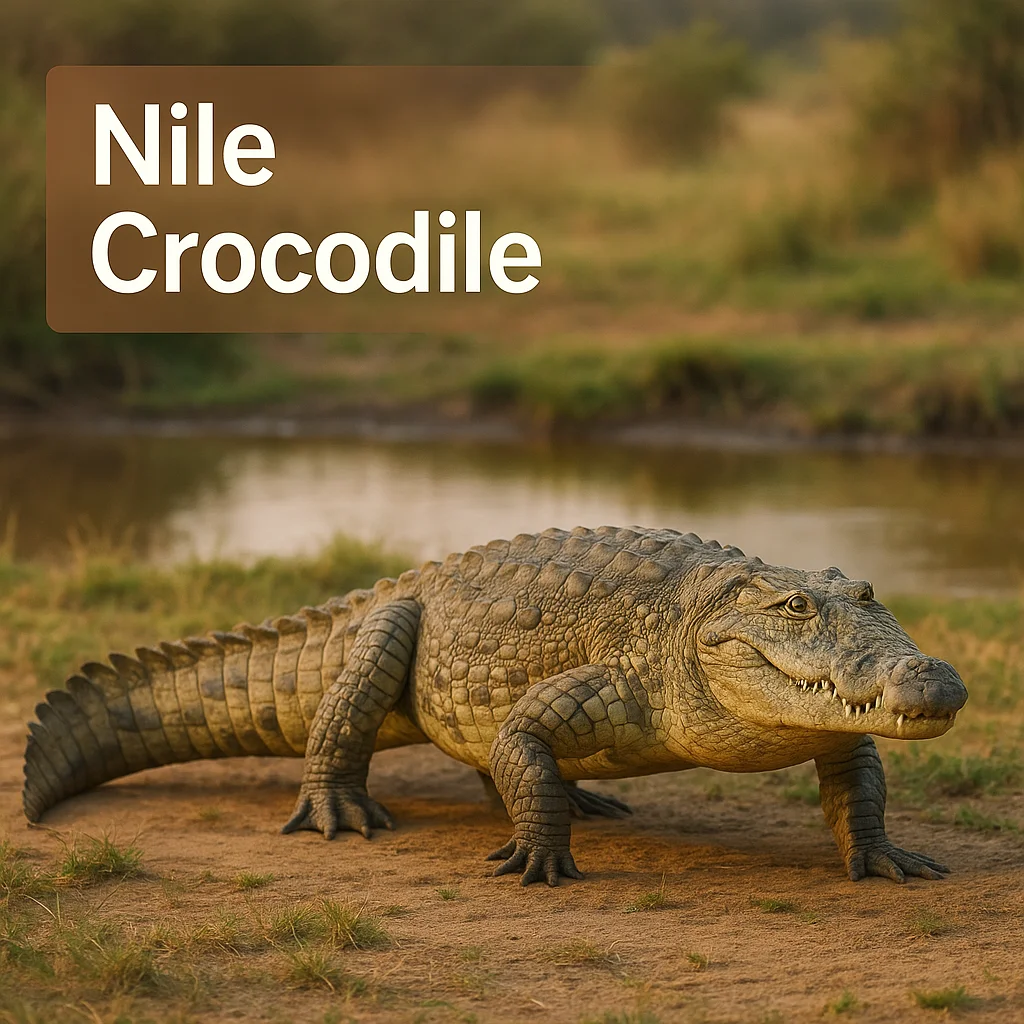
- Common name(s): Nile Crocodile
- Scientific name: Crocodylus niloticus
- Animal type: Reptile
- Typical adult size: 3.5 to 5 meters (11 to 16 feet) long
- Typical lifespan: 50 to 70 years in the wild
- Diet type: Carnivore; preys on fish, birds, mammals
- Activity pattern: Primarily nocturnal
- Social structure: Often found in groups; not solitary
- Speed / movement highlights: Can move swiftly on land in short bursts, excellent swimmer
- Intelligence/learning: Displays problem-solving behavior and social learning
- Primary habitats: Rivers, marshes, and swamps
- Geographic range: Africa, primarily sub-Saharan regions
- Predators/threats: Large cats, humans
- Conservation status: Varies by region; some populations are dwindling
🔍 Identification & Appearance
The Nile Crocodile is immediately recognizable thanks to its robust, muscular build and long, streamlined body suited for aquatic life. Its coloration typically ranges from dark bronze to a dull green, providing excellent camouflage in murky waters.
- Body shape and silhouette: Elongated body with strong limbs and tail
- Key colors/patterns: Olive to brown tones with occasional black patches
- Distinctive features: Prominent scutes (bony plates) on the back
- Tracks: Thick tail drags with webbed footprints
- Common look-alikes: Similar to other crocodiles; can be distinguished by size and snout shape
- Strong, streamlined build
- Olive to brown coloration
- Scutes along back
- Elongated, tough tail
- Serrated teeth easily visible
- Prominent eye ridges
🧱 Body Structure & Physical Adaptations
The Nile Crocodile boasts a powerful, muscular frame, with a proportionate but strong tail that propels it through water. Its limb placement allows for on-land agility.
- Build and proportions: Stocky with muscular limbs and tail
- Teeth/jaw adaptations: Sharp, conical teeth grasp prey securely
- Claws: Sturdy claws ideal for gripping and climbing riverbanks
- Sensory strengths: Acute night vision and excellent underwater hearing
- Stocky, muscular build
- Sharp, conical teeth
- Powerful jaw muscles
- Robust tail for swimming
- Strong, agile limbs
- Enhanced night vision
🌍 Range & Distribution
The Nile Crocodile inhabits a broad swath of sub-Saharan Africa, thriving in rivers, lakes, and marshes. Its distribution encompasses regions from Egypt to South Africa, with sizable populations in the Nile basin and Savannah watersheds.
- Predominantly sub-Saharan Africa
- Abundant in Egypt and South Africa
- Inhabits river basins and lakes
- Present in African savannahs
- Often found at lower elevations
🏞️ Habitat & Shelter
Nile Crocodiles are primarily found in wetlands, rivers, and marshy environments. They make use of water bodies for hunting and thermoregulation, often basking in the sun during cooler days and retreating into the water for shelter.
Habitat knowledge is crucial for understanding their thermoregulatory behavior and how it impacts the broader ecosystem. These crocodiles are pivotal in maintaining healthy aquatic environments.
🧭 Behavior & Ecology
The Nile Crocodile is an apex predator within its habitat. Its behavior entails stealthy ambushes from water fringes to capture unsuspecting prey. Despite its fearsome reputation, it plays a critical role in maintaining ecological balance.
- Active during twilight and night
- Engages in basking to regulate body temperature
- Vocalizations for communication during courtship
- Scavenging behavior supplementing diet
- Helps control fish populations
👥 Social Life & Group Dynamics
While often perceived as solitary, Nile Crocodiles exhibit social behaviors, especially during basking and nesting. They may share sections of territory with conspecifics, displaying occasional hierarchical behaviors but minimal aggression in such settings.
- Often found in groups around prime basking sites
- Minimal direct interaction outside of mating season
- Hierarchies observed at larger congregation sites
- Some cooperative nesting observed
🍽️ Diet, Prey & Predators
The diet of the Nile Crocodile varies based on availability, typically consisting of fish, birds, and small-medium mammals. They employ ambush tactics for larger prey, while also scavenging when necessary. Young crocodiles may fall prey to larger predators such as big cats or birds of prey.
- Primary diet includes fish and aquatic birds
- May prey on larger mammals when opportunity arises
- Employs stealth ambushes at water edges
- Scavenges carrion opportunistically
🦌 Hunting, Foraging & Movement
Nile Crocodiles are adept hunters, relying on their powerful jaws and stealth to capture prey. They are efficient swimmers, using their muscular tails to navigate swiftly through water while remaining stealthy. Their hunting times are typically during twilight hours, though they remain opportunistic feeders.
- Utilizes ambush tactics near water edges
- Swift and agile in aquatic environments
- Primarily hunts during dusk and night
- Optimal hunting facilitated by strong tail propulsion
🧠 Intelligence & Senses
Although not primarily known for intelligence, Nile Crocodiles exhibit behaviors indicating problem-solving and social awareness, particularly in cooperative breeding and territorial sharing. Their sensory adaptations are geared towards nocturnal hunting, with excellent night vision and sensitive hearing.
- Displays basic problem-solving capabilities
- Learn from older or more experienced individuals
- Acute sense of hearing and smell
- Highly developed night vision
🪺 Reproduction, Pregnancy & Parenting
Nile Crocodiles have a defined breeding season aligned with the wet season, where males engage in displays to court females. Following mating, females lay clutches of eggs on sandy riverbanks, exhibiting protective behavior until hatching. Hatchlings are precocial, though they receive maternal protection against predators.
- Breeds during the wet season
- Males display bellowing calls and physical displays
- Females lay clutches of 25–80 eggs
- Parental guarding of nesting sites
♀️♂️ Male vs Female Differences
While both sexes appear similar, male Nile Crocodiles tend to be larger and more robust than females. These size differences contribute primarily to the males' role in defense and territorial displays during the breeding season.
- Males generally larger than females
- Slight variation in head and body proportion
- Mating displays prominent in males
- Females more involved in nesting
🧬 Subspecies & Variation
Subspecies classification of Nile Crocodiles is occasionally debated among herpetologists. Variations in size and coloration exist in different habitats, often related to specific environmental adaptations.
- Some regional coloration differences
- Size variations based on habitat resources
- Debate exists over distinct subspecies
⚠️ Threats, Conservation & Human Interaction
Nile Crocodiles face several threats, including habitat destruction, poaching for skins, and retaliatory killings. Conservation efforts include habitat protection and management. Human interactions vary, with some cultures having traditional, respectful cohabitation practices.
- Habitat loss due to human encroachment
- Poaching for leather trade
- Conflict with human populations near water bodies
- Conservation efforts include awareness programs
✨ Fun Facts & Unique Traits
- Nile Crocodiles have the strongest bite of any animal
- Known to use floating debris as a camouflage tool
- Plays a key role in preventing fish overpopulation
- Can hold their breath underwater for up to 30 minutes
- Communicate through a range of vocalizations
- Historical records indicate interactions with ancient Egyptians
📌 Summary
- Large, powerful reptiles native to Africa
- Recognizable by elongated body and scutes
- Found in rivers and wetlands in sub-Saharan Africa
- Applies ambush tactics for hunting a varied diet
- Social, often found in basking groups
- Breeding during wet seasons, protective of young
- Intelligent, with excellent sensory adaptations
- Facing conservation challenges but still common in certain regions