🦁 Leopard Gecko
🧾 Quick Facts
The Leopard Gecko, known for its vibrant colors and mild temperament, is a popular reptile among pet enthusiasts and a fascinating subject for nature lovers. This nocturnal creature is native to the arid regions of Asia and showcases remarkable adaptations that allow it to thrive in such environments.
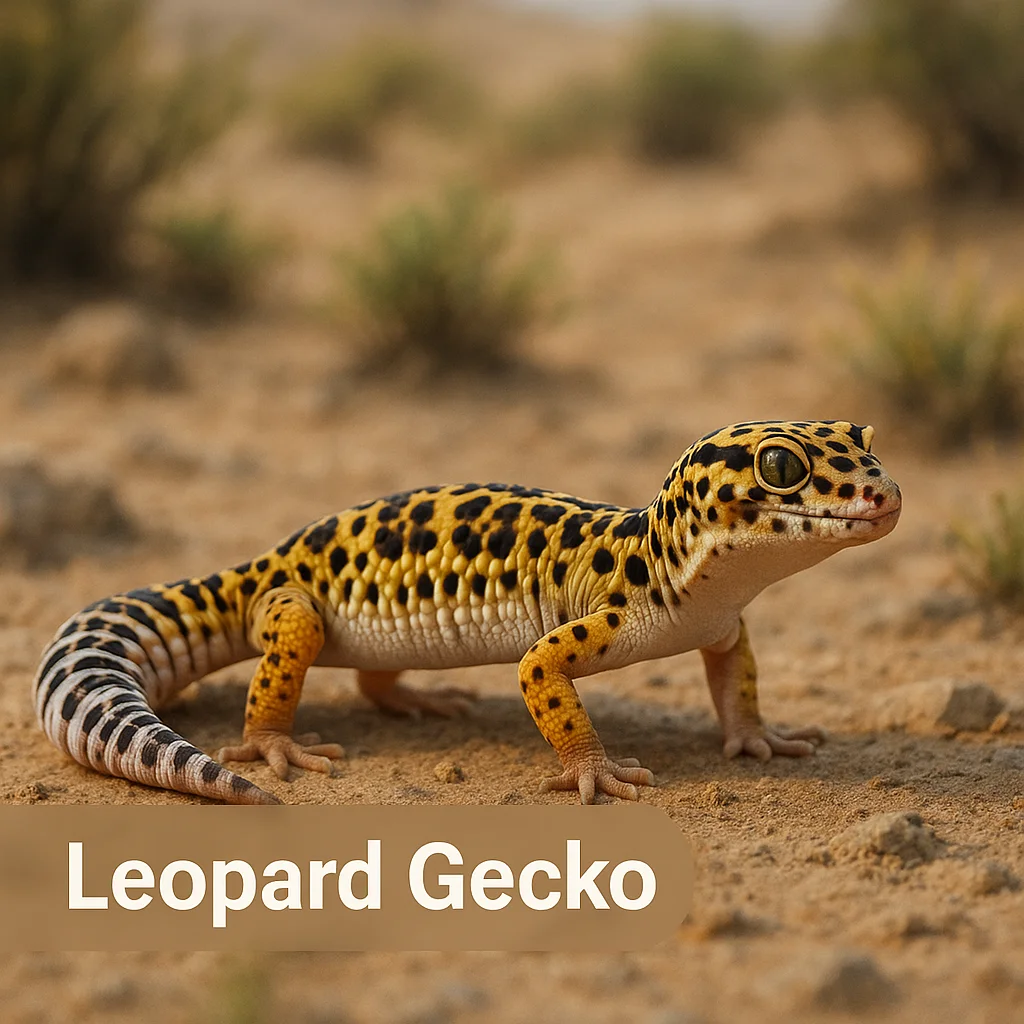
- Common name(s): Leopard Gecko
- Scientific name: Eublepharis macularius
- Animal type: Reptile
- Typical adult size: 7–10 inches in length
- Typical lifespan: 10–20 years in captivity
- Diet type: Carnivore; primarily insects
- Activity pattern: Nocturnal
- Social structure: Generally solitary but can be housed in groups with appropriate care
- Speed / movement highlights: Moderate-paced with bursts of speed to catch prey
- Intelligence/learning: Capable of basic learning and recognizing handlers
- Primary habitats: Deserts and arid grasslands
- Geographic range: Central and South Asia
- Predators/threats: Snakes, larger reptiles, birds of prey
- Conservation status: Least Concern, but varies by region
🔍 Identification & Appearance
Leopard Geckos are easily recognized by their distinctively spotted skin, resembling a leopard's coat. They have a moderately robust body with a broad head and long, flexible tail. These geckos exhibit bright patterns of yellow and black spots and sometimes have tangerine or subtle pastel hues.
- Body shape and silhouette: Stocky with a broad head and noticeable tapering tail
- Key colors/patterns: Yellow skin with black spots; varies with morphs
- Distinctive features: Lid-lidded eyes, movable eyelids, and fine scales
- Tracks, scat, or other field signs: Small footprints with five toes; scat is typically dry
- Common look-alikes: Fat-tailed gecko; distinguishable by patterns and size
- Spotted patterns mimic a leopard's coat
- Broad head with pronounced eyes
- Movable eyelids, unlike most geckos
- Tactile tail used for balance and fat storage
- Flexible, primarily yellow body with variable markings
- Keen nocturnal vision
🧱 Body Structure & Physical Adaptations
The Leopard Gecko's physique is adapted for survival in its desert habitat. Its stout build and strong limbs support efficient movement across various terrains. These geckos have sharp, retractable claws suitable for climbing and digging, while their tails serve dual roles in storing fat and aiding in balance. Their teeth and jaws allow them to efficiently capture and consume live prey.
- Build and proportions: Compact and robust, with short legs
- Teeth/beak/jaw adaptations: Small, conical teeth for grasping and holding prey
- Claws optimized for: Digging and gripping the ground while moving
- Sensory strengths: Exceptional night vision and acute hearing
- Robust and flexible build
- Sharp claws for traction and digging
- Storing fat in the tail for lean times
- Strong, grasping jaws for live prey
- Clear vision adapted to low light
- Excellent camouflage in native habitat
🌍 Range & Distribution
Leopard Geckos are found across Central and South Asia, predominantly inhabiting the semi-desert and arid grassland regions. They tend to avoid areas with excessive moisture and cold temperatures, preferring environments that offer ample hiding opportunities and warm climates.
- Typical regions: Pakistan, India, Afghanistan, Iran
- Elevation range: Typically found in lowland to mid-elevation areas
- Seasonal movements: Generally resident; may seek higher shelter during cold spells
- Northern India
- Southeastern Afghanistan
- Western Pakistan
- Northeastern Iran
- Central Asia's semi-deserts
- Arid grasslands and rocky outcroppings
🏞️ Habitat & Shelter
Leopard Geckos thrive in areas with sparse vegetation such as deserts and rocky grasslands. They utilize rocky crevices, underground burrows, and other naturally occurring shelters to hide from predators and extreme weather conditions. Their activity is heavily influenced by temperature, becoming more active during warm nights and retiring during harsh, hot days.
🧭 Behavior & Ecology
Leopard Geckos demonstrate a variety of intriguing behavioral adaptations. As nocturnal hunters, they scavenge for insects and small invertebrates under the cover of darkness using their acute senses. They are territorial and will utilize vocalizations and body language to communicate with others, especially in captivity where social dynamics can be closely observed. In their natural environments, Leopard Geckos play a vital role in controlling insect populations.
- Engage in regular grooming with tongue use
- Communicate with clicks, chirps, and tail gestures
- Predominantly hunt during dusk and night
- Territorially protective especially during breeding season
- Play a major role in insect population control
- Use body language for signaling and defensive purposes
👥 Social Life & Group Dynamics
While generally solitary, Leopard Geckos can be kept together under specific conditions to avoid territorial aggression. In a controlled environment, some may form loose social structures, especially during breeding. Outside breeding season, these reptiles prefer solitary lives, only interacting with others when necessary.
- Primarily solitary creatures
- Can be peaceful in groups with ample space
- Occasionally forms pairs during breeding season
- Minimal cooperative behavior outside consumer-gather interactions
- Displays mild dominance behaviors, usually non-violent
🍽️ Diet, Prey & Predators
The Leopard Gecko's diet predominantly consists of insects, reflecting its role as a carnivore. They primarily prey on crickets, mealworms, and various small invertebrates. They exhibit quick reflexes and methods typical of ambush predators, sneaking close to their prey before striking. Natural predators include snakes and birds, against which they deploy camouflage and stealth.
- Eats variety including crickets, waxworms, and small beetles
- Occasionally consumes spiders
- Revolutionary defenses include tail shedding
- Thrives on calcium-rich foods in captivity
- Employs stealth and camouflage to escape predators
🦌 Hunting, Foraging & Movement
Leopard Geckos primarily rely on ambush methods for hunting. With an expansive field of vision and sensitive hearing, they adeptly sneak up on prey. They are medium-paced runners capable of swift, short bursts to capture insects, often using their tails for balance and rapid direction change. Typically, these geckos remain within a familiar area, rarely straying unless disturbances force relocation.
- Bursts of speed when capturing prey
- Ambush tactics primarily used in hunting
- Prefers dusk and night for foraging
- Exhibits territorial tendencies in known ranges
- Utilizes visual landmarks for navigation
🧠 Intelligence & Senses
Leopard Geckos exhibit a moderate level of intelligence, demonstrating the ability to learn through conditioning. They recognize familiar surroundings and can differentiate between handlers in captivity. Their sensory adaptations are finely tuned for night activity, relying heavily on acute nocturnal eyesight and audibly attentive structures.
- Recognizes caregivers and familiar environments
- Relies heavily on night vision
- Responsive to tactile stimuli
- Sensitive auditory capacity
- Conditional learning abilities
🪺 Reproduction, Pregnancy & Parenting
Reproduction in Leopard Geckos involves a courtship ritual that includes distinct sounds and gestures. These geckos usually breed in warm seasons; after mating, females lay clutches of soft-shelled eggs in moist, secluded sites. The incubation period lasts about 45-60 days, which can vary by temperature. Post-hatching, juveniles receive no parental care and are immediately independent.
- Breeding peaks during warmer seasons
- Polygynous with sometimes multiple partners per season
- Lays 2 eggs per clutch, often several clutches per year
- Incubation period depends on environmental temperature
- No parental investment post-hatching
♀️♂️ Male vs Female Differences
Male and female Leopard Geckos can be distinguished by color intensity and physical characteristics. Males typically exhibit brighter coloration and larger, more developed femoral pores, while females tend to be slightly smaller. During the breeding season, behavioral differences emerge with males becoming more territorial.
- Males larger with brighter colors
- Females slightly smaller, less vibrantly colored
- Mature males have pronounced pore lines
- Males exhibit increased territoriality during breeding
- Subtle variation in behavior between genders
🧬 Subspecies & Variation
There are several recognized Leopard Gecko morphs resulting from selective breeding usually visible in captivity settings. These morphs display significant variation in skin color, patterns, and size. Wild populations may have natural color variations adapted to local environments; however, subspecies classification is subject to ongoing study.
- Common morphs include albino, tangerine, and blizzard
- Subtle wild variations reflecting regional adaptation
- Ongoing research into distinct subspecies
- No definitive subspecies classification yet
⚠️ Threats, Conservation & Human Interaction
Leopard Geckos face minimal threats in the wild due to effective camouflage and flexible habitats. In captivity, they are highly popular; however, responsible breeding and pet ownership are essential to prevent crossing ethics boundaries. In the wild, their chief threats include habitat alteration and natural predation pressures.
- Natural predators include serpents and birds
- Generally stable in current geographic range
- Human interaction primarily limited to captive care
- Conservation varies and localized habitat preservation is ongoing
✨ Fun Facts & Unique Traits
- Leopard Geckos can regenerate their tails if lost.
- Unlike most geckos, they have eyelids they can blink.
- Their skin patterns provide excellent desert camouflage.
- Leopard Geckos use their tails to communicate.
- They can live over 20 years under optimal care.
- Nocturnal nature helps evade many common predators.
📌 Summary
- Identification: Yellow with black spots; robust form and distinctive look.
- Habitat: Arid regions across Central and South Asia.
- Distribution: Widely across semi-desert areas of Central Asia.
- Diet: Carnivorous, insect-focused diet.
- Predators: Snakes and avian threats in natural settings.
- Social Life: Solitary with occasional social behavior during breeding season.
- Reproduction: Several clutches per year with incubation tied to environmental temperatures.
- Key Adaptations: Fat-storing tail, retractable claws, exceptional night vision.
- Distinctiveness: Tamed nature for captivity, striking patterns that mimic leopards.