🦁 Komodo Dragon
🧾 Quick Facts
The Komodo Dragon, renowned for its formidable size and predatory skills, is an apex reptile found in select regions of Southeast Asia. These magnificent lizards are fascinating creatures with unique adaptations that make them notable within the animal kingdom.
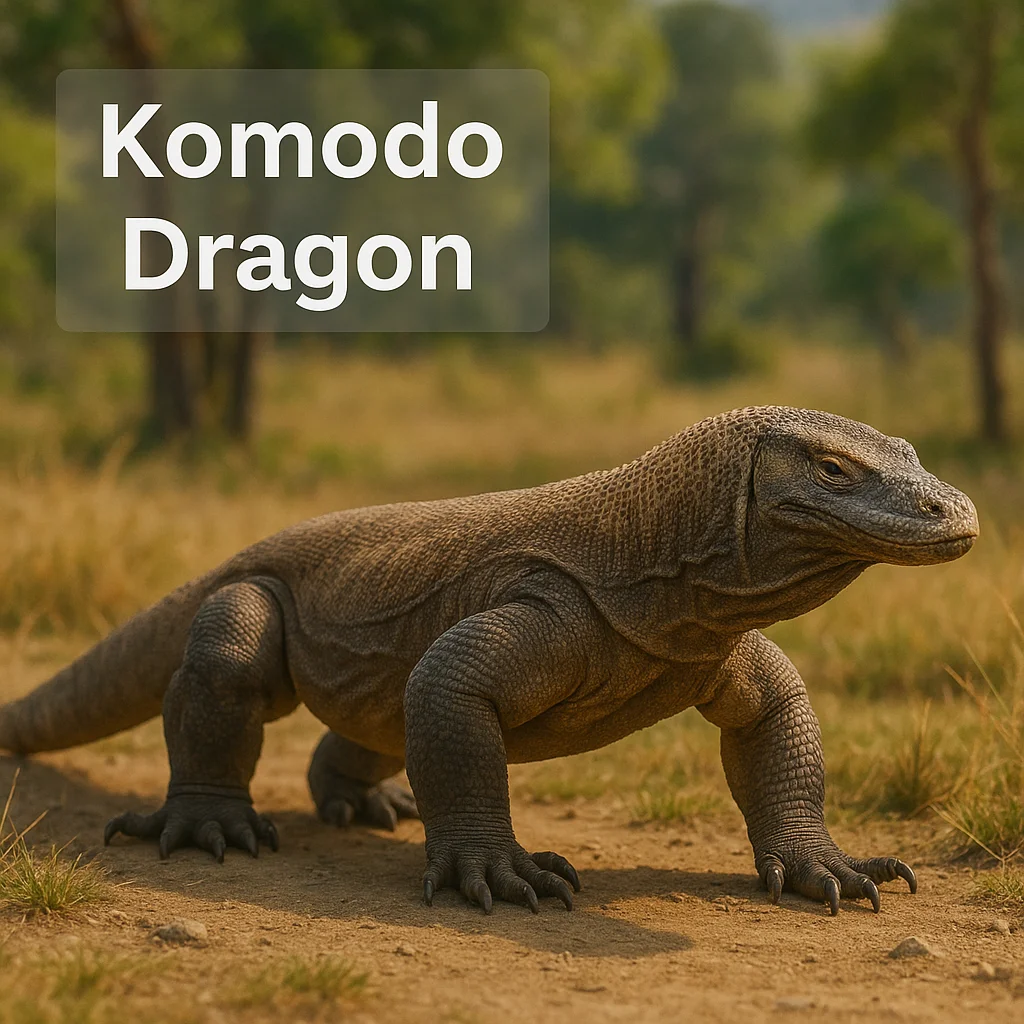
- Common name(s): Komodo Dragon
- Scientific name: Varanus komodoensis
- Animal type: Reptile
- Typical adult size: Up to 10 feet in length; up to 150-200 pounds in weight
- Typical lifespan: 20-30 years in the wild; up to 30-40 years in captivity
- Diet type: Carnivore; prey includes deer, wild boar, and smaller reptiles
- Activity pattern: Diurnal
- Social structure: Mostly solitary, except during feeding and breeding
- Speed: Can reach speeds up to 12 mph in short bursts
- Intelligence/learning: Demonstrates basic problem-solving abilities
- Primary habitats: Tropical savannas, forests
- Geographic range: Indigenous to Indonesian islands, including Komodo and Rinca
- Predators/threats: Very few natural predators; human encroachment and habitat loss are threats
- Conservation status: Vulnerable, due to limited range and habitat destruction
🔍 Identification & Appearance
The Komodo Dragon is unmistakable, with its massive, stocky body and thick, muscular limbs. Its long, flat head houses sharp, serrated teeth, perfect for slicing flesh, while the tail is strong and often used as a powerful weapon for defense.
Coloration ranges from gray to a dark brown, often displaying muted scales that blend into its natural habitat. As they mature, dragons may darken, but their patterns remain consistent throughout their lives.
Characters often compared, but different from other large lizards, include the monitor lizard group, which are smaller and typically have less robust builds.
- Body shape: Large, elongated body with a low, broad stance
- Colors: Earthy tones of gray, brown, with possible hints of olive
- Features: Long, forked tongue; sharp claws; powerful tail
- Tracks: Noticeable tail drag marks alongside clawed footprints
- Head: Flat, with a noticeable round snout
- Patterns: Uniform color with some small pattern variations by individual
- Scaling: Rough and sturdy scales across the body
- Tongue: Forked, used primarily for sensory purposes
- Size: Much larger than average monitor lizards
🧱 Body Structure & Physical Adaptations
The Komodo Dragon’s formidable body provides it with numerous survival advantages. Its robust legs and powerful tail aid in both hunting and defense. The jaw is equipped with serrated teeth that are continually replaced throughout its life, enabling it to efficiently dismember prey.
Strong claws are essential for digging, grasping prey, and scaling uneven landscapes. While it may not stand out for speed, its sprinting capability is crucial for capturing prey or escaping threats.
- Build: Stocky and muscular, ideal for powerful movements
- Teeth: serrated, capable of inflicting serious injury to prey
- Claws: Sharp and curved for grasping and climbing
- Sensory: Excellent sense of smell, detecting scents from afar
- Tail: Used as a potent weapon and for balance
- Limbs: Short but strong, supporting its substantial weight
- Vision: Good, but primarily at shorter distances
- Jaws: Extremely strong, delivering a powerful bite
🌍 Range & Distribution
The Komodo Dragon is found exclusively on several Indonesian islands, including Komodo, Rinca, Flores, Gili Motang, and Padar. Within this confined range, they occupy hot and dry habitats such as savannas and dry open grasslands near the beaches and forests.
As non-migratory creatures, these lizards have established territories where they remain for most of their lives, indicating a high level of habitat fidelity.
- Komodo and Rinca Islands
- Limited to Indonesia
- Found in savannas and forests
- Stable in well-preserved national parks
- Occasionally found near beaches and sandy areas
- No seasonal migration
- Rarely adjusted elevation preferences
- Mainly found in lower elevations
- Concentrated populations in protected areas
🏞️ Habitat & Shelter
Favoring habitats that offer both open spaces for stalking prey and covered areas for concealment, Komodo Dragons excel in environments that blend grasslands with forests. These habitats provide necessary thermal options, allowing them to regulate their body temperature through basking or taking shade.
Shelter often consists of underbrush, rock crevices, or burrows, which they dig to escape the intense midday heat. Understanding the habitat preferences of the Komodo Dragon helps explain their territorial behavior and strategies for survival within their limited range.
🧭 Behavior & Ecology
Komodo Dragons are known for their solitary nature, although they congregate around carrion and during breeding seasons. These reptiles are territorial, relying on both physical displays and scent marking to establish dominance and deter rivals.
They play a vital role as apex predators in their ecosystem, controlling prey populations and scavenging carrion. This dual role helps maintain ecological balance within their habitat.
- Primarily solitary, except during feeding or breeding
- Regularly use scent marking to delineate territory
- Digestive capabilities allow for scavenging on carrion
- Rely heavily on stealth and ambush tactics for hunting
- Capable of detecting scents from several kilometers
- Infrequent but intense encounters with rivals
- Interaction with other species mainly as predators
- Exhibit threat displays to intimidate potential threats
- Maintain well-defined home ranges
- Nocturnal scavenging reported occasionally
👥 Social Life & Group Dynamics
Komodo Dragons are primarily solitary, but their social interactions become evident during feeding frenzies. In these situations, dominance hierarchies form, with larger and stronger dragons gaining priority access to food.
Breeding periods also stimulate social interactions, with males competing for the opportunity to mate. Despite aggressive tendencies, actual physical confrontations are rare, generally resolved through visual and auditory displays.
- Primarily solitary outside of breeding season
- Temporary social interactions during feeding
- Food resources can lead to temporary hierarchies
- Few long-term bonds, even among individuals sharing territory
- Conflict avoidance through intimidation or display
- Male rivalries more common during mating season
- Cooperative behavior is uncommon
- Female-driven dispersion of offspring
🍽️ Diet, Prey & Predators
As apex carnivores, Komodo Dragons are formidable hunters that primarily feed on large mammals like deer and boar. Their ambush strategy is aided by patience and a powerful bite, which often weakens prey through septicemia.
Despite their top position in the food chain, young dragons are vulnerable to birds of prey and other larger Komodo Dragons. Notably, they exhibit scavenging behavior, consuming carrion and leftover kills.
- Main diet includes deer, pigs, and carrion
- Prey selection varies based on availability and size
- Young dragons prey on small mammals and insects
- Scavenging forms a significant part of the diet
- Prey immobilization through bite-induced toxicity
- Nocturnal feeding on occasion reported
- Employ ambush tactics for hunting efficiency
- Potentially can be cannibalistic
- Limited natural predators due to size dominance
🦌 Hunting, Foraging & Movement
These dragons are primarily ambush predators, relying on stealth and the element of surprise to capture unsuspecting prey. They can sprint in short bursts to chase down targets, displaying remarkable agility despite their size.
Komodo Dragons are known for their capability to traverse varied terrains, using their muscular limbs and strong tails for balance. Their strategic feeding involves waiting patiently near water sources or game trails where prey is likely to venture.
- Efficient ambush predators
- Short bursts of speed up to 12 mph
- Forage by scent and environmental cues
- Often hunt alone, relying on stealth
- Exploit water sources as strategic hunting grounds
- Rarely pursue prey over long distances
- Adept at climbing to access food or vantage points
- Compact home range minimizes need for long travels
- Skilled at utilizing terrain for concealment
🧠 Intelligence & Senses
While not commonly associated with advanced cognitive abilities, Komodo Dragons display impressive problem-solving skills in the wild. They are capable of learning from experience and even adapting hunting strategies based on environmental conditions.
Their sense of smell is exceptionally keen, thanks to the Jacobson's organ, allowing them to detect food or other dragons over extensive distances. Despite good vision, it primarily serves at closer ranges.
- Notable long-distance olfactory capabilities
- Demonstrates basic learning behaviors
- Adapts strategies based on prior experiences
- Sensory abilities primarily rely on smell and sight
- Engages in environment-based problem-solving
- Uses sensory data to track potential mates or rivals
🪺 Reproduction, Pregnancy & Parenting
Typically breeding from May to August, Komodo Dragons engage in intense courtship, with males often battling for access to females. These lizards follow a polygynous mating system, where dominant males mate with multiple females.
The eggs, ranging from 15 to 30 in a clutch, are laid and incubated in borrowed or constructed nests, hatching in about 7–8 months. Hatchlings are generally left to fend for themselves, showcasing precocial development and innate independence.
- Breeding season from May to August
- Polygynous mating system with male competition
- Gestation lasts approximately 7–8 months
- Females lay 15 to 30 eggs per clutch
- Incubate eggs in mounds or abandoned nests
- Hatchlings display precocial developmental traits
- Minimal parental investment post-hatching
- Females select nesting sites carefully for safety
♀️♂️ Male vs Female Differences
Sexual dimorphism in Komodo Dragons is subtle but present. Males tend to be slightly larger, with heavier, more robust builds suitable for territorial combat and reproductive competition. Both sexes share similar coloration and patterning.
Behaviorally, males often engage in more aggressive and competitive interactions, especially during the breeding season. Females are more inclined towards discreet behavior, focusing mainly on reproductive processes and nesting.
- Males generally larger than females
- Aggressive behavior more common among males
- Females focus heavily on nesting and reproduction
- Similar coloration and patterning across genders
- Male territorial behavior more pronounced
- Subtle size differences evidence in adult dragons
- Nesting females exhibit strategic site selection
🧬 Subspecies & Variation
The Komodo Dragon species does not have officially recognized subspecies, although some regional morphs exhibit slight differences in size and color due to environmental adaptations. These variations are largely influenced by island-specific ecological pressures.
Among these deviations, minor shifts in scale pigmentation or size are observed depending on conditions such as available prey types or habitat characteristics. Nonetheless, these variations remain within the general classification of Varanus komodoensis.
- No officially recognized subspecies
- Slight regional size variations noted
- Island-specific environmental adaptations present
- Variations primarily influenced by diet availability
- Overall coloration changes minor and localized
⚠️ Threats, Conservation & Human Interaction
Komodo Dragons face several challenges, primarily due to habitat encroachment and human activity. Limited to protected parks, these areas are under constant pressure from deforestation and development. Conservation efforts focus on maintaining these habitats and minimizing human-dragon conflicts.
While they pose no significant threat to humans when unprovoked, education and awareness play crucial roles in mitigating potential encounters. Zoos function as conservation and education centers that enhance understanding and support for this unique species.
- Habitat encroachment from human expansion
- Conservation efforts aimed at habitat preservation
- Limited range increases vulnerability to changes
- Eco-tourism provides economic incentive for preservation
- Human education critical for coexistence
- Zoos aid in species awareness and conservation
- Habitat preservation includes managing visitor impacts
✨ Fun Facts & Unique Traits
- Komodo Dragons can consume up to 80% of their body weight in one meal.
- They have approximately 60 teeth that are continuously replaced.
- Their saliva contains over 50 different strains of bacteria, aiding in subduing prey.
- Despite their size, they can climb trees to find food or escape threats.
- Their strong tail is not only a weapon but also used for swimming.
- Younger Komodo Dragons are arboreal, living primarily in trees to avoid predators.
- They are capable swimmers, occasionally moving between islands.
- Characteristic tongue flicking helps detect scents over long distances.
- These lizards communicate through hissing and visual displays.
📌 Summary
- The Komodo Dragon is the world's largest living lizard.
- Known for its powerful build and serrated teeth, it's an apex predator.
- It resides exclusively on select Indonesian islands.
- Favors tropical savannas and sparse forests for habitation.
- Utilizes ambush tactics to capture various prey, primarily large mammals.
- Displays complex behaviors during rare social interactions.
- Breeds polygynously with clutch sizes ranging up to 30 eggs.
- Survival threatened by habitat loss and limited distribution.
- Distinguished by unique biological adaptations, such as their potent bite.