🦁 King Cobra
🧾 Quick Facts
The King Cobra, often hailed as the monarch among snakes, is a fascinating reptile known for its impressive size and potent venom. While commonly referred to by its regal name, it is a single species with scientific nuances that entail distinct characteristics.
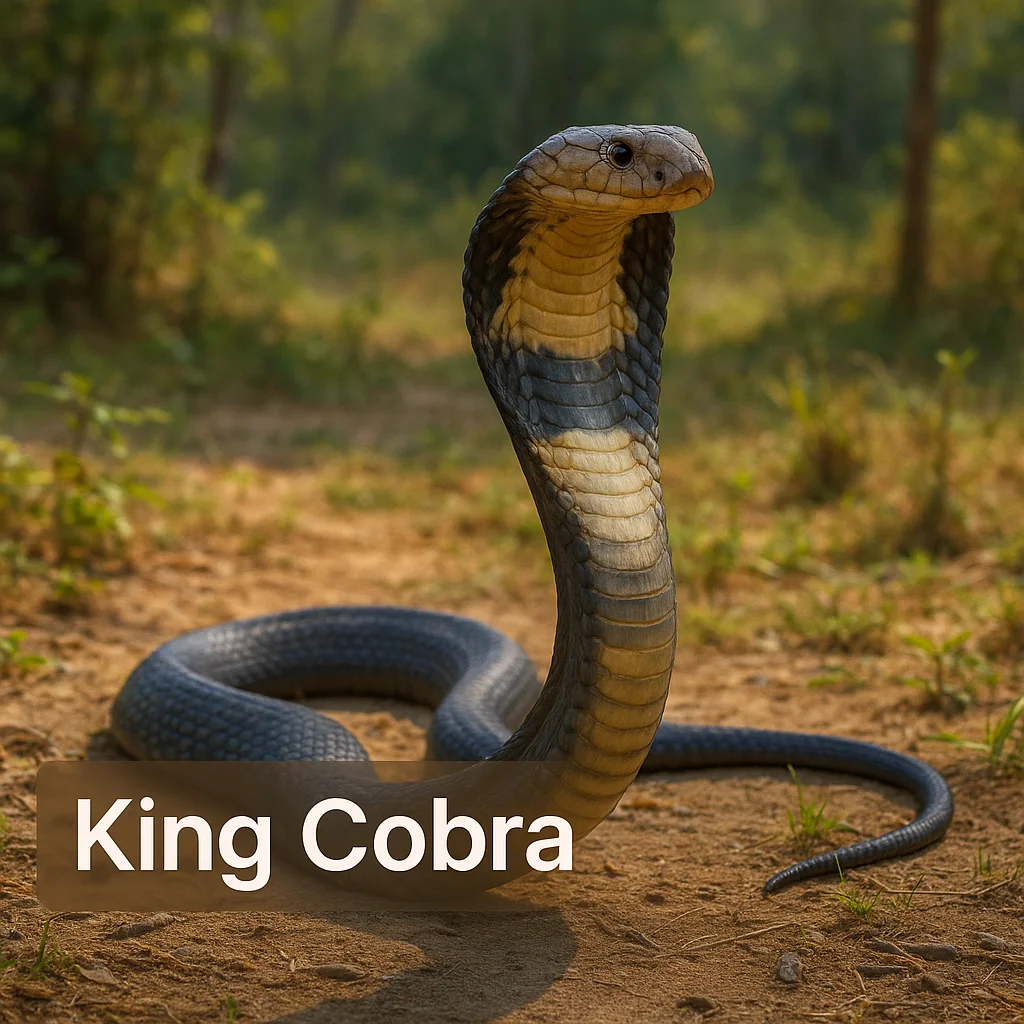
- Common name(s): King Cobra
- Scientific name: Ophiophagus hannah
- Animal type: Reptile
- Typical adult size: 10-13 feet (up to 18 feet in rare cases)
- Typical lifespan: 20 years in the wild
- Diet type: Carnivore; primarily eats other snakes
- Activity pattern: Diurnal
- Social structure: Primarily solitary
- Speed / movement highlights: Can move quickly over short distances
- Intelligence/learning: Exhibits learning and complex behaviors
- Primary habitats: Forests, grasslands, and mangrove swamps
- Geographic range: South and Southeast Asia
- Predators/threats: Larger mammals, birds of prey; habitat loss and persecution
- Conservation status: Varies by region; some populations are vulnerable
🔍 Identification & Appearance
The King Cobra is immediately recognizable by its large size and the distinctive 'hood' it displays when threatened. Its body is typically a uniform olive, brown, or black color with subtle cross bands, which help it blend into its forested environments.
- Body is long and slender, with a narrow but imposing hood
- Colors range from olive green to brown or black
- Juveniles have more distinct bands compared to adults
- Head is large with a wide mouth adapted for large prey
- Round pupils with excellent vision
- Tracks can resemble those of other large snakes; scat is seldom found
- Common look-alike: Indian cobra; differs in size and hood pattern
- Top ID Tips
- Look for the hood when the snake is threatened
- Observe the length; King Cobras are significantly larger than most snakes
- Note the uniform color in adults
- Distinguish by the broad head and elongated hood
- Observe habitat; King Cobras prefer forested regions
- Juvenile banding is more pronounced than in adults
🧱 Body Structure & Physical Adaptations
The King Cobra’s physique is optimized for hunting and defense within its natural habitats. Its muscular body allows for quick, purposeful movements, crucial for ambushing prey.
- Build is long and muscular; body supports swift, stealthy movement
- Sharp, recurved teeth for holding slippery prey
- No limbs; relies on muscular movement for propulsion
- Forked tongue and advanced Jacobson's organ for excellent scent detection
- Limited hearing; vibration-sensitive
- Excellent binocular vision, aiding in hunting
- Key Adaptations
- Expandable rib bones allow hood expansion
- Heat-sensitive scales aid in thermoregulation
- Venom specialized to inhibit nervous system function in prey
- Camouflage coloration helps avoidance of larger predators
- Capable of lifting nearly one-third of its body off the ground
🌍 Range & Distribution
The King Cobra is native to parts of South and Southeast Asia, thriving in a variety of habitats ranging from dense rainforests to more arid areas.
- Found in India, Bangladesh, Thailand, Vietnam, Indonesia, and the Philippines
- Common in both mainland and islands of Southeast Asia
- Prefers humid, tropical regions but can adapt to dry habitats
- Not known for migratory behavior; hold a home range
- Primarily found at elevations from sea level up to 2,000 meters
- Where You Might Find It
- Sundarbans mangrove forest
- Western Ghats in India
- Northern and Eastern Thailand forests
- Borneo's interior jungles
- Philippine forests
- Evergreen forests of Bangladesh
🏞️ Habitat & Shelter
The King Cobra thrives in diverse habitats that offer plenty of cover and food resources. Forested areas dominated by dense vegetation provide ideal conditions for shelter and hunting.
- Prefers dense forests, mangroves, and bamboo thickets
- Can be found near streams or pools where prey is abundant
- Adapts to agricultural fields and degraded forests when necessary
- Seasonal behavior varies little; remains active in tropical climates
- Habitat knowledge is crucial for conservation and reducing human conflict
🧭 Behavior & Ecology
King Cobras exhibit a range of behaviors that reflect their status as top predators. While predominantly solitary, they maintain territories, especially during breeding season.
- Active primarily during the day, using a blend of vision and scent to hunt
- When threatened, they exhibit a defensive display, raising their hood and hissing
- Play a critical role as a predator, controlling snake populations
- Engage in complex interactions with other snake species
- Exhibit territoriality, particularly males during mating season
- Behavior Highlights
- Primarily solitary but fierce when defending territory or nest
- Unique among snakes for building nests for their eggs
- Female guards nest until eggs hatch
- Prey dominance includes other cobra species
- Exceptional climbing abilities allow access to arboreal prey
👥 Social Life & Group Dynamics
Despite their intimidating size and reclusive nature, King Cobras exhibit fascinating behaviors, particularly in relation to their nesting and territory.
- Solitary outside of breeding periods
- Encounter aggressive displays during mating season
- Females showcase rare nesting behavior among snakes
- Males engage in combat with rivals during breeding season
- No structured group cooperation outside of mating
- Social Structure Notes
- Nest building is a female-exclusive task among King Cobras
- Mating involves complex rituals and territory disputes
- Their name signifies dominance over other snake species
- Post-mating, interactions are minimal
- Highly territorial during breeding season
🍽️ Diet, Prey & Predators
The King Cobra's diet is highly specialized, consisting mainly of other reptiles. This dietary preference affects its foraging behavior and ecological role as predator and prey.
- Primarily eats other snakes, including rat snakes and other cobras
- Will occasionally consume small mammals, birds, and lizards
- Utilizes its potent venom to immobilize prey quickly
- Young are vulnerable to predator birds and larger carnivores
- Defensive displays and size deter most potential threats
- Feeding Notes
- Highly specialized diet focused on snake consumption
- Venom is neurotoxic, aiding in swift subjugation of prey
- Juveniles often have more diverse diets due to smaller size
- Engages in cannibalism when food resources are scarce
- Main natural threats are mongooses due to immunity to venom
🦌 Hunting, Foraging & Movement
The King Cobra boasts an efficient hunting method augmented by its ability to navigate various terrains, from dense undergrowth to the forest canopy.
- Known for ambushing prey; employs stealth over speed
- Capable of climbing trees to catch arboreal snakes
- Generally moves in a line with bursts of speed up to 12 mph
- Exhibits strategic navigation within its home range
- Defends territory aggressively during the mating season
- Movement & Strategy
- Primarily an ambush predator
- Uses trees and water sources for food gathering
- Home range remains constant but fiercely defended
- Smooth, rapid movements aid in sudden strikes
- Stealthily maneuvers through dense forest
🧠 Intelligence & Senses
King Cobras are intelligent reptiles capable of demonstrating advanced cognitive functions and sensory abilities crucial for their survival.
- Capable of learning from their environment and previous encounters
- Sophisticated understanding of territory and threats
- Powerful eyesight for precise detection of movement
- Specialized vomeronasal organ enhances chemical detection
- Unclear tool use; primarily utilizes natural surroundings
- Notable Abilities
- Can identify specific prey from afar by scent and sight
- Displays strategic positioning and planning when hunting
- Adaptive learning from encounters with other species
- Exhibits strong memory of geographical territories
- Superior ability to sense environmental vibrations
🪺 Reproduction, Pregnancy & Parenting
Reproductive behaviors of King Cobras involve complex courtship and rare parental care. Unlike most snake species, females invest significant effort in nest building and offspring protection.
- Breeding season generally from January to April
- Engages in ritualized combat behaviors during courtship
- Oviparous, laying between 20-50 eggs
- Female guards the nest site for approximately two months
- Hatchlings are independent immediately after hatching
- Reproduction Snapshot
- Females construct nests out of leaves and debris
- Typically monogamous during a single breeding season
- Egg incubation period lasts about 60-70 days
- Guarding the nest increases survival rates of hatchlings
- Hatchlings are venomous from birth
♀️♂️ Male vs Female Differences
Notable differences exist between male and female King Cobras, most prominently in size and specific behavior during breeding seasons.
- Males are generally longer but not significantly heavier
- Females more involved in offspring care, particularly nest guarding
- Both sexes have similar coloration and patterns
- Males engage in combats over territory and mates
- Behavioral roles during breeding season distinct between genders
- Sex Differences at a Glance
- Males often displace females in size contests
- Distinct combat behavior in males defending breeding rights
- Females more aggressive when protecting nests
- Differences most evident during breeding season
- Sexual dimorphism limited beyond size and behavior
🧬 Subspecies & Variation
The King Cobra exhibits limited subspecies variation, although geographical and environmental factors can influence its physical and behavioral traits.
- Debate exists over strict subspecies classification
- Size and color patterns can vary based on regional conditions
- Paucity of research on distinct genetic subspecies
- Adaptations are often correlated to prey availability and type
- Variation Notes
- Island populations may exhibit stunted growth
- Diversity in color based on habitat (ranging from dark olive to lighter hues)
- Forest vs grassland populations might differ in prey choice
- Mainland cobras can grow larger due to more abundant prey
⚠️ Threats, Conservation & Human Interaction
King Cobras face numerous challenges stemming from both natural interactions and human-induced pressures, making understanding relationships between humanity and nature vital.
- Vulnerable to habitat loss due to deforestation
- Subject to human persecution from fear and misunderstanding
- Considered a symbol of power in many cultures, influencing capture and trade
- Climate changes affect prey availability and habitat conditions
- Public education critical for conservation and reducing fear-based harm
- Responsible Notes
- Respect natural habitats when observing in the wild
- Seek professional advice if encountering a snake in a human area
- Conflict avoidance strategies are key in reducing tensions
- Promote conservation programs emphasizing ecological roles
- Informative outreach integral to altering public perceptions
✨ Fun Facts & Unique Traits
- King Cobras are the longest venomous snakes in the world
- They are the only species of snake that builds nests for eggs
- The name "Ophiophagus" means "snake-eater," highlighting their diet
- Despite their size, they can lift about a third of their body off the ground
- When rearing to strike, they can directly look a person in the eye
- Their mating rituals can involve complex "neck wrestling" displays
- They have a unique ability to "stand" tall and move forward while doing so
📌 Summary
- Identified by large size and distinct hood
- Prefers tropical forest habitats across South and Southeast Asia
- Carnivorous diet focused on other snakes
- Acts as both predator and prey, managing snake populations
- Exhibits solitary behavior with territorial tendencies
- Complex reproductive behaviors with female nest guarding
- Physical adaptations include potent venom and excellent vision
- Challenges include habitat loss and human conflict
- Unique as a snake with nest-building and guarding behavior