🦁 Green Anaconda
🧾 Quick Facts
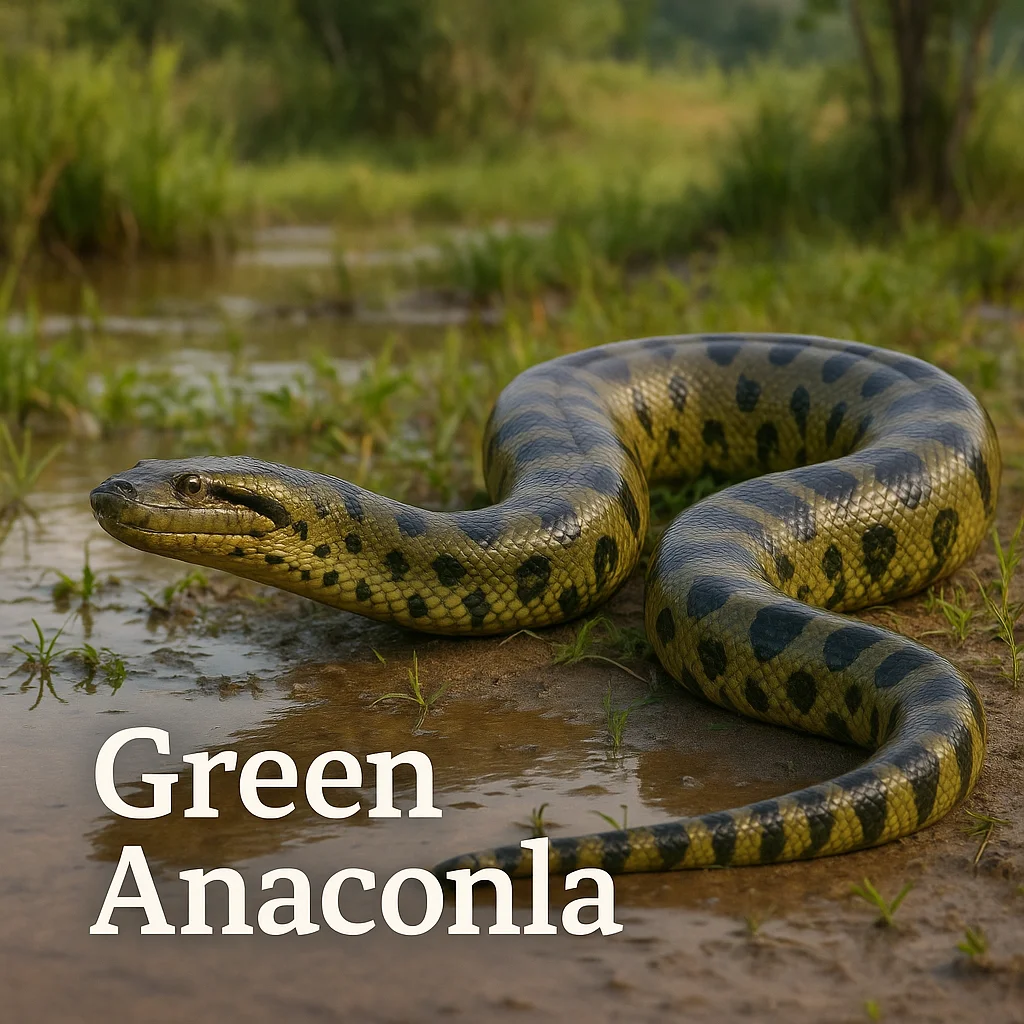
The Green Anaconda, often listed scientifically as Eunectes murinus, is one of the largest snakes in the world, well-known for its immense size and habitat in the tropical rivers and swamps of South America. This swampland denizen is both fascinating and formidable, capturing the interest of both scientists and nature enthusiasts alike.
- Common name(s): Green Anaconda, Water Boa
- Scientific name: Eunectes murinus
- Animal type: Reptile
- Typical adult size: 15-30 feet (4.5-9 meters); weight ranges up to 550 pounds (250 kg)
- Typical lifespan: 10-15 years in the wild, longer in captivity
- Diet type: Carnivore; feeds on fish, birds, mammals, and other reptiles
- Activity pattern: Nocturnal
- Social structure: Primarily solitary
- Speed / movement highlights: Adept swimmer; utilizes rivers and swamps for stealthy movement
- Intelligence/learning: Limited problem-solving abilities; instinct-driven
- Primary habitats: Tropical forests, swamps, rivers
- Geographic range: Northern South America including Amazon Basin
- Predators/threats: Jaguars, caimans, humans (habitat destruction and hunting)
- Conservation status: Not currently endangered, but status varies by region
🔍 Identification & Appearance
Recognizable by its massive size, the Green Anaconda has a thick, muscular body that tapers into a short tail. Its olive-green color is adorned with black blotches running the length of its body, providing effective camouflage in its murky aquatic environment. The anaconda’s eyes and nostrils are positioned on top of its head, allowing it to see and breathe while remaining mostly submerged. It lacks an obvious visual counterpart, but can be confused with other large boas, distinguishable by size and habitat preference.
- Top ID Tips
- Thick, heavy-bodied snake
- Olive-green with black blotches
- Position of eyes and nostrils indicates its aquatic habits
- Powerful constrictor
- Typically rests coiled in water
- Large size is a distinguishing feature
- Ventral side is paler with a slight yellowish hue
🧱 Body Structure & Physical Adaptations
The Green Anaconda's body is stocky and muscular, optimized for constriction. Its muscular system is well-adapted for overpowering prey. Unlike many snakes, it has a reduced number of long sharp teeth designed to grip rather than cut. Its eyes and nostrils are on top of its head, facilitating breathing and watching for prey even while submerged. Its scales provide tactile sensitivity, crucial for navigating murky waters.
- Key Adaptations
- Extremely muscular for constriction
- Streamlined body for swimming
- Nostrils and eyes situated for aquatic breathing
- Rough scales for touch and grip
- Sharp teeth for holding prey
- Jaw flexibility to swallow large prey
🌍 Range & Distribution
The Green Anaconda is found in the Amazon Basin, thriving in the slow-moving rivers, swamps, and marshes of tropical South America. It does not migrate but may move within its aquatic and semi-aquatic habitats in response to water availability and prey distribution. Adapted to a hot, wet climate, the Green Anaconda is less frequently found in drier regions.
- Where You Might Find It
- Amazon Basin in South America
- Countries like Brazil, Venezuela, and Colombia
- Mangroves and wetlands
- Lowland tropical forests
- Flooded savanna areas
🏞️ Habitat & Shelter
Green Anacondas are intimately tied to their aquatic habitats, such as swamps, slow-moving streams, and marshes. They rely on these environments for both hunting and concealment from predators. Seasonally, during the dry months, these snakes may take refuge further inland in burrows or under dense vegetation to retain moisture. Their tendency to remain near water sources is vital for maintaining their body condition and ensuring access to prey.
🧭 Behavior & Ecology
Green Anacondas are primarily nocturnal, spending much of their time in water where they are near-invisible. They showcase ambush predation, awaiting prey while submerged, often near banks and edges. Their communication is limited and mainly involves body language such as posture during mating. As apex predators, they play an essential role in maintaining the balance of local ecosystems by regulating the populations of their prey species.
- Behavior Highlights
- Primarily nocturnal activity aids stealth
- Camouflaged ambush predator
- Critical apex predator in ecosystem
- Has limited and basic social behaviors
- Utilizes an extensive home range adjacent to water
👥 Social Life & Group Dynamics
As largely solitary creatures, Green Anacondas are only found together during mating season. There is no group hunting or social coordination involved in their behaviors. Males may engage in physical combat over females during the breeding season. Young snakes lead independent lives shortly after birth, receiving no parental care.
- Social Structure Notes
- Solitary outside of mating season
- Minimal social interaction
- Young are independent immediately
- Mating aggregations involve multiple males
🍽️ Diet, Prey & Predators
Green Anacondas are opportunistic carnivores, taking on mammals, birds, reptiles, and fish. They primarily employ a sit-and-wait method for hunting, using stealth and patience to capture unsuspecting prey before constriction. While adult anacondas face few natural threats due to their size, juveniles are more vulnerable to predation from birds of prey, small jungle cats, caimans, and adult anacondas.
- Feeding Notes
- Large diet range: mammals, reptiles, birds
- Constricts prey due to immense strength
- Feeding frequency varies by prey size
- Juveniles face predation risk
🦌 Hunting, Foraging & Movement
Green Anacondas excel in aquatic ambush hunting. Their nocturnal foraging is done in stealth, becoming near-invisible in dim waters. Though they appear slow, they are capable of sudden bursts of speed when capturing prey. They traverse territories using waterways, rarely venturing far from a water source. They typically establish home ranges dominated by preferred hunting grounds.
- Movement & Strategy
- Adept at swimming; prefers water routes
- Effective ambush tactic dependent on stealth
- Tactics vary based on prey size and type
- Uses waterways for territory navigation
🧠 Intelligence & Senses
Due to their dependence on instinct, Green Anacondas display limited cognitive abilities compared to more advanced snakes. Their primary assets are acute tactile sensitivity and impeccable camouflaging skills. They rely heavily on their sense of smell to detect prey and locate potential mates, despite limited sight used mainly for detecting large movements.
- Notable Abilities
- Advanced tactile skin sensitivity
- Strong sense of smell guides hunting
- Large focus on camouflaging behavior
- Instincts heavily govern actions
🪺 Reproduction, Pregnancy & Parenting
Green Anacondas have a unique reproductive system, breeding during the rainy season when food is most abundant. They employ a mating ball, where several males might compete for a single appreciative female. The species is viviparous, with females giving birth to live young after a gestation period of about six months. This reproductive strategy allows them to quickly adapt to various environmental conditions.
- Reproduction Snapshot
- Viviparous: gives birth to live young
- No parental care after birth
- Mating usually occurs in water
- Males follow scent trails for mating
- Frequency influenced by food availability
♀️♂️ Male vs Female Differences
Sexual dimorphism is visible in Green Anacondas, with females significantly larger than males, a reversal from many animal patterns likely attributable to reproductive strategy. This allows females to carry more offspring in a single gestation. Mating behavior highlights this size aspect since males must congregate in competitive "mating balls" around females.
- Sex Differences at a Glance
- Females are substantially larger than males
- Size aids in reproductive capacity
- Slight variance in male and female coloration; subtle
🧬 Subspecies & Variation
While the Green Anaconda itself has no recognized subspecies, variation does occur across its range in terms of size and behavior, influenced by environmental conditions such as prey availability and habitat water content. These factors can cause regional variations in terms of growth rates and overall size.
- Variation Notes
- Size varies significantly with geography
- Behavioral adaptations seen with different prey
- Adaptive to different aquatic conditions
⚠️ Threats, Conservation & Human Interaction
The Green Anaconda faces threats from habitat degradation due to agriculture and logging, threatening their wetland ecosystems. Despite not being endangered, localized pressures can deplete their populations. Combatting such threats requires habitat conservation focused on preserving wetland environments. Public education on coexistence and ecosystem benefits is critical in areas where humans might interact with them.
- Responsible Notes
- Preservation of wetland habitats crucial
- Human education to reduce unnecessary fear
- Hunting threatens certain populations
- Encourage eco-friendly tourism approaches
✨ Fun Facts & Unique Traits
- The Green Anaconda is renowned for being one of the heaviest snakes in the world.
- These anacondas can hold their breath underwater for up to ten minutes.
- They rarely hunt on dry land, preferring the stealth of water.
- Anacondas digest large prey over several weeks.
- They exhibit very limited mouth openings despite jaw flexibility.
📌 Summary
- Anacondas are the heaviest snakes with tremendous constriction power.
- They thrive in the tropical wetlands of the Amazon Basin.
- These solitary giants are made famous by their natural ability to overpower large prey.
- Green Anacondas have a unique vocalization restricted to hisses and growls.
- A gender reversal attributing larger females redefines traditional snake dimorphism.
- External threats include habitat reduction and cultural misconceptions.