🦁 Black Mamba
🧾 Quick Facts
One of the most enigmatic and often misunderstood snakes in the animal kingdom, the Black Mamba (scientific name Dendroaspis polylepis) is a member of the Elapidae family. Known for its speed, potent venom, and intriguing behaviors, this snake is native to sub-Saharan Africa and plays a crucial role in its ecosystem.
- Common name(s): Black Mamba
- Scientific name: Dendroaspis polylepis
- Animal type: Reptile
- Typical adult size: 2.5 to 4.5 meters in length
- Typical lifespan: 11 to 15 years in the wild
- Diet type: Carnivore; primarily small mammals and birds
- Activity pattern: Diurnal
- Social structure: Solitary
- Speed / movement highlights: Can reach speeds up to 20 km/h
- Intelligence/learning: Known for keen hunting strategies; no evidence of tool use
- Primary habitats: Savannas, rocky hills, and deserts
- Geographic range: Sub-Saharan Africa
- Predators/threats: Large birds of prey, humans
- Conservation status: Least Concern; conservation varies by region
🔍 Identification & Appearance
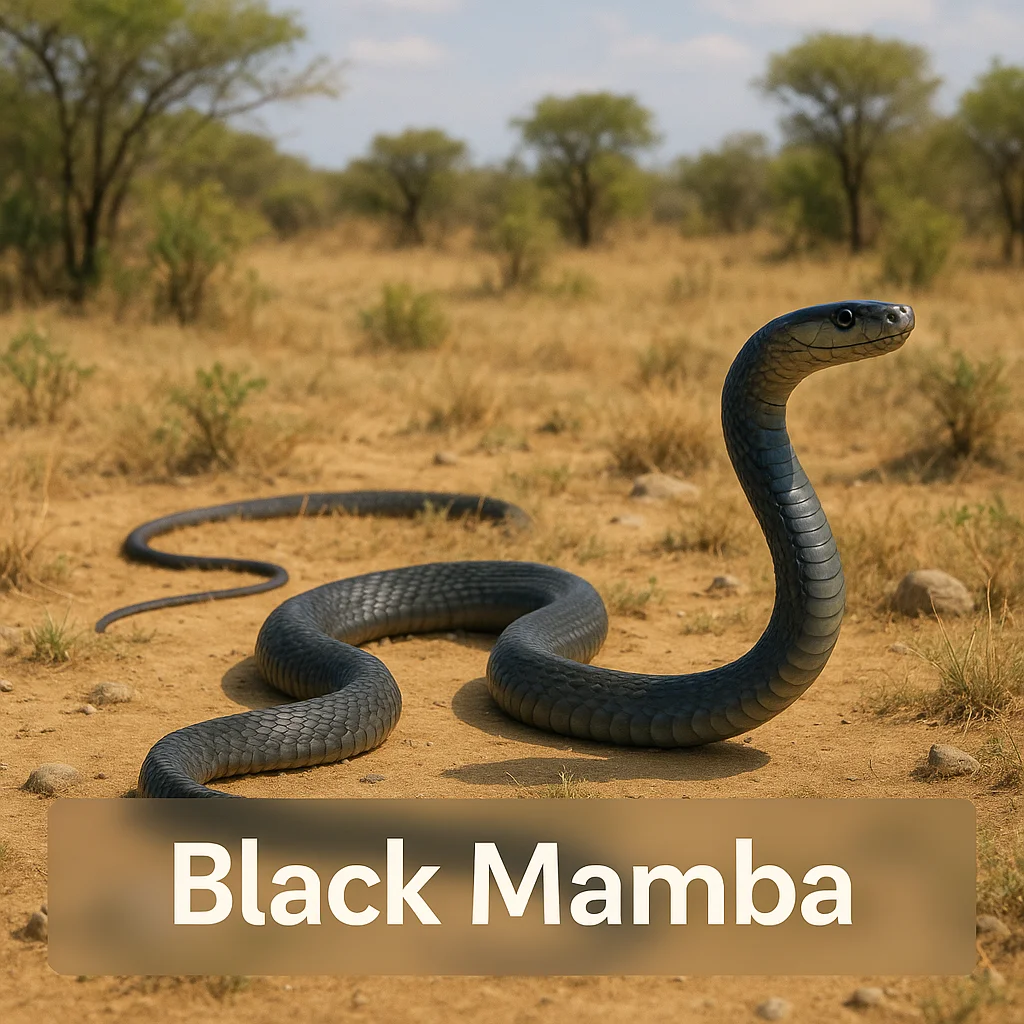
The Black Mamba is easily recognizable by its long, slender body and the coffin-shaped head. Despite its name, its color varies from gray to dark brown, not actually black. The interior of its mouth is inky black, a feature that gives the snake its name.
- Lengthy, cylindrical body
- Gray to olive brown color, with a pale underbelly
- Coffin-shaped head with a smooth, tapered snout
- Dark black mouth lining
- Highly mobile, with a rapid and smooth motion
- Can rear nearly one-third of its body off the ground
- Sheds skin in long, full lengths
- Broad anal scale at the tail
🧱 Body Structure & Physical Adaptations
The Black Mamba's body is perfectly adapted for speed and agility. Its long, slender frame allows for swift movement which is vital for both hunting and evasion. It possesses specialized jaw adaptations that enable it to deliver venom efficiently.
- Streamlined, elongated body for high speed
- Flexible jaws to engulf relatively large prey
- Acute vision used for detecting prey and predators
- Reinforced, hollow fangs for injecting venom
- Robust circulatory system enhances stamina
- Scales that reduce friction, aiding in swift movement
- Lightweight skeleton contributing to agility
🌍 Range & Distribution
The Black Mamba is widely distributed across diverse regions of sub-Saharan Africa. It inhabits a variety of environments, from savannas and rocky areas to lowland forests, demonstrating its adaptability to different climates and landscapes. However, it is mostly found at elevations below 1,500 meters.
- Mostly found in southern and eastern Africa
- Common in countries like South Africa, Kenya, and Uganda
- Prefers lowland grasslands and bushlands
- Can be found in rocky environments and open woodlands
- Adapts to semi-arid environments
- Thrives in warmer climates; avoids dense forests
🏞️ Habitat & Shelter
The Black Mamba favors habitats that offer plenty of cover for hunting while also providing the means for quick escape. It often selects shelters such as burrows or rock crevices to rest and hide from predators. Weather, particularly temperatures, can influence its level of activity.
In dry seasons, it may be more active in the early mornings and late afternoons to avoid the midday heat, whereas it can be more responsive during overcast, cooler days. Habitat knowledge is essential to understand this snake's behavior and predatory habits.
🧭 Behavior & Ecology
The behavior of the Black Mamba is driven by its solitary nature. It spends much of its time hunting and basking in the sun. The snake is also known for its agility and can escape quickly when disturbed. Communication is often through hissing and body posture, especially when threatened.
Ecologically, the Black Mamba plays a role as a crucial predator that helps control the population of small mammals and birds, thereby maintaining a balance in its ecosystem. However, it must also avoid conflicts with larger predators.
- Typically solitary except during mating
- Uses speed and stealth for hunting
- Highly territorial, especially during breeding season
- Resolves conflicts by showing its dark mouth before retreating
- Essential predator in its ecological niche
- Relies on heat for metabolic function
👥 Social Life & Group Dynamics
Black Mambas are primarily solitary creatures. Social interactions are minimal outside the breeding season where temporary pair bonds may form. These snakes do not participate in parental care or have strong social ties.
- Solitary by nature
- Temporary pair bonds during breeding
- No parental involvement post-egg laying
- Aggression primarily for territory, not social rank
- Lack of any developed social hierarchy
- Encounters are usually competitive rather than cooperative
🍽️ Diet, Prey & Predators
As a carnivore, the Black Mamba primarily preys on small mammals and birds. Its diet can include rodents, squirrels, and occasionally other smaller reptiles. Hunting involves striking quickly with precision, often delivering a lethal dose of venom to incapacitate its prey.
Main predators include birds of prey such as eagles and large mammals that may see the snake as a threat. To defend itself, the Black Mamba is known for its intimidating display and rapid escapes over striking.
- Diet composed of small birds and mammals
- Ambush predator with efficient venom use
- Utilizes stealth and speed in hunting
- Avoids larger animals and humans
- Reluctant to attack unless provoked
- Provides crucial predation control in its ecosystem
🦌 Hunting, Foraging & Movement
The Black Mamba is a master of ambush and pursuit. It can accelerate rapidly to pursue prey or evade threats. With a lateral undulating movement, it is capable of covering vast areas in search of prey, aligning with its diurnal activity pattern.
These snakes do not have a fixed territory but rather a home range that includes several resting and hunting spots. They rely on visual cues for navigation and often return to the same shelters.
- Relies on lateral undulation for swift movement
- Capable of moving at high speeds of up to 20 km/h
- Diurnal hunter, generally foraging during daylight
- Ambush tactics combined with active pursuit
- Utilizes vision and terrain familiarity for navigation
🧠 Intelligence & Senses
The intelligence of the Black Mamba is evident in its highly effective hunting strategies and avoidance behavior. While not as social as some animals, it demonstrates problem-solving abilities, particularly in navigation and habitat selection.
Its acute eyesight is critical for spotting prey and detecting threats at a distance. While its sense of smell is not as developed as that of other snakes, vision compensates for its predatory habits.
- Excellent visual acuity for daytime hunting
- Notable evasion strategies and speed
- Limited by a less acute sense of smell
- Uses visual landmarks for territory orientation
- Limited research on learning behavior
🪺 Reproduction, Pregnancy & Parenting
The breeding season of the Black Mamba occurs in the warm months, generally from September to February. Males engage in combat for access to females. Courtship involves a series of body displays and movements.
Females lay between 6 to 17 eggs in a safe, hidden location. Young mambas are independent at birth, equipped with the same venomous capabilities as adults but require several molts to reach full maturity.
- Breeding season during warm months
- Polygynous mating system
- Inter-male combat observed for mating rights
- Egg incubation lasts around 2-3 months
- Young are agile and capable immediately upon hatching
♀️♂️ Male vs Female Differences
There are no stark differences in coloration or patterning between male and female Black Mambas. However, males can sometimes be slightly larger and more robust. The primary behavioral difference is observed during the breeding season, where males can be more aggressive.
- Males may be slightly longer
- Behavioral differences during breeding season
- Slight weight variation; males are more robust
- Females focused on egg-laying site selection
🧬 Subspecies & Variation
The Black Mamba, Dendroaspis polylepis, does not have widely recognized subspecies. However, local populations can show slight variations in size and coloration, influenced by regional environmental conditions.
- No widely recognized subspecies
- Color variation from grey to dark brown
- Size variation influenced by geographical range
- Environmental adaptations common
- Minor genetic variations exist across ranges
⚠️ Threats, Conservation & Human Interaction
While currently listed as "Least Concern," Black Mambas face threats from habitat destruction and human conflict, particularly in rapidly urbanizing areas. Conservation efforts focus on habitat preservation and public education to coexist safely with this elusive snake.
Ethically, it is important to approach interactions with Black Mambas carefully and professionally trained personnel should manage encounters to ensure both human and snake safety.
- Faces habitat destruction and urban encroachment
- Accidental killings due to fear
- Valued in some cultures for traditional medicine
- Current population stable but monitored
- Public education essential for coexistence
✨ Fun Facts & Unique Traits
- The Black Mamba can travel up to 20 km/h, one of the fastest of all snakes.
- Despite its name, the snake's skin isn't black; it's the mouth lining that's black.
- This snake has the ability to rear a significant part of its body upright.
- Black Mambas are capable of delivering multiple quick strikes.
- They have a distinctive warning display involving flattening their neck and opening their black mouths.
- Their venom can be fatal to humans, and seeking immediate medical attention is critical in case of severe envenomation.
📌 Summary
- Recognizable by its long, slender, cylindrical body and gray to olive coloration.
- Inhabits a wide range of environments in sub-Saharan Africa, favoring savannas and rocky hills.
- Solitary by nature, engaging briefly with others during the breeding season.
- Carnivorous, preying on small mammals and birds, and playing an important role in ecological balance.
- Known for remarkable speed and a highly effective venom delivery system.
- Differences between sexes are minimal, with slight variations in size.
- Conservation primarily focused on habitat protection and reducing human-wildlife conflict.
- Unique for its speed and characteristic black mouth lining, which enhances its notorious reputation.