🦁 Wrasse
🧾 Quick Facts
The wrasse is not just a single species but a diverse group of fish under the Labridae family. Wrasses are known for their vibrant colors and intricate behaviors, making them a staple in marine ecosystems and aquariums worldwide.
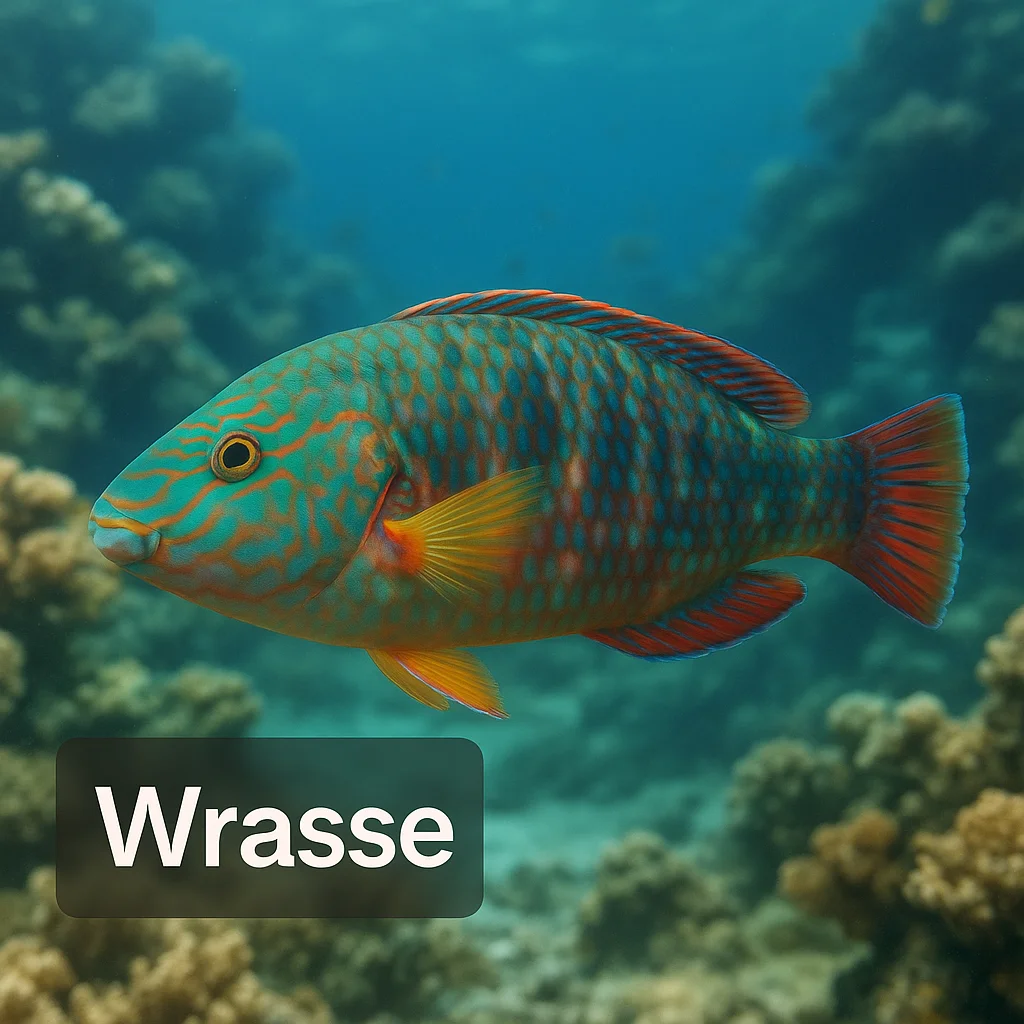
- Common name(s): Wrasse
- Scientific name: Labridae family (varies by species)
- Animal type: Fish
- Typical adult size: From under 10 cm to over 2 meters, depending on species
- Typical lifespan: Varies widely by species; from a few years to over a decade
- Diet type: Carnivore; feeds on small invertebrates, mollusks, and crustaceans
- Activity pattern: Diurnal
- Social structure: Varies; some are solitary, others in groups
- Swimming speed: Moderate, with agile movements among coral reefs
- Intelligence/learning: Known for their complex cleaning symbiosis and territorial behaviors
- Primary habitats: Coral reefs, rocky shorelines, seagrass beds
- Geographic range: Tropical and temperate seas worldwide
- Predators/threats: Larger fish, birds, human fishing practices
- Conservation status: Varies by species; some are threatened due to habitat degradation and overfishing
🔍 Identification & Appearance
Wrasses are easily recognized by their elongated bodies and vivid coloration, which can vary significantly among species and even individuals within a species. Many species display sexual dimorphism, with males often displaying more vibrant colors.
- Body shape and silhouette: Streamlined and slender; excellent for maneuvering through corals
- Key colors/patterns: Bright, multicolored patterns; species-specific, with blue, green, red, and yellow common
- Distinctive features: Protruding lips and, sometimes, teeth that resemble a beak
- Tracks or field signs: N/A in water environments
- Common look-alikes: Parrotfish; can be differentiated by the beak-like mouth of parrotfish
- Look for vibrant, multicolored patterns
- Elongated, streamlined bodies
- Protruding lips typical of many species
- Differences in color between males and females (sexual dimorphism)
- Commonly found near coral reefs or rocky shorelines
- Distinct swimming style, gliding smoothly among reefs
- Variety in size, from small to large species
- Species-specific color patterns help with identification
🧱 Body Structure & Physical Adaptations
Wrasses exhibit a variety of physical adaptations that suit their specific environments. Adaptations such as flexible jaws and strong, agile bodies are paramount, allowing them to thrive within their habitats. Many have thick lips and teeth optimized for gripping prey.
- Build and proportions: Slender and elongated, aiding agile swimming
- Teeth/jaw adaptations: Strong jaws with conical teeth, some species have 'cleaner' roles
- Fins: Optimized for intricate and precise swimming through reefs
- Sensory strengths: Highly developed vision for spotting prey and predators
- Strong jaws with conical teeth
- Elongated, streamlined bodies for agile swimming
- Fins adapted for maneuverability
- Protruding lips for gripping prey
- Superior vision adapted for underwater environments
- Some species have specialized teeth for specific diets
- Well-coordinated swimming for navigating complex reef structures
🌍 Range & Distribution
Wrasses are distributed across tropical and temperate seas around the world. They are commonly found in coral reefs or rocky areas where there are plentiful food sources and hiding places.
- Continents/regions: Found in oceans globally, notably around the Indo-Pacific region
- Common biomes: Coral reefs, seagrass beds, rocky shorelines
- Latitude/climate range: Tropical to temperate waters
- Indo-Pacific region is highly biodiverse with wrasses
- Found along tropical reef systems
- Temperate coastal regions worldwide
- Common in coral reefs and associated ecosystems
- Found from near-surface waters to moderate depths
🏞️ Habitat & Shelter
Wrasses rely on specific habitats for food and protection. Coral reefs provide both a rich source of food and numerous hiding spots. Wrasses often shelter within crevices or under coral heads, offering refuge from predators and strong currents.
- Preferred habitats: Coral reefs and rocky shorelines
- Shelter: Crevices, coral heads, or within seagrass beds
- Behavior changes: Utilizes crevices during the night for protection
🧭 Behavior & Ecology
Wrasses display fascinating behaviors, including territory defense and cleaning symbiosis. Social dynamics can vary, but many participate in intricate mutualisms, cleaning larger fish of parasites. They play a crucial role in maintaining healthy reef ecosystems.
- Daily routine: Active primarily during the day
- Communication: Body language and movement patterns
- Role in ecosystem: Acts as both predator and cleaner, controlling parasites
- Active diurnally, engaging in feeding and cleaning activities
- Complicated social behaviors and communication
- Play a role as ecosystem cleaners via symbiotic relationships
- Contribute to controlling fish parasites in reef environments
- Hold territories, often engaging in minor disputes
👥 Social Life & Group Dynamics
The social structure of wrasses can range significantly among species. Some are solitary, while others form small groups or harems. Dominance hierarchies are often present, with larger, more vibrant males tending to exert more control over territories and mates.
- Solitary vs social: Varies by species; some form groups, others are solitary
- Group types: Harems with one dominant male, including various females
- Cooperation: Cleaning cooperation with other fish
- Presence of harems dominated by a single male
- Engage in social cleaning interactions
- Social structures vary greatly between species
- Some species form loose aggregations
- Tendency to establish and defend territories
🍽️ Diet, Prey & Predators
Wrasses primarily feed on small invertebrates, consuming mollusks, crustaceans, and other small marine organisms. Some species play the role of cleaner fish, acquiring food by removing parasites from larger fish. Their small size makes them prey for larger fish and seabirds.
- Diet type: Carnivorous
- Main foods: Small invertebrates, mollusks, crustaceans
- Predators: Larger fish and seabirds
- Feed on small invertebrates and marine organisms
- Some serve as cleaner fish, removing parasites from others
- Predators include larger fish and marine birds
- Occupy various niches within marine food webs
- Typical feeding behavior includes picking at rock or coral surfaces
🦌 Hunting, Foraging & Movement
Wrasses are adept swimmers, using their agile bodies to navigate complex coral landscapes. They primarily rely on vision to hunt and forage during daylight hours. Many wrasse species exhibit a unique swimming pattern, using their pectoral fins for propulsion and dorsal fins for steering.
- Locomotion style: Efficient swimmers with precise control for navigation
- Speed and endurance: Moderate speed with high agility
- Typical foraging behavior: Feeding during daylight, often around reef areas
- Navigate reef structures with ease and precision
- Adept swimmers using pectoral and dorsal fins
- Highly adept at short-range foraging activities
- Known for complex swimming patterns and efficiency
- Capable of traversing intricate coral reef environments
🧠 Intelligence & Senses
Wrasses are known for their keen senses, particularly their eyesight, which is crucial for identifying prey and avoiding predators. They are also intelligent, displaying behaviors such as working as cleaner fish and showing territoriality.
- Problem-solving: Evidenced by cleaning symbiosis and habitat navigation
- Senses: Vision is particularly well-developed for underwater observation
- Highly acute vision suited for underwater environments
- Display complex cleaning symbiotic behaviors
- Show territorial behaviors and hierarchies
- Use movement patterns as communication
- Capable of navigating densely populated reefs
🪺 Reproduction, Pregnancy & Parenting
The reproductive strategies of wrasses are diverse. Many species show clear sexual dimorphism, with males often being more vibrant. Some species are sequential hermaphrodites, meaning they can change sex, usually from female to male, to maintain social stability.
- Breeding seasonality: Often linked with warmer months
- Reproductive strategy: Includes harem dynamics and mate guarding
- Sequential hermaphroditism evident in some species
- Some males maintain harems of females
- Breeding typically occurs during warmer months
- Male courtship displays involve brightening coloration
- Mating systems vary across species
♀️♂️ Male vs Female Differences
The differences between male and female wrasses are primarily in size and coloration. Males often exhibit more intense colors, especially during mating seasons, and may be larger than females, which are usually more camouflaged.
- Size differences: Males typically larger and more colorful
- Coloration: Males often exhibit brighter colors
- Behavioral roles: Males often occupy and defend territories
- Males are more vibrant and conspicuous
- Sexual dimorphism present, especially in colors
- Males generally larger in many species
- Sex-based roles in harem dynamics
🧬 Subspecies & Variation
The wrasse family is extensive, with numerous species spread across different oceans, each adapting to their specific environments. This results in notable variations in color, size, and behavior, often influenced by geographic location.
- Subspecies: Variations include color and size differences among populations
- Local adaptations: Bright colors in coral-dense regions, more muted elsewhere
- Large family with numerous species
- Geographic variation in coloration and size
- Adaptations specific to local environments
- Behavioral differences among species in varying regions
⚠️ Threats, Conservation & Human Interaction
Wrasses face a variety of threats mainly driven by habitat loss and overfishing. Coral reef degradation due to climate change and human activity poses significant risks. Conservation efforts focus on habitat preservation and sustainable fishing practices.
- Natural challenges: Predation by larger fish and birds
- Human-related pressures: Overfishing, habitat destruction
- Coexistence tips: Conservation efforts emphasize marine protected areas
- Coral reef degradation affects habitat and food availability
- Conservation efforts aim to protect critical habitats
- Overfishing poses population risks for some species
- Marine protected areas aid in conservation
✨ Fun Facts & Unique Traits
- Wrasses are capable of changing gender, often switching from female to male.
- Several species engage in cleaning symbiotic relationships, eating parasites off other fish.
- Some wrasses bury themselves in sand at night for protection.
- Their bright colors aid in communication and social interaction.
- They can significantly impact reef ecosystems by controlling parasite populations.
- Wrasses often exhibit intricate courtship dances and color changes during mating.
- Some species can bite hard times than their weight suggests, thanks to strong jaws.
- Many wrasses play essential roles as ecosystem engineers in their marine habitats.
📌 Summary
- Wrasses are a diverse group of fish known for their vibrant colors and role in the ecosystem.
- They are found in tropical and temperate reefs worldwide.
- Wrasses play crucial ecological roles, including parasite control through cleaning behaviors.
- They exhibit great diversity in size, color, and social structure among species.
- Conservation efforts are essential, focusing on habitat preservation and sustainable fishing.
- Wrasses face threats from habitat degradation and overfishing.
- They possess highly adapted bodies for maneuvering through complex reef systems.
- Wrasses exhibit unique traits such as color changes and gender flexibility.