🦁 Triggerfish
🧾 Quick Facts
Triggerfish are fascinating marine creatures known for their unique appearance and behavior. While "triggerfish" is a group name encompassing various species, they all share some common features that make them recognizable and intriguing to marine enthusiasts.
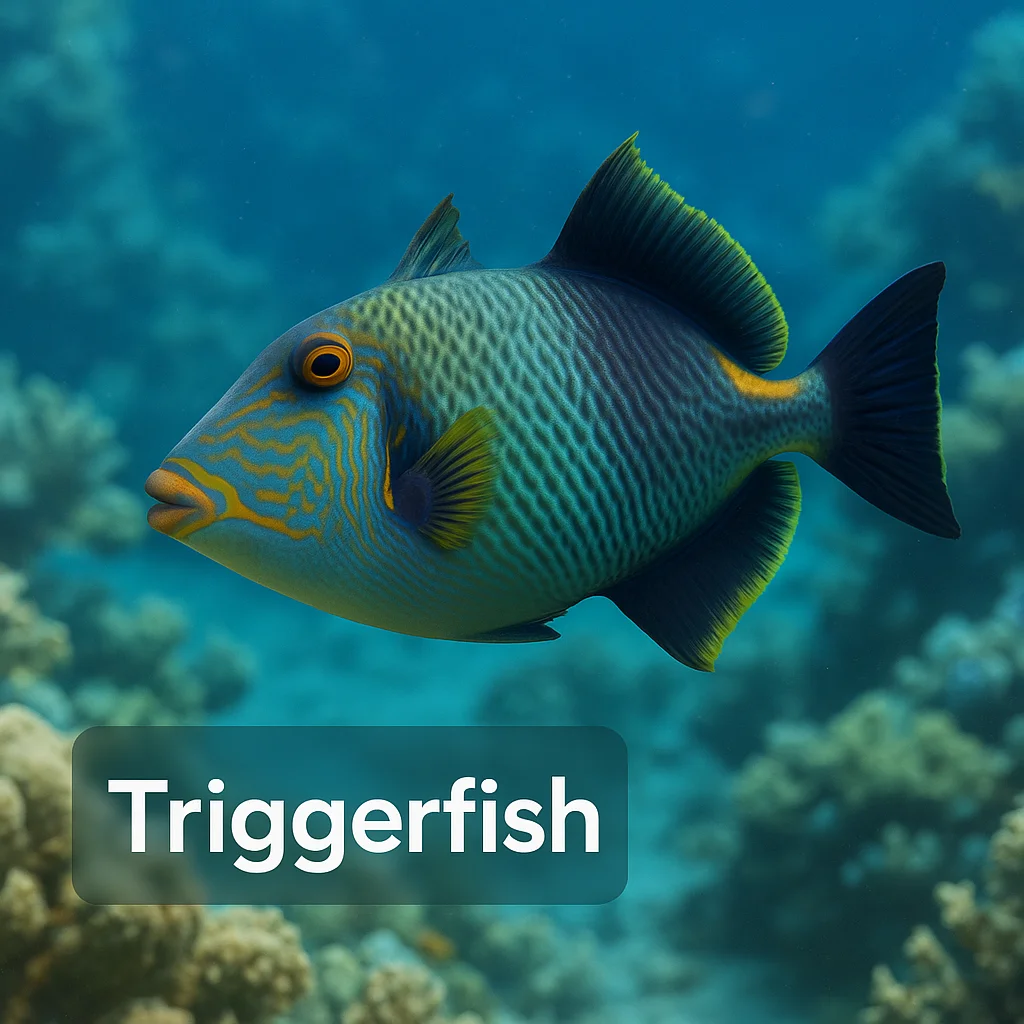
- Common name(s): Triggerfish
- Scientific name: Balistidae family (varies by species)
- Animal type: Fish
- Typical adult size: 20–75 cm (8-30 inches) in length
- Typical lifespan: 7–12 years in the wild
- Diet type: Omnivore; eats algae, plankton, mollusks, and small crustaceans
- Activity pattern: Diurnal
- Social structure: Mostly solitary
- Speed / movement highlights: Agile swimmers; use pectoral fins for maneuvering
- Intelligence/learning: Known for curiosity and problem-solving abilities
- Primary habitats: Coral reefs, rocky shores, shallow coastal waters
- Geographic range: Tropical and subtropical oceans worldwide
- Predators/threats: Larger fish, sharks, human fishing activities
- Conservation status: Varies by species; some are of concern due to habitat loss
🔍 Identification & Appearance
Triggerfish are easily identifiable by their distinctive shape and vibrant color patterns. They have a laterally compressed, oval-shaped body, which aids in their ability to squeeze through narrow crevices. The color patterns can range significantly among different species, from bright blues and greens to more muted browns and grays. They often have bold markings like stripes or spots.
A key feature of triggerfish is their dorsal fin, which can be "triggered" up and down, giving them their name. The mouth is small but strong, equipped with teeth designed to crush hard shells.
- Top ID Tips:
- Oval-shaped, laterally compressed body
- Vibrant and varied color patterns with stripes or spots
- Retractable dorsal fin that can "lock" upright
- Small but strong jaws with prominent teeth
- Eyes set high and independently moving
- Larger species may reach up to 75 cm (30 inches)
- Typically found in shallow, tropical waters
- Solitary, rarely found in schools
🧱 Body Structure & Physical Adaptations
Triggerfish are built for both resilience and precision in their environments. Their bodies are stocky and robust, allowing them to withstand the pressures of life within coral reefs. Their jaws are equipped with strong, sharp teeth capable of breaking through the hard shells of mollusks and crustaceans, which form a significant part of their diet.
Their fins are uniquely structured; the dorsal fin features a locking mechanism to deter predators. Pectoral fins enable them to be agile swimmers. They possess excellent vision, an adaptation that aids in spotting food and avoiding predators.
- Key Adaptations:
- Stocky, resilient build for coral reef living
- Strong jaws and sharp teeth for breaking shells
- Lockable dorsal fin for protection
- Agile swimmers using pectoral fins
- Excellent eyesight for locating food and avoiding danger
- Ability to maneuver through narrow crevices
- Coloration providing camouflage among coral reefs
🌍 Range & Distribution
Triggerfish are primarily found in the warm, tropical and subtropical waters of the world's oceans. They are distributed across the Atlantic, Indian, and Pacific Oceans, commonly inhabiting coral reefs and rocky springs. They generally reside at depths ranging from shallow waters to about 50 meters (164 feet). Some species may have slightly different preferences based on environmental conditions.
- Where You Might Find It:
- Caribbean Sea and Gulf of Mexico
- Indian Ocean coastal reefs
- Pacific Ocean reefs near Hawaii and the Philippines
- Great Barrier Reef, Australia
- Coral-trough regions in Southeast Asia
- East African coastal waters
- Tropical Pacific islands
- Reefs surrounding the Maldives
- Indo-Pacific warm waters
🏞️ Habitat & Shelter
Triggerfish are predominantly associated with coral reefs, where they find shelter, food, and breeding grounds. They thrive in the nooks and crannies of the coral formations, which offer protection from predators and strong ocean currents. In addition to coral reefs, some species can also be found in rocky coastal areas.
Their behavior changes with tides and daylight, as they often hide in crevices at night to avoid nocturnal predators. Understanding their habitat preferences is crucial for conservation efforts, as coral reef degeneration poses significant threats to their survival.
🧭 Behavior & Ecology
Triggerfish exhibit fascinating behavior, primarily dictated by their solitary nature. These fish are territorial and may be aggressive when defending their space or food. They rest in sheltered areas during the night, becoming active at sunrise when they forage for food. Communication is largely visual, with body movements playing a vital role in social interactions.
Ecologically, triggerfish play a role in controlling invertebrate populations within reef systems, being both grazers and predators in their ecosystems. This dual role helps maintain balance within the coral reef community.
- Behavior Highlights:
- Territorial and aggressive when threatened
- Solitary by nature, though sometimes found in pairs
- Visual communicators using body movement
- Important predators of invertebrates, grazing on sea urchins and mollusks
- Employ their strong jaws to access difficult-to-reach food sources
- Daytime foragers, hiding in protected areas at night
- Crucial to coral reef biodiversity and health
👥 Social Life & Group Dynamics
Though mostly solitary, triggerfish can occasionally be seen in loose aggregations, especially during breeding periods. However, they remain highly territorial and aggressive towards intruders, which can include other triggerfish. They do not form structured groups like some other fish species, but temporary alliances can occur during mating.
- Social Structure Notes:
- Primarily solitary
- Aggressive territorial defense
- Occasional pair formations
- Loose aggregations in breeding seasons
- Temporary cooperation among groups for breeding
- No permanent social hierarchy
🍽️ Diet, Prey & Predators
The diet of triggerfish is varied and opportunistic. They consume a wide range of marine organisms, including algae, plankton, small crustaceans, and mollusks. Triggerfish have evolved specific hunting strategies to extract prey from crevices, often using jets of water to expose hidden food items.
Natural predators of triggerfish include larger fish and some species of sharks. Triggerfish defend themselves by using their dorsal spines and fleeing to safe nooks in the reef.
- Feeding Notes:
- Omnivorous diet with a preference for invertebrates
- Utilize strong jaws to crush shells
- Alter food selection based on seasonal availability
- Hunt using bursts of water to uncover prey
- Natural predators include larger fish and sharks
- Defensive use of dorsal spines
🦌 Hunting, Foraging & Movement
Triggerfish are agile swimmers, using their pectoral fins for precise movements while their dorsal and anal fins work in coordination for propulsion. Their foraging method involves both direct pursuit and ambush techniques, depending on the prey and environment.
They are highly adapted to navigate the intricate labyrinths of coral reefs, often establishing a territory and aggressively defending it from other fish. Given their diurnal activity pattern, triggerfish actively hunt during the day and seek shelter at night.
- Movement & Strategy:
- Agile swimming with pectoral fin control
- Navigate intricate reef ecosystems efficiently
- Daytime active hunters
- Territorial and maintain specific home ranges
- Use of water jets to expose hidden prey
- Aggressive defense of territory
🧠 Intelligence & Senses
Triggerfish demonstrate notable intelligence, particularly in their problem-solving capabilities. They exhibit curiosity and engage with their environment in ways that suggest a level of cognitive complexity uncommon in fish. They use their acute vision to locate prey and avoid threats, with their eyes moving independently to maximize their field of view.
Research into triggerfish cognitive abilities is ongoing, but they are recognized for learning to interact with their environments innovatively.
- Notable Abilities:
- High problem-solving skills
- Curious nature, often exploring their surroundings
- Acute vision aiding in navigation and hunting
- Independent eye movement for broad field vision
- Learning capabilities evidenced by experience-based behavior
🪺 Reproduction, Pregnancy & Parenting
Triggerfish are known for intriguing reproductive behaviors. They generally have defined breeding seasons during which they engage in complex courtship rituals, often involving elaborate displays. Most triggerfish species lay eggs in nests created by clearing and fanning substrate materials. Females are particularly active in guarding the eggs and the resulting fry.
Parental care is more extensive in triggerfish than in many other fish species, with females fiercely protecting their nests from predators.
- Reproduction Snapshot:
- Seasonal breeding with elaborate courtship
- Females lay eggs in specially prepared nests
- Intense parental guarding of eggs
- Nest construction involves substrate manipulation
- Protective and nurturing female roles
♀️♂️ Male vs Female Differences
Differences between male and female triggerfish can be subtle, generally involving size and aggressive behavior rather than coloring or physical features. Males may exhibit more dominant territorial behavior and engage in courtship displays. Both sexes participate in nest protection, though females are more involved in nurturing.
- Sex Differences at a Glance:
- Males can be slightly larger
- Males often more territorial
- Both sexes show nest defense behavior
- Females play a primary role in egg care
- Behavioral differences more pronounced than physical
🧬 Subspecies & Variation
Triggerfish encompass around 40 species within the Balistidae family, each varying in size, coloration, and habitat preference. The Picasso Triggerfish (Rhinecanthus aculeatus) and Clown Triggerfish (Balistoides conspicillum) are among the visually striking examples.
Local adaptations can include variations in color as camouflage to specific reef architectures and dietary adaptations based on the availability of prey types.
- Variation Notes:
- Around 40 distinct species within the family
- Coloration varies significantly among species
- Adaptations to local reef conditions
- Dietary preferences vary with regional prey
- Species show differing territorial behaviors
⚠️ Threats, Conservation & Human Interaction
Triggerfish face various threats, primarily due to human activities such as overfishing and habitat destruction, especially the degradation of coral reefs due to climate change and pollution. In certain areas, they are caught for the aquarium trade and local fisheries.
Efforts to conserve triggerfish populations focus on habitat protection and sustainable fishing practices. Understanding their environmental roles can help foster conservation measures aimed at maintaining reef health.
- Responsible Notes:
- Threatened by coral reef degradation
- Poor water quality and pollution are significant threats
- Subject to overfishing in some regions
- Conservation efforts focus on habitat and ecosystem protection
- Awareness of their role in reef health is crucial
✨ Fun Facts & Unique Traits
- Triggerfish have been observed using tools, such as breaking shells with rocks.
- Their name comes from the ability to lock their dorsal spine in place, a defense mechanism.
- Some species can change color to communicate or adapt to their environment.
- Triggerfish have a unique "grunting" sound produced by grinding their teeth, often heard during courtship.
- Known for their strong territorial instincts, making them both fascinating and challenging to observe in the wild.
- The Picasso Triggerfish is named for its distinctive, artistic color patterns.
- In French Polynesia, triggerfish are considered a delicacy and are part of traditional cuisine.
📌 Summary
- Triggerfish are vibrant reef dwellers from the Balistidae family.
- Recognizable by their oval shape, vibrant color patterns, and strong jaws.
- Found in tropical and subtropical oceans, particularly coral reefs.
- Solitary and territorial, with aggressive defense of feeding and nesting areas.
- Omnivores feeding on invertebrates and algae.
- Intelligent problem-solvers with acute vision.
- Complex courtship rituals and intensive parental care by females.
- Subject to threats from human activities like fishing and pollution.
- Play a crucial ecological role in maintaining coral reef health.
- Protective dorsal spine mechanism, allowing effective defense against predators.