🦁 Seahorse
🧾 Quick Facts
The seahorse, a unique and fascinating marine creature, belongs to the genus Hippocampus, which is part of the family Syngnathidae. These small fish are notable for their horse-like head shape and unusual reproductive behaviors. Various species exist within this group, showing diverse adaptations to their environments.
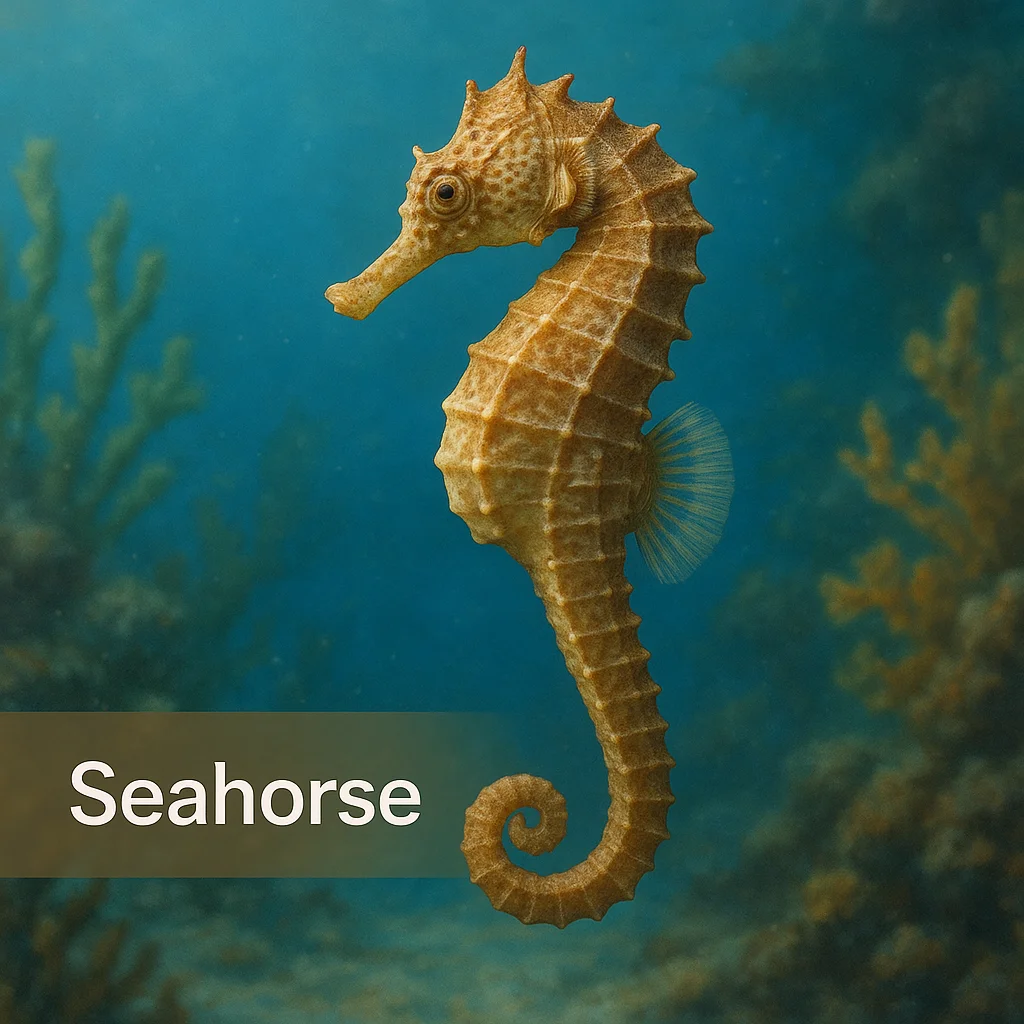
- Common name(s): Seahorse
- Scientific name: Hippocampus spp.
- Animal type: Fish
- Typical adult size: 1.1 to 14 inches (3 to 35 cm)
- Typical lifespan: 1 to 5 years in the wild; up to 5 years in captivity
- Diet type: Carnivore; primarily consumes small crustaceans and plankton
- Activity pattern: Diurnal
- Social structure: Mostly solitary or in pairs
- Speed / movement highlights: Slow swimmers; use dorsal fin for propulsion
- Intelligence/learning: Capable of basic problem-solving and learning their environment
- Primary habitats: Shallow coastal waters, coral reefs, seagrass beds
- Geographic range: Found in temperate and tropical waters worldwide
- Predators/threats: Crabs, rays, and fish; human threats include habitat destruction and capture
- Conservation status: Varies by region; many species are near-threatened or vulnerable
🔍 Identification & Appearance
Seahorses are recognized by their unique body structure and equine appearance. They possess a slender, elongated body covered in bony plates, with a distinct, curved neck that resembles a horse's. Their colors can vary widely, including hues of orange, red, yellow, and green, often with spots or banding.
- Body shape and silhouette: Long, slender, with a prehensile tail
- Key colors/patterns: Range from vibrant to muted tones; can change color to blend with surroundings
- Distinctive features: Horse-like head, armored body, small fins
- Tracks, scat, or other field signs: Rarely leaves visible traces
- Common look-alikes: Pygmy pipehorses; distinguishable by their size and head shape
- Top ID Tips
- Look for the horse-like head silhouette
- Check for a prehensile tail used for anchoring
- Notice the small dorsal fin for propulsion
- Observe color variations that mimic habitat
- Spot small pectoral fins used for steering
- Recognize bony body plates instead of scales
🧱 Body Structure & Physical Adaptations
Seahorses display unique adaptations that support their survival in aquatic environments. Their small dorsal fins are crucial for their distinctive style of swimming, which is unlike any other fish. They use their prehensile tails to anchor themselves to seagrass or coral when foraging for food.
- Build and proportions: Small, elongated body with a prehensile tail
- Teeth/beak/jaw adaptations: Jawless mouth; rely on a tube-like snout for feeding
- Claws/hooves/wings/fins: Fins are small and adapted for slow, precise movements
- Sensory strengths: Good vision; can move eyes independently for greater field of view
- Key Adaptations
- Prehensile tail for gripping and stability
- Bony armor provides protection
- Independent eye movement for scanning surroundings
- Long snout for extracting prey from crevices
- Camouflaging abilities to evade predators
- Lack of typical fish scales, replaced by bony plates
🌍 Range & Distribution
Seahorses are commonly found in temperate and tropical ocean waters around the globe. They inhabit areas where they can easily camouflage and find food sources, like coral reefs and seagrass beds.
- Continents/regions: Worldwide in tropical and temperate oceans
- Typical countries/biomes: Often found in regions near coral reefs or seagrass communities
- Elevation range or latitude/climate range: Prefer shallow waters, rarely found deeper than 100 meters
- Seasonal movements or migration: Primarily resident, with limited migration for breeding or food
- Where You Might Find It
- Tropical coral reefs
- Temperate seagrass beds
- Sandy seabeds near wetlands
- Coastal lagoons
- Estuaries and mangrove forests
- Near shores with rocky substrates
- Among kelp forests
🏞️ Habitat & Shelter
Seahorses prefer sheltered waters like coral reefs and seagrass beds, where they can attach themselves using their tails and blend into their surroundings. These environments provide abundant food and protection from predators.
The suitability of these habitats ensures the survival of seahorses by offering not just food resources but also safety from the strong currents and large predators found in open waters.
🧭 Behavior & Ecology
Seahorses exhibit intriguing behaviors such as their slow, deliberate motion and ability to change color. Their ecology is marked by a reliance on camouflage and their position in the food web as both predator and prey.
- Daily routine involves foraging and rest while clinging to substrates
- Communication through color changes for mating or territorial displays
- Mutualistic relationships with certain types of algae or corals
- Serve as prey for larger marine species while controlling plankton populations
- Behavior Highlights
- Use color to communicate with potential mates
- Anchors to seagrass or coral to maintain position in currents
- Slow, fin-propelled swimming as a unique locomotive style
- Change colors for camouflage and mood expression
- Engage in a courtship dance during the breeding season
- Exhibit site fidelity, often remaining in the same area for long periods
👥 Social Life & Group Dynamics
Seahorses are typically solitary, though they may form pairs, especially during the breeding season. Their monogamous pair bonding is a rarity among fish, characterized by daily greetings and partner reinforcement.
- Mostly solitary, with pair bonding during the breeding season
- Pairs partake in mutual grooming practices
- Some species show a strong allegiance to their chosen mates
- Pair bond exhibits some level of territorial behavior
- Social Structure Notes
- Primarily solitary except during breeding
- Practice monogamous pair bonding
- Daily greetings strengthen pair bond
- Pairs hold small territories together
- Minimal aggression toward other seahorses outside mating disputes
- Can be found loosely aggregating in resource-rich areas
🍽️ Diet, Prey & Predators
Seahorses are carnivorous, feeding mainly on small crustaceans, plankton, and larval fish. Their unique feeding mechanism involves sucking prey through their elongated snouts. As prey, seahorses are targeted by larger fish and invertebrates.
- Year-round diet includes amphipods, copepods, and shrimp larvae
- Utilize a sit-and-wait predatory strategy
- Natural predators include crabs, large fish, and rays
- Defensive behaviors include camouflage and remaining motionless
- Feeding Notes
- Feed on small sea creatures using suction feeding
- Have no teeth, digest food whole
- Rely on high intake because of inefficient digestion
- Often feed by clinging and striking at passing prey
- Nocturnal and diurnal feeding patterns vary with habitat light conditions
🦌 Hunting, Foraging & Movement
Seahorses utilize a slow, deliberate mode of swimming propelled by their dorsal fin. Their foraging strategy involves using their tails to anchor themselves while waiting for prey to pass by, using quick suction to draw them in.
- Swimmer that relies on dorsal fin flapping for movement
- Low speed but highly maneuverable
- Foraging is often opportunistic and non-territorial
- Routine includes hiding among plants or corals to ambush prey
- Movement & Strategy
- Propulsion focuses on dorsal fin fluttering
- Pectoral fins serve primarily for steering
- Anchoring to substrates to resist tidal movements
- Silhouette minimization for predator evasion
- Limited range of movement, few long-distance excursions
🧠 Intelligence & Senses
Seahorses demonstrate moderate levels of intelligence, with the ability to recognize territories and mates. Their sensory capabilities are specialized; excellent camouflaging abilities, acute eyesight, and motionless floating aid in prey capture and predator avoidance.
- Problem-solving involves habitat adaptation
- Sensitive to water currents aiding orientation and balance
- Eye movement allows constant scanning for food and threats
- Memory aids in recognizing mates
- Notable Abilities
- Can recognize partners, reinforcing pair bonds
- Adapt color to match environment quickly
- Excellent field vision due to independently moving eyes
- Efficient in using tails to grip and anchor
- Possess basic locomotion problem-solving abilities
🪺 Reproduction, Pregnancy & Parenting
Reproduction in seahorses is fascinating due to the male's role in pregnancy. During the breeding season, seahorses perform a courtship dance. Females transfer eggs into the male's brood pouch where the male fertilizes them and carries them until birth.
- Breeding primarily occurs in warmer seasons
- Monogamous pair bonds are typical during breeding
- The male undergoes pregnancy for two to four weeks
- Brood size can range from 5 to over 1,000, depending on species
- The male gives birth to fully formed miniature seahorses
- Parental care after birth is minimal; young are independent
- Reproduction Snapshot
- Breeding driven by lunar and temperature cues
- Intricate courtship dance is a prelude to mating
- Male brood pouch is a unique adaptation
- Young are released from pouch and must fend for themselves
- Eagle-eyed hunters from birth, not needing parental feeding
♀️♂️ Male vs Female Differences
Differences between male and female seahorses are relatively subtle, but the most notable distinction is the presence of a brood pouch in males. This adaptation enables them to carry and give birth to young, a role reversal uncommon in the animal kingdom.
- Size/weight differences are minimal; similar body lengths
- Males have distinct brood pouches, lacking in females
- Behavioral role differentiation mainly during reproduction
- Coloration differences can vary, but are typically species-specific rather than sex-specific
- Sex Differences at a Glance
- Males bear brood pouch under their tails
- Females transfer and females do not possess pouches
- Both genders exhibit similar dietary and territorial behaviors
- No significant size disparity; both are similar-sized
- Reproductive role differentiation marked by distinct pouch and transferring behaviors
🧬 Subspecies & Variation
The seahorse comprises numerous species, such as the lined seahorse or the pygmy seahorse, showcasing variations in size, color, and pattern. While formally classified, differences can be subtle, often related to their specific habitats.
- Subspecies exist often with geographic or habitat-driven adaptations
- Color pattern variation aids in habitat camouflage
- Size differences among species correlate with ecological niche
- Pygmy species are smaller due to microhabitat adaptations
- Morphological adaptations can be seen in fin shape and function
- Variation Notes
- Species show distinct habitat-specific coloration
- Pygmy seahorses adapt to life in certain coral species
- Some variants exhibit more exaggerated armor plates
- European seahorses are separate from their tropical counterparts
- Size variations result from different selective pressures
⚠️ Threats, Conservation & Human Interaction
Seahorses face numerous threats, ranging from habitat degradation to the effects of climate change. They are also targeted by humans for traditional medicine and aquarium trade. Conservation efforts focus on habitat protection and regulation of trade.
- Natural challenges include predation and changing sea conditions
- Human pressures involve habitat destruction, capture, and pollution
- Conservation efforts aim at habitat restoration and sustainable trade practices
- Coexistence guidelines emphasize sustainable marine management
- Responsible Notes
- Promote marine environment conservation
- Understand regulations regarding their capture
- Support sustainable source guarantees in pet trade
- Seek eco-friendly options in traditional medicine substitutes
- Participate in habitat clean-up operations for marine health
✨ Fun Facts & Unique Traits
- Male seahorses are unique in their role of pregnancy and childbirth
- Fossils suggest seahorses have preserved their form for millions of years almost unchanged
- Seahorses can change color to camouflage or communicate
- Can move eyes independently like chameleons
- Seahorse tails are square for better gripping strength
- They use skin filaments for camouflage, which mimic their environment
- Each species of seahorse has a unique coronet pattern, similar to a fingerprint
- Seahorses are a key species indicating the health of marine ecosystems
📌 Summary
- Seahorses are small, uniquely shaped fish found in tropical and temperate waters
- Easily identified by their horse-like head and prehensile tail
- They inhabit coral reefs and seagrass beds, known for their intricate camouflage abilities
- Carnivorous diet focusing on small crustaceans and plankton
- Primary threats include habitat loss, pollution, and unsustainable trade
- Known for monogamous pair bonds and the male's role in reproduction
- Exhibit unique social bonds by greeting partners daily
- Conservation relies on marine ecosystem protection and management