🦁 Scorpionfish
🧾 Quick Facts
The scorpionfish, often listed under the family Scorpaenidae, is a fascinating group of marine fish known for their venomous spines and masterful camouflage. They inhabit oceans worldwide and have intriguing adaptations for ambush predation. Here's a snapshot of their essential characteristics.
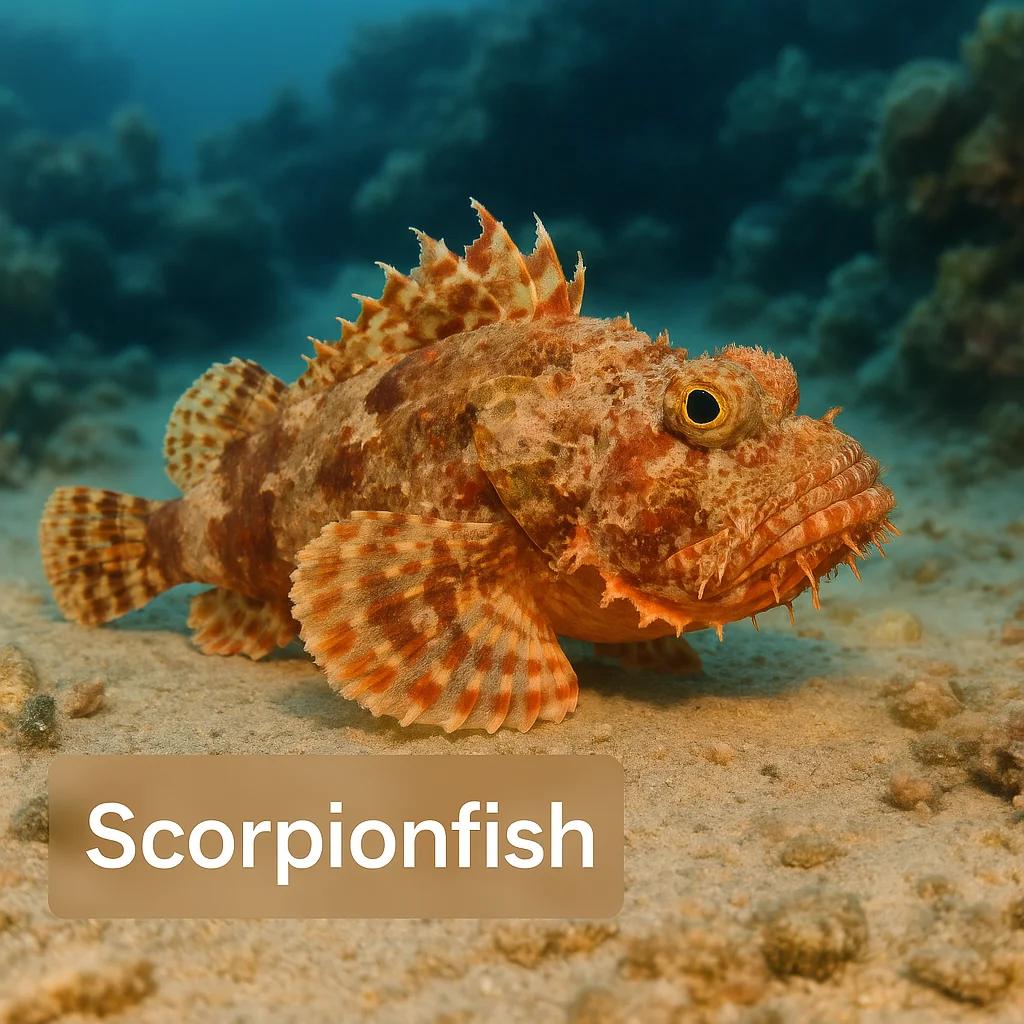
- Common name(s): Scorpionfish
- Scientific name: Varies among species; family Scorpaenidae
- Animal type: Fish
- Typical adult size: 10 to 50 cm (4 to 20 inches) in length
- Typical lifespan: 10 to 15 years in the wild
- Diet type: Carnivore; primarily feeds on small fish and invertebrates
- Activity pattern: Nocturnal; primarily active at night
- Social structure: Solitary
- Speed / movement highlights: Slow-moving but can quickly dart to capture prey
- Intelligence/learning: Employ camouflage and ambush tactics
- Primary habitats: Coral reefs, rocky bottoms, and shallow coastal waters
- Geographic range: Found globally, particularly in tropical and subtropical regions
- Predators/threats: Larger fish, sharks, human activities
- Conservation status: Varies by region; generally not endangered
🔍 Identification & Appearance
Scorpionfish are easily recognized by their robust bodies, spiny fins, and tendrils that help them blend with their surroundings. Their coloration often mimics surrounding corals and rocks, providing excellent camouflage.
- Body shape and silhouette: Stocky and robust
- Key colors/patterns: Red, brown, and orange with mottled patterns
- Distinctive features: Venomous spines on their dorsal fin, broad pectoral fins
- Tracks or field signs: None; entirely aquatic
- Common look-alikes: Stonefish; scorpionfish's colors are often brighter
- Top ID Tips
- Robust body and spiny fins
- Mottled patterns for camouflage
- Tendrils and skin flaps on the body
- Venomous spines
- Found near coral reefs and rocky substrates
- Night-time activity
- Solitary nature
🧱 Body Structure & Physical Adaptations
Scorpionfish have a build optimized for stealth and ambush, with features enhancing their efficiency as predators. Their venomous spines offer defense, while their sensory systems support hunting.
- Build and proportions: Stocky with a broad, flat head and fused pectoral fins for stabilization
- Teeth/beak/jaw adaptations: Small but sharp teeth for gripping prey
- Claws/hooves/wings/fins: Pectoral fins are broad and assist with hovering on the seafloor
- Sensory strengths: Acute vision; limited by necessary camouflage
- Key Adaptations
- Venomous spines for protection
- Mottled skin for camouflage
- Broad pectoral fins for stabilization
- Small, sharp teeth for holding prey
- Camouflaged to blend with coral and rocks
- Acute vision
- Ambush hunting strategy
🌍 Range & Distribution
Scorpionfish are widespread across tropical and subtropical oceans, inhabiting diverse marine environments. They tend to be most populous in coral-rich areas.
- Continents/regions: Found in Atlantic, Pacific, and Indian Oceans
- Elevation range or latitude: Found primarily from 0 to 400 meters deep
- Seasonal movements or migration: Mostly resident, with some depth-based movements
- Where You Might Find It
- Coral reefs
- Rocky sea bottoms
- Shallow coastal waters
- Tropical regions
- Subtropical climates
- Sandy sea floors
- Seagrass beds
- Brackish waters near river mouths
🏞️ Habitat & Shelter
Scorpionfish are masters of disguise, often resting among rocks or coral where their coloration provides excellent concealment. This camouflage is crucial for both hunting and avoiding predators.
- Preferred habitats: Coral reefs, rocky substrates, sandy and muddy bottoms
- Microhabitats and shelter: Among coral branches, under rocks, in crevices
- How weather/season changes behavior: During changes in temperature, may shift to deeper waters; active primarily at night
- Why habitat knowledge matters: Understanding habitat helps locate feeding and resting sites
🧭 Behavior & Ecology
Scorpionfish are solitary and primarily ambush predators, relying on stealth and patience. Their venomous spines provide a strong defense against threats.
- Daily routine: Rest in hidden spots during the day, active at night foraging
- Communication: Limited; rely more on stealth than communication
- Typical interactions with other species: Predatory; minimal interaction beyond hunting and defense
- Role in the ecosystem: Predator controlling populations of smaller fish and invertebrates
- Behavior Highlights
- Nocturnal foraging
- Ambush hunting strategy
- Utilizes camouflage for disguise
- Solitary lifestyle
- Defensive use of venomous spines
- Minimal social interaction
👥 Social Life & Group Dynamics
Generally solitary, scorpionfish do not form social groups but may be found in proximity to others when suitable habitat is limited.
- Solitary vs social tendencies: Primarily solitary
- Group types: None; solitary with occasional proximity in ideal habitats
- Cooperation: Non-existent; focus is on individual survival
- Dominance hierarchies: None observed; solitary species
- Social Structure Notes
- Primarily solitary
- Occasional proximity around rich habitats
- No observed cooperation
- Individualistic territorial behavior
- Solitary hunting strategies
🍽️ Diet, Prey & Predators
Scorpionfish primarily feed on small fish and invertebrates, using their ambush tactics to capture prey. They have few natural predators due to their venomous defenses.
- Diet across seasons: Consistent; small fish and crustaceans
- If a predator: Ambushes prey from a camouflaged position
- Main natural predators: Larger fish, some shark species
- Scavenging behavior: Rare; mostly active predators
- Feeding Notes
- Ambush predation
- Feeds on crustaceans and small fish
- Few natural predators
- Venom used as a defense mechanism
- Predominantly nocturnal foraging
🦌 Hunting, Foraging & Movement
Scorpionfish use stealth to their advantage, remaining still and camouflaged until prey comes within reach. Their locomotion is optimized for sudden bursts rather than prolonged swimming.
- Locomotion style: Slow-moving with sudden strikes to catch prey
- Speed and endurance: Capable of quick bursts; otherwise slow-moving
- Typical hunting times: Night; remains hidden during the day
- Navigation and spatial behavior: Stays within a familiar home range
- Movement & Strategy
- Slow, deliberate movements
- Quick bursts for capture
- Primarily nocturnal
- No long-distance migrations
- High reliance on camouflage
- Ambush predation
🧠 Intelligence & Senses
Scorpionfish have excellent vision for detecting movement against the substrate. Their ability to blend into their environment shows adaptability rather than learned intelligence.
- Problem-solving, learning: Limited; primarily instinctual behavior
- Senses: Visual acuity assists in prey detection
- State uncertainties: Social intelligence research is limited
- Notable Abilities
- Visual acuity for prey detection
- Exceptional camouflage skills
- Sharp defensive instinct
- Limited problem-solving within natural contexts
- Instinctual ambush strategy
🪺 Reproduction, Pregnancy & Parenting
Reproduction in scorpionfish occurs through external fertilization. There is minimal parental care, as eggs are typically left to develop and hatch independently.
- Breeding seasonality and courtship: Varies; often coincides with warmer months
- Mating system: Typically promiscuous
- Gestation/incubation period: Egg development time varies based on temperature
- Litter/clutch size range: Females release many eggs
- Parenting roles: No parental involvement post-spawning
- Reproduction Snapshot
- External fertilization
- High egg numbers
- No parental care
- Promiscuous mating
- Warm season spawning
♀️♂️ Male vs Female Differences
Differences between male and female scorpionfish are often subtle and primarily related to size and reproductive roles. Visual differences are minimal.
- Size/weight differences: Females may be larger
- Behavioral role differences: Females have reproductive responsibilities
- Subtle visual distinctions: Minimal coloration differences
- Sex Differences at a Glance
- Females often slightly larger
- Reproductive behavior-specific roles
- Subtle coloration differences
- Similar general appearance
🧬 Subspecies & Variation
Scorpionfish encompass a variety of species with localized adaptations. These include differences in size, pattern, and coloration based on specific habitats.
- Known subspecies: Variation exists due to environment
- Local adaptations: Coloration follows the habitat's camouflage needs
- Variation Notes
- Species adapt colors to local habitats
- Size can vary by environment
- Camouflage patterns vary
- Local names and identification differences
⚠️ Threats, Conservation & Human Interaction
Scorpionfish face threats from habitat destruction and pollution. While not generally endangered, human impacts on coral reefs affect their survival.
- Natural challenges and human pressures: Pollution, habitat degradation
- Coexistence tips: Maintain safe distances; do not handle due to venomous spines
- Kept in captivity: Suitable for experienced aquarists; requires specific conditions
- Responsible Notes
- Avoid handling due to venomous spines
- Support coral reef conservation efforts
- Pollution impacts on habitat
- Maintain ecological balance by preserving habitats
✨ Fun Facts & Unique Traits
- Scorpionfish have the ability to change color slightly to enhance their camouflage.
- Their venom can cause pain, but fatalities are rare.
- These fish can sit motionless for extended periods, waiting to ambush prey.
- They use their pectoral fins to "walk" along the bottom.
- The family includes some of the world's most venomous fish.
- Despite their danger, scorpionfish are a popular aquarium species.
- Their spines are a main defense, deterring many potential predators.
📌 Summary
- Scorpionfish are robust, venomous fish with excellent camouflage.
- Found globally in tropical and subtropical waters.
- Solitary, nocturnal, and adept ambush predators.
- Primarily feed on small fish and invertebrates.
- Face threats from habitat degradation and pollution.
- Reproduction involves external fertilization with no parental care.
- Distinguished by venomous spines and mottled patterns.
- Play a key role in controlling prey populations in their ecosystem.