🦁 Rainbow Runner
🧾 Quick Facts
The Rainbow Runner, Elagatis bipinnulata, is a popular and colorful species of fish known for its speed and agility in the open ocean. Its distinctive coloration and streamlined body make it an unmistakable sight in tropical and subtropical waters.
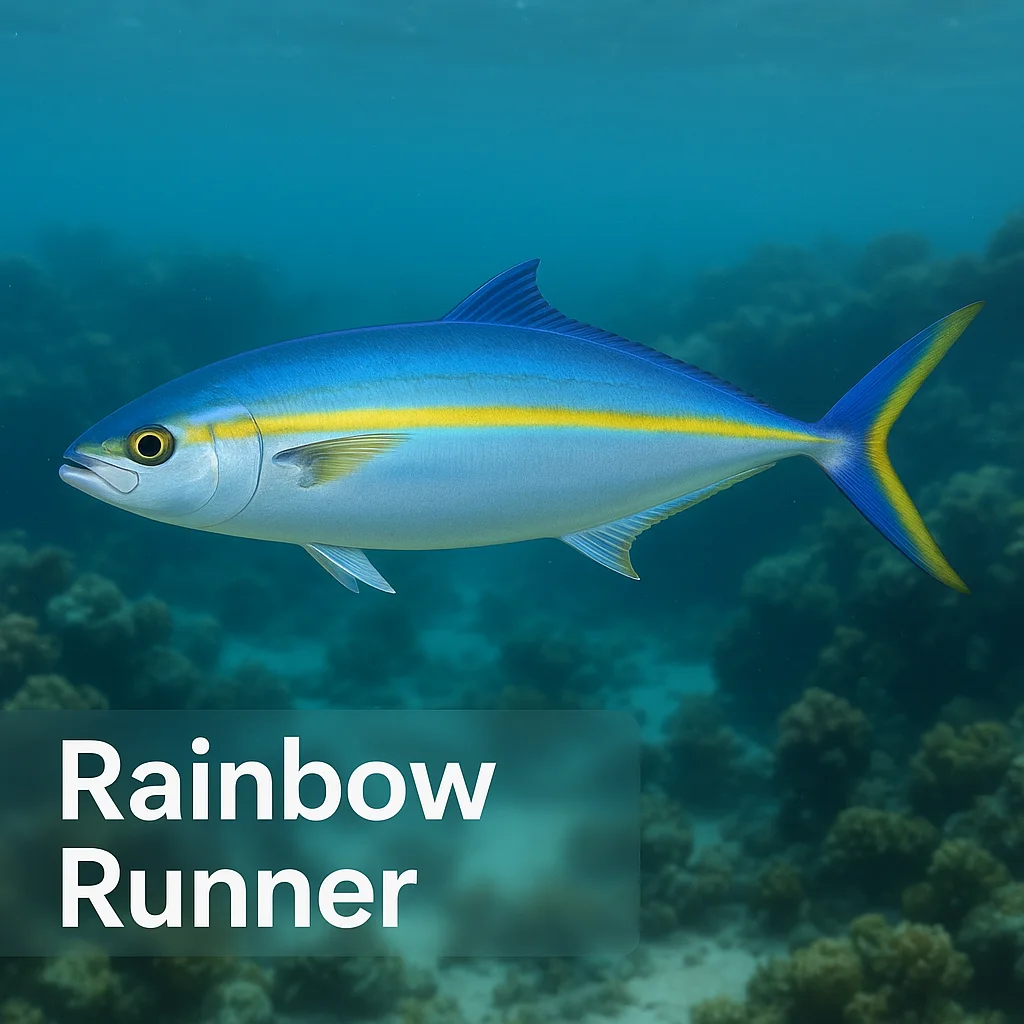
- Common name(s): Rainbow Runner
- Scientific name: Elagatis bipinnulata
- Animal type: Fish
- Typical adult size: Up to 120 cm (47 inches) in length
- Typical lifespan: 5-8 years
- Diet type: Carnivore; feeds on small fish, squid, and crustaceans
- Activity pattern: Diurnal
- Social structure: Often found in schools
- Speed / movement highlights: Swims swiftly
- Intelligence/learning: Adapted for efficient hunting
- Primary habitats: Pelagic regions of the ocean
- Geographic range: Tropical and subtropical waters worldwide
- Predators/threats: Larger fish, marine mammals, and human fishing
- Conservation status: Not currently endangered, but subject to varying regional pressures
🔍 Identification & Appearance
The Rainbow Runner is recognizable by its long, slender body and vivid coloration. Its back is dark blue or green, fading to a bright silver or white belly, with a distinct yellow stripe running along the sides. These colors can change slightly based on age and environment.
- Body shape and silhouette: Streamlined and elongated
- Key colors/patterns: Blue to green back, silver belly, yellow lateral line
- Distinctive features: Forked tail and elongated pectoral fins
- Common look-alikes: Difficult to confuse due to unique coloration
🧱 Body Structure & Physical Adaptations
The Rainbow Runner is built for speed and endurance. Its streamlined body reduces drag, allowing swift movement through water. Its jaws are equipped with fine teeth suited for gripping slippery prey like fish and squid.
- Build and proportions: Slender with elongated fins
- Teeth/beak/jaw adaptations: Fine teeth optimized for catching slippery prey
- Claws/hooves/wings/fins: Long pectoral fins enhance swimming agility
- Sensory strengths: Excellent vision aids in locating prey
🌍 Range & Distribution
The Rainbow Runner is found in tropical and subtropical regions of the Atlantic, Pacific, and Indian Oceans. It primarily inhabits the pelagic zone, often near the surface but occasionally deeper.
- Atlantic Ocean
- Pacific Ocean
- Indian Ocean
- Prefers open ocean waters
- Occasionally found near coral reefs
🏞️ Habitat & Shelter
The Rainbow Runner favors the open ocean but can often be found near reefs, drop-offs, and floating debris which provide shelter and hunting grounds. Seasonal changes in currents can lead to variations in location.
🧭 Behavior & Ecology
Rainbow Runners are active hunters during the day, often forming schools to increase hunting efficiency. They use speed and agility to catch prey and are known to associate with larger fish and marine animals.
- Daily routine: Diurnal, active during daylight
- Communication: Primarily visual with schooling behavior
- Role in the ecosystem: Important predator in the marine food web
👥 Social Life & Group Dynamics
Rainbow Runners are typically found in schools, which improves their chances of successful hunting and reduces individual risk of predation. These groups can range from small to large, depending on the abundance of food.
- Solitary vs social: Highly social
- Group types: Schools
- Cooperation: Hunting in groups
🍽️ Diet, Prey & Predators
A carnivorous species, the Rainbow Runner's diet consists mainly of smaller fish, squid, and crustaceans. They are preyed upon by larger predatory fish and marine mammals, and employ swift swimming as their primary defense.
- Feeding strategy: Fast swimming to capture medium-sized prey
- Main predators: Larger fish and marine mammals
🦌 Hunting, Foraging & Movement
The Rainbow Runner is a powerful swimmer, utilizing its streamlined body to achieve high speeds over long distances. Schools tend to move through oceanic habitats foraging for food.
- Locomotion style: Swift swimmers
- Speed and endurance: Capable of covering long distances quickly
🧠 Intelligence & Senses
Rainbow Runners rely on acute vision for hunting and detecting predators. Their schooling behavior indicates a level of social intelligence necessary for maintaining group cohesion and effective hunting.
- Vision: Excellent visual hunters
- Social intelligence: Effective coordination in schools
🪺 Reproduction, Pregnancy & Parenting
Spawning occurs seasonally in warm waters, with little known about specific courtship behaviors. Fertilization is external with eggs and larvae developing in open water. There is no parental care post-spawning.
- Mating system: Polygynous;
- Breeding season: Varies
♀️♂️ Male vs Female Differences
Males and females of the Rainbow Runner tend to be similar in appearance, with size differences being minimal. Any behavioral or physical differences are not well-documented.
- Size/weight differences: Minimal, if any
🧬 Subspecies & Variation
The Rainbow Runner is generally not divided into subspecies, although individuals can vary slightly in scale patterning or coloration based on environmental factors.
- Local adaptations: Minor color variations can occur
⚠️ Threats, Conservation & Human Interaction
While not currently endangered, Rainbow Runners face threats from commercial and recreational fishing. Responsible fishing practices are encouraged to maintain sustainable populations. They are popular among sport fishers due to their speed.
- Human pressures: Overfishing
- Conservation priority: Not currently a high-priority conservation target
✨ Fun Facts & Unique Traits
- Rainbow Runners are known for their vibrant coloration, which gives them their name.
- They are capable of burst speeds that earn them a place among the fastest ocean inhabitants.
- Rainbow Runners often associate with floating objects in the ocean, which attract prey.
- They are sometimes used as baitfish for larger predatory species.
- Rainbow Runners are popular in sport fishing due to their fight and agility.
📌 Summary
- The Rainbow Runner is a colorful, diurnal fish found in tropical and subtropical oceans worldwide.
- Identified by its streamlined body, vivid blue, green, and silver coloration, and a distinct yellow line.
- Common in open ocean habitats, occasionally near reefs and debris.
- Fast swimmer and predator, feeding primarily on fish and squid.
- Forms schools for effective hunting and protection against larger predators.
- Breeds externally, with minimal differences between males and females.
- Faces pressures from fishing, but populations are currently stable.
- Known for their speed and agility, making them popular among sport fishers.