🦁 Pufferfish
🧾 Quick Facts
The Pufferfish, also known for its ability to inflate into a ball-shape as a defense mechanism, is a fascinating group of fish primarily found in tropical and subtropical ocean regions. There are many species under the umbrella of "Pufferfish," and they are distinguished by their unique physical adaptations and ecological roles.
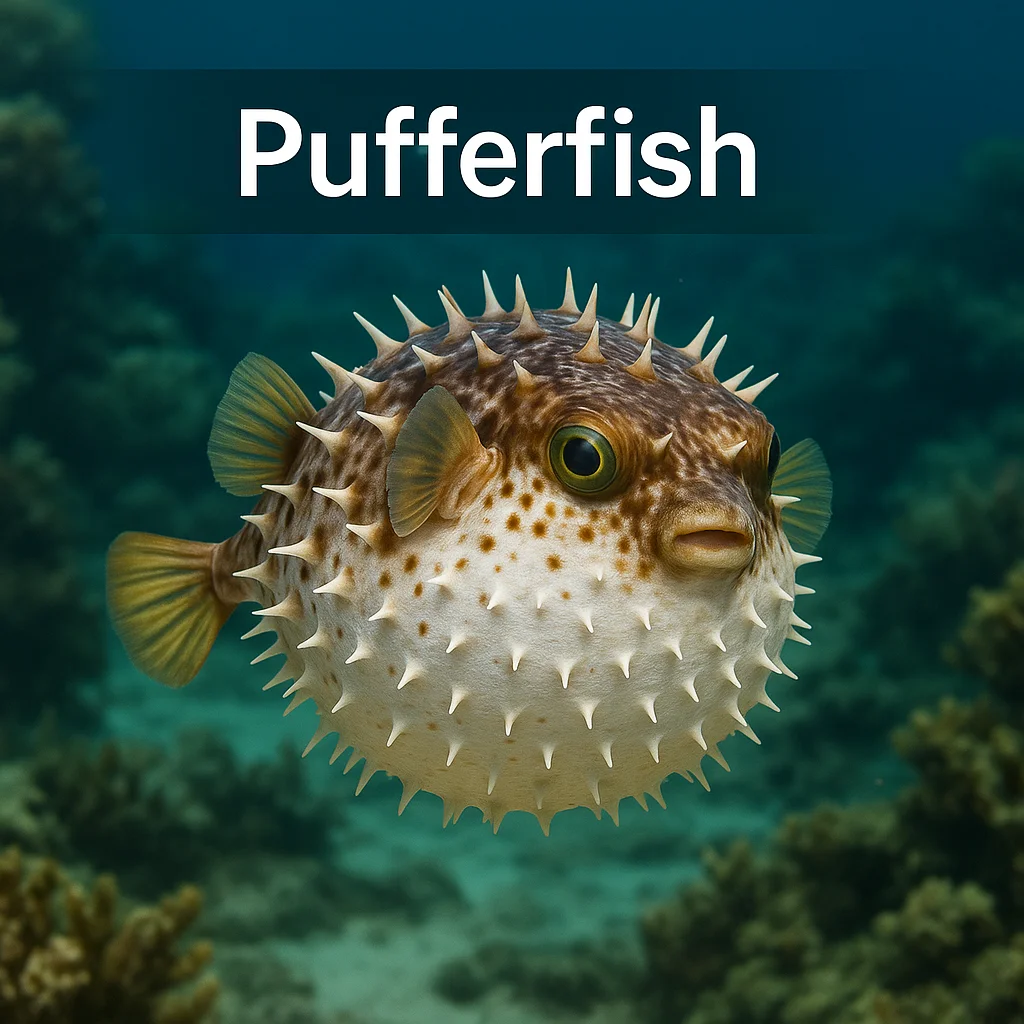
- Common name(s): Pufferfish, Blowfish
- Scientific name: Family Tetraodontidae
- Animal type: Fish
- Typical adult size: 1 to 24 inches (2.5 to 60 cm) in length
- Typical lifespan: 10-15 years in the wild
- Diet type: Omnivore; common foods include algae, invertebrates, and small crustaceans
- Activity pattern: Mostly diurnal, but can vary by species
- Social structure: Solitary, occasionally pairs or small groups
- Speed: Moderate swimming speed; capable of quick bursts when threatened
- Intelligence/learning: Known for curiosity and problem-solving abilities
- Primary habitats: Oceans, coral reefs, seagrass beds
- Geographic range: Tropical and subtropical regions worldwide
- Predators/threats: Larger predatory fish, sharks, habitat loss, pollution
- Conservation status: Varies by region; some species endangered
🔍 Identification & Appearance
Pufferfish are easily recognized by their unique ability to inflate their bodies into a spherical shape when threatened. They possess a somewhat stocky body with a round silhouette. Most species exhibit a range of colors from muted grays and browns to vibrant yellows and greens, often with spots or stripes.
- Body shape: Spherical when inflated, typically rounded when relaxed
- Color: Varies by species; most have some form of pattern like spots
- Distinctive features: Prominent eyes, no scales, leathery skin
- Common look-alikes: Porcupinefish; distinguished by their spines
- Top ID Tips:
- Rounded body shape typical of a Pufferfish
- Presence of beak-like teeth
- Lack of pelvic fins
- Ability to inflate quickly
- Diverse color patterns but often include spots
- Protrusive eyes that can rotate for a wide viewing angle
🧱 Body Structure & Physical Adaptations
Pufferfish have a distinct build with a rigid, round body that contributes to their unique defense mechanism of puffing up. Their strong jaw and beak-like teeth are adapted for crushing shells of mollusks and crustaceans, their primary diet.
- Build: Stocky and rigid when inflated
- Beak-like teeth: Optimized for cracking shells
- Fins: Rounded dorsal and anal fins for maneuverability
- Sensory strengths: Good vision with the capability to independently move each eye
- Key Adaptations:
- Inflation capability due to elastic skin
- Tetrodotoxin toxin for deterring predators
- Beak-like structure for strong jaw action
- Absence of scales; tough leathery skin
- Coloration for camouflage among coral reefs
- Highly maneuverable fins for precise movements
🌍 Range & Distribution
Pufferfish are predominantly found in tropical and subtropical areas across the globe, particularly populating coral reefs, lagoons, and seagrass beds. While some species can adapt to brackish or freshwater, most are marine inhabitants.
- Continents: Widely distributed across tropical oceans worldwide
- Typical countries: Indonesia, Australia, Philippines, Caribbean nations
- Biomes: Coral reefs, seagrass beds, coastal seas
- Mostly resident with limited migrations
- Where You Might Find It:
- Coral-rich coastal environments
- Mangrove ecosystems
- Sandy bottoms surrounded by rocky structures
- Estuaries (for some brackish-water species)
- Tropical and subtropical ocean regions worldwide
🏞️ Habitat & Shelter
Pufferfish typically reside in diverse marine habitats, favoring environments with ample cover and abundant food sources. They are often seen around coral reefs where they find food, mates, and protection. Changes in weather, such as tides and monsoon seasons, can influence their sheltering strategies and behavior.
Understanding the habitat preferences of Pufferfish helps researchers predict their behavior patterns and survival strategies, which is crucial for conservation efforts.
🧭 Behavior & Ecology
Pufferfish are known for their solitary lifestyle, yet some species exhibit more social tendencies, such as forming small groups or pairs. They maintain a daily routine that includes foraging, resting, and occasionally exhibiting territorial behaviors. Their inflation ability serves as a unique defense tactic, deterring many predators, including sharks and larger fish.
- Behavior Highlights:
- Mostly solitary, occasional pairs or groups
- Defensive inflation when threatened
- Diverse communication methods; mostly visual and tactile
- Contributes to ecosystem balance by managing invertebrate populations
- Plays a role as both predator (to smaller sea creatures) and prey (to larger fish)
👥 Social Life & Group Dynamics
Pufferfish are largely solitary creatures, though particular species have been observed forming pairs or smaller groups, especially during breeding periods. They generally do not exhibit complex social structures, focusing instead on individual survival tactics.
- Social Structure Notes:
- Predominantly solitary
- Instances of pair bonding during breeding
- Limited social interaction outside breeding
- No observed dominance hierarchies
- Rare instances of mutual cooperation
🍽️ Diet, Prey & Predators
Pufferfish are omnivores, with diets that change slightly by species but generally consist of algae, small invertebrates, and crustaceans. Despite their formidable defensive capabilities, they are preyed upon by some predatory marine animals such as sharks.
- Feeding Notes:
- Consumes algae and small animals
- Beak-like mouth helps break hard shells
- Flexible diet based on accessibility
- Employs inflating defense against predators
🦌 Hunting, Foraging & Movement
Pufferfish are swimmers, using their well-adapted fins for precise movements in their environment. They forage for food mostly during the day, and their movements can be characterized by sudden quick bursts when escaping threats.
- Movement & Strategy:
- Uses short bursts of speed to evade predators
- Forages during daylight hours
- Capable of complex navigation around reefs
- Employs swimming accuracy for foraging
🧠 Intelligence & Senses
Pufferfish exhibit some level of problem-solving abilities and possess acute vision, allowing them to easily navigate and locate food resources. Their ability to inflate and the presence of tetrodotoxin serve as advanced survival mechanisms.
- Notable Abilities:
- Capable problem-solving
- Acute vision, including independent eye movement
- Inflation and toxin presence as defenses
- Complex behavior repertoire
🪺 Reproduction, Pregnancy & Parenting
Pufferfish typically breed seasonally, with male-female pairs engaging in courtship displays. They exhibit a variety of mating systems, depending on the species, and may produce numerous eggs that are often laid in nests guarded by males.
- Reproduction Snapshot:
- Breeding season varies, often warm months
- Engages in distinct courtship displays
- Males often guard eggs
- Clutch size varies widely by species
♀️♂️ Male vs Female Differences
Male and female pufferfish can be difficult to distinguish, although differences may exist in subtle coloration or size, particularly during breeding seasons. The behavioral roles regarding mating and some species-specific displays highlight these differences.
- Sex Differences at a Glance:
- Subtle coloration differences during breeding
- Males may be more prominently territorial
- Slight size variations by species
🧬 Subspecies & Variation
The Pufferfish family, Tetraodontidae, consists of numerous species, each adapted to their specific environmental context. These fish exhibit a variety of sizes, patterns, and colorations that align with their habitats and behaviors.
- Variation Notes:
- Wide range of size variation among species
- Coloration adaptation to specific environments
- Differences in toxicity levels among species
⚠️ Threats, Conservation & Human Interaction
Pufferfish face several challenges, including habitat destruction, pollution, and overfishing. While they are fascinating creatures frequently displayed in aquariums, conservation practices need to take precedence for their long-term survival and well-being.
- Responsible Notes:
- Habitat preservation is crucial
- Impact of pollution on ocean ecosystems
- Support conservation efforts for threatened species
✨ Fun Facts & Unique Traits
- Pufferfish can inflate to twice or more their normal size.
- Their skin contains tetrodotoxin, a potent toxin.
- They have four fused teeth forming a beak.
- Pufferfish are known to exhibit strong perching behavior.
- They are occasionally used in Japanese cuisine, known as "fugu."
📌 Summary
- Pufferfish are distinctive for their ability to puff up as a defense mechanism.
- They are primarily found in tropical and subtropical ocean regions.
- They possess a wide range of adaptations including unique coloration and powerful toxins.
- Pufferfish are solitary and have a small yet significant impact on their ecosystem.
- They are omnivorous, feeding on algae and small invertebrates.
- Pufferfish face natural threats from predators and environmental changes.
- They exhibit complex mating rituals, with broader parental investment in egg guarding.