🦁 Filefish
🧾 Quick Facts
Filefish are a fascinating group of marine fishes known for their quirky appearance and interesting behaviors. Belonging to the family Monacanthidae, filefish are found in various marine environments. Here's a quick overview of some essential aspects of filefish:
- Common name(s): Filefish
- Scientific name: Often listed as Monacanthidae (varies by genus)
- Animal type: Fish
- Typical adult size: 10–50 cm in length
- Typical lifespan: Varies, commonly 1–5 years in the wild
- Diet type: Omnivore; feeds on algae, small invertebrates, and coral polyps
- Activity pattern: Diurnal
- Social structure: Often solitary, occasionally in pairs
- Speed / movement highlights: Slow-moving swimmers
- Intelligence/learning: Displays problem-solving skills, adaptive foraging
- Primary habitats: Coral reefs, seagrass beds, lagoons
- Geographic range: Tropical and subtropical oceans worldwide
- Predators/threats: Larger fish, sharks, human fishing activities
- Conservation status: Varies by region; some species are vulnerable
🔍 Identification & Appearance
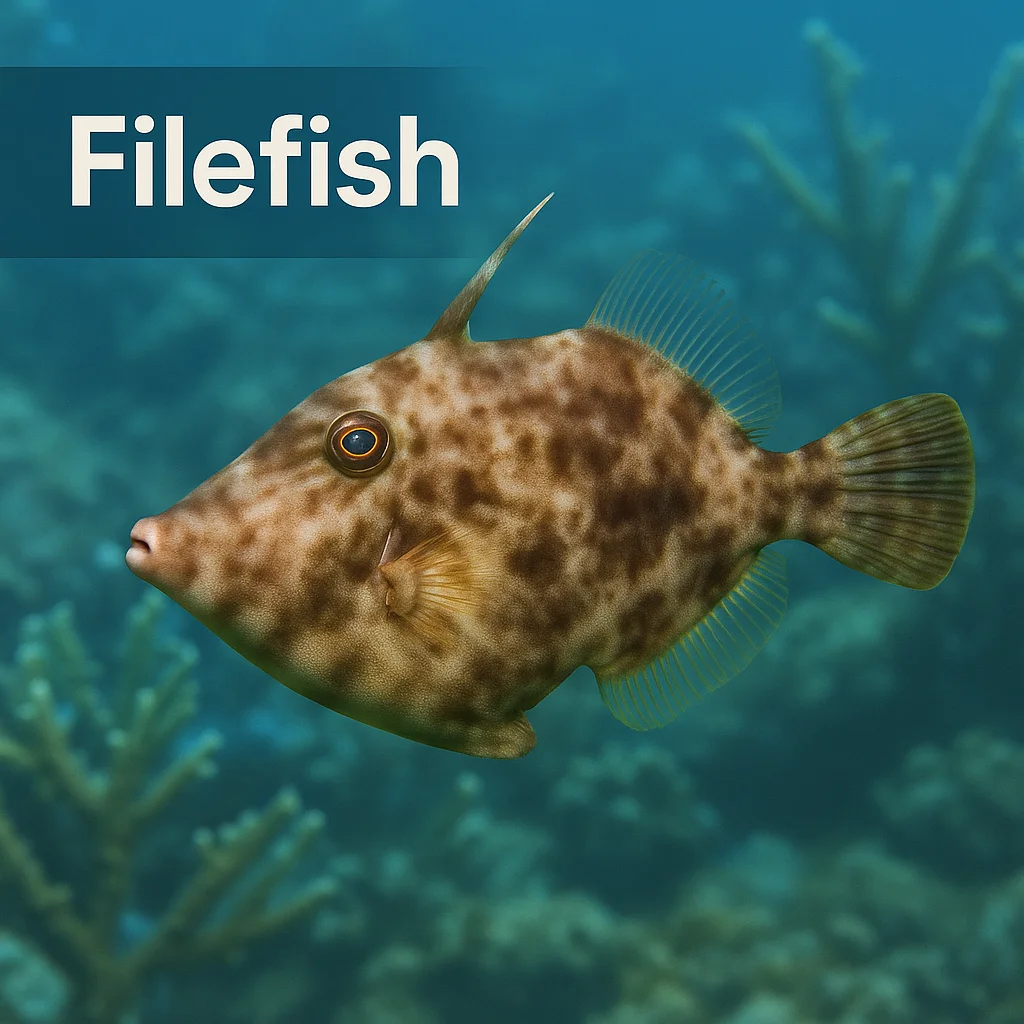
Filefish are easily identified by their unique body shape and distinctive features. They have a laterally compressed body, giving them a flat appearance. Their elongated snout and rough, file-like skin are distinctive characteristics. Coloration can range from drab browns and grays to vibrant yellows and oranges, depending on the species and environment. Some species possess intricate patterns, such as stripes or spots, which can change with age or mood. Filefish are equipped with a first dorsal fin that can be raised or lowered.
- Flat, elongated body with a compressed silhouette
- Rough, sandpaper-like skin texture
- Variety of colors and patterns influenced by species and habitat
- Small mouth with specialized teeth for feeding
- Obvious, single dorsal spine
- Often confused with triggerfish, but filefish have distinct body shapes and fin structures
- Coloration can serve as camouflage in coral reefs
🧱 Body Structure & Physical Adaptations
The body structure of filefish reflects their adaptation to life in diverse marine environments. They have slender, elongated bodies optimized for navigating coral reefs and finding food. Filefish have small, pointed mouths with specialized teeth for scraping algae and consuming invertebrates. Their fins provide precise control and stability while swimming. Although generally slow swimmers, they can make quick adjustments to evade predators. Sensory strengths include a keen sense of sight and touch, aiding in food detection and social interactions.
- Elongated body with a laterally compressed build
- Specialized mouthparts for algae scraping and invertebrate consumption
- Flexible fins for precise swimming maneuvers
- Keen eyesight for navigating complex environments
- Adaptation to blend with coral reef backgrounds
- Single dorsal spine raised as a defense mechanism
🌍 Range & Distribution
Filefish are distributed across tropical and subtropical oceans worldwide, often found in shallow coastal waters. They inhabit coral reefs, rocky seashores, and seagrass beds. While many species are resident to their habitats, some display limited migratory patterns based on reproductive cycles or seasonal changes in water temperature.
- Common in Atlantic and Indo-Pacific regions
- Found in warm, tropical seas near coral formations
- Occur in waters around coral reefs, lagoons, and rocky shores
- Presence noted from Caribbean islands to Southeast Asian coasts
- Can be found along the eastern coasts of North and South America
- More prevalent in warm, shallow marine environments
🏞️ Habitat & Shelter
Filefish prefer habitats rich in coral and plant life, choosing to reside in coral reefs, seagrass beds, and rocky shorelines with ample crevices for protection. Their cryptic coloration allows them to blend in with surrounding environments, providing shelter from predators. Filefish use coral structures and plant life not only as a source of food but also for shelter and breeding. Seasonal weather changes can influence their movements, often prompting them to seek deeper regions during storms or seasonal migrations.
🧭 Behavior & Ecology
Daily life for filefish involves navigating their reef environments for food and shelter. They are diurnal, engaging in grazing and foraging activities during the day. Filefish communicate through body language and coloration changes, establishing territorial boundaries or identifying mates. They play a role in controlling algae populations on reefs, which is essential to coral health. Filefish may engage with other species through competitive foraging or commensalism, often seeking cleaning services from cleaner fish.
- Active during the day, foraging in well-lit reef areas
- Utilize color changes for communication
- Participate in maintaining coral health through algae consumption
- Form temporary pairs during breeding seasons
- Can show aggressive behaviors when defending territory
- Coexistence with other reef species, maintaining ecological balance
👥 Social Life & Group Dynamics
Filefish are generally solitary, with more social interactions occurring during reproductive seasons when they may form temporary pairs. Social structures are not rigid, with individuals occasionally grouping when resources are plentiful. They exhibit a level of behavioral flexibility, allowing adaptation to changing environments. During territorial disputes, filefish may demonstrate aggressive displays to establish dominance without physical confrontation.
- Primarily solitary, increasing interaction during breeding
- Territorial displays prominent between individuals
- Mutualistic associations with cleaning stations on reefs
- Occasional pairing behaviors noted in stable environments
- Flexible social dynamics depending on environmental conditions
- Aggression levels vary by food availability and space competition
🍽️ Diet, Prey & Predators
Filefish have an omnivorous diet, focusing on marine algae, small invertebrates, and occasionally coral polyps. Their specialized mouthparts facilitate the scraping of algae and consumption of small crustaceans. Young filefish primarily feed on plankton before shifting to the adult diet. Natural predators include larger fish and sharks, but filefish utilize their cryptic coloration and spines as anti-predatory defenses. Their feeding habits contribute to the control of algae on reefs, promoting coral growth.
- Omnivorous, feeding on small marine invertebrates and algae
- Primary predators include larger reef fish and sharks
- Employ cryptic coloration for predator avoidance
- Young filefish feed on plankton in early developmental stages
- Slow feeders, often grazing throughout the day
- Spines used as a deterrent against potential predators
🦌 Hunting, Foraging & Movement
Filefish exhibit a unique locomotion pattern, primarily characterized by slow and deliberate swimming using their dorsal and pectoral fins. This style allows for precise navigation through complex coral terrains. They are proficient grazers and foragers, usually feeding during daylight hours. Their movement is not typically guided by long-distance migrations but may vary based on water conditions and food availability.
- Use dorsal and pectoral fins for precise movements
- Steady and controlled swimming style for reef navigation
- Daytime foraging predominantly for algae and small invertebrates
- Non-migratory, with localized movements for food and habitat
- Rely on eyesight for navigation in reef environments
- Seldom exhibit high speeds, focusing on maneuverability instead
🧠 Intelligence & Senses
Filefish demonstrate problem-solving capabilities and are capable of learning from their environment. Though not known for high intelligence, they show adaptive behaviors in response to environmental changes. Their senses are adept at detecting predators and locating food. Vision plays a crucial role in their daily activities, augmented by acute tactile senses that assist in detecting food textures and avoiding obstacles.
- Moderate problem-solving skills; adapt to changing environments
- Relatively well-developed eyesight for prey location
- Perceptive touch helps navigate and forage among corals
- Moderately developed social intelligence for brief interactions
- Limited research on cognitive abilities, varies among species
🪺 Reproduction, Pregnancy & Parenting
Reproduction among filefish varies, with many species forming monogamous pairs during breeding. Courtship involves elaborate displays of coloration and fin movements. Fertilization is external, with females laying eggs in secure reef crevices. Incubation periods and clutch sizes can vary significantly between species. Following hatching, parental care is minimal, with offspring being independent from a young age.
- Primarily monogamous during breeding periods
- Eggs laid in protected reef areas for incubation
- External fertilization through synchronized spawning
- Limited parental care post-hatching
- Clutch size varies, adaptation to specific conditions
- Courtship involves body language and color displays
♀️♂️ Male vs Female Differences
Differences between male and female filefish can be subtle, varying with size, coloration, and reproductive behavior. Males often exhibit more vibrant hues during the breeding season, while females may have larger body sizes for egg carrying. Behavioral differences include males being more territorial during reproduction, focusing on courtship and mate protection.
- Subtle size differences, often females slightly larger
- Color intensity typically heightened in males during breeding
- Males engage in more frequent courtship displays
- Females may have a slightly different body shape for carrying eggs
- Behavioral differences prominent during breeding
- Characteristic display behaviors noted more in males
🧬 Subspecies & Variation
Filefish encompass a variety of species and subspecies across different marine settings. Subspecies variations often involve differences in size, coloration, and ecological adaptations, such as reef-specific camouflage or open-water resilience. Taxonomic classifications can vary as marine environments continue to be explored and studied.
- Size and coloration vary significantly among subspecies
- Certain traits adapted to specific reef environments
- Ongoing study and classification, sometimes debated
- Reef-specific subspecies exhibit unique camouflage strategies
- Island-dwelling filefish may differ from continental relatives
⚠️ Threats, Conservation & Human Interaction
Filefish face natural and human-induced challenges, including predation by larger marine species and habitat destruction through coral reef degradation. Human activities, such as pollution and fishing, also impact filefish populations. Conservation efforts focus on preserving marine habitats and mitigating harmful practices. Filefish are sometimes kept in aquariums, demanding responsible husbandry to avoid impacting wild populations negatively.
- Threats from reef degradation and global climate change
- Predation by larger marine species
- Conservation varies by geographic location
- Responsible aquarium keeping emphasized for sustainability
- Pollution and overfishing impact populations directly
✨ Fun Facts & Unique Traits
- Filefish are named for their rough, file-like skin texture.
- Some filefish can change color to blend with their surroundings.
- They are closely related to pufferfish and triggerfish.
- Filefish fins allow them to hover precisely in reef environments.
- They play a crucial role in controlling algae on coral reefs.
- Their dorsal spine can be raised as a deterrent against predators.
- Filefish exhibit unique courtship dances during mating seasons.
- Their skin texture is due to minuscule scales embedded within the skin.
- Filefish can thrive in diverse environments, from tropical to cooler waters.
- Filefish often engage in symbiotic relationships with cleaner fish.
📌 Summary
- Unique flattened body with rough, file-like skin.
- Primarily inhabit coral reefs and are found worldwide in tropical seas.
- Omnivorous, feeding on algae and small invertebrates.
- Natural predators include larger fish and sharks, with camouflage as a protection mechanism.
- Generally solitary but form pairs during breeding seasons.
- Monogamous breeding, with very limited parental care.
- Specialized fins for slow, precise swimming.
- Males often more vibrant during breeding times, subtle size differences with females.
- Contribute significantly to the ecosystem by controlling algae populations on reefs.
- Vulnerable to habitat loss and fishing pressures, requiring conservation actions to maintain populations.