🦁 Emperor Angelfish
🧾 Quick Facts
The Emperor Angelfish, with its dazzling colors and intricate patterns, is a captivating sight in the vibrant underwater world. Known for their elegant appearance and fascinating behaviors, these fish are a staple in tropical marine ecosystems.
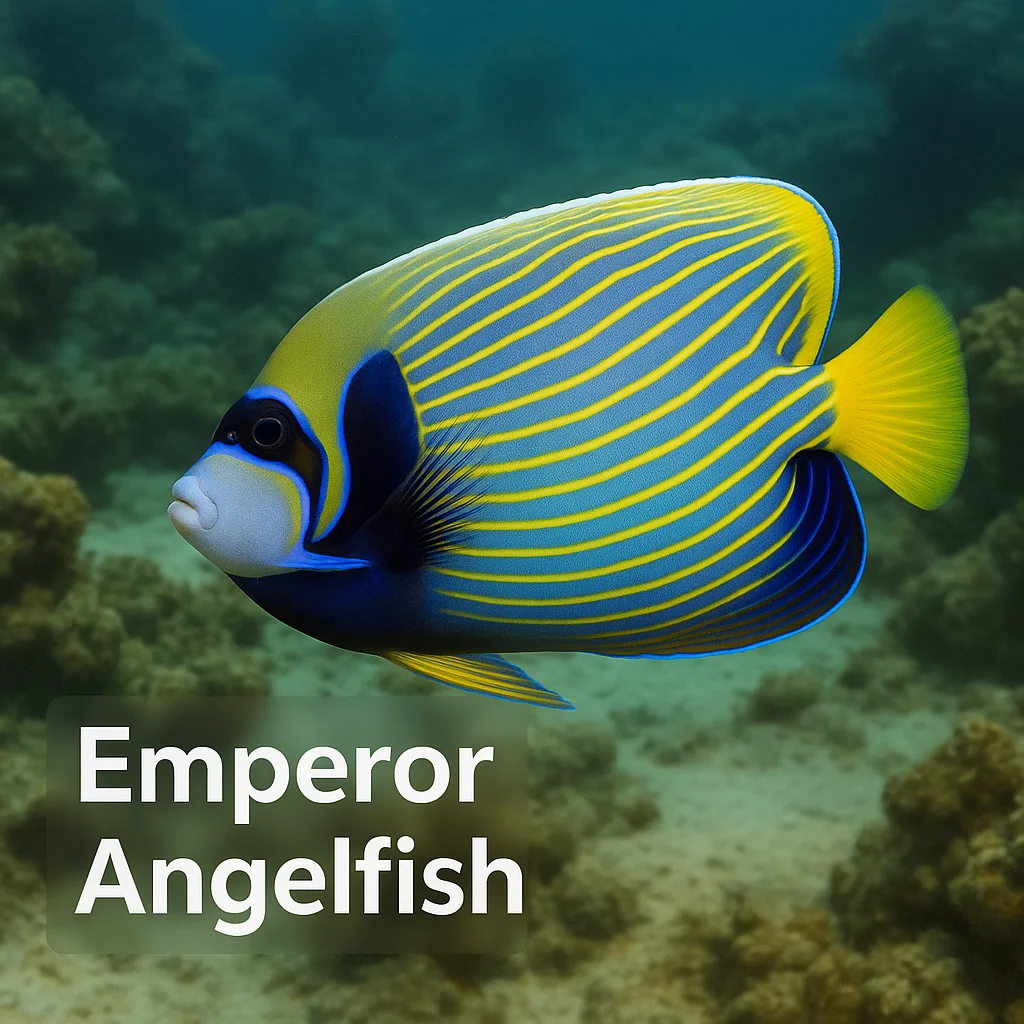
- Common name(s): Emperor Angelfish
- Scientific name: Pomacanthus imperator
- Animal type: Fish
- Typical adult size: 10-15 inches in length
- Typical lifespan: 15-20 years in the wild
- Diet type: Omnivore; feeds on sponges, algae, and small invertebrates
- Activity pattern: Diurnal
- Social structure: Solitary or in pairs
- Movement highlights: Graceful swimmer
- Intelligence/learning: Notable for complex social interactions and territorial behavior
- Primary habitats: Coral reefs
- Geographic range: Indian and Pacific Oceans
- Predators/threats: Larger fish, human activities
- Conservation status: Stable, but varies by region
🔍 Identification & Appearance
Recognized for their striking visuals, Emperor Angelfish have an oval body shape with an elongated dorsal fin. Their coloration shifts dramatically as they age; juveniles exhibit concentric light blue and white rings, while adults flaunt horizontal stripes of yellow and blue.
- Oval body shape
- Juveniles have concentric circles; adults have horizontal stripes
- Distinctive dark mask across the eyes
- Bright blue lines from head to tail
- Yellow and blue coloration in adults
- White tail fin
- Common look-alikes: Other angelfish species
- Distinguished from similar species by size and specific pattern differences
🧱 Body Structure & Physical Adaptations
Emperor Angelfish have a streamlined body optimized for swimming among coral reefs. Their mouths are small and suited for grazing on sponges and algae. Sensory adaptations include excellent vision, aiding in navigation and foraging.
- Sleek, oval body for efficient swimming
- Tiny mouth adapted for sponge and algae consumption
- Long dorsal fin for stability in water
- Sharp vision for spotting predators and prey
- Vivid coloration for communication and camouflage
- Robust pectoral fins for precise movement
🌍 Range & Distribution
The Emperor Angelfish is found in the warm, tropical waters of the Indian and Pacific Oceans. Its range includes the Red Sea, East Africa, the Maldives, Indonesia, and the Great Barrier Reef.
- Indian Ocean from East Africa to the Maldives
- Western Pacific Ocean including Japan and Australia
- Common in the Red Sea
- Prefers water temperatures of 72-82°F
- Typically found at depths of 3 to 100 feet
- Non-migratory species
🏞️ Habitat & Shelter
Primarily inhabiting coral reefs, the Emperor Angelfish relies on the complex reef structures for shelter and food. These reef environments offer protection from predators and serve as a rich feeding ground.
Species-specific shelters or microhabitats commonly utilized by the Emperor Angelfish include shallow lagoons and seaward reefs where they can hide among corals and rocks. Changes in water temperature and seasonal algae blooms can affect their foraging behavior and habitat choices.
🧭 Behavior & Ecology
The Emperor Angelfish is mostly active during the day, spending its time foraging, maintaining territories, and interacting with other reef inhabitants. They communicate through body displays and subtle movements, playing a key role as both predator and prey in the reef ecosystem.
- Territorial behavior, defending specific reef areas
- Forming lifelong pairs for breeding
- Engage in cleaning symbiosis with smaller fish
- Helps control sponge populations on reefs
- Non-aggressive with compatible species
👥 Social Life & Group Dynamics
Emperor Angelfish are generally solitary or found in pairs, especially when breeding. While not known to form large groups, their pairing system ensures cooperation in territory defense and reciprocal benefits during cleaning interactions with other reef species.
- Mostly solitary
- Pairs with a mate for life
- Defends a shared territory with mate
- Occasionally seen interacting with mixed-species groups
- Utilizes body language for social communication
🍽️ Diet, Prey & Predators
Emperor Angelfish have a varied diet, primarily grazing on sponges and algae found on coral reefs. They are also known to eat small invertebrates. Their natural predators include larger reef fish and humans through fishing activities.
- Feed primarily on sponges and algae
- Occasional small invertebrate consumption
- Algae blooms adjust dietary schedules
- Anti-predator strategy: hiding among corals
- Nocturnal resting in well-concealed reef crevices
🦌 Hunting, Foraging & Movement
As reef inhabitants, Emperor Angelfish exhibit graceful swimming skills, weaving through coral structures with precision. They are primarily diurnal feeders, using their keen vision and small mouths to graze on algae and sponges efficiently.
- Efficient coral reef navigators
- Forage during daylight hours
- Use short bursts of speed when necessary
- Home range often overlaps with mate's territory
- Rarely engage in widespread migrations
🧠 Intelligence & Senses
The Emperor Angelfish exhibits notable perceptual skills, particularly in visual acuity, which aids in their navigation and foraging activities. These fish demonstrate problem-solving through effective territory defense strategies and social interactions.
- Excellent visual perception
- Responsive to environmental changes
- Adept at recognizing mate and territory
- Sophisticated social cues interpretation
- Exhibits learning behaviors in response to threats
🪺 Reproduction, Pregnancy & Parenting
Reproduction for the Emperor Angelfish occurs within territorial pairs. Spawning is typically synchronized with lunar cycles, with fertilized eggs released into open water. Subsequent parental roles are minimal, as the eggs are left to develop independently.
- Breeds during specific moon phases
- Spawns by releasing eggs into the water
- No parental care post-spawning
- Eggs develop externally in open water
- Juveniles settle on reefs after hatching
♀️♂️ Male vs Female Differences
Differences between male and female Emperor Angelfish can be subtle, primarily manifesting in size variance and slight coloration alterations, although these are not always apparent.
- Generally similar in size
- Subtle coloration distinctions in some individuals
- Equal roles in territory defense
- Jointly engage in spawning activities
- Pair-bonded throughout breeding seasons
🧬 Subspecies & Variation
While traditionally recognized as a single species, regional variations in coloration and behavior have been noted, though formal classification into subspecies is limited and debated among scientists.
- Minor regional color variations
- ID challenges in overlapping territories
- Distinct juvenile vs adult appearance
- Potential for behavioral alterations by region
- Debate over formal subspecies classification
⚠️ Threats, Conservation & Human Interaction
Emperor Angelfish face various threats, including habitat destruction due to coral bleaching, climate change, and human activities such as fishing and the aquarium trade. Conservation efforts are crucial for maintaining their populations.
- Impacted by coral reef degradation
- Popular in the aquarium trade
- Sustainable fishing practices essential
- Conservation areas provide critical habitats
- Avoid handling wild specimens
✨ Fun Facts & Unique Traits
- Juvenile to adult coloration transformation is dramatic and unique
- Displays complex cleaning behaviors in the reef ecosystem
- Exhibits lifelong pairing and active territory defense
- Recognizes their mate even in vibrant, confusing reef environments
- Notable for their role in controlling reef sponge populations
- Adaptable to slight changes in their environment, highlighting resilience
📌 Summary
- Recognizable by striking blue and yellow colors
- Inhabits coral reefs across the Indian and Pacific Oceans
- Omnivorous diet focused on sponges and algae
- Predators include larger fish; human-induced threats exist
- Socially pairs for life, often defending territory together
- Reproduction involves spawning without parental care
- Adapted with excellent visual skills aiding survival
- Critical role in reef ecology as grazers and prey
- Coloration shifts dramatically from juvenile to adult stages
- Conservation efforts are vital in preserving their habitats