🦁 Damselfish
🧾 Quick Facts
Damselfish are a diverse group of small, vibrant fish commonly found in reef environments. Known for their territorial behavior, these fish play a significant role in the marine ecosystem.
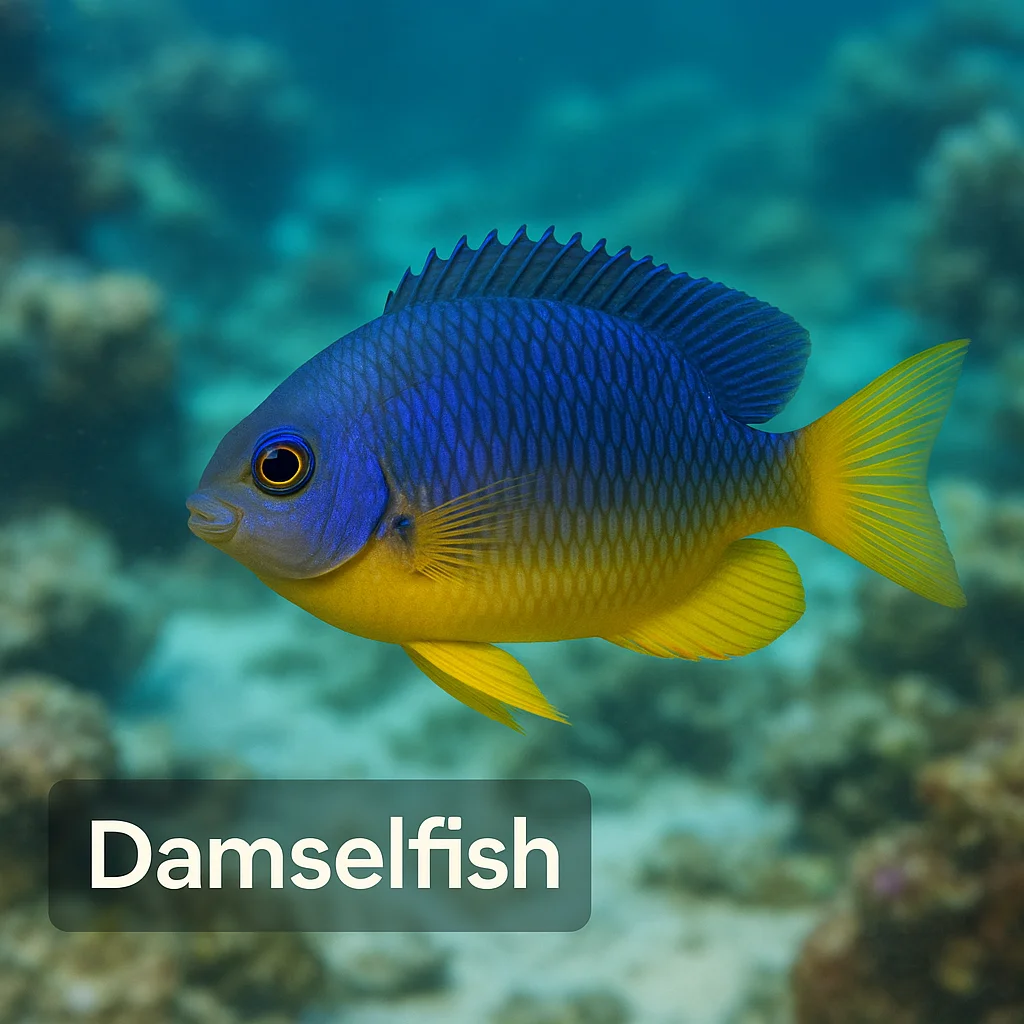
- Common name(s): Damselfish
- Scientific name: Pomacentridae (Family; numerous species)
- Animal type: Fish
- Typical adult size: Varies, commonly 6–15 cm
- Typical lifespan: 5–10 years in the wild
- Diet type: Omnivore; algae, plankton, small invertebrates
- Activity pattern: Diurnal
- Social structure: Solitary or small groups
- Speed / movement highlights: Agile swimmers
- Intelligence/learning: Capable of learning through observation
- Primary habitats: Coral reefs
- Geographic range: Tropical and subtropical oceans worldwide
- Predators/threats: Larger fish, seabirds, human activities
- Conservation status: Varies by region
🔍 Identification & Appearance
Damselfish are recognizable by their bright colors and compact body shape. They often exhibit striking patterns and variable hues across species.
- Body shape and silhouette: Laterally compressed, oval-shaped body
- Key colors/patterns: Bright blues, yellows, greens; some species change color as they age
- Distinctive features: Small mouth, deeply forked tail
- Tracks, scat, or other field signs: Not applicable in marine setting
- Common look-alikes: Chromis; distinguishable by Damsel's robust body and territorial behavior
- Look for bright colors
- Check for a short, deep body
- Observe behavior; territorial nature is common
- Note the forked tail
- Size varies but generally small
- Found near coral structures
- Observe color changes for juvenile vs. adult
- Notice the small mouth adapted for feeding on algae
- Spot the variations in dorsal fin size among species
- Top ID Tips
🧱 Body Structure & Physical Adaptations
Damselfish have adapted to thrive in complex reef ecosystems. Their bodies and senses are fine-tuned for survival and reproduction in this environment.
- Build and proportions: Sturdy, laterally compressed body ideal for navigating reefs
- Teeth/beak/jaw adaptations: Small, sharp teeth for scraping algae and catching plankton
- Fins: Large pectoral fins for agile swimming and quick maneuvers
- Sensory strengths: Acute vision for detecting movement; some species show enhanced color perception
- Small size aids in hiding among coral
- Bright colors used in communication and deterrence
- Agility allows for efficient navigation and evasion
- Territorial behavior defends food sources
- Diverse diet supported by specialized teeth
- Color changes aid in signaling and camouflage
- Vision tailored to the reef's light conditions
- Fine scales for protection against predators
- Key Adaptations
🌍 Range & Distribution
Damselfish are widely distributed across tropical and subtropical oceans, predominantly occupying coral reefs. Their presence is critical to reef health and stability.
- Found in tropical Pacific and Atlantic Oceans
- Present in the Indian Ocean
- Common in coral reef biomes
- Mostly resident; some species may shift with environmental changes
- Occupy a range of depths, from shallow waters to deeper reefs
- Great Barrier Reef, Australia
- Caribbean Sea, Mexico
- Red Sea, Egypt
- Philippines Archipelago
- Hawaiian Islands
- Coral reefs globally
- Lagoon environments
- Coastal reef slopes
- Protected marine reserves
- Where You Might Find It
🏞️ Habitat & Shelter
Damselfish predominantly inhabit coral reefs, where they find protection and abundant food. The health of these ecosystems is vital for their survival.
- Prefer shallow reefs with abundant coral cover
- Shelter within branching corals and rocky crevices
- Behavior varies with tides; more active during day
- Depend on coral for both food and protection
- Habitat knowledge essential for conservation efforts
🧭 Behavior & Ecology
Damselfish exhibit fascinating behaviors that emphasize their adaptability and importance within reef ecosystems. Their interactions shape and maintain the dynamics of their habitats.
- Territorial and aggressive, especially males during breeding
- Vocalizations include clicking sounds for communication
- Symbiotic relationships with anemones and corals
- Key prey species, controlling algal growth
- Defending territory from intruders
- Coexistence with other reef fish
- Participating in cleaning behaviors with shrimp and small fish
- Algae farming by some species
- Cooperation with symbiotic partners
- Frequent use of safe havens during rest
- Color signaling for mate attraction
- Understanding signals from potential threats
- Behavior Highlights
👥 Social Life & Group Dynamics
Social structures in damselfish vary, encompassing solitary individuals and small loose groups. They exhibit complex social behaviors related to survival and reproduction.
- Primarily solitary but some display group living
- Form small territories centered around corals
- Dominance hierarchies observed during breeding
- Limited cooperative behavior
- Conflict resolved through displays and physical encounters
- Strong individual territories
- Occasional small, loose groupings for feeding
- Breeding males fiercely guard territories
- Established hierarchies during breeding seasons
- Groups benefit from mutual protection
- Juvenile schooling at times for protection
- Pair bonds formed during breeding
- Social Structure Notes
🍽️ Diet, Prey & Predators
Damselfish have a varied diet that allows them to thrive in reef ecosystems, supporting both their nutritional needs and their role as ecosystem regulators.
- Consume algae and small invertebrates
- Feeding on plankton in open water
- Defend feeding territories to maintain resources
- Predators include larger fish, seabirds, and marine mammals
- Defensive tactics include hiding and rapid swimming
- Tend to gardens of algae
- Benefit from diverse diet options on reefs
- Eyes adapted for spotting small prey
- Tightly control algae levels, preventing reef damage
- Transient feeding near plankton-rich areas
- Alert to predator presence, reducing risk
- Sometimes found foraging with other fish
- Feeding Notes
🦌 Hunting, Foraging & Movement
Damselfish are agile swimmers capable of quick maneuvers, which are vital for both predator avoidance and effective foraging in their reef environments.
- Efficient swimmers; frequent quick dashes
- Engage in diurnal foraging
- Plankton-catching tactics involve short pursuances
- Navigate with precision through reefs
- Mostly resident, dependent on local resources
- Nimble moves to avoid predators
- Forage extensively within territories
- Plankton pursuit amidst shifting currents
- Use coral cover for stealth during hunts
- Maintain proximity to safe retreats
- Complex 3D navigation in reef structures
- Utilize eddies and currents for food traps
- Movement & Strategy
🧠 Intelligence & Senses
Damselfish display adaptability and learning in their daily lives. Sensory adaptations enable them to efficiently utilize and protect their niches on the reef.
- Capable problem solvers, adapting feeding strategies
- Vivid color vision is crucial for survival
- Limited ability for tool use
- Learn from environmental cues and peers
- Research on cognitive abilities remains limited
- Color recognition for choosing mates
- Rapid environmental adaptation
- Memory for navigating territories
- Effective communication through visual cues
- Audio sensitivity for detecting danger
- Learn nesting site preferences
- Spatial awareness for complex routes
- Sensitive to reef ecosystem changes
- Notable Abilities
🪺 Reproduction, Pregnancy & Parenting
Damselfish have diverse reproductive strategies, which are adapted to ensure their offspring’s survival in challenging reef environments.
- Breed year-round in warm waters
- Primarily monogamous, some species vary
- Short incubation, typically a few days
- Multiple egg batches laid on hard surfaces
- Male often guards and aerates eggs
- Bright color displays during courtship
- Spawning triggered by water temperature
- Eggs hidden among coral or protected zones
- Create "nests" for egg-laying
- High parental investment from males
- Pair partnerships often form during breeding
- Multiple broods increase survival chances
- Reproduction Snapshot
♀️♂️ Male vs Female Differences
Sexual dimorphism in damselfish is often subtle, with differences most notable during the breeding season when behaviors and minor physical variations are more evident.
- Females typically less vibrant outside breeding season
- Males exhibit enhanced territoriality
- Size differences often minimal
- Breeding males show brighter coloration
- Breeding-related color changes
- Males more aggressive when defending territory
- Females less colorful in non-breeding settings
- Males more involved in egg care
- Some species show distinct fin patterns
- Sex Differences at a Glance
🧬 Subspecies & Variation
The Pomacentridae family encompasses a wide array of species, each with unique traits and adaptations that facilitate their survival in diverse environments.
- Over 300 species in the family Pomacentridae
- Subspecies showing variation in color and size
- Adaptations seen for specific reef types
- Some debate over regional classification
- Diverse morphologies in different regions
- Island-specific adaptations common
- Variations in dietary habits
- Local color morphs within species
- Size variation linked to ecological roles
- Variation Notes
⚠️ Threats, Conservation & Human Interaction
Damselfish face a range of threats primarily due to habitat degradation and human interference. Conservation efforts focus on habitat preservation.
- Coral bleaching a significant threat
- Pollution and sedimentation reduce habitat
- Climate shifts alter distribution
- Overfishing affects population dynamics
- Popular in aquarium trade
- Support sustainable reef-friendly products
- Advocate for coral conservation initiatives
- Minimize disturbance in natural habitats
- Encourage reef environmental protection
- Engage in ethical aquarium practices
- Responsible Notes
✨ Fun Facts & Unique Traits
- Some damselfish cultivate algae gardens, protecting and harvesting their own food source.
- They can produce distinct sounds for communication and during territorial disputes.
- Juveniles often exhibit dramatically different colors compared to adults.
- Some species change sex if the dominant member of a group is lost.
- Their small size allows them to explore crevices that are inaccessible to many predators.
- Many damselfish are named for their beautiful, “damsel-like” colors.
- Damselfish are known to maintain and even enhance coral health by managing algae growth.
- They play a crucial role in reef ecosystems by controlling populations of both algae and invertebrates.
📌 Summary
- Brightly colored, small-bodied fish prevalent in coral reefs.
- Widespread distribution across tropical and subtropical oceans.
- Known for territorial behavior and involvement in reef ecosystem dynamics.
- Omnivorous diet supports algae control and reef health.
- Main predators include larger marine animals, mitigated by quick swimming.
- Solitary or in small groups, with complex breeding behaviors.
- Exhibit sexual dimorphism during the breeding season.
- Range of adaptations including vivid colors, rapid movements, and territorial instincts.