🦁 Boxfish
🧾 Quick Facts
The term "Boxfish" encompasses a group of related species within the Ostraciidae family, notable for their unique box-like body shape. These marine fishes are found in tropical and subtropical ocean environments.
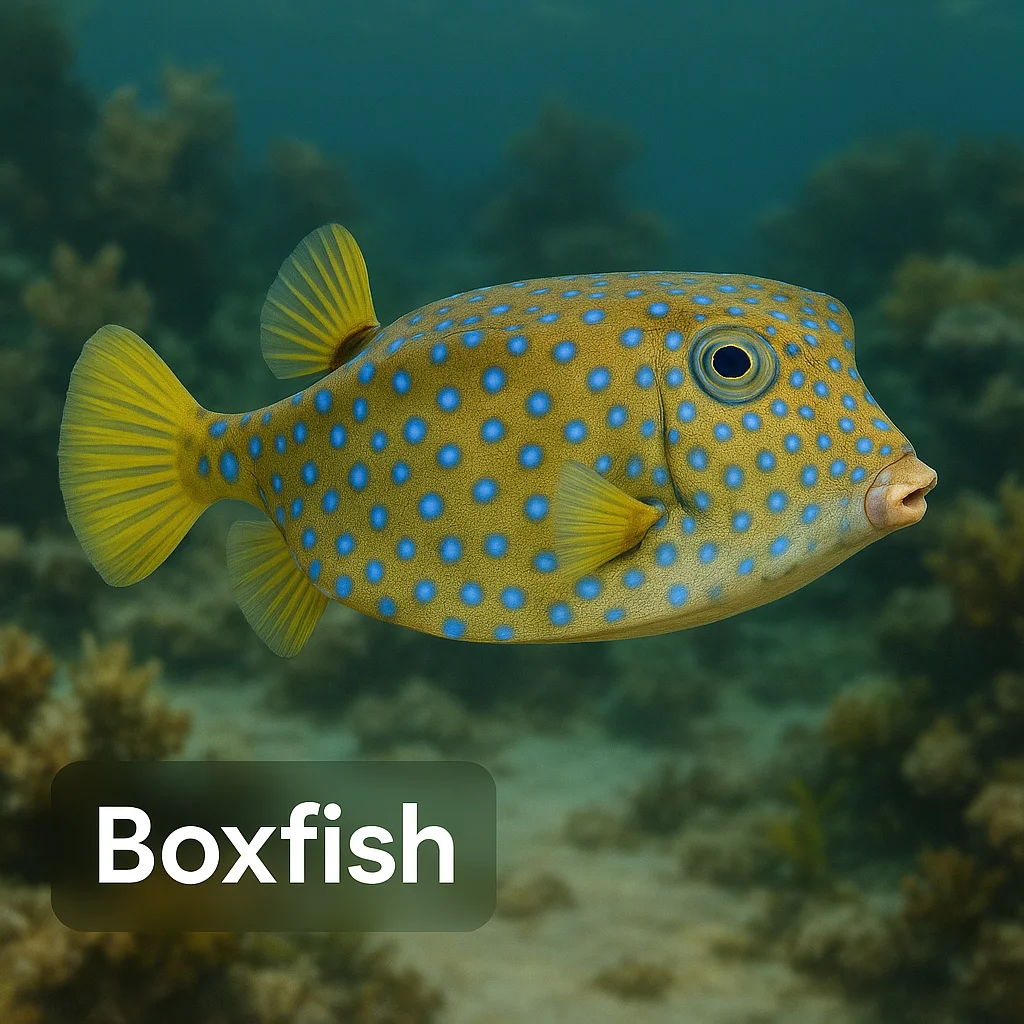
- Common name(s): Boxfish, Cowfish, Trunkfish
- Scientific name: Varies by species (e.g., Ostracion cubicus, Lactoria cornuta)
- Animal type: Fish
- Typical adult size: 15 to 45 cm in length
- Typical lifespan: 5 to 10 years in the wild
- Diet type: Omnivore; algae, sponges, crustaceans, and mollusks
- Activity pattern: Diurnal
- Social structure: Solitary or small groups
- Speed / movement highlights: Relatively slow swimmers due to body structure
- Intelligence/learning: Limited, but can learn to recognize feeding times
- Primary habitats: Reefs and lagoon areas
- Geographic range: Indian and Pacific Oceans, parts of the Atlantic
- Predators/threats: Larger fish, habitat loss
- Conservation status: Generally stable, but varies by region
🔍 Identification & Appearance
Boxfish are easily recognized by their signature box-like body shape, created by a carapace of bony plates. They display a variety of colors and patterns which can change as they age, including bright yellows, blues, and browns often with spots or honeycomb patterns.
- Body shape and silhouette: Boxy and compact
- Key colors/patterns: Vivid patterns with age-related changes
- Distinctive features: Horn-like projections in some species like the Longhorn Cowfish
- Tracks, scat, or other field signs: Not applicable due to aquatic life
- Common look-alikes: Pufferfish (distinguished by body texture and behavior)
- Box-like body shape
- Bright coloration and patterns
- Horn-like projections in some species
- Solid covering of bony plates
- Small puckered mouths
- Pectoral fin-based movement
🧱 Body Structure & Physical Adaptations
Boxfish possess a rigid, bony carapace that limits their speed but provides excellent protection against predators. Their small mouths are adapted to picking food from crevices, and their fins provide maneuverability despite their bulky shape.
- Build and proportions: Stocky and rigid
- Teeth/beak/jaw adaptations: Small mouths perfect for soft prey
- Fins: Pectoral and caudal fins for propulsion; dorsal and anal fins for stability
- Sensory strengths: Good vision but limited swimming agility
- Bony carapace for protection
- Adapted mouth for picking prey
- Efficient fin maneuverability
- Bright coloration for communication
- Slime-covered skin for protection
- Pectoral fin-driven movement
🌍 Range & Distribution
Boxfish are found in tropical and subtropical oceans worldwide. They typically inhabit coral reefs, lagoons, and reef outcrops, often preferring shallow water with abundant food sources.
- Continents/regions: Indian Ocean, Pacific Ocean, parts of the Atlantic Ocean
- Ecosystems: Coral reefs and lagoon areas
- Migration: Generally resident, with minor local movements
- Coral reefs in Australia
- Lagoons of the Maldives
- Reef systems in the Caribbean
- Coastal waters of Southeast Asia
- Nearshore areas of Hawaii
🏞️ Habitat & Shelter
Boxfish thrive in the crevices and overhangs of coral reefs, which provide ample food and cover from predators. The complexity of reef environments supports the varied diet of Boxfish while offering shelter during resting periods.
Habitat knowledge is critical to understanding the survival of Boxfish, as reef health directly impacts their food availability and shelter options.
🧭 Behavior & Ecology
Boxfish engage in a daily rhythm of feeding and resting. These solitary or small-group-dwelling fish communicate subtly through coloration changes and posture. As generalists, they play a role in controlling algal growth on reefs, contributing to the ecosystem balance.
- Daily routine: Active by day, resting in reef crevices at night
- Communication: Coloration and posture changes
- Interactions: Some mutualistic relationships with cleaner fish
- Role in ecosystem: Grazer of algae and predator of small invertebrates
- Diurnal activity
- Color change communication
- Algae and invertebrate consumption
- Common in reef systems
- Predation mainly by larger reef fish
- Nocturnal retreat to shelters
👥 Social Life & Group Dynamics
While primarily solitary, Boxfish may form small groups during feeding. There is little evidence of strong social bonds, and territorial behaviors are mostly absent. Males may display dominance through color displays during mating periods.
- Social tendencies: Largely solitary
- Group dynamics: Loose aggregations for feeding
- Cooperation: Minimal; feeding-focused groupings
- Generally solitary
- Loose feeding groups
- Paucity of strong social structures
- Dominance through display only
- Mating cues initiate aggregations
🍽️ Diet, Prey & Predators
Boxfish are omnivorous, primarily eating algae, small invertebrates, and occasional zooplankton. Predators include larger fish like sharks and groupers. They rely on their tough exterior and toxin-secreting skin to deter predators when threatened.
- Diet: Algae, small crustaceans, and mollusks
- Natural predators: Larger fish like groupers and sharks
- Anti-predator defenses: Tough skin secretes toxins
- Omnivorous feeding
- Varied invertebrate diet
- Bony body as a defense
- Toxin secretion when threatened
- Occasional scavenging
🦌 Hunting, Foraging & Movement
Boxfish are steady searchers, using their pectoral fins for precise movements among reef structures. They forage in daylight, especially in complex reef environments where their diverse diet can be explored.
- Locomotion style: Slow, controlled swimming using pectoral fins
- Foraging tactics: Picking food from small spaces within reefs
- Navigation: Utilizes memory of familiar reef territories
- Pectoral fin-driven locomotion
- Daytime foraging
- Memory for reef navigation
- Efficient crevice searching
- Home range reliance on reef structure
🧠 Intelligence & Senses
Boxfish exhibit basic learning abilities and are known to recognize aquarium feeding schedules. Their vision is well-developed for detecting movement and colors among reefs. However, limited research suggests basic problem-solving abilities.
- Problem-solving: Limited evidence
- Sensory capabilities: Strong vision, average on other senses
- Learning: Recognition of feeding times
- Good spatial awareness
- Recognizes regular feeding schedules
- Excellent visual acuity
- Alert to color changes
- Basic adaptation to captivity
🪺 Reproduction, Pregnancy & Parenting
Boxfish engage in seasonal breeding, often forming loose aggregations. Their mating system is generally promiscuous, with little post-mating parental investment. Egg laying occurs, with larvae developing independently after a brief pelagic stage.
- Breeding seasonality: Varies by region, often linked to water temperature
- Mating system: Promiscuous
- Egg development: Laid in open water
- Parenting: No parental care post-laying
- Seasonal breeding
- Promiscuous mating
- Egg-laying in open ocean
- No direct parental care
- Pelagic larval stage
♀️♂️ Male vs Female Differences
In Boxfish, there are subtle size differences, with males generally being larger. Males may exhibit brighter coloration, particularly during mating periods. Behavioral roles do not show significant differences between the sexes outside of breeding.
- Size: males generally larger
- Coloration: males often brighter
- Mating displays more common in males
- No marked behavioral role differences
- Coloration changes during breeding
🧬 Subspecies & Variation
Boxfish species show variation across oceans, with distinct physical characteristics like pattern and horn projection length. Variations also occur due to island-specific adaptations, leading to unique subspecies in isolated areas.
- Physical variation by pattern and shape
- Longhorn vs short-horn types
- Color adaptation to local environments
- Island-specific subspecies
- Horn length dependent on species
⚠️ Threats, Conservation & Human Interaction
Boxfish face natural threats from larger predators and human-induced pressures such as habitat destruction and climate change. Conservation efforts focus on protecting reef habitats. Usage in the aquarium trade prompts ethical considerations over capture methods and habitat impact.
- Threats include reef habitat loss
- Climate-induced changes affecting distribution
- Aquarium trade considerations
- Importance of habitat protection
- Impact of marine pollution
✨ Fun Facts & Unique Traits
- Boxfish can secrete toxins as a defense mechanism.
- Some species of Boxfish have horn-like structures on their heads.
- Despite their rigid bodies, Boxfish can swim gracefully using pectoral fins.
- Boxfish patterns can act as camouflage among coral reefs.
- They can change color during social interactions or mating displays.
- Their carapace provides effective protection against predators.
- Boxfish toxins have been studied for potential medical applications.
- Some Boxfish are often seen cleaning stations attended by cleaner fish.
📌 Summary
- Boxfish are recognized by their distinct box-shaped, bony bodies.
- They inhabit tropical and subtropical reef environments.
- Their diet is omnivorous, including algae and invertebrates.
- Larger reef fish are their main predators.
- Boxfish are primarily solitary with simple social interactions.
- Reproduction involves seasonal, promiscuous breeding with no parental care.
- Key adaptations include a toxin-secreting body for defense.
- Unique horn-like projections are found in some species.