🦁 Steppe Eagle
🧾 Quick Facts
The Steppe Eagle (often listed as Aquila nipalensis) is a large bird of prey found in open habitats, particularly in Asia, Europe, and Africa. Known for its majestic flight and powerful hunting skills, the Steppe Eagle plays a significant role in its ecosystem as a top predator. Here are some quick facts about this fascinating bird:
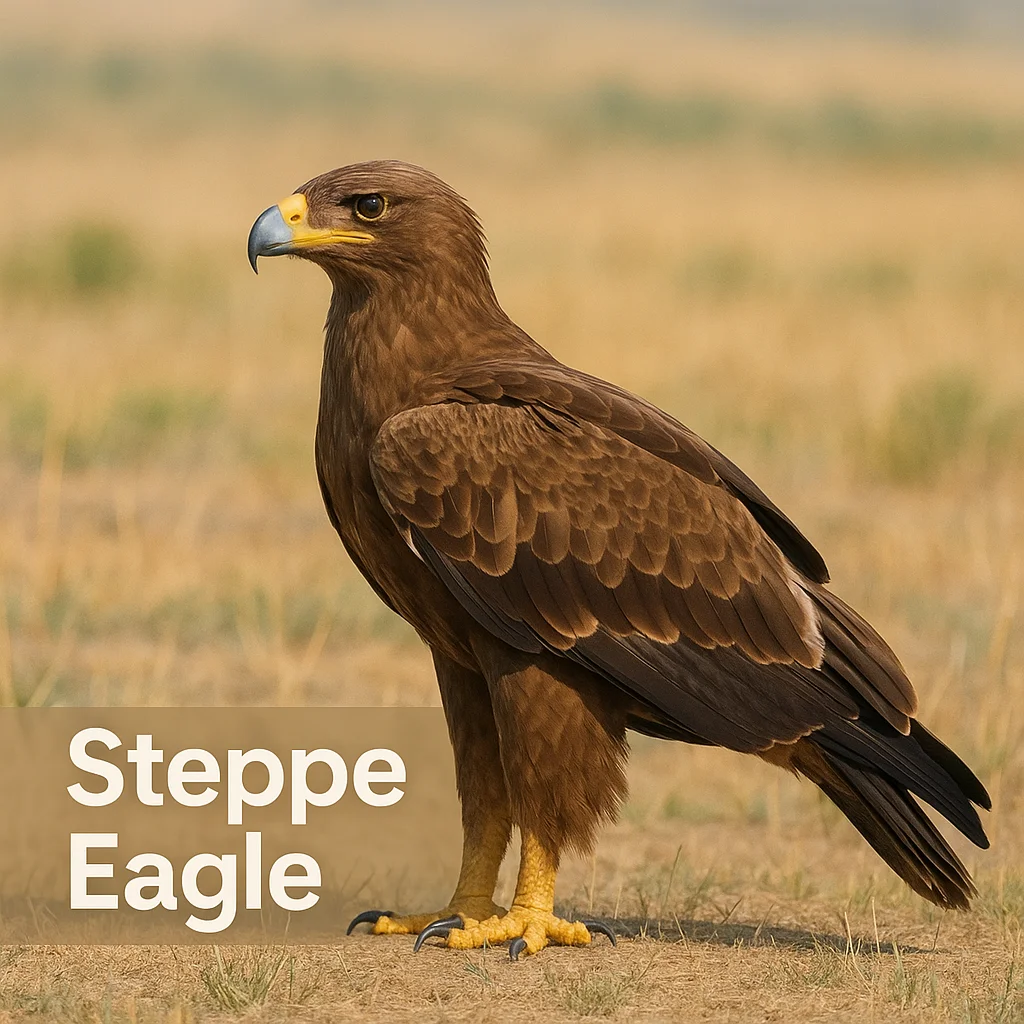
- Common name(s): Steppe Eagle
- Scientific name: Aquila nipalensis
- Animal type: Bird
- Typical adult size: Length 62-81 cm (24-32 inches), Wingspan 160-210 cm (63-83 inches)
- Typical lifespan: 15-25 years in the wild; potentially longer in captivity
- Diet type: Carnivore; primarily feeds on small mammals, birds, and carrion
- Activity pattern: Diurnal
- Social structure: Often solitary or found in pairs
- Speed / movement highlights: Capable of soaring long distances on thermal currents
- Intelligence/learning: Demonstrates hunting skill and adaptability
- Primary habitats: Steppe, grassland, savanna
- Geographic range: Central Asia, Eastern Europe, Northern Africa
- Predators/threats: Predation rare but can include large mammals; human-related pressures like habitat loss
- Conservation status: Varies by region; generally vulnerable
🔍 Identification & Appearance
The Steppe Eagle is recognizable by its large, robust body and broad wings. It has a prominent hooked beak and piercing yellow eyes. Its plumage is predominantly brown with lighter streaks, and it possesses flight feathers that are golden-brown. Juveniles and adults can differ in coloration, with juveniles often displaying a more mottled appearance.
- Top ID Tips:
- Large size and broad wings
- Golden-brown flight feathers
- Hooked yellow beak
- Bright yellow eyes
- Mottled appearance in juveniles
- Robust, powerful build
- Characteristic haunting call
- Typically seen soaring gracefully
🧱 Body Structure & Physical Adaptations
The Steppe Eagle's body is built for both power and endurance during flight. Its broad wings allow for soaring at high altitudes and covering large distances with minimal energy expenditure. The strong, hooked beak is adapted for tearing into prey, and the talons are sharp and powerful for capturing and securing food. Vision is its most developed sense, allowing for spotting prey from great heights.
- Key Adaptations:
- Broad wings for soaring flight
- Hooked beak for tearing prey
- Sharp talons for capturing prey
- Powerful build for long flights
- Exceptional long-range vision
- Sturdy skeletal structure
🌍 Range & Distribution
The Steppe Eagle is widely distributed across Central Asia and Eastern Europe, extending into parts of Northern Africa. It migrates seasonally, travelling vast distances between breeding and wintering grounds. Steppe Eagles can be found in open landscapes such as the Central Asian steppes, semi-deserts, and savannas.
- Where You Might Find It:
- Central Asian steppes
- Eastern European grasslands
- Northern African savannas
- Seasonal migration routes
- Near open water sources in steppe regions
🏞️ Habitat & Shelter
Preferring open habitats, the Steppe Eagle thrives in grasslands, steppes, and semi-desert environments where it can easily spot and hunt for prey. Nests are typically built on cliffs or tall trees, providing a vantage point for observing surroundings. The availability of prey like rodents, small mammals, and carrion is crucial to its survival, influencing nesting site selection and migration patterns. Seasonal changes can prompt migration to areas with less harsh climate conditions and more abundant food resources.
🧭 Behavior & Ecology
The Steppe Eagle is diurnal, spending daylight hours soaring on thermals in search of prey. It uses its acute vision to spot potential food from great heights, diving swiftly to capture it. The eagle's haunting call is often part of its communication, particularly during the breeding season. Its presence on the steppe is vital for controlling small mammal populations, maintaining ecological balance.
- Behavior Highlights:
- Diurnal hunting and soaring
- Utilizes thermals for effortless flight
- Communicative calls during breeding
- Plays a key role as top predator in its ecosystem
- Migratory habits influenced by food availability
👥 Social Life & Group Dynamics
Generally solitary, Steppe Eagles may form pairs during breeding seasons. They are territorial, maintaining hunting areas and nesting sites with vigor. While these eagles are more commonly seen alone or in pairs, observing them in small groups during migration is not unusual. Cooperation is not prominent; each eagle fends for itself except during mating and raising young.
- Social Structure Notes:
- Primarily solitary
- Pairs during breeding season
- Occasional group sightings during migration
🍽️ Diet, Prey & Predators
The diet of the Steppe Eagle consists mainly of small mammals, birds, and carrion. Rodents are a staple, but they are opportunistic feeders, scavenging or adapting their diet to available resources. Their hunting strategy usually involves soaring high to spot and swoop down on unsuspecting prey. Natural threats include larger birds of prey, though human activities such as habitat destruction present significant concerns.
- Feeding Notes:
- Diet includes small mammals and birds
- Relies heavily on rodents
- Opportunistic scavenger
- Human activities present primary threats
🦌 Hunting, Foraging & Movement
Steppe Eagles employ soaring and gliding techniques, using thermals to conserve energy while covering large territories. Their endurance is remarkable, aiding long migrations. Preferred hunting times are during daylight when visibility is maximized. Navigation during migration is thought to involve both visual landmarks and perhaps magnetic fields, though research continues in this area.
- Movement & Strategy:
- Efficient at utilizing thermals
- Long-distance flyers with great endurance
- Daytime hunting enhances prey visibility
- Complex navigation during migrations
🧠 Intelligence & Senses
The Steppe Eagle exhibits a significant degree of intelligence necessary for survival in vast and sometimes barren landscapes. Known for keen eyesight, they can detect the slightest movements from high above. While tool use is not typical, their adaptability to variable prey availability highlights a certain behavioral flexibility. Their cognitive abilities ensure effective hunting and territory management.
- Notable Abilities:
- Keen eyesight for spotting prey
- Behavioral flexibility for varied diets
- Efficient territory management
🪺 Reproduction, Pregnancy & Parenting
Breeding occurs once annually, with courtship involving vocal calls and aerial displays. Monogamous pair bonds are common, with both parents involved in raising young. The female incubates eggs for 6-8 weeks, and both parents provide food for the chicks upon hatching. Clutch sizes typically range from 1-3 eggs. Parental roles include feeding and protection until the juveniles fledge.
- Reproduction Snapshot:
- Annual breeding cycle
- Monogamous pair bonds
- Shared parental care
- Clutch size: 1-3 eggs
- Incubation period: 6-8 weeks
♀️♂️ Male vs Female Differences
Dimorphic differences in Steppe Eagles are subtle. Females are generally larger and heavier than males, a common trend in birds of prey that supports the demands of egg production and incubation. Both sexes exhibit similar plumage. Behavioral roles in hunting and nesting are shared, although females may spend more time on the nest during incubation.
- Sex Differences at a Glance:
- Females slightly larger than males
- Shared plumage characteristics
- Collaborative parental roles
🧬 Subspecies & Variation
There is some debate over subspecies classification of the Steppe Eagle, primarily in terms of geographical distinctions and slight morphological differences. Variations can occur in plumage coloring, but these are not marked enough to warrant separate classification according to most authorities. Some geographical populations adapt locally, and there is ongoing research into potential subspecies.
- Variation Notes:
- Minimal distinct subspecies
- Geographical variations present
- Slight plumage color adaptations
⚠️ Threats, Conservation & Human Interaction
Human activities, including habitat destruction and pollution, significantly threaten Steppe Eagles. Collision with power lines and intentional persecution are notable threats. Conservation efforts focus on habitat preservation and reducing human-wildlife conflict. Education about coexistence is vital in regions where they are most under threat. Ethical observations promote appreciation without interference.
- Responsible Notes:
- Habitat preservation initiatives
- Awareness of collision risk with infrastructure
- Reduce persecution through education
- Ethical wildlife observation
✨ Fun Facts & Unique Traits
- The Steppe Eagle is known for its extensive migratory routes, covering more than 10,000 kilometers.
- They are revered in some cultures as symbols of power and freedom.
- Their nests are reused for many years, with new materials added annually.
- The eagle's haunting call is distinct and often heard over vast distances.
- They play a crucial role in their ecosystems by controlling rodent populations.
📌 Summary
- Recognized by large size and powerful build; golden-brown feathers are key identifiers.
- Inhabits grassy and open landscapes like steppes and savannas, with seasonal migration.
- Primarily preys on small mammals and birds; plays a role in ecosystem balance.
- Solitary or in pairs, shows territorial behavior with noted migratory patterns.
- Faces threats from habitat destruction and human interference; conservation essential.
- Breeding involves shared parental care; females slightly larger with subtle color differences.
- Important predator in open landscapes, controlling rodent populations.
- Migratory endurance exhibits strong navigation skills and ecological significance.