🦁 Snowy Owl
🧾 Quick Facts
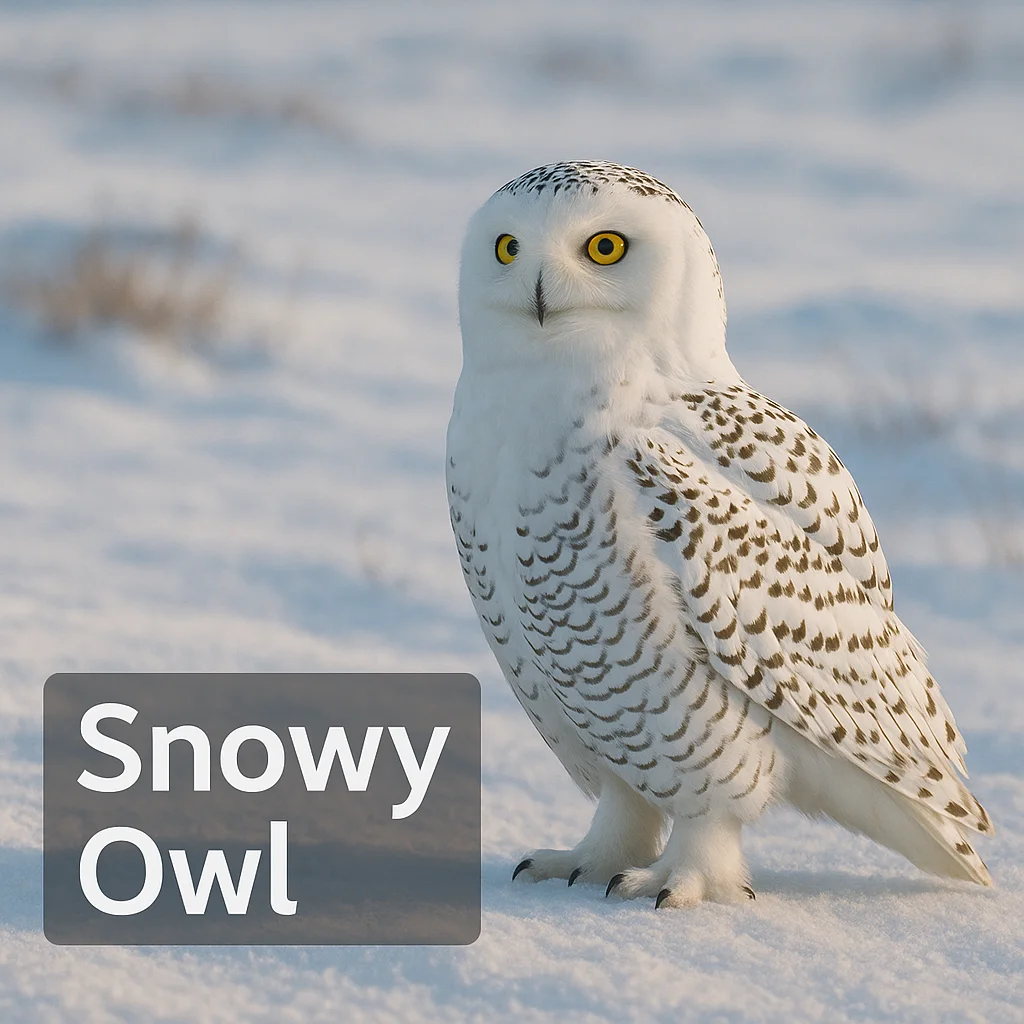
The Snowy Owl, known for its striking white plumage, is a captivating species that inhabits the Arctic regions of North America and Eurasia. This bird is well adapted to its cold environment and is famous for its powerful hunting skills and iconic appearance.
- Common name(s): Snowy Owl, Arctic Owl
- Scientific name: Bubo scandiacus
- Animal type: Bird
- Typical adult size: 52-71 cm (20-28 in) in length, 1.6-3 kg (3.5-6.6 lbs) in weight
- Typical lifespan: 9-10 years in the wild, up to 28 years in captivity
- Diet type: Carnivore; primarily feeds on small mammals and birds
- Activity pattern: Diurnal during breeding season; more crepuscular outside of it
- Social structure: Mostly solitary but forms loose breeding groups
- Speed / movement highlights: Efficient flyer with moderate speed and endurance
- Intelligence/learning: Adaptable hunter; uses keen senses and strategies
- Primary habitats: Tundra, open treeless areas, sometimes marshes
- Geographic range: Arctic regions of North America, Europe, and Asia
- Predators/threats: Foxes, wolves, raptors; human disturbance and climate change
- Conservation status: Least Concern, but vulnerable to environmental changes
🔍 Identification & Appearance
The Snowy Owl is easily recognizable by its snowy white plumage, which is an adaptation for camouflage in its Arctic habitat. Both males and females are primarily white, although females and younger birds often display more dark barring. Notable features include a rounded head without ear tufts, striking yellow eyes, and strong talons.
- Body shape: Round head, broad wings, robust body
- Key colors/patterns: Predominantly white, with variations of dark barring
- Distinctive features: Yellow eyes, no ear tufts, large black talons
- Tracks: Large, round footprints with claw marks
- Common look-alikes: Barn owl, Great Horned Owl (distinguished by ear tufts)
- Top ID Tips:
- Look for pure white plumage in males
- Note the absence of ear tufts
- Observe in open, treeless areas
- Spot the striking yellow eyes
- Tail is relatively short in proportion to body size
🧱 Body Structure & Physical Adaptations
The Snowy Owl is robustly built, with powerful wings and a body adapted to its frigid environment. Its plumage is dense and insulating, and its feathers extend down to cover the legs. The beak and claws are sharp, aiding in its hunting prowess.
- Build: Stocky and muscular with broad wings
- Beak: Hooked for tearing prey
- Claws: Strong, black, ideal for seizing prey
- Vision: Acute eyesight for hunting during low light
- Key Adaptations:
- Dense plumage for insulation
- Wide wings for silent flight
- Padded talons for secure grip on prey
- Coloration provides winter camouflage
- Alert to changes in light, suggesting sensory acuity
🌍 Range & Distribution
Snowy Owls are found in the circumpolar regions of the Northern Hemisphere. They inhabit the Arctic tundra during the breeding season and may venture southward in the winter months, sometimes reaching as far as southern Canada and parts of the northeastern United States.
- Continents: North America, Europe, Asia
- Typical biomes: Tundra, sometimes open grasslands or coastal areas
- Elevation: Generally low-lying areas near sea level
- Migration: Some populations migrate seasonally, while others remain resident
- Where You Might Find It:
- Arctic tundra during summer
- Coastlines in winter
- Northern plains in North America
- Occasionally found in lower latitudes during winter irruptions
- High-latitude regions of Europe
🏞️ Habitat & Shelter
Typical habitats for the Snowy Owl include the open tundra, where they have a clear line of sight for hunting. They are ground nesters and seek shelter in the form of snowbanks or tufts of grass. Seasonal changes influence their movement patterns—staying in one area during breeding and dispersing more widely in winter.
The Snowy Owl's habitat is critical to its success, as it relies on open spaces for hunting and raising its young.
🧭 Behavior & Ecology
The Snowy Owl is a diurnal hunter during the breeding season, taking advantage of the 24-hour daylight of the Arctic summer. Its behaviors include extensive use of perches for hunting and large territories to support its prey needs. They communicate with vocal calls and displays prominent in mating rituals. Snowy Owls play a vital role as predators within their ecosystem and help control small mammal populations.
- Diurnal hunting during summer months
- Vocalizations include hoots and screeches
- Interaction with other species: excludes competing raptors from territories
- Top predator of Arctic rodents
- Behavior Highlights:
- Perches prominently for hunting
- Defends territory vigorously
- Uses vocal calls in various contexts
- Predatory checks on mammal populations
- Can exhibit nomadic behavior in response to prey abundance
👥 Social Life & Group Dynamics
The Snowy Owl is primarily solitary, but during the breeding season, loose gatherings or group formations can occur around rich food sources. They are generally solitary hunters but can form pair bonds in mating seasons. While territorial, they may tolerate neighboring nests if food is abundant.
- Typically solitary but social during breeding
- Group formations are irregular and resource-dependent
- Pair bonding during breeding, seasonal cooperation
- Social Structure Notes:
- Mostly solitary except during rich food supply
- Breeding pairs may defend shared territories
- Occasional inhabitation near other owls during winter irruptions
🍽️ Diet, Prey & Predators
Snowy Owls are opportunistic hunters with diets composed mainly of small mammals like lemmings and voles, and birds. They employ silent flight and acute vision to locate prey. Natural enemies include larger birds of prey and terrestrial mammals, but their main threats are from climatic shifts and disturbances by humans.
- Diet primarily consists of lemmings and small birds
- Employs agile flight and sharp talons to catch prey
- Uses visual detection combined with patient observation
- Limited natural predators due to apex position
- Feeding Notes:
- Feeds on a wide range of small prey
- Diet flexibility aligns with prey availability
- Capable of swallowing small prey whole
- Occasional scavenging on carrion during scarcity
🦌 Hunting, Foraging & Movement
Snowy Owls are active hunters, typically flying low and using the element of surprise to capture prey on the ground with powerful talons. They can fly moderate distances and show significant endurance. During the breeding season, they may hunt at any time of day due to the perpetual Arctic daylight.
- Locomotion: Strong flier with silent flight adaptations
- Flying speeds are moderate but sustained
- Primarily use sight for hunting
- Movement & Strategy:
- Uses flight height to scan for prey
- Shows seasonal adaptability in hunting techniques
- Forages actively during extended daylight
- Remarkably patient, awaiting favorable opportunities
🧠 Intelligence & Senses
Snowy Owls possess competent sensory abilities, especially sharp vision for detecting prey. While their problem-solving abilities are less documented, they demonstrate intelligent hunting strategies and adaptability to changing environments. Their capacity for recognizing and defending territories indicates some level of spatial awareness.
- Significant ability to adapt hunting to environmental conditions
- Highly developed vision critical for survival
- Communication through vocalizations indicates social awareness
- Notable Abilities:
- Acute vision for low-light hunting
- Tactical use of environment for hunting efficiency
- Adaptability to changing conditions
- Territorial recognition during breeding season
🪺 Reproduction, Pregnancy & Parenting
Snowy Owls breed once annually, generally in the spring. They are primarily monogamous, with the male performing aerial displays to attract females. The female lays 3-11 eggs, which are incubated for about a month. Both parents are involved in the care of the young, with the male primarily supplying food while the female guards the nest.
- Breeding season: Spring; varies with prey abundance
- Monogamous with shared parenting duties
- Incubation lasts approximately 32 days
- Chicks are semi-precocial, developing quickly
- Reproduction Snapshot:
- Breeding tied to food supply, more prey equals larger broods
- Males engage in demonstrative courtship displays
- High parental investment in chick survival
- Nest site typically scraped in ground, sheltered by surroundings
♀️♂️ Male vs Female Differences
Male Snowy Owls are typically whiter than females, with less barring, which aids in distinguishing the sexes from afar. Females have denser plumage with more frequent dark markings, assisting in camouflage while nesting. Males and females may share similar behavioral roles regarding territory defense but the females are the primary nest guards.
- Size differences are minimal, males may be slightly smaller
- Males are whiter, aiding territory display and mate attraction
- Females often remain closer to nests during breeding season
- Sex Differences at a Glance:
- Male coloration tends to be purer white
- Female tends to display more barring to aid in nesting concealment
- Both sexes are involved in territorial and predatory behaviors
🧬 Subspecies & Variation
The Snowy Owl is generally considered a monotypic species with a continuous distribution across the Arctic. Local variations mostly arise from environmental pressures, such as prey availability and climatic conditions, rather than distinct subspecies. This has led to phenotypic plasticity within the species, ensuring adaptability across varying regions.
- No recognized subspecies, but genetic studies suggest some differentiation
- Wide phenotypic range supports adaptation to local environments
- Environmental conditions drive phenotypic plasticity throughout range
- Variation Notes:
- No formal subspecies, but variations in plumage based on habitat
- Migratory patterns differ between populations
- Lifestyle adaptations align with habitat demands and prey densities
⚠️ Threats, Conservation & Human Interaction
Snowy Owls face natural challenges such as shifts in tundra ecosystems and climate change impacts, which alter prey availability. Human-related pressures include habitat disturbance from industry and changes in land use. They are not commonly kept in captivity due to their specific habitat needs, but they are a subject of interest and protection in many conservation programs.
- Vulnerable to climate variability impacting prey dynamics
- Human disturbances can impact nesting sites and resources
- Specific conservation measures target habitat preservation
- Responsible Notes:
- Limited direct conflict with humans, but indirect disturbance through habitat impact
- Coexistence reliant on stable ecosystems and minimal disturbance
- Conservation efforts focus on understanding ecosystem links
✨ Fun Facts & Unique Traits
- Snowy Owls have feathered feet to act as natural snowshoes
- They are one of the few owl species that are truly diurnal
- Capable of enduring extreme cold due to specialized feathers
- The male's pure white plumage turns yellower with age
- Can travel significant distances if needed, responding to prey availability
- Known for their resilience during cyclical low-prey periods
📌 Summary
- Identification: White plumage, yellow eyes, no ear tufts
- Habitat: Arctic tundra and open areas
- Distribution: Circumpolar in Northern Hemisphere
- Diet: Carnivore, feeds on small mammals and birds
- Predators: Few natural, watch for raptors and larger mammals
- Social Life: Solitary but pairs in breeding season
- Reproduction: Monogamous, with both parents caring for young
- Key Adaptations: Insulating plumage, powerful flight, keen vision
- Distinctiveness: Diurnal hunting, adaptability to extreme cold