🦁 Kestrel
🧾 Quick Facts
The Kestrel is a fascinating group of small falcons belonging to the genus Falco, known for their elusive hunting skills and adaptability. Found widespread across various regions, these birds display notable variations based on geography and species.
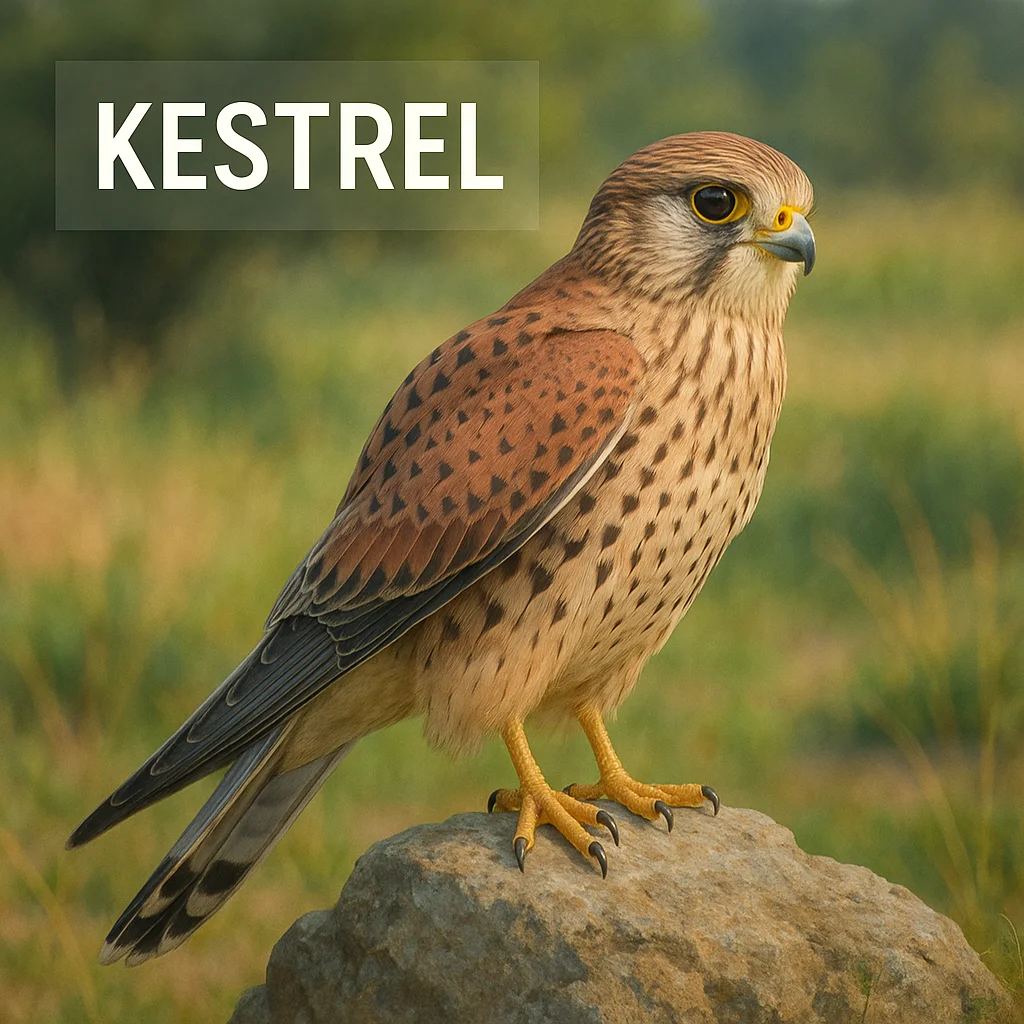
- Common name(s): Kestrel, Common Kestrel, American Kestrel
- Scientific name: Falco tinnunculus (varies by species)
- Animal type: Bird
- Typical adult size: 22–35 cm (8.66–13.78 inches) in length, with a wingspan of 50–75 cm (19.7–29.5 inches)
- Typical lifespan: 4–10 years in the wild
- Diet type: Carnivore; primarily small mammals, birds, and insects
- Activity pattern: Diurnal
- Social structure: Solitary or pairs
- Speed highlights: Capable of swift, agile flights; uses hovering technique during hunting
- Intelligence/learning: Known for problem-solving and keen vision
- Primary habitats: Open countryside, grasslands, urban areas
- Geographic range: Europe, Africa, Asia, the Americas
- Predators/threats: Larger birds of prey; habitat destruction due to human activities
- Conservation status: Generally stable but varies by region
🔍 Identification & Appearance
The Kestrel is easily recognizable by its distinct hovering behavior and sharp silhouette. It typically exhibits a reddish-brown plumage with a speckled pattern, which can vary with age and location.
- Top ID Tips:
- Compact body shape with long wings
- Characteristic hovering flight
- Distinct speckled chest
- Dark streaks down cheeks (moustached appearance)
- Wings are pointed and streamlined
- Tail features a black terminal band
- Look for variations in plumage depending on season/age
- Male typically has slate-blue head and tail, females are generally more uniformly colored
🧱 Body Structure & Physical Adaptations
Designed for agile hunting, the Kestrel exhibits numerous physical adaptations that make it an effective predator in its environment.
- Key Adaptations:
- Slim, aerodynamic body suitable for agile flying
- Sharp, hooked beak ideal for tearing prey
- Raptorial claws for gripping and catching prey
- Exceptional forward-facing binocular vision for accurately judging distances
- Highly developed auditory senses despite not being nocturnal
- Evolved to hover in place for spotting potential prey
- Specialized feathers that aid silent flight
🌍 Range & Distribution
Kestrels are incredibly widespread and can be found in diverse regions across the globe. Their adaptability allows them to thrive in various biomes.
- Where You Might Find It:
- Throughout Europe and the UK
- Northern and Southern Africa
- Across the Asian continent
- Across both North and South America
- Prefers lowland areas but can be found up to sub-alpine levels
- Generally non-migratory, but some populations show movement based on climate
🏞️ Habitat & Shelter
Kestrels adapt to a wide range of habitats. Their choice of nesting and hunting grounds varies considerably, contributing to their survival success.
Primarily favor open terrains with short vegetation, such as grasslands and farmlands. They can also be found in urban areas, where tall buildings substitute for natural perches.
In adverse weather conditions, they are known to rest more than usual and may seek shelter in tree hollows or sheltered crevices to avoid exposure.
🧭 Behavior & Ecology
Kestrels exhibit unique behavioral traits that are essential to their lifestyle and overall role in the ecosystem. They are solitary hunters but may form loose associations during migration or roosting.
- Behavior Highlights:
- Masterful hovering ability to spot prey
- Loud, clear vocalizations typically used for communication
- Territorial displays during breeding season
- Critical role as a rodent control agent in ecosystems
- Interacts with other bird species, often competing for territory
- Uses keen eyesight as a primary hunting tool
- Able to detect ultraviolet light used to observe trails of prey urine
👥 Social Life & Group Dynamics
While Kestrels are largely solitary, they may form pair bonds during the breeding season. They exhibit minimal cooperative behavior, relying heavily on individual skills for survival.
- Social Structure Notes:
- Primarily solitary outside of mating season
- Strong pair bonds during breeding months
- Males perform aerial displays to attract mates
- Generally territorial and will defend nesting sites aggressively
- Rarely involved in cooperative hunting
🍽️ Diet, Prey & Predators
The diet of Kestrels is mainly composed of small mammals, insects, and sometimes smaller birds. They play a crucial role in maintaining the balance of ecosystems by controlling rodent populations.
- Feeding Notes:
- Prefers voles, field mice, and other small mammals
- Insect prey includes grasshoppers, beetles, and crickets
- Occasionally preys on small birds
- Known to hunt by sight from a perch or during flight
- Adopts a stationary hover over fields when hunting
- Main predators include larger raptors such as hawks and owls
- Includes reptiles like lizards and snakes in diet where available
🦌 Hunting, Foraging & Movement
Kestrels are remarkable for their methodical and often spectacular hunting techniques. Their movements are defined by their preference for hovering and quick pursuits.
- Movement & Strategy:
- Efficient fliers that use thermal currents for soaring
- Unique ability to hover mid-air to track prey
- Mostly active hunters during daylight hours
- Known for their swift, direct flight supported by streamlined wing shape
- Possible vertical migrations based on food availability
🧠 Intelligence & Senses
Kestrels are equipped with various intelligence markers and improved sensory capabilities that aid in their survival.
- Notable Abilities:
- Highly acute vision allows for spotting distant prey
- Ability to perceive ultraviolet light, aiding in tracking
- Keen observational skills aid in learning and adaptation
- Displays problem-solving skills by adjusting hunting techniques
- Limited understanding of cooperative hunting
🪺 Reproduction, Pregnancy & Parenting
The breeding habits of Kestrels are varied, and they are known for forming monogamous pairs. Breeding season timing differs depending on their geographical location, ensuring food availability for the young.
- Reproduction Snapshot:
- Breeding season typically in spring
- Monogamous pairs with strong pair bonding
- Incubation period ranges from 28–32 days
- Clutch size usually around 3–6 eggs
- Young are altricial and rely heavily on parents for food and protection
- Males provide food while females incubate and care for chicks
♀️♂️ Male vs Female Differences
Sexual dimorphism in Kestrels is evident, though subtle, often seen in size and plumage coloration differences.
- Sex Differences at a Glance:
- Males are typically slightly smaller than females
- Distinctive slate-blue head and tail in males, uniformly colored in females
- Males usually have fewer black bands on tail feathers
- Involvement in territory defense may vary, with males often more active
🧬 Subspecies & Variation
The Kestrel group displays considerable diversity, with numerous subspecies adapted to various environments across their range.
- Variation Notes:
- Notable subspecies include the Common Kestrel and American Kestrel
- Variation in size and plumage can occur due to geographic location
- Potential for regional adaptations, such as larger size in colder areas
- Subspecies classification sometimes debated among ornithologists
⚠️ Threats, Conservation & Human Interaction
Despite being relatively abundant, Kestrels face numerous challenges arising from human-induced environmental changes.
- Responsible Notes:
- Threats include habitat loss due to agriculture and urbanization
- Climate change impacts prey availability
- Rodenticides can accumulate in predators like Kestrels
- Conservation efforts focus on preserving natural habitats
- Easily coexists in urban environments if disturbances are minimized
✨ Fun Facts & Unique Traits
- Kestrels can hover in mid-air by flying into the wind at matching speeds.
- They are the smallest falcons in the world, known for their elegant flight.
- Kestrels are able to see ultraviolet light, increasing their hunting prowess.
- The American Kestrel is North America's most widespread falcon.
- Kestrels are known for their keen eyesight, which is superior to that of humans.
- They have a special notched beak suited for dispatching prey effectively.
- Kestrels often use perches to survey large areas for potential prey below.
- They can survive on minimal water intake, obtaining moisture from their prey.
📌 Summary
- Kestrels are small falcons recognized for their hovering ability.
- They are widely distributed, inhabiting a variety of open terrains.
- Top predators of small mammals and insects, maintaining ecological balance.
- Possess acute vision, allowing them to spot and track prey effectively.
- Exhibit considerable variation across different geographic subspecies.
- Form monogamous pairs, providing cooperative parenting.
- Key adaptations include raptorial claws and notched beaks.
- Face threats from habitat loss but remain relatively stable overall.
- Iconic for their speckled chest and slate-blue head in males.
- Play a significant ecological role in controlling rodent populations.